
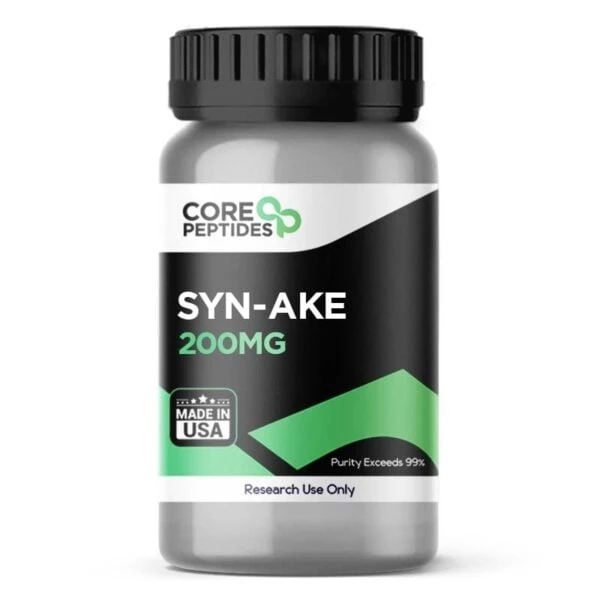

Syn-AKE (200mg) – Dipeptide Diaminobutyroyl Benzylamide Diacetate
Syn-AKE (200mg) is a synthetic peptide research material associated with cosmetic science, topical peptide formulations and research into expression-line appearance.
Also known by its INCI name Dipeptide Diaminobutyroyl Benzylamide Diacetate, Syn-AKE is a small peptide inspired by the activity of Waglerin-1, a naturally occurring peptide found in the venom of the temple viper (Tropidolaemus wagleri).
The synthetic peptide was developed to provide a reversible model for investigating muscular acetylcholine receptor activity and facial-expression-related skin appearance.
The 200mg format provides researchers with a defined quantity of Syn-AKE for appropriate analytical, formulation, cosmetic-science and laboratory research. Syn-AKE is particularly relevant to investigations involving neuromodulating cosmetic peptides, nicotinic acetylcholine receptors, expression lines, peptide delivery and topical formulations.
For research and laboratory use only. Not intended for human or animal consumption.
What Is Syn-AKE (200mg)?
Syn-AKE is a synthetic tripeptide used primarily as a cosmetic research ingredient. Its INCI name is Dipeptide Diaminobutyroyl Benzylamide Diacetate, and its CAS number is 823202-99-9. Manufacturer documentation identifies Syn-AKE as a small synthetic peptide designed to mimic aspects of Waglerin-1 functionality.
Unlike naturally occurring snake venom, Syn-AKE is a synthetically produced peptide. Its research interest comes from the interaction between the peptide and the muscular nicotinic acetylcholine receptor (nAChR), a receptor involved in neuromuscular signalling.
In cosmetic research, this mechanism has led to Syn-AKE being investigated for its potential relationship with facial muscle activity and the appearance of dynamic expression lines. It is commonly studied alongside other cosmetic peptides such as Argireline and SNAP-8, although these compounds act through different molecular pathways.
Syn-AKE Product Specifications
| Specification | Details |
|---|---|
| Product Name | Syn-AKE |
| Quantity | 200mg |
| INCI Name | Dipeptide Diaminobutyroyl Benzylamide Diacetate |
| CAS Number | 823202-99-9 |
| Peptide Classification | Synthetic tripeptide |
| Research Area | Cosmetic peptide and topical formulation research |
| Primary Research Target | Muscular nicotinic acetylcholine receptor |
| Inspired By | Waglerin-1 |
| Origin | Synthetic |
| Intended Use | Research, laboratory and analytical applications |
What Is Dipeptide Diaminobutyroyl Benzylamide Diacetate?
Dipeptide Diaminobutyroyl Benzylamide Diacetate is the INCI name associated with the active peptide in Syn-AKE. It is a small synthetic peptide developed for cosmetic applications and research into expression-line appearance. Manufacturer information identifies the active ingredient as a synthetic tripeptide with a molecular weight below 500 Da.
The compound has been incorporated into topical cosmetic formulations because of its proposed ability to interact with the muscular nicotinic acetylcholine receptor. Research into this receptor pathway provides a scientific basis for examining whether temporary modulation of facial muscle contraction may influence the appearance of expression-related lines.
As with other cosmetic peptides, the biological mechanism observed in experimental systems should be distinguished from demonstrated clinical outcomes. Independent sources note that further research is needed to validate the efficacy of Syn-AKE beyond manufacturer-associated studies.
How Does Syn-AKE Work?
The proposed mechanism of Syn-AKE centres on the muscular nicotinic acetylcholine receptor (nAChR). These receptors are involved in communication between motor nerves and muscle cells.
According to manufacturer research documentation, Syn-AKE acts as a reversible antagonist of the muscular nicotinic acetylcholine receptor. By interacting with the receptor, the peptide is proposed to reduce receptor activation and attenuate the signalling associated with muscle contraction.
Syn-AKE was designed to mimic aspects of Waglerin-1, a peptide found in temple viper venom. Waglerin-1 is known to interact with nicotinic acetylcholine receptors at the neuromuscular junction. Syn-AKE uses this biological concept as the basis for a synthetic cosmetic peptide rather than reproducing the venom itself.
This proposed mechanism is why Syn-AKE is commonly categorised within the broader group of neurotransmitter-inhibiting or neuromodulating cosmetic peptides.
Syn-AKE and Facial Expression Lines
Expression lines develop partly as a consequence of repeated facial movement. Areas such as the forehead, glabella and outer eye region are frequently affected because the underlying muscles contract repeatedly during normal facial expression.
Cosmetic research into Syn-AKE examines whether temporary modulation of muscular signalling can reduce the appearance of these dynamic lines. Manufacturer information describes Syn-AKE as an ingredient intended to help the face relax while maintaining normal facial expressiveness.
This differs from permanent muscle paralysis. The manufacturer’s technical information characterises the effect as reversible, which is an important distinction when discussing the peptide’s proposed cosmetic mechanism.
Syn-AKE and Waglerin-1
Waglerin-1 is a naturally occurring peptide identified in the venom of the temple viper, Tropidolaemus wagleri. Scientific research has shown that Waglerin-1 interacts with nicotinic acetylcholine receptors involved in neuromuscular transmission.
Syn-AKE was developed as a synthetic peptide inspired by the functionality of Waglerin-1. The commercial peptide does not consist of snake venom and should not be confused with the naturally occurring toxin.
The relationship between the two compounds is therefore one of molecular inspiration and mechanism: Syn-AKE was designed around the biological concept provided by Waglerin-1 while being produced synthetically for cosmetic applications.
Syn-AKE and the Nicotinic Acetylcholine Receptor
The nicotinic acetylcholine receptor is a ligand-gated ion channel involved in rapid communication between nerve cells and muscle tissue.
At the neuromuscular junction, acetylcholine released from a motor neuron binds to receptors on the muscle-cell membrane. This initiates ion movement and electrical changes that contribute to muscle contraction.
Syn-AKE research focuses on the possibility of reversible receptor antagonism. Manufacturer materials describe the peptide as capable of blocking muscular nAChR activity and attenuating the signalling that leads to muscle contraction.
This provides a useful model for laboratory investigations into peptide–receptor interactions and the molecular mechanisms underlying neuromuscular signalling.
Potential Research Applications of Syn-AKE (200mg)
Syn-AKE (200mg) may be of interest to qualified researchers working in several areas of peptide and cosmetic science.
- Cosmetic peptide research: Investigation of synthetic peptides used in topical skincare formulations.
- Expression-line research: Study of mechanisms associated with dynamic facial lines.
- Receptor research: Investigation of muscular nicotinic acetylcholine receptor interactions.
- Neuromuscular research: Examination of receptor-mediated muscle signalling.
- Peptide formulation: Development and evaluation of experimental topical formulations.
- Skin-delivery research: Investigation of peptide transport through topical delivery systems.
- Analytical chemistry: Identification and characterisation of Dipeptide Diaminobutyroyl Benzylamide Diacetate.
- Peptide stability research: Assessment of stability under controlled laboratory conditions.
- Comparative peptide studies: Comparison with other expression-line peptides such as Argireline, SNAP-8 and Leuphasyl.
Syn-AKE for Cosmetic Formulation Research
Syn-AKE has been developed specifically with topical cosmetic applications in mind. Manufacturer documentation describes it as a water-miscible ingredient suitable for incorporation into skincare formulations.
Research involving Syn-AKE can therefore extend beyond peptide biology into formulation science. Researchers may investigate how different bases, solvents, emulsions and delivery systems influence peptide stability and performance.
Relevant formulation research may include:
- Serum formulation studies.
- Moisturiser and cream development.
- Eye-area formulation research.
- Topical delivery systems.
- Peptide stability testing.
- Compatibility with other cosmetic ingredients.
- pH and temperature stability investigations.
- Preservative and packaging compatibility studies.
Manufacturer formulation guidance indicates that commercial SYN-AKE preparations are supplied in an aqueous glycerine-based format and are water-miscible. Researchers working with the specific 200mg research material should nevertheless follow the product’s own batch documentation rather than assuming that commercial premixes and isolated research material have identical formulation characteristics.
Syn-AKE vs Other Expression-Line Peptides
| Peptide | Primary Research Mechanism | Common Research Area |
|---|---|---|
| Syn-AKE | Muscular nicotinic acetylcholine receptor modulation | Expression-line and topical cosmetic research |
| Argireline | SNARE-related neurotransmitter-release pathway | Topical anti-wrinkle research |
| SNAP-8 | SNAP-25/SNARE complex research | Cosmetic peptide and expression-line research |
| Leuphasyl | Enkephalin-inspired signalling pathway | Expression-line research |
These peptides are sometimes grouped together because they are researched for similar cosmetic applications, but their molecular structures and proposed mechanisms are different. Syn-AKE is particularly distinguished by its focus on the postsynaptic muscular nicotinic acetylcholine receptor, whereas Argireline and SNAP-8 are generally discussed in relation to presynaptic SNARE-related mechanisms.
Research Evidence for Syn-AKE
Syn-AKE has attracted attention because manufacturer-sponsored research has reported changes in the appearance of expression lines following topical application.
Manufacturer documentation describes studies in which formulations containing SYN-AKE were evaluated over several weeks, with reported improvements in wrinkle appearance. The manufacturer’s current product materials describe the ingredient as fast acting, long lasting and reversible.
However, the available evidence should be interpreted carefully. Independent cosmetic-science sources note that much of the available efficacy evidence is connected to manufacturer-associated studies and that additional independent research is needed to establish the magnitude and reproducibility of the effect.
For this reason, Syn-AKE should be presented on a research website as a peptide of scientific and cosmetic interest, rather than as a clinically proven treatment for wrinkles or facial ageing.
Syn-AKE and Skin Penetration
Topical peptide research involves an important scientific consideration: skin penetration.
The outermost layer of the skin, the stratum corneum, provides a significant barrier to the transport of many active molecules. Although Syn-AKE is a relatively small peptide, successful penetration through the skin does not automatically demonstrate that sufficient quantities reach the intended biological target.
Researchers studying topical Syn-AKE may therefore examine formulation-dependent factors such as:
- Peptide concentration.
- Vehicle composition.
- pH.
- Skin hydration.
- Exposure time.
- Occlusion.
- Permeation enhancers.
- Peptide stability.
- Target-site availability.
These variables can have a substantial influence on the results of topical peptide experiments.
Analytical Research with Syn-AKE
Analytical characterisation is an important component of peptide research. Laboratories may use appropriate analytical techniques to verify peptide identity, purity, concentration and stability.
Potential analytical approaches include:
- High-performance liquid chromatography (HPLC): Evaluation of chromatographic purity and related impurities.
- Liquid chromatography–mass spectrometry (LC-MS): Confirmation of molecular identity and analytical characterisation.
- Mass spectrometry: Molecular-mass assessment and structural verification.
- Stability testing: Evaluation of degradation under defined conditions.
- Formulation analysis: Assessment of peptide recovery from experimental topical formulations.
Researchers should use validated laboratory procedures and consult the relevant batch-specific Certificate of Analysis when assessing the quality of a research material.
Why Choose Syn-AKE (200mg)?
Syn-AKE (200mg) provides researchers with a defined quantity of a well-known synthetic cosmetic peptide for laboratory and formulation research.
- 200mg quantity: Suitable for research programmes requiring a larger amount of peptide material.
- Defined identity: Dipeptide Diaminobutyroyl Benzylamide Diacetate.
- CAS identified: 823202-99-9.
- Established cosmetic research interest: Extensively studied in relation to expression-line appearance.
- Distinct mechanism: Research focuses on muscular nicotinic acetylcholine receptor activity.
- Synthetic origin: Produced as a synthetic peptide rather than sourced from venom.
- Formulation relevance: Suitable for experimental topical and cosmetic formulation research.
- Analytical applications: Appropriate for qualified peptide identity, purity and stability investigations.
Storage and Handling of Syn-AKE
Researchers should follow the current product documentation and batch-specific storage instructions supplied with the material.
- Keep the material in its original, correctly labelled container.
- Protect the peptide from unnecessary exposure to moisture and environmental contaminants.
- Follow the supplier’s recommended storage conditions.
- Minimise repeated temperature fluctuations.
- Use appropriate laboratory protective equipment.
- Prevent contamination during handling and formulation experiments.
- Follow institutional procedures for laboratory waste and disposal.
Commercial SYN-AKE ingredient documentation recommends storage of the corresponding formulation in its unopened original container, protected from light and within the manufacturer’s specified temperature range. Researchers should not automatically apply premixed ingredient storage specifications to a separate 200mg research material; the current product label and Certificate of Analysis should take precedence.
Frequently Asked Questions About Syn-AKE (200mg)
What is Syn-AKE?
Syn-AKE is a synthetic cosmetic peptide associated with the INCI name Dipeptide Diaminobutyroyl Benzylamide Diacetate. It was developed as a peptide inspired by the activity of Waglerin-1 and is researched primarily in relation to expression lines and muscular acetylcholine receptor signalling.
Is Syn-AKE made from snake venom?
No. Syn-AKE is a synthetic peptide. Its mechanism was inspired by Waglerin-1, a peptide found in temple viper venom, but the commercial synthetic peptide is not snake venom.
What is the INCI name of Syn-AKE?
The active INCI name is Dipeptide Diaminobutyroyl Benzylamide Diacetate.
What is Syn-AKE used for in research?
Research applications include cosmetic peptide science, expression-line research, nicotinic acetylcholine receptor studies, neuromuscular signalling, topical formulation development, peptide stability and analytical research.
How does Syn-AKE differ from Argireline?
Syn-AKE and Argireline are both researched as expression-line peptides, but they have different structures and proposed mechanisms. Syn-AKE is primarily associated with muscular nicotinic acetylcholine receptor antagonism, while Argireline is associated with SNARE-related neurotransmitter release mechanisms.
Is Syn-AKE the same as Waglerin-1?
No. Syn-AKE is a synthetic peptide inspired by the functionality of Waglerin-1. The two compounds are chemically distinct and should not be treated as interchangeable.
Can Syn-AKE be used in skincare formulation research?
Yes. Syn-AKE is specifically associated with topical cosmetic formulation research, including experimental serums, creams and other skincare preparations. Manufacturer documentation provides formulation information for commercial SYN-AKE ingredient preparations.
Does Syn-AKE permanently paralyse facial muscles?
No. Manufacturer materials describe its proposed cosmetic mechanism as reversible. It should not be compared directly with permanent or medical neuromuscular interventions.
Is Syn-AKE clinically proven to remove wrinkles?
Manufacturer-associated studies have reported improvements in the appearance of expression lines, but independent sources note that additional independent research is needed. Therefore, Syn-AKE should not be represented as a clinically proven treatment for wrinkles.
What does the 200mg quantity mean?
The 200mg designation indicates the quantity of Syn-AKE research material supplied. It is not a recommended human dose or instruction for self-administration.
Is Syn-AKE intended for human consumption?
No. This product is intended for research, laboratory, analytical and formulation-development applications only and is not intended for human or animal consumption.
Syn-AKE (200mg) Research Summary
Syn-AKE (200mg) is a synthetic peptide research material associated with the INCI name Dipeptide Diaminobutyroyl Benzylamide Diacetate. It was developed as a cosmetic peptide inspired by the functionality of Waglerin-1 and is primarily researched in relation to the muscular nicotinic acetylcholine receptor and expression-line appearance.
Its proposed mechanism involves reversible antagonism of muscular nicotinic acetylcholine receptors, providing a research model for investigating neuromuscular signalling and the relationship between facial muscle activity and dynamic expression lines.
The 200mg format can be used by appropriately qualified researchers for analytical testing, peptide characterisation, topical formulation research, stability studies, skin-delivery investigations and controlled laboratory experiments.
While manufacturer-associated research has reported cosmetic benefits, independent sources highlight the need for additional evidence. Accordingly, scientific claims surrounding Syn-AKE should be interpreted in the context of the available evidence and should not be presented as established medical or therapeutic outcomes.
Research-Use Disclaimer
Syn-AKE (200mg) is intended solely for qualified research, laboratory, analytical and formulation-development purposes. It is not intended for human or veterinary consumption, self-administration, diagnosis, treatment, cure or prevention of any disease.
References to muscular acetylcholine receptors, neuromuscular signalling, expression lines, wrinkle appearance or other biological mechanisms describe areas of scientific and cosmetic research. They should not be interpreted as medical advice or as proof of a therapeutic effect.
Researchers are responsible for ensuring that all work involving this material complies with applicable laws, regulations, institutional requirements and laboratory safety procedures. Always consult the current product documentation and applicable Certificate of Analysis before conducting experiments.
For research use only. Not for human or animal consumption.
Be the first to review “Syn-AKE (200mg)”
Related products
Peptides for Sale
Peptides for Sale
Peptides for Sale
Peptides for Sale
Peptides for Sale
Peptides for Sale
Peptides for Sale
Peptides for Sale
Reviews
There are no reviews yet.