
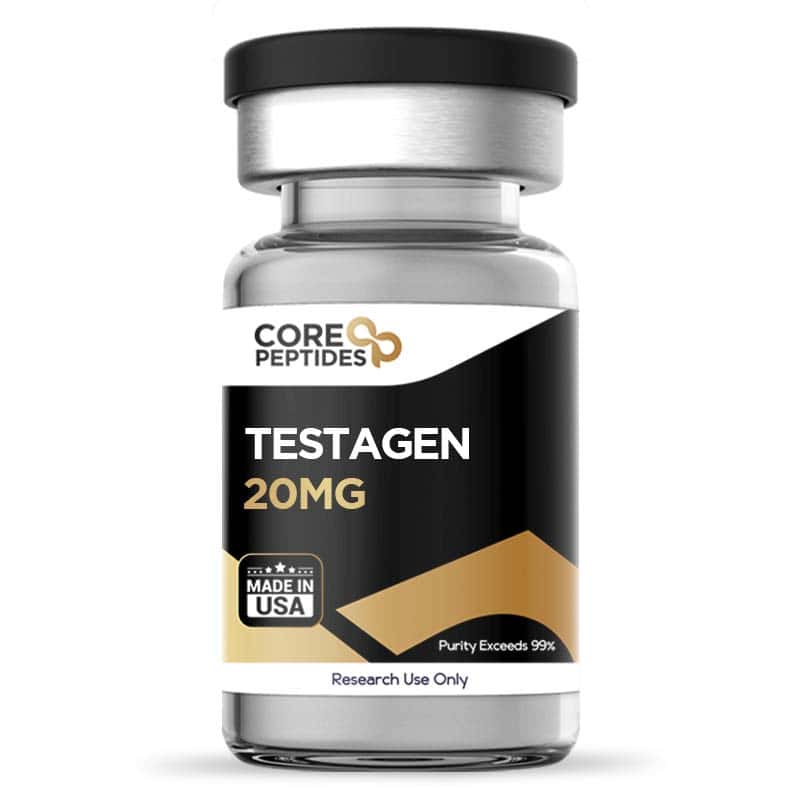

Buy Testagen (20mg) – Research Peptide
Testagen (20mg), also known as KEDG or Anterior Pituitary Peptide (APP), is a short synthetic peptide belonging to the group of Khavinson peptides studied for their potential role in cellular signalling and peptide bioregulation.
Testagen is a tetrapeptide composed of the amino acids lysine, glutamic acid, aspartic acid and glycine. According to the Core Peptides product specification, this research material contains 20mg of Testagen and is supplied as a lyophilised powder with a stated purity of >99%.
The listed peptide sequence is Lys-Glu-Asp-Gly, with a molecular formula of C17H29N5O9 and a molecular weight of approximately 447.2 g/mol.
Testagen has been investigated in experimental research relating to the anterior pituitary gland, endocrine signalling, gene expression, chromatin interactions and the hypothalamic-pituitary-thyroid and hypothalamic-pituitary-gonadal axes.
These areas remain subjects of scientific investigation, and findings from experimental or clinical studies should not be interpreted as evidence of an established therapeutic application for this research product.
For research, laboratory and analytical purposes only. Not for human or animal consumption.
What Is Testagen?
Testagen is a short synthetic peptide also referred to as KEDG. It belongs to a group of peptides associated with research into biological regulation at the cellular and tissue level.
The peptide consists of four amino acids arranged in the sequence Lys-Glu-Asp-Gly. Its short molecular structure is of interest in peptide research because small peptides can participate in biological signalling and may interact with cellular components under specific experimental conditions.
Research involving Testagen has explored potential interactions with pituitary and endocrine systems, as well as possible relationships between short peptide signalling and gene regulation.
Experimental studies have also investigated interactions between short peptides and histones, providing a basis for further research into peptide-mediated regulation of chromatin structure and gene expression.
Testagen (20mg) Product Specifications
| Specification | Details |
|---|---|
| Product Name | Testagen |
| Alternative Name | KEDG / Anterior Pituitary Peptide (APP) |
| Quantity | 20mg |
| Peptide Type | Tetrapeptide |
| Sequence | Lys-Glu-Asp-Gly |
| Form | Lyophilised powder |
| Stated Purity | >99% |
| Molecular Formula | C17H29N5O9 |
| Molecular Weight | 447.2 g/mol |
| Reconstitution | Required for applicable laboratory procedures |
| Research Category | Peptide Research |
| Intended Use | Laboratory, analytical and in-vitro research |
The specifications above follow the product information published by Core Peptides for Testagen 20mg.
Testagen Chemical Profile
Testagen is a particularly small peptide, consisting of four amino acids. Its sequence is:
Lys-Glu-Asp-Gly
The individual residues are:
- Lys: Lysine
- Glu: Glutamic acid
- Asp: Aspartic acid
- Gly: Glycine
The Core Peptides listing identifies the molecular formula as C17H29N5O9 and the molecular weight as approximately 447.2 g/mol.
What Makes Testagen Relevant to Peptide Research?
Short peptides are increasingly investigated as potential signalling molecules because their relatively small structures can interact with biological molecules under appropriate experimental conditions.
Research cited by Core Peptides has investigated whether short peptides can cross cellular and nuclear membranes and interact with nucleic acids or nuclear proteins. Such studies are relevant to broader investigations into peptide-mediated regulation of cellular processes and gene expression.
Testagen is therefore of interest as a model compound for studying the biological behaviour of short regulatory peptides, particularly in research involving endocrine tissues and cellular regulation.
Testagen and Anterior Pituitary Research
The anterior pituitary gland is an important endocrine organ responsible for producing and regulating several hormones. These hormones influence processes involving growth, reproduction, thyroid function, metabolism and other physiological systems.
Testagen has been investigated because its amino-acid composition is associated with peptide extracts derived from the anterior pituitary. Research has consequently examined whether the peptide may interact with cellular processes associated with pituitary function.
These studies provide a scientific basis for investigating Testagen in experimental models of endocrine regulation, although the precise molecular mechanisms underlying its reported biological activity remain an area for further research.
Testagen and the Hypothalamic-Pituitary-Gonadal Axis
The hypothalamic-pituitary-gonadal (HPG) axis is an interconnected endocrine system involving the hypothalamus, pituitary gland and reproductive organs. It regulates several processes related to reproductive hormone signalling.
Research cited on the Testagen product page has investigated the peptide in relation to testosterone synthesis and androgen-related endocrine pathways. One clinical study referenced by Core Peptides examined Testagen in patients with chronic abacterial prostatitis and androgen deficiency, reporting changes in testosterone-related measures and inflammatory indicators.
These findings provide research context but should not be interpreted as establishing Testagen as an approved treatment or as supporting self-administration of research-grade peptide material.
Testagen and Testosterone Research
Testagen has attracted research interest because of proposed interactions with endocrine pathways involved in testosterone production. Some experimental and clinical research has examined whether Testagen may influence testosterone-related parameters in specific research populations.
The Core Peptides reference material describes research in which changes in total testosterone and inflammatory markers were observed in a study population with androgen deficiency associated with chronic abacterial prostatitis.
However, the mechanisms responsible for these observations are not fully established. Further controlled research is required to determine how Testagen interacts with endocrine signalling and whether reported effects can be reproduced consistently across different experimental models.
Testagen and the Hypothalamic-Pituitary-Thyroid Axis
The hypothalamic-pituitary-thyroid (HPT) axis regulates thyroid function through communication between the hypothalamus, pituitary gland and thyroid gland.
Testagen has been investigated in experimental models examining thyroid morphology and thyroid-related endocrine activity. Research cited by Core Peptides included studies using hypophysectomised avian models to investigate changes in thyroid structure and hormone-related parameters following experimental exposure to the peptide.
Reported observations included changes in thyroid morphology and hormone concentrations in experimental animals. Such findings are useful for generating research hypotheses but cannot automatically be translated into human clinical outcomes.
Testagen and Cellular Regulation
One area of scientific interest surrounding short regulatory peptides is their potential relationship with cellular and nuclear processes.
Research involving short fluorescently labelled peptides has investigated their ability to enter cells and nuclei and interact with DNA or deoxyribooligonucleotides. These findings have contributed to broader scientific discussion regarding how short peptides might participate in cellular regulation.
For Testagen specifically, proposed mechanisms involving nuclear proteins and chromatin remain subjects for further investigation. The interaction between short peptides and histones is particularly relevant to research into epigenetic regulation and gene expression.
Testagen and Histone Research
Histones are proteins that help package DNA within the cell nucleus. Their interactions with DNA and other nuclear molecules can influence the organisation and accessibility of genetic material.
Research cited by Core Peptides has investigated interactions between short peptides and histones, including the potential formation of peptide-histone complexes.
These studies suggest that peptide interactions with histones may depend on molecular conformation and spatial structure rather than simple sequence similarity.
Further investigation is required to determine the biological significance of these interactions and whether they influence processes such as transcription, DNA repair, replication or cellular differentiation.
Potential Research Areas
Testagen (20mg) may be of interest to qualified laboratories conducting research in several areas, including:
- Short peptide signalling.
- Anterior pituitary biology.
- Endocrine signalling pathways.
- Hypothalamic-pituitary-gonadal axis research.
- Hypothalamic-pituitary-thyroid axis research.
- Testosterone-related endocrine research.
- Thyroid biology.
- Cellular signalling.
- Peptide-nucleic acid interactions.
- Histone and chromatin research.
- Gene expression research.
- Epigenetic research.
- Peptide stability and analytical characterisation.
Testagen and Gene Expression Research
Gene expression describes the processes through which information encoded in DNA is used by cells to produce functional RNA and proteins. Because chromatin structure influences access to genetic material, research into peptide interactions with nuclear proteins may provide insights into potential regulatory mechanisms.
Studies cited by Core Peptides have explored interactions between short peptides, DNA and histones. These findings form part of a wider research area examining whether small regulatory peptides can influence cellular processes at the nuclear level.
Testagen can therefore be investigated as part of laboratory research examining relationships between short peptide structure, nuclear interactions and cellular regulation.
Testagen and Epigenetic Research
Epigenetics refers to mechanisms that influence gene activity without changing the underlying DNA sequence. Histone modification, chromatin organisation and DNA-associated proteins are among the areas commonly investigated in epigenetic research.
The potential interaction of Testagen and related short peptides with histones has generated interest in whether such compounds could influence chromatin-associated processes. At present, these mechanisms should be regarded as research hypotheses requiring appropriate experimental validation rather than established therapeutic mechanisms.
Research on Testagen in Experimental Models
Experimental research has examined Testagen in animal models to investigate possible effects on endocrine tissues. The Core Peptides reference material describes research involving avian models in which pituitary disruption was associated with changes in thyroid structure and hormone-related measurements. Testagen exposure was subsequently investigated for potential effects on these changes.
Such models can be useful for studying biological mechanisms and generating hypotheses. However, differences between animal and human physiology mean that experimental observations should not be assumed to predict human outcomes.
Why Use Lyophilised Testagen?
The product is supplied as a lyophilised powder. Lyophilisation, commonly known as freeze-drying, is widely used for laboratory peptide materials because it produces a dry preparation that can be handled and stored according to appropriate research protocols.
The Core Peptides listing specifies that reconstitution is required. Researchers should follow the current product documentation and laboratory protocols for any applicable preparation procedures rather than relying on general peptide-handling assumptions.
Analytical Characterisation of Testagen
Analytical characterisation is an important part of peptide research. Researchers may evaluate peptide identity, purity, molecular mass and stability using validated laboratory methods.
Common analytical approaches for peptide research include:
- High-performance liquid chromatography (HPLC): Used to assess chromatographic purity and related substances.
- Mass spectrometry: Used to determine molecular mass and support peptide identification.
- LC-MS: Combines chromatographic separation with mass-based analysis.
- Stability testing: Used to monitor changes in peptide composition under defined experimental conditions.
- Peptide analysis: Used to characterise the material and evaluate its suitability for a particular research protocol.
Researchers should review the relevant batch-specific Certificate of Analysis before beginning experimental work.
Testagen (20mg) Research Summary
| Research Characteristic | Information |
|---|---|
| Compound | Testagen |
| Also Known As | KEDG / Anterior Pituitary Peptide (APP) |
| Peptide Length | 4 amino acids |
| Sequence | Lys-Glu-Asp-Gly |
| Quantity | 20mg |
| Formula | C17H29N5O9 |
| Molecular Weight | 447.2 g/mol |
| Physical Form | Lyophilised powder |
| Stated Purity | >99% |
| Research Focus | Cellular signalling, endocrine and peptide research |
Frequently Asked Questions About Testagen (20mg)
What is Testagen?
Testagen is a short synthetic tetrapeptide also known as KEDG or Anterior Pituitary Peptide. It is composed of lysine, glutamic acid, aspartic acid and glycine and has been investigated in research involving endocrine and cellular signalling.
What is the sequence of Testagen?
The listed sequence is Lys-Glu-Asp-Gly.
How much Testagen is in this product?
This product contains 20mg of Testagen. The 20mg specification refers to the quantity of peptide supplied and should not be interpreted as a dosage recommendation.
What is the molecular weight of Testagen?
The molecular weight listed for Testagen is approximately 447.2 g/mol.
What is the molecular formula of Testagen?
The listed molecular formula is C17H29N5O9.
What does KEDG mean?
KEDG is an alternative designation for Testagen based on the one-letter or abbreviated representation of its four constituent amino acids: lysine, glutamic acid, aspartic acid and glycine.
What is Anterior Pituitary Peptide?
Anterior Pituitary Peptide, or APP, is another name associated with Testagen. The designation reflects the peptide’s research association with biological processes involving the anterior pituitary.
What areas of research involve Testagen?
Testagen has been investigated in relation to anterior pituitary function, testosterone-related endocrine signalling, thyroid biology, cellular regulation, gene expression, histone interactions and chromatin research.
Is Testagen a hormone?
No. Testagen is a short synthetic peptide. It has been studied in connection with endocrine signalling pathways, but it is not itself a conventional steroid or peptide hormone such as testosterone or thyroid hormone.
Does Testagen contain testosterone?
No. Testagen does not contain testosterone. Research involving Testagen has investigated potential relationships with testosterone production and endocrine signalling, but the peptide itself is not testosterone.
Is Testagen supplied as a liquid?
No. The product is supplied as a lyophilised powder. The product specification indicates that reconstitution is required for applicable laboratory procedures.
What is the stated purity of Testagen (20mg)?
The Core Peptides product listing states a purity of >99%. Researchers should consult the applicable batch-specific Certificate of Analysis for detailed analytical information.
Is Testagen approved for medical use?
This research-grade Testagen product should not be represented as an approved medicinal product. The supplier specifically states that its products are intended for research, laboratory or analytical purposes and are not for human consumption.
Can Testagen be used for self-administration?
No. This product is supplied for research and laboratory use only and is not intended for self-administration or human consumption.
Storage and Laboratory Handling
Researchers should consult the current product documentation and Certificate of Analysis for product-specific storage requirements.
- Keep the peptide in its original labelled container.
- Protect the lyophilised material from unnecessary moisture exposure.
- Follow the supplier’s specified storage conditions.
- Minimise unnecessary temperature fluctuations.
- Use appropriate laboratory protective equipment when handling research materials.
- Prevent contamination during laboratory procedures.
- Maintain appropriate batch and experimental records.
- Dispose of research materials according to applicable institutional and laboratory procedures.
General peptide-handling practices should not replace product-specific instructions supplied with the material.
Research Applications and Experimental Considerations
Testagen offers researchers an opportunity to investigate a very short peptide in several areas of molecular and endocrine science. Because it consists of only four amino acids, it can also serve as an interesting model for exploring how small peptide structures may interact with larger biological molecules.
Potential experimental research questions include:
- How does Testagen interact with endocrine-related cellular pathways?
- Can short peptides interact with nuclear proteins under defined experimental conditions?
- What structural characteristics influence peptide-histone interactions?
- How do short peptides affect cellular signalling in controlled laboratory models?
- What relationship exists between peptide exposure and gene-expression markers?
- How stable is Testagen under different experimental conditions?
- How can analytical methods be used to verify Testagen identity and purity?
These questions require controlled experimental models and should not be converted into assumptions about clinical effectiveness.
Testagen (20mg) for Laboratory Research
For laboratories investigating short regulatory peptides, Testagen (20mg) provides a defined tetrapeptide research material with a documented molecular structure and stated purity.
Its research profile encompasses several interconnected areas, including pituitary biology, endocrine signalling, thyroid-related research, testosterone-related pathways, histone interactions and gene-expression studies. The breadth of these research areas makes Testagen a useful subject for exploratory laboratory investigation.
The product’s 20mg quantity, >99% stated purity and lyophilised format provide researchers with a defined material for appropriate analytical and experimental applications.
Important Research Disclaimer
Testagen (20mg) is supplied strictly for research, laboratory and analytical purposes.
This product is not intended for human or animal consumption, self-administration, diagnosis, treatment, cure or prevention of any disease. Information concerning testosterone, thyroid function, gene expression, endocrine signalling, histones or other biological pathways is provided for scientific and educational context only and should not be interpreted as medical advice or a therapeutic claim.
Results reported in experimental or clinical studies involving Testagen should not automatically be extrapolated to this research-grade product or to other populations, formulations or experimental conditions. Additional controlled research is required to establish the biological significance of proposed mechanisms and observed effects.
Researchers are responsible for complying with applicable laws, institutional requirements, laboratory safety procedures and appropriate handling protocols when working with Testagen.
For research use only. Not for human or animal consumption.
Be the first to review “Testagen (20mg)”
Related products
Peptides for Sale
Peptides for Sale

Peptides for Sale
Peptides for Sale
Peptides for Sale

Peptides for Sale
Peptides for Sale

Peptides for Sale
Reviews
There are no reviews yet.