
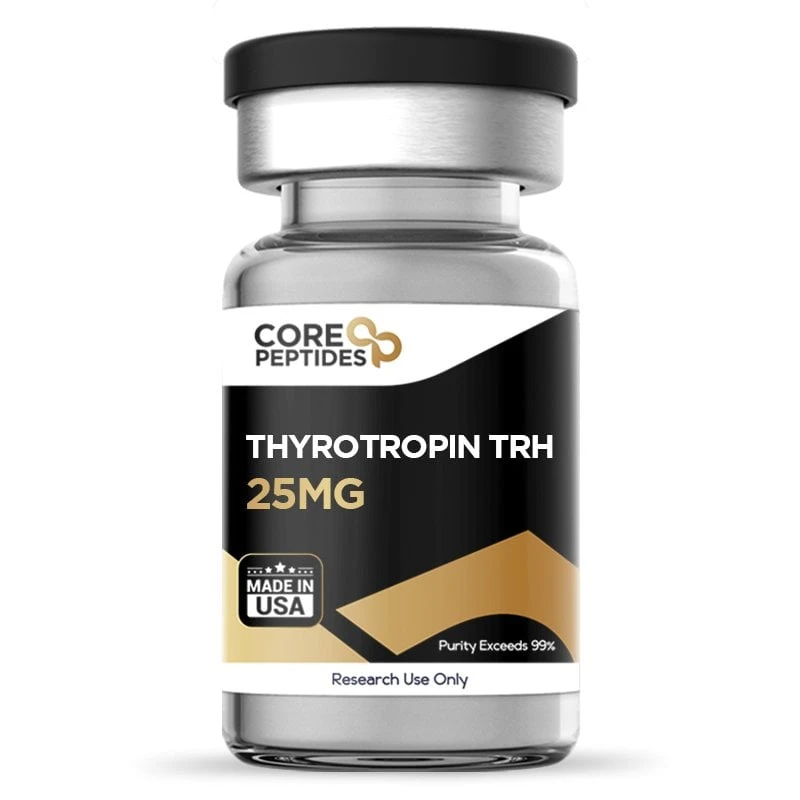
Thyrotropin TRH (25mg) – Research Peptide
Thyrotropin TRH (25mg), commonly referred to as thyrotropin-releasing hormone (TRH), is a small peptide associated with research into neuroendocrine signalling, thyroid-axis regulation and TRH receptor biology.
TRH is an important signalling molecule in the hypothalamic-pituitary-thyroid axis and has also been investigated for its activity within the central nervous system.
Core Peptides lists Thyrotropin TRH (25mg) as a research peptide supplied in a 25mg format. The Core Peptides catalogue currently lists the product at $73.00.
Native TRH is a tripeptide with the sequence pyroglutamyl-histidyl-prolinamide, often represented as pGlu-His-Pro-NH2. PubChem identifies the compound as protirelin and gives the molecular formula C16H22N6O4 and molecular weight of approximately 362.34 g/mol.
TRH research encompasses thyroid-stimulating hormone signalling, TRH receptor activity, hypothalamic regulation, pituitary function and neuroendocrine communication.
Because TRH is biologically active, research involving this compound should be conducted by appropriately qualified laboratories using suitable institutional procedures.
For research, laboratory and analytical purposes only. Not for human or animal consumption.
What Is Thyrotropin TRH?
Thyrotropin-releasing hormone (TRH) is a naturally occurring hypothalamic peptide that participates in neuroendocrine signalling. It is best known for its role in the regulation of thyrotropin, also called thyroid-stimulating hormone (TSH), from the anterior pituitary.
TRH is a particularly small peptide consisting of three amino-acid-derived components. PubChem describes its sequence as H-Pyr-His-Pro-NH2, where the N-terminal pyroglutamyl residue is followed by histidine and prolinamide.
The peptide is synthesised as part of a larger precursor molecule and subsequently processed into mature TRH. Its biological activity is mediated through specific TRH receptors, making receptor-binding and signal-transduction studies important areas of experimental research.
Thyrotropin TRH (25mg) Product Overview
| Specification | Details |
|---|---|
| Product Name | Thyrotropin TRH |
| Common Name | Thyrotropin-releasing hormone (TRH) |
| Alternative Name | Protirelin |
| Quantity | 25mg |
| Peptide Type | Tripeptide |
| Sequence | pGlu-His-Pro-NH2 |
| Molecular Formula | C16H22N6O4 |
| Molecular Weight | Approximately 362.34 g/mol |
| Primary Research Areas | Neuroendocrine signalling, TRH receptors and thyroid-axis research |
| Intended Use | Laboratory, analytical and in-vitro research |
The molecular information above is consistent with the PubChem record for protirelin/TRH.
TRH and the Hypothalamic-Pituitary-Thyroid Axis
One of the most established research areas for TRH is the hypothalamic-pituitary-thyroid (HPT) axis. This endocrine pathway involves communication between the hypothalamus, pituitary gland and thyroid gland.
Within this signalling system, hypothalamic TRH acts on pituitary thyrotroph cells through TRH receptors. This signalling is associated with the release of thyroid-stimulating hormone (TSH), which subsequently participates in thyroid regulation.
Studying TRH therefore provides researchers with a useful model for investigating communication between the central nervous system and endocrine tissues.
TRH Receptor Research
The biological activity of TRH depends on interactions with specialised TRH receptors. Receptor studies can help researchers investigate how small peptides initiate cellular signalling events.
TRH receptor research may involve receptor binding, ligand selectivity, receptor activation, intracellular signalling and downstream cellular responses. PubChem also provides records for TRH receptors, illustrating their classification as protein targets involved in TRH-related signalling.
These receptor systems make TRH useful for laboratory investigations into peptide-receptor interactions and neuroendocrine signal transduction.
TRH and Pituitary Signalling
The pituitary gland is a central component of the endocrine system and produces several hormones that regulate physiological processes throughout the body.
TRH has been studied particularly in relation to pituitary thyrotroph cells and TSH release. Experimental systems involving TRH can therefore be used to investigate the molecular mechanisms underlying hypothalamic control of pituitary hormone secretion.
Researchers may examine receptor activation and downstream signalling pathways to better understand how TRH communicates information between hypothalamic and pituitary tissues.
TRH and Neuroendocrine Research
Although TRH is strongly associated with thyroid regulation, its biological significance extends beyond the HPT axis. The peptide has been investigated in the context of neuroendocrine communication and central nervous system signalling.
Neuroendocrine research examines how neuronal signals and endocrine signals interact to regulate physiological processes. TRH provides an established model for studying this interaction because it originates within hypothalamic neurosecretory pathways and acts on endocrine tissues.
Laboratory studies may therefore use TRH to investigate peptide signalling at the interface between neuronal and hormonal systems.
TRH and Central Nervous System Research
TRH is also present within the central nervous system, where it has been investigated independently of its endocrine role in TSH regulation.
Research has explored TRH-associated signalling in different areas of neurobiology, including neuronal communication and receptor-mediated responses. The presence of TRH receptors in neural tissues has contributed to continuing interest in the peptide’s broader biological functions.
These studies help distinguish the peptide’s neuroendocrine actions from its wider neurological research profile.
TRH Structure and Peptide Composition
Native TRH is considerably smaller than many commonly studied research peptides. It is a tripeptide composed of pyroglutamic acid, histidine and prolinamide.
PubChem lists the sequence as H-Pyr-His-Pro-NH2 and identifies the systematic chemical name as L-pyroglutamyl-L-histidyl-L-prolinamide.
| Structural Property | TRH Information |
|---|---|
| Peptide | Thyrotropin-releasing hormone |
| Length | 3 residues |
| Sequence | pGlu-His-Pro-NH2 |
| Molecular Formula | C16H22N6O4 |
| Molecular Weight | Approximately 362.34 g/mol |
| PubChem Name | Protirelin |
These structural details refer to native TRH/protirelin rather than modified TRH analogues. PubChem distinguishes native TRH from numerous synthetic TRH derivatives and analogues.
Native TRH vs TRH Analogues
Researchers should distinguish native TRH from synthetic TRH analogues. A number of related compounds have been developed by modifying one or more residues of the native TRH structure.
For example, taltirelin is a TRH analogue with a modified molecular structure and a different molecular formula from native TRH. PubChem identifies taltirelin as a thyrotropin-releasing hormone analogue.
Other specialised TRH derivatives are also documented in chemical databases, including modified histidine-containing analogues.
Consequently, researchers should verify the exact compound identity before comparing experimental results between TRH and related analogues.
Research Applications of Thyrotropin TRH
Qualified researchers may investigate TRH in several areas of experimental science, including:
- Hypothalamic-pituitary-thyroid axis research.
- Thyroid-stimulating hormone signalling.
- TRH receptor binding studies.
- Neuroendocrine signalling research.
- Pituitary-cell research.
- Peptide-receptor interaction studies.
- Central nervous system research.
- Hormonal signalling investigations.
- Cellular signal-transduction research.
- Peptide structure and analytical research.
- Comparative studies involving TRH analogues.
These represent areas of scientific investigation rather than approved therapeutic indications or recommendations for use.
TRH Receptor and Signal-Transduction Studies
Small signalling peptides such as TRH can be valuable tools for studying receptor-mediated cellular communication. Researchers may investigate how TRH interacts with its receptor and how receptor activation produces downstream intracellular responses.
Potential experimental endpoints can include receptor binding characteristics, changes in intracellular signalling molecules, hormone secretion and gene-expression responses, depending on the experimental model.
Appropriate controls are particularly important when comparing native TRH with structurally modified analogues because even small changes in peptide structure can alter receptor interactions and biological activity.
Analytical Research with TRH
Analytical characterisation is an important component of peptide research. Depending on the research objective, laboratories may use complementary analytical techniques to verify identity, purity and stability.
- High-performance liquid chromatography (HPLC): Used to evaluate chromatographic purity and related substances.
- Mass spectrometry: Used to investigate molecular mass and support compound identification.
- LC-MS: Combines chromatographic separation with mass-based detection.
- Receptor-binding assays: Used in appropriate research systems to investigate peptide-receptor interactions.
- Cell-based assays: Used to evaluate biological responses under controlled experimental conditions.
Researchers should use validated analytical procedures appropriate to their laboratory’s objectives and consult the relevant batch documentation supplied with the research material.
Why Study Thyrotropin TRH?
TRH occupies an important position within endocrine and neuroendocrine research because it connects hypothalamic signalling with pituitary hormone regulation.
Its small, well-defined molecular structure also makes it useful for investigating fundamental questions surrounding peptide-receptor interactions. By studying TRH, researchers can examine how a short peptide ligand interacts with its receptor and how that interaction can influence downstream endocrine and cellular signalling.
TRH therefore remains relevant to laboratories investigating peptide biology, endocrine communication, receptor pharmacology and neuroendocrine regulation.
Thyrotropin TRH (25mg) Research Summary
| Research Characteristic | Information |
|---|---|
| Compound | Thyrotropin-releasing hormone (TRH) |
| Alternative Name | Protirelin |
| Product Quantity | 25mg |
| Peptide Length | 3 residues |
| Sequence | pGlu-His-Pro-NH2 |
| Molecular Formula | C16H22N6O4 |
| Molecular Weight | Approximately 362.34 g/mol |
| Primary Research Areas | Neuroendocrine signalling, TRH receptors, pituitary and thyroid-axis research |
| Intended Use | Laboratory, analytical and in-vitro research |
Structural and molecular information is based on the PubChem record for protirelin/TRH.
Frequently Asked Questions About Thyrotropin TRH (25mg)
What is Thyrotropin TRH?
Thyrotropin TRH refers to thyrotropin-releasing hormone, a naturally occurring tripeptide involved in hypothalamic and pituitary signalling. PubChem identifies native TRH as protirelin.
What does TRH stand for?
TRH stands for thyrotropin-releasing hormone. It is also commonly described as thyrotropin-releasing factor or abbreviated TSH-releasing hormone in older scientific literature.
What is the sequence of TRH?
Native TRH has the sequence pGlu-His-Pro-NH2, consisting of pyroglutamyl, histidyl and prolinamide components.
What is the molecular formula of TRH?
PubChem lists the molecular formula of native TRH/protirelin as C16H22N6O4.
What is the molecular weight of TRH?
The molecular weight of native TRH/protirelin is approximately 362.34 g/mol.
What is TRH studied for?
TRH is studied in areas including the hypothalamic-pituitary-thyroid axis, TSH signalling, TRH receptor biology, pituitary function, neuroendocrine communication and peptide-receptor interactions.
Is TRH the same as TSH?
No. TRH and TSH are different hormones. TRH is a hypothalamic signalling peptide that participates in the regulation of pituitary TSH secretion. TSH is a separate pituitary hormone that acts on the thyroid gland.
Is Thyrotropin TRH the same as a TRH analogue?
No. Native TRH is structurally distinct from modified TRH analogues such as taltirelin. Researchers should verify the exact molecular identity before comparing compounds.
What quantity does the Core Peptides product contain?
The Core Peptides catalogue lists Thyrotropin TRH (25mg), indicating a 25mg product quantity.
Can Thyrotropin TRH be used for self-administration?
No. This product is presented as a research material and should be used only for appropriate laboratory, analytical or in-vitro research. It is not intended for human or animal consumption or self-directed use.
Research Handling and Storage
Researchers should follow the current supplier documentation and batch-specific Certificate of Analysis for product-specific storage and handling requirements.
- Keep the research material in its original labelled container.
- Protect the material from unnecessary environmental exposure.
- Follow the storage conditions specified in the current product documentation.
- Minimise unnecessary temperature fluctuations.
- Use suitable laboratory protective equipment when handling research peptides.
- Maintain appropriate batch and experimental records.
- Prevent contamination during laboratory handling.
- Dispose of unused research material in accordance with applicable institutional procedures.
No dosage, administration or self-use instructions are provided because this product is intended for laboratory research rather than human or veterinary use.
Why Choose Thyrotropin TRH (25mg) for Research?
Thyrotropin TRH (25mg) offers researchers a defined peptide model for investigating neuroendocrine signalling and TRH receptor biology. Native TRH has a compact tripeptide structure and a well-established role within endocrine research, making it useful for controlled investigations into peptide-receptor interactions and hypothalamic-pituitary signalling.
The Core Peptides catalogue lists the product in a convenient 25mg research format, providing a practical quantity for appropriately designed laboratory and analytical studies.
Important Research Disclaimer
Thyrotropin TRH (25mg) is supplied strictly for research, laboratory and analytical purposes.
This product is not intended for human or animal consumption, self-administration, diagnosis, treatment, cure or prevention of any disease. Information concerning thyroid signalling, pituitary activity, neuroendocrine pathways or other biological processes describes areas of scientific research and should not be interpreted as medical advice or a therapeutic claim.
TRH is biologically active, and research involving the compound should be performed only by appropriately qualified personnel using suitable laboratory procedures, controls and safety practices.
Researchers are responsible for complying with applicable legislation, institutional requirements and laboratory safety procedures when working with this material.
For research use only. Not for human or animal consumption.
Be the first to review “Thyrotropin TRH (25mg)”
Related products

Peptides for Sale
Peptides for Sale
Peptides for Sale
Peptides for Sale

Peptides for Sale
Peptides for Sale
Peptides for Sale
Peptides for Sale
Reviews
There are no reviews yet.