
CJC-1295 (Mod GRF 1-29) & Ipamorelin & GHRP-2 Blend (9mg) – Research Peptide
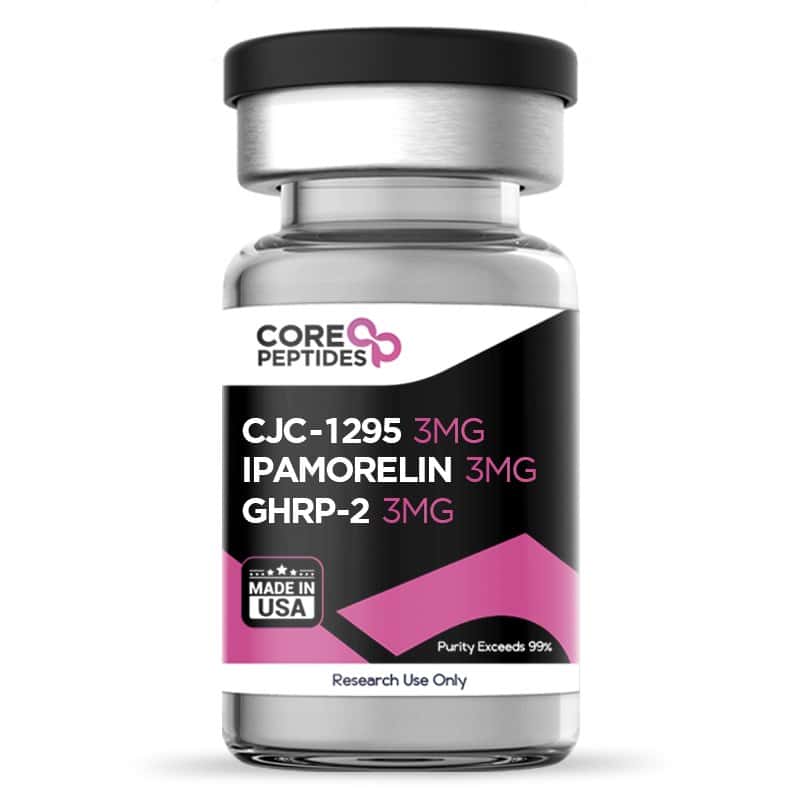
CJC-1295 (Mod GRF 1-29) & Ipamorelin & GHRP-2 Blend (9mg) is an experimental three-peptide formulation designed for laboratory research involving growth-hormone signalling, pituitary biology and the interaction between GHRH-related and growth-hormone-secretagogue pathways.
The referenced formulation contains 3mg CJC-1295 (No DAC / Mod GRF 1-29), 3mg Ipamorelin and 3mg GHRP-2, providing a total peptide content of 9mg. The product is supplied as a lyophilised powder with a stated purity of >99%.
Each component belongs to a different but related area of growth-hormone research. CJC-1295 (No DAC), commonly referred to as Modified GRF 1-29, is studied as a GHRH analogue. Ipamorelin and GHRP-2 are growth-hormone secretagogues associated with the ghrelin/GHS-R1a receptor pathway.
This combination therefore provides researchers with an experimental model for examining multiple signalling inputs involved in pituitary growth-hormone release.
Importantly, research involving the individual peptides or related combinations should not automatically be interpreted as evidence for the exact 9mg formulation. The scientific rationale for studying the blend comes from the different signalling pathways associated with its individual components, while direct evidence concerning this specific product remains limited.
What Is the CJC-1295, Ipamorelin & GHRP-2 Blend?
The CJC-1295 (Mod GRF 1-29) & Ipamorelin & GHRP-2 Blend combines three synthetic peptides that have been investigated in relation to the regulation of growth-hormone secretion.
CJC-1295 (No DAC / Mod GRF 1-29) is a modified analogue related to growth-hormone-releasing hormone (GHRH). Research into this compound focuses on the GHRH receptor and its role in pituitary signalling.
Ipamorelin is a synthetic pentapeptide studied as a selective growth-hormone secretagogue associated with the ghrelin receptor, also known as the growth-hormone secretagogue receptor or GHS-R1a.
GHRP-2, also known as Growth Hormone-Releasing Peptide-2 or Pralmorelin, is a synthetic hexapeptide investigated for activity through the growth-hormone-secretagogue receptor pathway.
Combining these three research compounds creates an experimental formulation that allows researchers to examine the interaction of GHRH-related signalling and GHS-R1a-mediated signalling within growth-hormone research models.
CJC-1295 (Mod GRF 1-29) in Research
CJC-1295 (No DAC) is commonly referred to as Modified GRF 1-29 or Mod GRF 1-29. It is a synthetic analogue related to the biologically active region of growth-hormone-releasing hormone.
GHRH is naturally involved in communication between the hypothalamus and pituitary gland. It binds to GHRH receptors on pituitary somatotroph cells and forms part of the signalling process involved in growth-hormone release.
Research into Modified GRF 1-29 therefore focuses on the GHRH receptor pathway, receptor activation, intracellular signalling and the regulation of pituitary GH secretion.
It is important to distinguish CJC-1295 without DAC from formulations containing a Drug Affinity Complex (DAC). The two forms have different pharmacological characteristics and should not be treated as interchangeable research materials. Current literature also indicates that direct human evidence for the No-DAC form remains limited.
Ipamorelin in Research
Ipamorelin is a synthetic pentapeptide investigated as a growth-hormone secretagogue. Research has associated it with the ghrelin receptor / GHS-R1a pathway, which plays an important role in the regulation of pituitary growth-hormone secretion.
Unlike a GHRH analogue, Ipamorelin represents a different signalling approach. Researchers can therefore study Ipamorelin alongside GHRH-related compounds to investigate how separate receptor systems influence the same endocrine pathway.
Ipamorelin has been described in the scientific literature as a selective growth-hormone-releasing peptide, making it a useful experimental compound for investigating secretagogue activity and pituitary signalling.
GHRP-2 in Research
GHRP-2, or Growth Hormone-Releasing Peptide-2, is a synthetic hexapeptide also known as Pralmorelin.
GHRP-2 is investigated primarily in relation to the growth-hormone-secretagogue receptor (GHS-R1a). This receptor is also associated with the physiological signalling actions of ghrelin.
Research involving GHRP-2 has examined growth-hormone secretion, pituitary responses and interactions between secretagogue signalling and the broader endocrine growth-hormone axis.
Because GHRP-2 and Ipamorelin are both associated with the GHS-R1a pathway, their inclusion in the same formulation provides an opportunity for researchers to investigate different secretagogue structures and signalling characteristics within a controlled experimental system.
CJC-1295, Ipamorelin & GHRP-2 Blend – Product Highlights
- Product name: CJC-1295 (Mod GRF 1-29) & Ipamorelin & GHRP-2 Blend
- Total quantity: 9mg
- CJC-1295 (No DAC / Mod GRF 1-29): 3mg
- Ipamorelin: 3mg
- GHRP-2: 3mg
- Blend ratio: 1:1:1 by stated mass
- Form: Lyophilised powder
- Stated purity: >99%
- Primary research area: Growth-hormone and pituitary biology
- Research pathways: GHRH receptor and GHS-R1a signalling
- Research status: Experimental
- Intended purpose: Laboratory and analytical research
CJC-1295, Ipamorelin & GHRP-2 Chemical Profile
| Property | CJC-1295 (No DAC) | Ipamorelin | GHRP-2 |
|---|---|---|---|
| Common designation | Mod GRF 1-29 | Ipamorelin / Ipamorelin Acetate | GHRP-2 / Pralmorelin |
| Quantity in blend | 3mg | 3mg | 3mg |
| Peptide class | GHRH analogue | Growth-hormone secretagogue | Growth-hormone secretagogue |
| Research-associated receptor | GHRH receptor | GHS-R1a | GHS-R1a |
| Research focus | GHRH signalling and GH release | Secretagogue signalling | Secretagogue signalling |
The supplier’s product listing identifies the formulation as 3mg of each peptide for a total of 9mg and describes it as a lyophilised powder with stated purity above 99%.
How the Growth-Hormone Axis Is Studied
The growth-hormone axis is a complex biological system involving communication between the hypothalamus, pituitary gland and peripheral tissues.
In simplified terms, researchers study several key signalling components:
- GHRH: A hypothalamic hormone involved in stimulating pituitary growth-hormone secretion.
- Somatostatin: A hypothalamic hormone that inhibits growth-hormone secretion.
- GHS-R1a: A receptor associated with ghrelin and several synthetic growth-hormone secretagogues.
- Growth hormone: A pituitary hormone involved in multiple physiological processes.
- IGF-1: A downstream growth factor produced primarily by the liver in response to GH signalling.
CJC-1295 (No DAC), Ipamorelin and GHRP-2 are of research interest because they interact with different components of this signalling network.
Two Major Signalling Pathways in One Research Blend
| Component | Research pathway | Role in experimental research |
|---|---|---|
| CJC-1295 (No DAC) | GHRH receptor | Study of GHRH-related pituitary signalling |
| Ipamorelin | GHS-R1a | Study of growth-hormone-secretagogue signalling |
| GHRP-2 | GHS-R1a | Study of synthetic secretagogue activity |
The combination therefore brings together a GHRH analogue with two growth-hormone secretagogues. This provides an experimental framework for investigating how different upstream signals influence pituitary GH release.
Why Combine CJC-1295, Ipamorelin and GHRP-2?
The primary research rationale for the blend is based on the fact that CJC-1295 (No DAC) and the two secretagogues represent different approaches to growth-hormone signalling.
CJC-1295 (No DAC) is studied in relation to the GHRH receptor, whereas Ipamorelin and GHRP-2 are studied in relation to GHS-R1a. Researchers can therefore examine how GHRH-related and secretagogue-mediated signalling interact.
Studies of GHRH and growth-hormone-releasing peptides have historically provided evidence that activation of complementary pathways can influence pituitary GH responses. However, this background research should not be interpreted as proof that the exact 9mg commercial blend produces a particular biological or therapeutic outcome.
The supplier describes the combination as potentially synergistic based on research and anecdotal observations, but the distinction between a theoretical research rationale and direct evidence for the exact formulation is important.
CJC-1295 No DAC vs CJC-1295 With DAC
The term CJC-1295 can refer to different research preparations, making the distinction between No DAC and DAC particularly important.
| Feature | CJC-1295 No DAC / Mod GRF 1-29 | CJC-1295 With DAC |
|---|---|---|
| DAC | Absent | Present |
| General classification | Modified GHRH 1-29 analogue | Modified CJC-1295 containing Drug Affinity Complex |
| Research focus | GHRH receptor signalling | Longer-duration GH-axis research |
| Pharmacological behaviour | Shorter-acting research profile | Extended pharmacokinetic profile |
Researchers should verify the precise form of CJC-1295 identified in any study before comparing experimental results.
Ipamorelin and GHRP-2 – Similar but Distinct Research Compounds
Although both Ipamorelin and GHRP-2 are associated with GHS-R1a signalling, they are chemically distinct peptides.
Ipamorelin is a pentapeptide, whereas GHRP-2 is a hexapeptide. Their structural differences make them useful research compounds for comparing different approaches to activation of the growth-hormone-secretagogue system.
| Feature | Ipamorelin | GHRP-2 |
|---|---|---|
| Alternative name | Ipamorelin Acetate / IPA | Pralmorelin |
| Peptide length | Pentapeptide | Hexapeptide |
| Research receptor | GHS-R1a | GHS-R1a |
| Research classification | Growth-hormone secretagogue | Growth-hormone-releasing peptide |
Research Applications
The CJC-1295 (Mod GRF 1-29), Ipamorelin and GHRP-2 blend may be relevant to laboratory investigations involving:
- Pituitary biology: Research into somatotroph-cell signalling and growth-hormone secretion.
- Endocrine research: Investigation of the regulatory mechanisms controlling the GH axis.
- GHRH receptor research: Study of signalling associated with Modified GRF 1-29.
- GHS-R1a research: Investigation of ghrelin-receptor-mediated signalling.
- Secretagogue research: Comparison of different synthetic GH secretagogues.
- Receptor interaction studies: Investigation of interactions between GHRH and GHS signalling pathways.
- Hormone-release models: Experimental investigation of pituitary hormone secretion.
- Peptide pharmacology: Study of structurally distinct peptides affecting related endocrine pathways.
- Cellular signalling: Investigation of intracellular pathways associated with peptide receptor activation.
Understanding the 9mg Formulation
The 9mg specification refers to the combined quantity of the three peptides in the referenced product.
- 3mg CJC-1295 (No DAC / Mod GRF 1-29)
- 3mg Ipamorelin
- 3mg GHRP-2
This represents a stated 1:1:1 ratio by mass.
The 9mg quantity is a product specification and should not be interpreted as a recommended human dose or clinical treatment quantity. The formulation is intended for research purposes rather than use as an approved medicine.
Lyophilised Peptide Blend
The product is supplied as a lyophilised powder. Lyophilisation, commonly known as freeze-drying, is widely used for laboratory peptide preparations.
A dry, lyophilised preparation can be subjected to analytical characterisation and handled according to appropriate laboratory protocols. Researchers should rely on batch-specific documentation and validated institutional procedures when working with experimental peptide materials.
Analytical Quality and Research Documentation
Reliable analytical characterisation is important when conducting peptide research. Researchers should establish the identity, purity and consistency of experimental materials before using them in controlled studies.
Common analytical methods used for peptide characterisation include:
- HPLC: High-performance liquid chromatography can be used to evaluate chromatographic purity.
- Mass spectrometry: Can help confirm molecular identity and molecular mass.
- Certificate of Analysis: Batch-specific documentation can provide information about analytical testing.
- Lot identification: Traceability helps researchers maintain consistency between experimental materials.
The referenced product listing states a purity of >99% for the 9mg blend.
Research Evidence and Scientific Limitations
The three individual peptides have been investigated in different areas of growth-hormone research, but the available evidence should be interpreted carefully.
Research findings concerning one peptide cannot automatically be transferred to a three-peptide formulation. Likewise, findings from related combinations should not be presented as direct evidence for the precise 3mg/3mg/3mg formulation.
Current research involving CJC-1295 without DAC is particularly limited in humans. Scientific literature and recent research reviews distinguish the No-DAC form from the longer-acting DAC-containing form and caution against extrapolating evidence from one preparation to another.
Consequently, the CJC-1295, Ipamorelin and GHRP-2 blend should be regarded as an experimental research formulation rather than a clinically validated treatment.
CJC-1295, Ipamorelin & GHRP-2 Research Synergy
The concept of synergy describes a combined biological response that is greater than would be expected from the individual effects of the components.
In growth-hormone research, interest in combinations of GHRH analogues and secretagogues comes from the fact that they can influence related endocrine pathways through different receptor systems.
CJC-1295 (No DAC) is associated with GHRH-receptor signalling, while Ipamorelin and GHRP-2 are associated with GHS-R1a signalling. This provides a theoretical basis for studying whether simultaneous activation of these pathways produces different responses from individual compounds.
However, the presence of complementary signalling pathways does not by itself prove synergy. Demonstrating true synergy requires controlled experimental comparisons using appropriate concentrations, controls and validated outcome measures.
Growth-Hormone and Pituitary Research
The pituitary gland plays a central role in growth-hormone regulation. Specialised somatotroph cells produce and release GH in response to multiple signals.
Laboratory research can examine how peptide receptor activation influences these cells and how different signalling pathways interact.
CJC-1295 (No DAC), Ipamorelin and GHRP-2 provide three distinct experimental components for investigating this biology. Their inclusion in one formulation allows researchers to consider interactions between GHRH-related and GHS-R1a-related signalling systems.
Growth Hormone and IGF-1 Research
Growth hormone is part of a wider endocrine signalling network that includes insulin-like growth factor 1 (IGF-1).
GH released from the pituitary can influence IGF-1 production, particularly in the liver. Researchers therefore frequently examine GH and IGF-1 together when studying the growth-hormone axis.
It is important, however, not to interpret the presence of these pathways as evidence that an experimental peptide blend produces clinically beneficial changes in body composition, recovery, athletic performance or other outcomes.
Frequently Asked Questions About CJC-1295, Ipamorelin & GHRP-2 Blend (9mg)
What is the CJC-1295, Ipamorelin & GHRP-2 Blend?
It is an experimental three-peptide formulation containing 3mg CJC-1295 (No DAC/Mod GRF 1-29), 3mg Ipamorelin and 3mg GHRP-2, for a total of 9mg.
What does the 9mg specification mean?
The 9mg refers to the total quantity of peptide material in the blend. It consists of 3mg of each of the three peptides.
What is CJC-1295 No DAC?
CJC-1295 No DAC is commonly referred to as Modified GRF 1-29. It is an experimental analogue related to GHRH and is studied in relation to the GHRH receptor pathway.
What is Ipamorelin?
Ipamorelin is a synthetic pentapeptide investigated as a growth-hormone secretagogue associated with the GHS-R1a receptor pathway.
What is GHRP-2?
GHRP-2, also known as Pralmorelin, is a synthetic hexapeptide studied as a growth-hormone-releasing peptide and secretagogue.
How much of each peptide is in the blend?
The referenced product contains 3mg CJC-1295, 3mg Ipamorelin and 3mg GHRP-2.
What is the ratio of the three peptides?
The formulation contains the three components in a stated 1:1:1 mass ratio.
Why are these three peptides combined?
They are combined for experimental investigation of complementary pathways involved in growth-hormone signalling. CJC-1295 is associated with the GHRH receptor, while Ipamorelin and GHRP-2 are associated with GHS-R1a signalling.
Is this blend clinically approved?
No. The formulation is an experimental research peptide blend and should not be represented as an approved medicinal product.
Is the 9mg quantity a human dosage?
No. The 9mg figure describes the amount of research material contained in the product and is not a recommended human dose.
Is CJC-1295 No DAC the same as CJC-1295 with DAC?
No. The No-DAC form, commonly called Mod GRF 1-29, differs from CJC-1295 formulations containing the Drug Affinity Complex. Researchers should verify which form is used when interpreting scientific literature.
What form is the blend supplied in?
The referenced product is supplied as a lyophilised powder.
What is the primary research area?
The primary research area is the growth-hormone axis, including pituitary biology, GHRH receptor signalling and growth-hormone-secretagogue pathways.
Does research on the individual peptides prove that the blend works?
No. Evidence involving individual peptides cannot automatically be applied to the exact three-peptide formulation. Controlled studies would be required to establish the biological characteristics of the specific blend.
Important Research Considerations
- Individual compounds are not the same as the blend: Results for CJC-1295, Ipamorelin or GHRP-2 individually should not automatically be attributed to the combined formulation.
- No-DAC terminology matters: CJC-1295 without DAC should be distinguished from DAC-containing preparations.
- Synergy requires direct testing: A theoretical interaction between signalling pathways is not proof of synergistic activity.
- Human evidence is limited: Experimental peptide research should not be confused with established clinical evidence.
- Long-term safety remains uncertain: Experimental compounds require further research before their long-term safety profile can be established.
- Product quantity is not dosage: The 9mg specification describes the amount supplied and does not establish a treatment regimen.
CJC-1295 (Mod GRF 1-29) & Ipamorelin & GHRP-2 Blend (9mg) Research Summary
CJC-1295 (Mod GRF 1-29) & Ipamorelin & GHRP-2 Blend (9mg) is an experimental three-peptide formulation containing equal quantities of CJC-1295 (No DAC), Ipamorelin and GHRP-2.
The formulation contains 3mg of each peptide, giving a total peptide content of 9mg. It is supplied as a lyophilised powder with a stated purity above 99%.
CJC-1295 (No DAC) is studied as a modified GHRH analogue associated with the GHRH receptor. Ipamorelin and GHRP-2 are growth-hormone secretagogues associated with the GHS-R1a receptor pathway. These different signalling routes provide a scientific rationale for investigating their interaction within controlled laboratory models.
Research into the individual peptides and related signalling pathways provides useful scientific context, but it should not be interpreted as direct evidence for the clinical efficacy of this specific blend. Further controlled research would be required to establish its pharmacological characteristics, biological effects and safety profile.
Research-Use Disclaimer
CJC-1295 (Mod GRF 1-29) & Ipamorelin & GHRP-2 Blend (9mg) is intended for laboratory and research use only. It is not a medicine, dietary supplement, food product or approved therapeutic treatment.
The information presented in this product description is intended for scientific and educational purposes. It summarises research areas associated with the individual peptide components and should not be interpreted as evidence that the blend can diagnose, treat, cure or prevent any disease or medical condition.
The available evidence for the exact three-peptide formulation is limited. Research findings involving individual compounds, related peptide combinations or different CJC-1295 formulations should not automatically be attributed to this specific product.
This description does not provide instructions for human administration, dosing, injection, reconstitution for human use or self-experimentation. Researchers should consult relevant scientific literature, batch-specific analytical documentation, institutional procedures and applicable laws and regulations when working with experimental peptide materials.
Be the first to review “CJC-1295 (Mod GRF 1-29) & Ipamorelin & GHRP-2 Blend (9mg)”
Related products
Peptides for Sale
Peptides for Sale
Peptides for Sale
Peptides for Sale
Peptides for Sale
Peptides for Sale
Peptides for Sale
Peptides for Sale
Reviews
There are no reviews yet.