
BPC-157 & TB-500 & GHK-Cu Blend (70mg) – Research Peptide Blend
BPC-157 & TB-500 & GHK-Cu Blend (70mg) is a multi-peptide research formulation combining three compounds that have attracted scientific interest in areas including cellular signalling, tissue remodelling, angiogenesis, wound-healing biology and connective-tissue research.
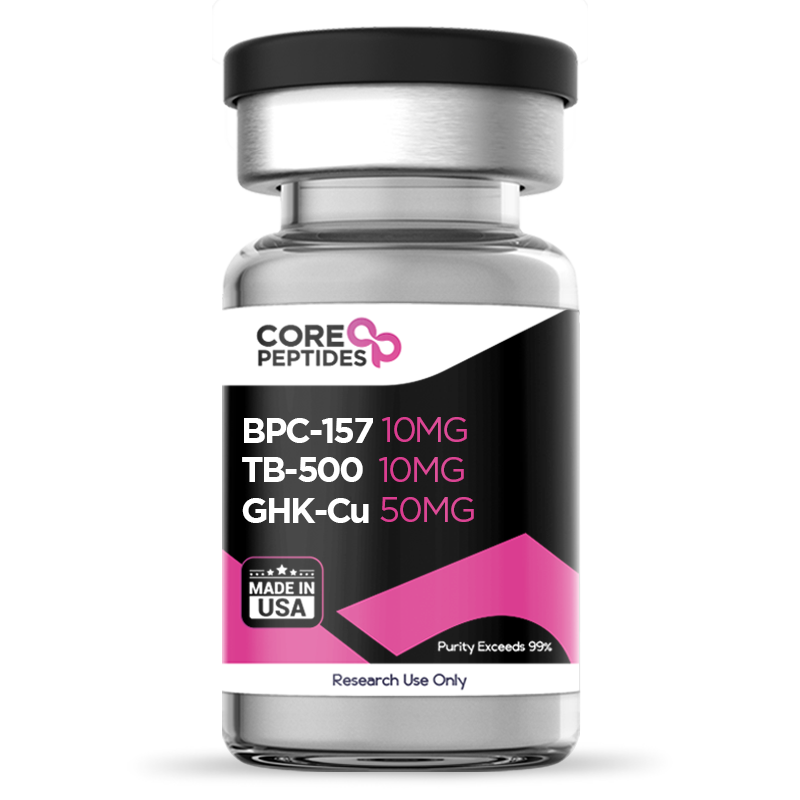
The referenced formulation contains 70mg of total peptide material, consisting of 10mg BPC-157, 10mg TB-500 and 50mg GHK-Cu. The product is supplied as a lyophilised powder and the supplier states a purity of >99%. It is intended for research and laboratory applications rather than use as an approved medicinal product.
BPC-157, TB-500 and GHK-Cu each have distinct biological characteristics and research histories. BPC-157 has primarily been investigated in preclinical models involving tissue repair, gastrointestinal biology, angiogenesis and connective tissue.
TB-500 is associated with research into thymosin beta-4-related cellular processes, including cell migration, cytoskeletal organisation and wound-healing mechanisms. GHK-Cu is a copper-binding tripeptide studied extensively in relation to extracellular-matrix remodelling, collagen biology, skin research and cellular signalling.
Although these compounds have overlapping areas of scientific interest, it is important to distinguish research involving the individual peptides from evidence concerning the complete three-peptide formulation.
At present, dedicated clinical research on the BPC-157, TB-500 and GHK-Cu combination is extremely limited. Findings from studies of individual ingredients cannot automatically be interpreted as evidence that the combined formulation produces the same effects.
What Is the BPC-157 & TB-500 & GHK-Cu Blend?
The BPC-157 & TB-500 & GHK-Cu Blend is a research-oriented peptide combination designed to place three experimentally investigated compounds in a single formulation.
The three components are:
- BPC-157 – 10mg: A synthetic 15-amino-acid peptide investigated in preclinical research involving angiogenesis, gastrointestinal biology, cellular signalling and tissue responses.
- TB-500 – 10mg: A peptide associated with thymosin beta-4 research and investigated in relation to cellular migration, actin organisation, angiogenesis and wound-healing mechanisms.
- GHK-Cu – 50mg: A copper complex of the tripeptide GHK (glycine-histidine-lysine), investigated extensively in research involving collagen, extracellular-matrix remodelling, skin biology and cellular signalling.
The total quantity supplied is 70mg per vial. According to the referenced product listing, the blend is supplied in a lyophilised form with a stated purity greater than 99%.
BPC-157 & TB-500 & GHK-Cu Blend – Product Highlights
- Total blend quantity: 70mg
- BPC-157: 10mg
- TB-500: 10mg
- GHK-Cu: 50mg
- Physical form: Lyophilised powder
- Stated purity: >99%
- Blend type: Multi-peptide research formulation
- Primary research areas: Cellular signalling, tissue biology and regenerative research
- Additional research areas: Angiogenesis, extracellular-matrix biology, wound-healing research and connective-tissue studies
- Intended purpose: Laboratory and scientific research
BPC-157 – Component Overview
BPC-157 is a synthetic pentadecapeptide consisting of 15 amino acids. It has become a prominent subject of preclinical peptide research, particularly in investigations involving tissue responses, gastrointestinal biology, angiogenesis and connective-tissue models.
Experimental studies have investigated BPC-157 in models involving skin wounds, gastrointestinal injury, tendon and ligament tissue, skeletal muscle and other biological systems. Research has also examined its relationship with cellular signalling pathways associated with vascular development and tissue remodelling.
Potential mechanisms investigated in the literature include signalling involving vascular endothelial growth factor, endothelial-cell activity, nitric-oxide pathways and intracellular pathways associated with cell migration.
Much of the BPC-157 evidence remains preclinical. Animal and cellular findings should therefore be considered experimental observations rather than evidence of established clinical efficacy.
TB-500 – Component Overview
TB-500 is commonly associated with research surrounding thymosin beta-4 and its biological functions. Thymosin beta-4 is a naturally occurring peptide involved in cellular processes including actin regulation, cell migration and tissue remodelling.
Research into thymosin beta-4 has investigated its involvement in cell migration, angiogenesis, wound-healing processes and cytoskeletal organisation. These mechanisms are relevant to laboratory studies examining how cells respond to injury and changes in their surrounding environment.
The terminology surrounding TB-500 should be handled carefully because commercially marketed TB-500 products and thymosin beta-4 are not necessarily interchangeable for scientific purposes. Researchers should verify the precise molecular identity and analytical documentation of any material used in an experiment.
GHK-Cu – Component Overview
GHK-Cu is a copper-containing peptide complex consisting of the tripeptide GHK, formed from glycine, histidine and lysine, bound to a divalent copper ion.
GHK-Cu has a substantial research history, particularly in studies of skin biology, collagen production, extracellular-matrix remodelling, wound-healing processes and cellular signalling.
Researchers have investigated GHK-Cu in relation to fibroblast activity, extracellular-matrix components and gene-expression patterns associated with tissue remodelling. Copper availability is also relevant to several enzymes and biological processes involved in connective-tissue and cellular function.
Unlike BPC-157 and TB-500, GHK-Cu has also been extensively examined in topical and cosmetic research. However, evidence for one route or formulation should not automatically be applied to a different formulation or research context.
Why Combine BPC-157, TB-500 and GHK-Cu?
The scientific rationale for studying the three compounds together comes primarily from their partially overlapping areas of biological research.
BPC-157 has been investigated in relation to vascular signalling and tissue responses. TB-500-related research focuses on cellular migration, cytoskeletal organisation and wound-healing biology. GHK-Cu has been studied extensively in connection with extracellular-matrix remodelling, collagen biology and cellular signalling.
These areas intersect in biological processes such as:
- Cell migration
- Extracellular-matrix remodelling
- Angiogenesis research
- Fibroblast activity
- Collagen-related research
- Cellular responses to tissue injury
- Inflammatory signalling
- Vascular biology
However, overlapping biological pathways do not establish that combining these compounds produces additive or synergistic effects. The specific 70mg blend itself has not been adequately validated through controlled human clinical trials.
BPC-157 & TB-500 & GHK-Cu Blend Chemical Composition
| Component | Quantity | Research Classification |
|---|---|---|
| BPC-157 | 10mg | Synthetic pentadecapeptide |
| TB-500 | 10mg | Thymosin beta-4-related research peptide |
| GHK-Cu | 50mg | Copper-binding tripeptide complex |
| Total | 70mg | Multi-peptide research blend |
BPC-157 Chemical Profile
BPC-157 is a 15-amino-acid peptide. The molecular formula listed by the supplier is C62H98N16O22.
BPC-157 research has focused on biological processes involving angiogenesis, gastrointestinal tissue, fibroblast activity, connective tissue and cellular signalling.
TB-500 Chemical Profile
The referenced product information identifies TB-500 with the molecular formula C212H350N56O78S and associates the compound with synthetic thymosin beta-4 research.
Researchers investigating TB-500 should verify the molecular identity, sequence and analytical specifications of the specific material under study rather than assuming that every commercially labelled TB-500 product is chemically identical.
GHK-Cu Chemical Profile
GHK-Cu is a copper-containing complex formed from the GHK tripeptide and copper. The supplier identifies its molecular formula as C14H23CuN6O4.
The copper component is particularly relevant to the chemical characteristics of GHK-Cu and contributes to its distinctive research profile in studies involving connective tissue, skin biology and cellular signalling.
Research Applications of the BPC-157 & TB-500 & GHK-Cu Blend
The individual components of this blend may be relevant to several areas of experimental research.
1. Tissue Repair Research
BPC-157, TB-500-related compounds and GHK-Cu have each been investigated in different experimental models involving tissue responses and repair mechanisms. Research may examine how peptide signalling influences cell migration, vascular responses, extracellular-matrix organisation and tissue remodelling.
2. Angiogenesis Research
Angiogenesis is the formation of new blood vessels from existing vascular structures. BPC-157 and thymosin beta-4 research has examined pathways associated with vascular development, making these compounds relevant to experimental angiogenesis studies.
3. Fibroblast Research
Fibroblasts are connective-tissue cells responsible for producing components of the extracellular matrix. Studies of BPC-157 and GHK-Cu have investigated fibroblast activity, migration and extracellular-matrix-related processes.
4. Collagen Research
Collagen is a major structural protein within connective tissue. GHK-Cu is particularly relevant to experimental studies of collagen and extracellular-matrix biology, while BPC-157 research has also investigated collagen deposition during experimental tissue repair.
5. Cellular Migration Research
Cell migration is an important component of wound repair and tissue remodelling. TB-500-related research has examined actin organisation and cellular movement, while BPC-157 studies have investigated fibroblast and endothelial-cell migration.
6. Wound-Healing Research
Experimental studies involving BPC-157, thymosin beta-4 and GHK-Cu have investigated different aspects of wound-healing biology. These include cell migration, vascularisation, extracellular-matrix formation and tissue remodelling.
7. Connective-Tissue Research
Tendons, ligaments and other connective tissues depend on organised extracellular-matrix structures. BPC-157 and related peptide research has examined connective-tissue models, while GHK-Cu research has explored collagen and matrix biology.
8. Cellular Signalling Research
The three components have distinct molecular targets and signalling profiles. Studying them individually or within a controlled experimental formulation may help researchers investigate interactions between cellular migration, vascular signalling and extracellular-matrix pathways.
BPC-157 & TB-500 & GHK-Cu and Angiogenesis
Angiogenesis plays an important role in tissue development and repair. New blood-vessel formation provides developing or recovering tissue with oxygen and nutrients.
BPC-157 research has investigated signalling associated with vascular endothelial growth factor and endothelial-cell behaviour. Thymosin beta-4 research has also examined angiogenic processes, while GHK-Cu has been studied in relation to tissue remodelling and vascular responses.
These individual research findings provide a scientific rationale for studying the pathways in combination, but they do not demonstrate that the BPC-157/TB-500/GHK-Cu blend itself produces enhanced angiogenesis.
BPC-157 & TB-500 & GHK-Cu and Extracellular-Matrix Research
The extracellular matrix is a complex network surrounding cells that provides structural support and participates in cell signalling. Collagen, elastin, glycosaminoglycans and other matrix components contribute to tissue structure and function.
GHK-Cu is particularly well known in experimental research involving extracellular-matrix regulation and collagen biology. BPC-157 research has also investigated collagen deposition and tissue remodelling, while TB-500-related research examines cellular movement and cytoskeletal organisation.
This combination of research interests makes the blend relevant to laboratory investigations into how peptide signalling interacts with extracellular-matrix processes.
BPC-157 & TB-500 & GHK-Cu and Cellular Migration
Cell migration is essential for processes such as wound closure, vascular development and tissue remodelling.
Experimental research has examined BPC-157 in relation to fibroblast and endothelial-cell migration. Thymosin beta-4 research has investigated actin organisation and cellular movement, while GHK-Cu has been studied for its effects on fibroblast and extracellular-matrix-related biology.
The three compounds therefore provide researchers with an interesting model for examining different molecular mechanisms associated with cellular movement.
BPC-157 & TB-500 & GHK-Cu and Fibroblast Research
Fibroblasts are connective-tissue cells that contribute to extracellular-matrix production and tissue remodelling. Their migration and activity are important in experimental models of wound repair.
BPC-157 research has investigated fibroblast migration and signalling, while GHK-Cu has been studied in relation to fibroblast activity and collagen-associated processes. These areas may be relevant when studying cellular responses within controlled laboratory systems.
TB-500-related research provides an additional research perspective because thymosin beta-4 is associated with actin regulation and cell migration.
Understanding the 70mg Formulation
The 70mg designation refers to the combined quantity of all three peptide components rather than 70mg of each individual compound.
| Ingredient | Amount | Percentage of Total Blend |
|---|---|---|
| BPC-157 | 10mg | Approximately 14.3% |
| TB-500 | 10mg | Approximately 14.3% |
| GHK-Cu | 50mg | Approximately 71.4% |
| Total | 70mg | 100% |
The formulation therefore contains a substantially larger quantity of GHK-Cu by mass, while BPC-157 and TB-500 each account for 10mg of the total material.
Why the Individual Components Should Be Studied Separately
When investigating a multi-peptide formulation, it is important to distinguish between evidence concerning each compound and evidence concerning the blend.
BPC-157, TB-500 and GHK-Cu have different molecular structures, biological targets and research histories. Consequently, results obtained from an experiment involving one compound cannot automatically be attributed to the other two.
Likewise, a finding observed with a particular peptide individually does not establish that the same effect will occur when the peptide is combined with other compounds.
At present, the scientific evidence for the complete BPC-157 + TB-500 + GHK-Cu combination is considerably more limited than the evidence available for some of the individual components.
Research Evidence and Scientific Limitations
The three individual compounds have attracted substantial scientific and commercial interest, but the quality and scope of evidence varies considerably between them.
BPC-157: Research is dominated by animal and laboratory studies involving tissue repair, angiogenesis, gastrointestinal models and musculoskeletal tissues. Human evidence remains limited.
TB-500 / thymosin beta-4: Research into thymosin beta-4 has examined cellular migration, actin regulation, angiogenesis and wound-healing mechanisms. However, researchers should distinguish established thymosin beta-4 literature from evidence relating specifically to commercially labelled TB-500 products.
GHK-Cu: GHK-Cu has a comparatively extensive research history involving skin biology, collagen, extracellular-matrix remodelling and cellular signalling, including topical and in-vitro studies.
The complete blend: Evidence directly testing BPC-157, TB-500 and GHK-Cu together is very limited. There are no robust controlled clinical trials demonstrating that this particular 70mg combination is safe or effective as a medical treatment.
Research-Use Considerations
Researchers working with multi-peptide formulations should consider several factors when evaluating a material:
- Identity: Confirm the molecular identity and sequence of each component.
- Purity: Review available analytical testing and certificates of analysis.
- Composition: Verify the quantity of each peptide rather than relying only on the total blend weight.
- Stability: Follow validated laboratory procedures appropriate for lyophilised peptide materials.
- Experimental design: Use appropriate controls to distinguish individual-component effects from blend effects.
- Reproducibility: Document batch information and analytical specifications for each experiment.
- Regulatory compliance: Ensure all research activities comply with applicable institutional and national requirements.
Frequently Asked Questions About BPC-157 & TB-500 & GHK-Cu Blend
What is the BPC-157 & TB-500 & GHK-Cu Blend?
It is a three-component research peptide formulation containing BPC-157, TB-500 and GHK-Cu. The referenced product contains 10mg BPC-157, 10mg TB-500 and 50mg GHK-Cu for a total of 70mg.
How much BPC-157 is in the 70mg blend?
The referenced formulation contains 10mg of BPC-157.
How much TB-500 is in the 70mg blend?
The referenced formulation contains 10mg of TB-500.
How much GHK-Cu is in the 70mg blend?
The referenced formulation contains 50mg of GHK-Cu.
Why is the product called a 70mg blend?
The 70mg designation represents the combined quantity of BPC-157, TB-500 and GHK-Cu: 10mg + 10mg + 50mg = 70mg.
What is BPC-157 studied for?
BPC-157 has been investigated primarily in preclinical research involving tissue responses, angiogenesis, gastrointestinal biology, fibroblast migration and connective-tissue models.
What is TB-500 studied for?
TB-500 is associated with thymosin beta-4 research involving cellular migration, actin organisation, angiogenesis and wound-healing biology.
What is GHK-Cu studied for?
GHK-Cu is a copper-binding tripeptide studied extensively in relation to collagen biology, extracellular-matrix remodelling, skin research and cellular signalling.
Is the complete BPC-157/TB-500/GHK-Cu blend clinically proven?
No. The complete blend has not been established as a clinically proven medical treatment. Most evidence concerns the individual compounds and is derived from laboratory, cellular or animal research.
Is this blend an approved medicine?
No. The referenced product is presented as research material and should not be marketed or represented as an approved medicine.
Is the 70mg quantity a recommended human dose?
No. The 70mg figure describes the total amount of research material in the formulation. It should not be interpreted as a human dosage recommendation.
What form is the BPC-157 & TB-500 & GHK-Cu Blend supplied in?
The referenced product is supplied as a lyophilised powder.
What is the stated purity?
The referenced Core Peptides listing states a purity of >99% for the product.
Does combining the three peptides guarantee synergistic effects?
No. Although the compounds have overlapping areas of biological research, there is insufficient direct evidence to establish that the combination produces synergistic effects.
Research Disclaimer
BPC-157 & TB-500 & GHK-Cu Blend (70mg) is intended for laboratory and research purposes only. It is not intended to diagnose, treat, cure or prevent any disease or medical condition.
The information presented here describes areas of scientific investigation and should not be interpreted as evidence that this peptide blend is clinically effective or safe for human therapeutic use. Much of the available evidence for the individual compounds comes from in-vitro experiments and animal models, while direct evidence concerning the complete three-peptide formulation remains limited.
This product description does not provide instructions for human administration, injection, dosing or self-experimentation. Researchers should consult relevant scientific literature, analytical documentation, institutional procedures and applicable laws and regulations before using experimental peptide materials.
BPC-157 & TB-500 & GHK-Cu Blend (70mg) – Research Summary
BPC-157 & TB-500 & GHK-Cu Blend (70mg) combines three experimentally investigated peptides in a single lyophilised formulation: 10mg BPC-157, 10mg TB-500 and 50mg GHK-Cu.
BPC-157 contributes a research profile centred around tissue responses, gastrointestinal biology, angiogenesis and connective-tissue models. TB-500 is associated with thymosin beta-4 research involving cellular migration, actin organisation and vascular biology. GHK-Cu provides a complementary research focus on copper-dependent peptide signalling, collagen biology and extracellular-matrix remodelling.
The combination therefore offers researchers an opportunity to investigate several interconnected biological processes within a defined multi-peptide formulation. However, the scientific literature should be interpreted carefully: evidence for the individual compounds does not constitute evidence that the complete blend has the same biological effects or provides synergistic activity.
For laboratory and scientific research involving peptide signalling, cellular migration, angiogenesis, extracellular-matrix biology and tissue-remodelling mechanisms, this 70mg formulation provides a defined combination of three widely investigated experimental peptides.
Be the first to review “BPC-157 & TB-500 & GHK-Cu Blend (70mg)”
Related products
Peptides for Sale
Peptide Blends for Sale
Peptides for Sale
Peptides for Sale
Peptides for Sale
Peptide Blends for Sale
Peptides for Sale
Peptides for Sale
Reviews
There are no reviews yet.