
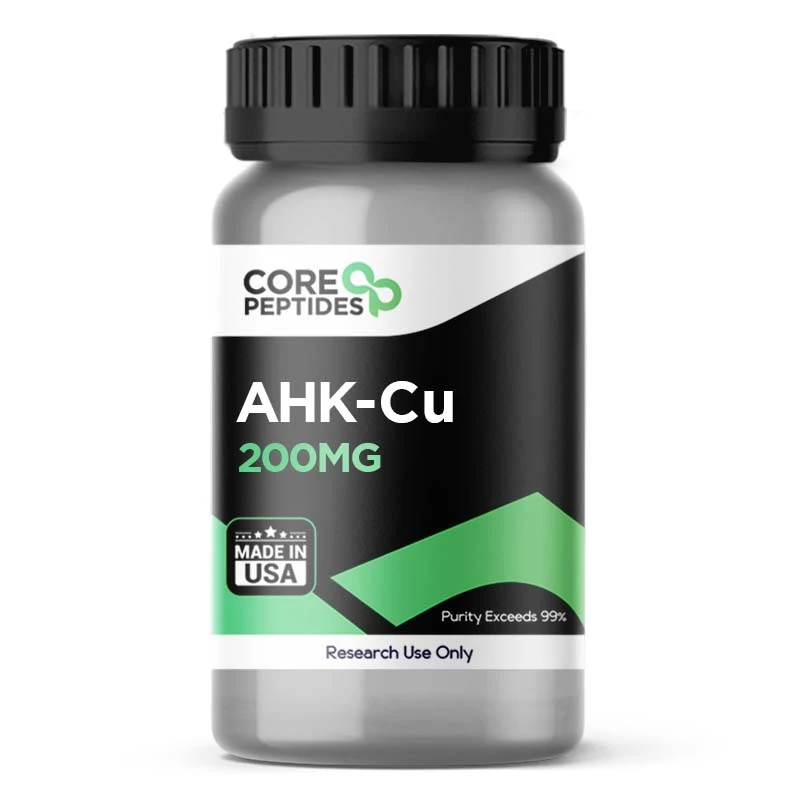

AHK-Cu (200mg) – Research-Grade Copper Tripeptide for Hair and Skin Research
AHK-Cu (200mg) is a synthetic copper-binding tripeptide investigated primarily in research involving hair follicles, dermal papilla cells, skin biology and cellular signalling. AHK-Cu is also known as L-alanyl-L-histidyl-L-lysine copper and consists of the tripeptide AHK associated with a copper ion.
Interest in AHK-Cu has grown particularly because laboratory and ex vivo research has investigated its effects on human hair follicles and dermal papilla cells. A 2007 study reported that AHK-Cu stimulated human hair-follicle elongation in an ex vivo model and increased proliferation of cultured dermal papilla cells. The researchers also investigated markers associated with apoptosis and cell survival.
AHK-Cu belongs to the wider family of copper-peptide complexes studied in cosmetic and biomedical research. Its biological properties make it relevant to investigations into follicular biology, extracellular signalling, fibroblast activity and skin-related processes. However, findings from laboratory or ex vivo experiments should not be interpreted as proof of a clinically established treatment for hair loss, skin ageing or other medical conditions.
The AHK-Cu (200mg) product is intended as a research material. It should be distinguished from finished cosmetic formulations containing copper peptides, as the characteristics, concentration, formulation and delivery system can substantially affect experimental outcomes.
What Is AHK-Cu?
AHK-Cu is a copper-containing tripeptide based on the amino-acid sequence alanine-histidine-lysine (AHK). The peptide coordinates with copper, forming a copper-peptide complex that has been investigated for biological activity in cellular and tissue models.
Research into AHK-Cu has focused particularly on dermal papilla cells, specialised cells located within hair follicles that play an important role in follicular development and hair growth. The 2007 study examining AHK-Cu reported effects on dermal papilla-cell proliferation and human hair-follicle elongation in experimental models.
The compound is therefore of interest to researchers investigating the molecular relationship between copper-containing peptides, follicular signalling and cellular behaviour.
AHK-Cu (200mg) Product Highlights
- Product: AHK-Cu
- Quantity: 200mg
- Compound type: Copper-binding tripeptide
- Full description: L-alanyl-L-histidyl-L-lysine copper
- Abbreviation: AHK-Cu
- Primary research area: Hair-follicle and dermal papilla-cell research
- Additional research areas: Skin biology, copper-peptide signalling and cellular research
- Format: Research-grade peptide material
- Intended purpose: Laboratory and research applications
AHK-Cu and Hair-Follicle Research
One of the most significant areas of AHK-Cu research concerns the biology of human hair follicles. Hair follicles undergo repeating phases of growth, regression and rest, with dermal papilla cells playing an important role in regulating follicular behaviour.
In an ex vivo human hair-follicle model, researchers found that AHK-Cu at experimental concentrations ranging from 10-12 to 10-9 M stimulated follicle elongation. The same study reported increased proliferation of cultured dermal papilla cells.
These findings provide a biological rationale for continued investigation into AHK-Cu and follicular signalling. Importantly, the concentrations used in a laboratory study should not be interpreted as recommended concentrations for human application.
AHK-Cu and Dermal Papilla Cells
Dermal papilla cells (DPCs) are specialised mesenchymal cells located at the base of hair follicles. They participate in signalling processes that influence follicular growth and cycling.
Researchers investigating AHK-Cu observed increased DPC proliferation following exposure to the copper tripeptide in vitro. The study also examined several molecular markers associated with cell survival and apoptosis.
These observations make AHK-Cu a useful research compound for studying the cellular mechanisms that regulate hair-follicle activity. They also provide a foundation for investigating how copper-containing peptides interact with follicular cells.
AHK-Cu and Apoptosis Research
Apoptosis is a regulated process of programmed cell death that plays an important role in normal tissue development and cellular turnover. Researchers investigating AHK-Cu have examined whether the compound can influence apoptotic processes in dermal papilla cells.
In the published hair-follicle study, treatment with AHK-Cu was associated with changes in several apoptosis-related markers. At the experimental concentration examined, the researchers reported an increased Bcl-2/Bax ratio and reductions in cleaved caspase-3 and PARP.
The study also noted that the reduction in apoptotic DPCs was not statistically significant. This distinction is important when interpreting the findings: the results suggest biological activity worth further investigation but do not establish a definitive anti-apoptotic effect in humans.
AHK-Cu and VEGF Research
Vascular endothelial growth factor, commonly known as VEGF, is a signalling protein involved in the formation and maintenance of blood vessels. The vascular environment surrounding a hair follicle is relevant to follicular biology because growing tissue requires adequate oxygen and nutrient delivery.
The published AHK-Cu study reported that copper tripeptide treatment stimulated dermal fibroblast proliferation and increased VEGF production.
This observation has contributed to interest in AHK-Cu as a research compound for studying interactions between dermal cells, vascular signalling and hair-follicle biology.
AHK-Cu and Fibroblast Research
Fibroblasts are connective-tissue cells responsible for producing and organising components of the extracellular matrix. They are important in skin structure, tissue remodelling and wound-related biological processes.
Copper-peptide research has examined how tripeptide-copper complexes can influence fibroblast behaviour and signalling. AHK-Cu research has specifically reported stimulation of dermal fibroblast proliferation alongside changes in VEGF and transforming growth factor-beta 1 (TGF-β1) secretion.
These findings make AHK-Cu relevant to experimental studies exploring relationships between copper availability, peptide signalling and connective-tissue biology.
AHK-Cu and Skin Research
Although AHK-Cu has attracted particular attention in hair-follicle research, copper-containing peptides are also studied in the broader field of skin biology. Researchers are interested in how copper coordination may affect cellular proliferation, extracellular-matrix signalling and tissue remodelling.
It is important to distinguish AHK-Cu from other copper peptides such as GHK-Cu. Although both are copper-containing tripeptide complexes, they have different amino-acid sequences and should not be treated as interchangeable research compounds.
AHK-Cu is based on the AHK sequence, whereas GHK-Cu is based on glycine-histidine-lysine. Research findings for one compound should therefore not automatically be attributed to the other.
AHK-Cu vs GHK-Cu
| Characteristic | AHK-Cu | GHK-Cu |
|---|---|---|
| Peptide sequence | Alanine-Histidine-Lysine | Glycine-Histidine-Lysine |
| Copper complex | Cu2+ | Cu2+ |
| Research emphasis | Hair-follicle and dermal papilla-cell research | Skin, extracellular matrix and broader tissue research |
| Hair research | Human hair follicles and dermal papilla cells investigated in vitro/ex vivo | Investigated in several broader skin and hair-related contexts |
| Identity | Distinct copper tripeptide | Distinct copper tripeptide |
Both compounds belong to the copper-peptide family, but their molecular identities and research histories are different. Researchers should use the exact compound specified in the experimental protocol rather than substituting one copper peptide for another.
How Does AHK-Cu Work in Research Models?
The biological activity of AHK-Cu is thought to involve both the peptide sequence and its ability to coordinate copper. Copper is an essential trace element involved in numerous enzymatic and cellular processes, while peptides can participate in molecular recognition and signalling.
In hair-follicle research, AHK-Cu has been investigated for its effects on dermal papilla-cell proliferation and survival-related signalling. The observed follicle elongation in ex vivo models suggests that the compound can influence processes relevant to follicular growth under controlled experimental conditions.
However, the precise molecular mechanisms responsible for every observed effect remain an area for further investigation. Research involving cell cultures and isolated follicles cannot fully reproduce the complex biology of an intact human scalp.
AHK-Cu Research and Hair Growth Mechanisms
Hair growth is controlled by interactions between epithelial cells, dermal papilla cells, immune mediators, hormones, vascular structures and extracellular-matrix components. AHK-Cu research has focused on a subset of these processes, particularly the behaviour of dermal papilla cells.
The 2007 study reported that AHK-Cu promoted the elongation of human hair follicles in an ex vivo model and stimulated DPC proliferation in vitro.
These findings indicate that AHK-Cu can influence follicular biology in controlled models. They do not, by themselves, establish that the compound can reverse a particular form of hair loss or produce comparable outcomes in humans.
AHK-Cu and Cellular Signalling
One reason copper peptides are of interest in laboratory research is their ability to interact with cellular environments involving metal ions, peptide ligands and signalling pathways.
AHK-Cu research has examined markers associated with cell proliferation, apoptosis and growth-factor signalling. The reported effects on VEGF, TGF-β1 and apoptosis-related proteins provide several potential pathways for future investigation.
Researchers can therefore use AHK-Cu as a defined molecular tool when investigating how copper-containing peptide complexes affect cultured cells or isolated tissue models.
Potential Research Applications for AHK-Cu
AHK-Cu may be relevant to controlled laboratory investigations involving:
- Hair-follicle biology: Research into the cellular mechanisms governing follicular growth.
- Dermal papilla cells: Investigation of DPC proliferation, survival and signalling.
- Hair-growth models: Ex vivo and in vitro investigation of follicular elongation.
- Fibroblast research: Study of dermal fibroblast proliferation and growth-factor signalling.
- VEGF research: Investigation of vascular endothelial growth-factor expression.
- Apoptosis research: Examination of cell-survival and programmed-cell-death markers.
- Copper-peptide research: Study of interactions between peptide ligands and copper ions.
- Skin biology: Investigation of cellular processes associated with dermal tissue.
- Extracellular-matrix research: Exploration of fibroblast-related tissue signalling.
- Comparative peptide studies: Comparison of AHK-Cu with other copper-containing peptide complexes.
AHK-Cu (200mg) Research Specifications
| Specification | Details |
|---|---|
| Product name | AHK-Cu |
| Quantity | 200mg |
| Compound class | Copper-binding tripeptide |
| Peptide identity | L-alanyl-L-histidyl-L-lysine copper |
| Abbreviation | AHK-Cu |
| Primary research area | Hair-follicle and dermal papilla-cell biology |
| Research format | Research-grade material |
| Primary experimental models | In vitro and ex vivo systems |
Why Research AHK-Cu?
AHK-Cu offers researchers a defined copper-tripeptide system for investigating the relationship between short peptide sequences, metal-ion coordination and cellular behaviour.
Its particular relevance to hair research comes from experimental evidence showing activity in human hair follicles and cultured dermal papilla cells. The published study provides a useful model for investigating follicular elongation, DPC proliferation and apoptosis-related pathways.
For laboratories working in cosmetic science, dermatological research or follicular biology, AHK-Cu can therefore provide a focused compound for controlled experimental investigation.
AHK-Cu Research Evidence
A key publication on AHK-Cu examined its effects on human hair follicles ex vivo and cultured dermal papilla cells. Researchers reported stimulation of follicular elongation and DPC proliferation at the concentrations tested. The study also examined Bcl-2/Bax ratios and cleaved caspase-3 and PARP as indicators associated with cell-survival and apoptotic processes.
More broadly, contemporary copper-tripeptide research continues to examine the potential role of copper complexes in tissue repair and cellular migration. A 2026 study of several copper(II)-tripeptide complexes reported promising wound-healing activity for two compounds in a fibroblast scratch assay, illustrating continuing interest in copper-peptide chemistry within regenerative research. However, those compounds were not AHK-Cu and the findings should not be attributed directly to AHK-Cu.
This distinction is important because copper-tripeptide research encompasses many structurally different compounds. The exact peptide sequence and copper complex should always be confirmed before comparing experimental results.
AHK-Cu and Copper-Peptide Research
Copper-peptide complexes represent a broader area of biochemical and cosmetic research. Copper can coordinate with peptide ligands and influence the chemical properties of the resulting complex, while the peptide portion can contribute to molecular recognition and biological interactions.
AHK-Cu is particularly interesting because its AHK sequence has been investigated in relation to hair-follicle biology. The combination of peptide structure and copper coordination provides a useful model for studying how small metal-binding peptides interact with biological systems.
For researchers comparing copper peptides, it is therefore important to consider peptide sequence, copper stoichiometry, purity, formulation, experimental concentration and model system rather than treating all copper peptides as equivalent.
Frequently Asked Questions About AHK-Cu (200mg)
What is AHK-Cu?
AHK-Cu is a copper-containing tripeptide based on alanine, histidine and lysine. It has been investigated in laboratory and ex vivo research involving hair follicles, dermal papilla cells and cellular signalling.
What does AHK-Cu stand for?
AHK refers to the three amino acids alanine, histidine and lysine, while Cu refers to the copper ion associated with the peptide.
What is AHK-Cu studied for?
AHK-Cu has been studied particularly in relation to hair-follicle biology. Research has examined human hair-follicle elongation, dermal papilla-cell proliferation and apoptosis-related markers.
Does AHK-Cu stimulate hair follicles?
In a published ex vivo study, AHK-Cu stimulated the elongation of human hair follicles at the experimental concentrations tested. It also increased the proliferation of cultured dermal papilla cells. These are laboratory findings and should not be interpreted as proof of a clinical hair-loss treatment.
Is AHK-Cu the same as GHK-Cu?
No. AHK-Cu and GHK-Cu are different copper-tripeptide complexes. AHK-Cu contains the alanine-histidine-lysine sequence, whereas GHK-Cu contains glycine-histidine-lysine.
What does the 200mg designation mean?
The 200mg designation refers to the quantity of AHK-Cu contained in the research product. It is a product specification rather than a recommended amount for human use.
Has AHK-Cu been studied in human hair follicles?
Yes. A published study investigated AHK-Cu using human hair follicles in an ex vivo model and cultured human dermal papilla cells in vitro. The researchers reported follicular elongation and increased DPC proliferation under the experimental conditions used.
Is AHK-Cu an approved treatment for hair loss?
No. Laboratory and ex vivo research into AHK-Cu does not establish it as an approved treatment for hair loss or another medical condition.
Can findings from GHK-Cu research be applied to AHK-Cu?
Not automatically. Although both are copper-containing tripeptides, their amino-acid sequences are different. Researchers should evaluate evidence for the specific compound being investigated.
What cells have been studied with AHK-Cu?
Research has examined cultured dermal papilla cells and dermal fibroblasts, as well as human hair follicles in ex vivo models.
What is VEGF and why is it relevant to AHK-Cu research?
VEGF is a signalling protein involved in blood-vessel formation and vascular biology. Research involving copper tripeptides has examined VEGF production in dermal fibroblasts, providing a possible connection between copper-peptide activity and vascular signalling.
Important Research-Use Disclaimer
AHK-Cu (200mg) is intended for research and laboratory applications only. It should not be presented as an approved medicine, dietary supplement or established treatment for hair loss, skin ageing, wound healing or any other medical condition.
The scientific evidence discussed on this page includes in vitro and ex vivo research. Results observed in cultured cells or isolated human hair follicles cannot automatically be translated into clinical outcomes in humans.
Researchers should consult the applicable product documentation, certificate of analysis, institutional laboratory procedures and relevant regulations before conducting experiments involving AHK-Cu.
AHK-Cu (200mg) – Research Summary
AHK-Cu (200mg) is a copper-containing tripeptide of interest in hair-follicle, dermal papilla-cell and cosmetic-science research. Its molecular structure consists of an alanine-histidine-lysine tripeptide associated with copper, providing a defined system for studying copper-peptide interactions in biological models.
The strongest specific research interest in AHK-Cu centres on hair biology. Published work has reported stimulation of human hair-follicle elongation ex vivo and increased proliferation of cultured dermal papilla cells, alongside investigation of VEGF and apoptosis-related markers.
AHK-Cu should nevertheless be distinguished from other copper peptides, particularly GHK-Cu, because differences in amino-acid sequence can result in different biological properties. Current evidence should also be interpreted according to the experimental model used rather than extrapolated into unsupported therapeutic claims.
For qualified laboratories investigating copper-peptide chemistry, follicular biology, dermal papilla cells or related cellular pathways, AHK-Cu (200mg) provides a focused research compound for controlled experimental studies.
Be the first to review “AHK-Cu (200mg)”
Related products
Peptides for Sale
Peptides for Sale
Peptides for Sale
Peptides for Sale
Peptides for Sale
Peptides for Sale
Peptides for Sale
Peptides for Sale
Reviews
There are no reviews yet.