
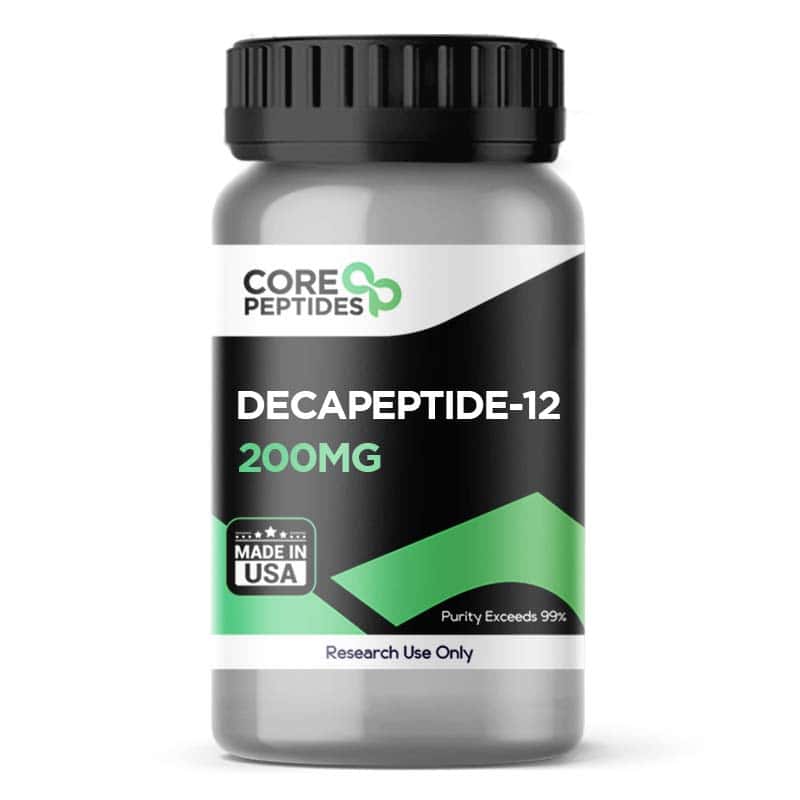

Decapeptide-12 (200mg) – Topical Research Peptide
Decapeptide-12 (200mg) is a synthetic ten-amino-acid peptide studied primarily in relation to melanogenesis, tyrosinase activity, skin pigmentation and cosmetic peptide research. The peptide is also known as Tyr-Arg-Ser-Arg-Lys-Tyr-Ser-Ser-Trp-Tyr and has attracted scientific interest because of its proposed ability to interact with tyrosinase, an important enzyme involved in melanin biosynthesis.
The referenced product is supplied as a 200mg topical research peptide. Decapeptide-12 is particularly relevant to laboratory investigations involving melanocyte biology, melanin synthesis, pigmentation pathways and the development of peptide-based topical formulations.
Research has investigated Decapeptide-12 in cellular models and topical formulations, including studies examining pigmentation and photodamage. However, available evidence should be interpreted carefully because experimental results do not automatically establish clinical efficacy for every formulation or application.
What Is Decapeptide-12?
Decapeptide-12 is a synthetic peptide consisting of ten amino acids. Its sequence is commonly reported as:
Tyr-Arg-Ser-Arg-Lys-Tyr-Ser-Ser-Trp-Tyr
The compound is sometimes described in scientific literature as an oligopeptide investigated for its effects on tyrosinase and melanogenesis. Tyrosinase is a key enzyme in the biochemical pathway responsible for converting tyrosine into intermediates that ultimately contribute to melanin formation.
Because of this relationship with melanogenesis, Decapeptide-12 has become an area of interest in cosmetic science and experimental dermatological research, particularly in the investigation of hyperpigmentation and skin-brightening formulations.
Decapeptide-12 (200mg) Product Highlights
- Product name: Decapeptide-12
- Quantity: 200mg
- Peptide type: Synthetic decapeptide
- Sequence: Tyr-Arg-Ser-Arg-Lys-Tyr-Ser-Ser-Trp-Tyr
- Primary research area: Melanogenesis and pigmentation biology
- Research focus: Tyrosinase activity and melanin synthesis
- Format: Topical research peptide
- Application area: Skin and cosmetic peptide research
- Intended use: Laboratory and research purposes
The product specification and 200mg quantity correspond to the referenced Core Peptides listing.
Decapeptide-12 Peptide Sequence
| Property | Details |
|---|---|
| Peptide | Decapeptide-12 |
| Peptide length | 10 amino acids |
| Sequence | Tyr-Arg-Ser-Arg-Lys-Tyr-Ser-Ser-Trp-Tyr |
| Classification | Synthetic decapeptide |
| Research pathway | Melanogenesis |
| Key enzyme of interest | Tyrosinase |
| Product quantity | 200mg |
| Research format | Topical |
How Decapeptide-12 Is Studied in Melanogenesis Research
Melanogenesis is the biological process through which melanocytes produce melanin. Melanin is synthesised within specialised organelles known as melanosomes and is subsequently transferred to surrounding keratinocytes.
Tyrosinase plays a central role near the beginning of this pathway. It catalyses the conversion of L-tyrosine into L-DOPA and subsequently participates in the formation of dopaquinone. Further reactions ultimately contribute to the production of different forms of melanin.
Decapeptide-12 has been investigated because experimental findings suggest that it can inhibit tyrosinase activity. This makes the peptide relevant to research examining ways of modulating melanin production at an early stage of the melanogenesis pathway.
Decapeptide-12 and Tyrosinase
Tyrosinase inhibition is one of the most important research characteristics associated with Decapeptide-12.
Research discussed by Core Peptides reports that Decapeptide-12 inhibited tyrosinase activity in melanocyte lysates, with approximately 35% inhibition reported under conditions favouring the enzyme’s monophenolase reaction. The same research suggested that the peptide may interact preferentially with the tyrosine-hydroxylase activity of tyrosinase.
The scientific literature has also identified Decapeptide-12 as an oligopeptide capable of competitively inhibiting tyrosinase without the melanocyte cytotoxicity associated with some conventional approaches to pigmentation research.
These findings make Decapeptide-12 useful as an experimental compound for studying enzyme inhibition and melanogenesis.
Decapeptide-12 and Melanin Synthesis
Because tyrosinase participates in the initial stages of melanin production, inhibiting its activity can affect downstream melanogenesis.
Experimental work cited by the supplier reported that Decapeptide-12 reduced intracellular melanin content by more than 40% following seven days of testing in cultured melanocytes. Such findings provide a mechanistic basis for continued investigation of the peptide in pigmentation research.
It is important to distinguish experimental reduction in melanin production from a proven clinical treatment effect. Cellular findings do not necessarily predict the results of a particular topical formulation when applied to human skin.
Decapeptide-12 and Skin Pigmentation Research
Decapeptide-12 has been investigated as a potential ingredient for research into conditions involving excessive or uneven pigmentation.
Research areas associated with the peptide include:
- Melanin biosynthesis
- Tyrosinase inhibition
- Melanocyte biology
- Post-inflammatory hyperpigmentation
- Melasma research
- Solar lentigines
- Photodamage-related pigmentation
- Topical peptide formulation
- Cosmetic skin-brightening research
These areas reflect the scientific and cosmetic interest surrounding Decapeptide-12 rather than establishing the peptide as an approved treatment for pigmentation disorders.
Decapeptide-12 and Post-Inflammatory Hyperpigmentation
Post-inflammatory hyperpigmentation (PIH) occurs when inflammatory skin processes stimulate increased or uneven melanin production.
The referenced Core Peptides research summary describes a clinical case study involving pigmented skin in which Decapeptide-12 was investigated for its potential to accelerate the clearance of post-inflammatory hyperpigmentation compared with placebo. The proposed explanation relates to the peptide’s tyrosinase-inhibiting activity.
Because individual studies can differ substantially in formulation, population, study design and treatment conditions, these findings should be considered within their original research context.
Decapeptide-12 and Solar Lentigines Research
Solar lentigines, sometimes referred to as age spots or sun spots, are areas of increased pigmentation associated with chronic ultraviolet exposure and photodamage.
One study examining a topical system containing Decapeptide-12 reported improvements in solar lentigines over a 24-week observation period. The study reported complete clearance in a proportion of evaluated subjects, while other participants showed varying degrees of improvement.
These results have contributed to scientific interest in Decapeptide-12 as a topical pigmentation research ingredient. Nevertheless, study-specific results should not be interpreted as a guarantee of the same outcome from an isolated 200mg research material.
Decapeptide-12 in Topical Peptide Research
Topical peptide research investigates whether peptide molecules can be incorporated into formulations designed to interact with the skin surface and underlying biological structures.
Decapeptide-12 is particularly interesting for this field because its primary research target, melanogenesis, occurs within melanocytes located in the skin.
Researchers may therefore investigate Decapeptide-12 in controlled formulations to evaluate:
- Peptide stability
- Skin compatibility
- Formulation characteristics
- Tyrosinase activity
- Melanin production
- Melanocyte responses
- Changes in pigmentation measurements
The behaviour of a peptide in a finished topical formulation can differ from that of the isolated peptide, making formulation-specific research particularly important.
Decapeptide-12 and Cosmetic Science
Decapeptide-12 has received attention within cosmetic peptide research because of its relationship with melanin production.
A review published in Experimental Dermatology identified Decapeptide-12 as a synthetic fragment associated with basic fibroblast growth factor research and discussed its competitive inhibition of tyrosinase. The review also described early topical research involving pigmentation.
This research history helps explain why Decapeptide-12 has become associated with skin-brightening and pigmentation-focused cosmetic formulations.
Research into Melanocyte Biology
Melanocytes are specialised cells located primarily in the basal layer of the epidermis. Their principal biological role is the production of melanin.
Melanin is packaged into melanosomes and transferred to neighbouring keratinocytes, where it contributes to skin pigmentation and provides some protection against ultraviolet radiation.
Decapeptide-12 research focuses on the biochemical pathway governing melanin synthesis rather than simply altering the appearance of the skin. By studying the interaction between the peptide and tyrosinase, researchers can investigate the regulation of melanocyte activity at a molecular level.
Research Mechanism of Decapeptide-12
The proposed mechanism of Decapeptide-12 centres on competitive inhibition of tyrosinase.
In simplified terms:
- Melanocytes synthesise melanin within melanosomes.
- Tyrosinase participates in the conversion of L-tyrosine into L-DOPA and subsequent intermediates.
- These reactions contribute to the downstream formation of melanin.
- Decapeptide-12 has been investigated for its ability to interfere with tyrosinase activity.
- Reduced tyrosinase activity may result in reduced melanin synthesis in experimental systems.
This proposed mechanism is supported by biochemical and cellular research, although the exact behaviour of the peptide can vary according to experimental conditions and formulation.
Research Evidence for Decapeptide-12
The scientific evidence surrounding Decapeptide-12 includes biochemical studies, cellular experiments, topical formulation research and clinical investigations.
| Research area | Scientific interest |
|---|---|
| Tyrosinase | Investigation of enzyme inhibition |
| Melanocytes | Study of cellular melanin production |
| Melanin | Investigation of pigment biosynthesis |
| Hyperpigmentation | Research into excessive or uneven pigmentation |
| Solar lentigines | Study of pigmentation associated with photodamage |
| Topical formulations | Investigation of peptide delivery and skin response |
PubMed-indexed clinical research has reported results from a 24-week open-label evaluation of a skin-brightening system containing Decapeptide-12, while earlier scientific reviews have discussed the peptide’s tyrosinase-inhibitory properties.
Decapeptide-12 and Skin-Ageing Research
In addition to pigmentation research, Decapeptide-12 has been discussed in relation to cellular ageing and skin appearance.
The supplier’s research material discusses investigations into sirtuins, a family of proteins involved in multiple cellular processes. This provides an additional research direction for studying the potential relationship between short peptides, cellular regulation and skin ageing.
However, research into cellular ageing mechanisms should be distinguished from claims that Decapeptide-12 reverses or prevents human ageing.
Decapeptide-12 (200mg) Research Specifications
| Specification | Details |
|---|---|
| Product | Decapeptide-12 |
| Quantity | 200mg |
| Type | Synthetic decapeptide |
| Sequence | Tyr-Arg-Ser-Arg-Lys-Tyr-Ser-Ser-Trp-Tyr |
| Length | 10 amino acids |
| Primary research target | Tyrosinase |
| Research pathway | Melanogenesis |
| Research field | Skin and cosmetic peptide research |
| Format | Topical research material |
Why Study Decapeptide-12?
Decapeptide-12 provides researchers with a defined synthetic peptide for investigating a specific biochemical pathway involved in skin pigmentation.
Its research value includes the ability to examine:
- Enzyme–peptide interactions
- Competitive inhibition of tyrosinase
- Melanocyte metabolism
- Melanin biosynthesis
- Topical peptide formulation
- Skin pigmentation pathways
- Photodamage-associated pigmentation
- Peptide-based cosmetic technologies
Its defined ten-amino-acid sequence also makes it suitable for controlled analytical and biochemical studies where reproducible peptide identity is important.
Frequently Asked Questions About Decapeptide-12 (200mg)
What is Decapeptide-12?
Decapeptide-12 is a synthetic peptide containing ten amino acids. It is primarily researched for its relationship with tyrosinase, melanogenesis and melanin production.
What is the sequence of Decapeptide-12?
The commonly reported sequence is Tyr-Arg-Ser-Arg-Lys-Tyr-Ser-Ser-Trp-Tyr.
What does the 200mg specification mean?
The 200mg specification refers to the quantity of Decapeptide-12 research material supplied. It should not be interpreted as a recommended dose or human-use instruction.
What is Decapeptide-12 researched for?
Research focuses primarily on tyrosinase activity, melanogenesis, melanin synthesis, melanocyte biology, pigmentation and topical peptide formulations.
How does Decapeptide-12 relate to tyrosinase?
Experimental research suggests that Decapeptide-12 can inhibit tyrosinase activity. Tyrosinase is an important enzyme involved in the early stages of melanin biosynthesis.
Has Decapeptide-12 been studied in human subjects?
Yes. A PubMed-indexed open-label evaluation investigated a skin-brightening system containing Decapeptide-12 over 24 weeks and reported improvements in photodamage-associated pigmentation.
Is Decapeptide-12 the same as other pigmentation peptides?
No. Decapeptide-12 is a specific ten-amino-acid sequence and should not be confused with other peptides that have different sequences, structures or mechanisms of action.
Is Decapeptide-12 a medicine?
The referenced product is presented as a research material rather than an approved medicinal product. Research findings should not be interpreted as evidence that the isolated peptide is an approved treatment for hyperpigmentation or another medical condition.
Is Decapeptide-12 intended for human consumption?
No. The product should be treated as a research material intended for appropriate laboratory or research applications, not as an ingestible product or self-administered medicine.
Can research on a Decapeptide-12 formulation be applied to the isolated 200mg peptide?
Not necessarily. Results depend on factors including formulation, concentration, delivery system, study population and experimental conditions. Findings from a finished cosmetic formulation should not automatically be attributed to the isolated research material.
Decapeptide-12 (200mg) Research Summary
Decapeptide-12 (200mg) is a synthetic ten-amino-acid peptide with a research profile centred on tyrosinase, melanogenesis and skin pigmentation. Its sequence is commonly identified as Tyr-Arg-Ser-Arg-Lys-Tyr-Ser-Ser-Trp-Tyr.
Biochemical and cellular research has investigated Decapeptide-12 for its ability to inhibit tyrosinase activity and reduce melanin production in experimental models. Additional research has explored its use in topical skin-brightening systems and pigmentation-related applications.
Clinical and formulation research provides useful evidence for continued investigation, but the results should be interpreted in the context of the specific formulations and study designs used. The scientific evidence does not establish that every Decapeptide-12 preparation will produce identical results.
For researchers working in cosmetic science, melanocyte biology, pigmentation research, tyrosinase inhibition and topical peptide development, Decapeptide-12 offers a defined peptide model for studying the molecular regulation of melanin synthesis.
Research-Use Disclaimer
Decapeptide-12 (200mg) is intended for laboratory, analytical and research purposes only. It is not a medicine, dietary supplement, food product or approved treatment.
The information provided in this description is intended for scientific and educational purposes. Research findings involving Decapeptide-12 should not be interpreted as evidence that the isolated research material can diagnose, treat, cure or prevent any disease or medical condition.
Results obtained from specific topical formulations, cellular models or clinical studies should not automatically be attributed to every Decapeptide-12 preparation. Researchers should consult relevant scientific literature, product documentation, analytical records and applicable laws and regulations when working with experimental peptide materials.
This description does not provide instructions for human administration, dosing, injection, reconstitution for human use or self-experimentation.
Be the first to review “Decapeptide-12 (200mg)”
Related products
Peptides for Sale
Peptides for Sale
Peptides for Sale
Peptides for Sale
Peptides for Sale
Peptides for Sale
Peptides for Sale
Peptides for Sale
Reviews
There are no reviews yet.