
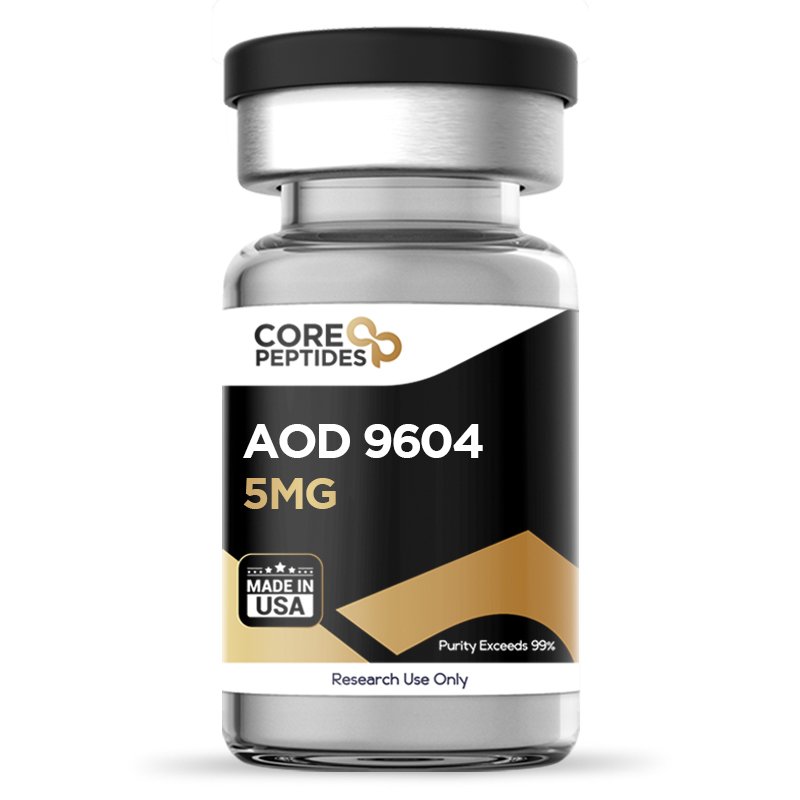
AOD 9604 (5mg) Peptide – Research-Grade Lipolytic Peptide
AOD 9604 (5mg) is a synthetic peptide fragment derived from the C-terminal region of human growth hormone (hGH) and is widely investigated in research involving lipolysis, lipid metabolism, adipose tissue and metabolic regulation. AOD 9604 is commonly described as a modified form of the growth-hormone fragment 176–191, with a tyrosine residue incorporated at the N-terminus.
The compound was originally developed as a research candidate for investigating the potential anti-obesity and fat-metabolism properties associated with a specific region of human growth hormone. Unlike full-length growth hormone, AOD 9604 was designed to investigate the metabolic activity of the hormone’s lipolytic region without reproducing the complete biological profile of the intact hormone.
Preclinical studies have investigated AOD 9604 in relation to fat breakdown, fatty-acid utilisation, adipose-tissue metabolism and changes in body weight. Research in obese animal models has reported increased lipolytic activity and reductions in body-weight gain following experimental treatment.
The 5mg format is intended as a research quantity for appropriately equipped laboratories. AOD 9604 should not be presented as an approved weight-loss medicine or as a clinically established treatment for obesity.
What Is AOD 9604?
AOD 9604 is a synthetic peptide based on the lipolytic region of human growth hormone. It is commonly associated with the C-terminal portion of hGH, particularly the region corresponding to amino acids 176–191, with structural modification at the N-terminus.
The name AOD refers to Anti-Obesity Drug, reflecting the original research objective behind the compound’s development. Research programmes investigated whether a selected region of growth hormone could influence fat metabolism without reproducing all of the actions associated with full-length growth hormone.
AOD 9604 has consequently become a frequently discussed research peptide in studies involving adipose biology and lipid metabolism.
AOD 9604 (5mg) Product Highlights
- Product: AOD 9604
- Quantity: 5mg
- Compound type: Synthetic peptide fragment
- Source region: C-terminal/lipolytic region of human growth hormone
- Commonly referenced sequence: hGH fragment 176–191 with N-terminal modification
- Primary research area: Lipid and adipose-tissue metabolism
- Additional research areas: Lipolysis, fatty-acid metabolism and metabolic regulation
- Research format: Lyophilised research material
- Intended application: Laboratory and research use
AOD 9604 and Lipolysis Research
Lipolysis is the biological process through which stored triglycerides in adipose tissue are broken down into fatty acids and glycerol. These products can subsequently participate in energy metabolism.
AOD 9604 has attracted research interest because studies have investigated whether the peptide can influence lipolytic processes in adipose tissue. In an experimental study involving obese Zucker rats, daily treatment with AOD 9604 increased lipolytic activity in adipose tissue and substantially reduced body-weight gain compared with controls.
Research in obese mice has similarly reported effects on body weight, body fat and lipolytic sensitivity following chronic administration of AOD 9604.
These observations provide a basis for continued laboratory investigation into the relationship between AOD 9604 and lipid metabolism. They should not, however, be interpreted as evidence of guaranteed fat loss in humans.
AOD 9604 and Adipose-Tissue Research
Adipose tissue is an important metabolic organ involved in energy storage, fatty-acid release and endocrine signalling. Understanding how adipocytes regulate the storage and mobilisation of triglycerides is an important area of metabolic research.
AOD 9604 has been investigated in animal models to determine whether it can influence adipose-tissue metabolism. Research has reported increased lipolytic activity following experimental exposure and changes in the expression of pathways associated with fat mobilisation.
These studies make AOD 9604 relevant to researchers examining how peptide fragments derived from growth hormone can influence adipocyte behaviour and lipid utilisation.
AOD 9604 and Fat Metabolism
Fat metabolism involves a complex network of processes controlling triglyceride storage, fatty-acid release, transport and oxidation. AOD 9604 has been investigated primarily in relation to the mobilisation and utilisation of stored lipids.
Experimental research has suggested that AOD 9604 can increase lipolytic sensitivity in certain animal models. In one study, the compound increased the expression of beta-3 adrenergic receptor RNA in obese mice while also producing effects on body weight and lipolysis.
Interestingly, the same research indicated that the lipolytic action of AOD 9604 was not directly mediated by beta-3 adrenergic receptors, demonstrating that the underlying mechanism is more complex than a simple receptor-activation model.
AOD 9604 and Growth Hormone Research
AOD 9604 was developed from a specific region of human growth hormone rather than from the complete 191-amino-acid hormone. This distinction is important when interpreting research involving the peptide.
Full-length human growth hormone has numerous biological effects, including effects on growth, metabolism and insulin-related pathways. AOD 9604 was investigated specifically because researchers wanted to examine the lipolytic activity associated with a smaller region of the hormone.
The original research therefore focused on whether the selected fragment could influence fat metabolism without reproducing the complete physiological actions of intact growth hormone.
AOD 9604 vs Human Growth Hormone
| Characteristic | AOD 9604 | Human Growth Hormone |
|---|---|---|
| Structure | Short synthetic peptide fragment | Full-length 191-amino-acid hormone |
| Research focus | Lipid metabolism and lipolysis | Growth, metabolism and multiple physiological pathways |
| Origin | Based on a C-terminal region of hGH | Complete human growth hormone |
| Research objective | Investigate selected metabolic activity | Study the broad biological actions of GH |
| Compound category | Synthetic research peptide | Peptide hormone |
AOD 9604 should therefore not be regarded as interchangeable with human growth hormone. Its smaller structure and different research profile are central to why it has been investigated separately.
AOD 9604 and Fatty-Acid Oxidation
Fatty-acid oxidation is the process through which fatty acids are metabolised to generate energy. It is an important component of energy balance and becomes particularly relevant when stored fat is mobilised.
Experimental work has examined whether AOD 9604 can influence fatty-acid utilisation. In an acute experiment using beta-3 adrenergic receptor knockout mice, AOD 9604 was reported to increase energy expenditure and fat oxidation, despite the absence of the beta-3 adrenergic receptor.
This finding is particularly relevant to mechanistic research because it suggests that the metabolic effects of AOD 9604 cannot be explained solely by beta-3 adrenergic receptor activity.
AOD 9604 and Obesity Research
The original development of AOD 9604 was closely associated with research into obesity and excess adipose tissue. Researchers investigated whether the lipolytic region of growth hormone could provide a more targeted approach for studying fat metabolism.
Preclinical studies produced promising observations. In obese Zucker rats, oral AOD 9604 administration reduced body-weight gain by more than 50% compared with controls over the experimental period and was associated with increased adipose-tissue lipolytic activity.
Another study found that chronic AOD 9604 treatment reduced body weight and body fat in obese mice and increased lipolytic sensitivity.
These results explain the continued scientific interest in AOD 9604. However, preclinical findings do not establish the peptide as an approved obesity treatment.
AOD 9604 and Animal Research
A significant proportion of the foundational AOD 9604 literature comes from animal research.
Studies have investigated AOD 9604 in models including obese Zucker rats, obese mice and beta-3 adrenergic receptor knockout mice. These models have been used to examine changes in body weight, body fat, lipolytic activity, energy expenditure and receptor expression.
Animal models are useful for understanding mechanisms and generating hypotheses, but differences between experimental animals and humans mean that findings should not automatically be extrapolated to clinical outcomes.
AOD 9604 and Beta-3 Adrenergic Receptors
Beta-3 adrenergic receptors are receptors associated with adipose-tissue metabolism and thermogenic processes. Because these receptors can influence lipolysis, researchers have investigated whether they contribute to the effects observed with AOD 9604.
Research in obese mice demonstrated increased beta-3 adrenergic receptor RNA expression following chronic AOD 9604 treatment. However, experiments in beta-3 adrenergic receptor knockout mice showed that the peptide could still produce certain acute metabolic effects.
The results suggest that beta-3 adrenergic signalling may contribute to some long-term responses but is not the sole mechanism responsible for AOD 9604-associated lipolytic activity.
AOD 9604 and Metabolic Research
AOD 9604 provides researchers with an experimental model for examining how a defined growth-hormone-derived peptide fragment interacts with lipid metabolism.
Potential areas of investigation include:
- Adipocyte lipid mobilisation
- Triglyceride breakdown
- Fatty-acid utilisation
- Energy expenditure
- Adipose-tissue signalling
- Beta-adrenergic pathways
- Metabolic adaptation
- Interactions between growth-hormone-derived peptides and lipid metabolism
AOD 9604 Research Applications
AOD 9604 may be relevant to controlled laboratory investigations involving:
- Lipolysis research: Investigation of pathways involved in triglyceride breakdown.
- Adipose biology: Study of how adipose tissue responds to experimental peptide exposure.
- Lipid metabolism: Research into fatty-acid mobilisation and utilisation.
- Obesity models: Investigation of metabolic changes in experimental models of obesity.
- Energy expenditure: Examination of changes in energy utilisation in experimental systems.
- Fatty-acid oxidation: Study of pathways involved in lipid-derived energy production.
- Growth-hormone research: Investigation of the metabolic activity associated with specific GH-derived peptide regions.
- Adrenergic signalling: Research into interactions between AOD 9604 and beta-adrenergic pathways.
- Metabolic physiology: Examination of peptide-mediated changes in energy balance.
- Comparative peptide research: Comparison of AOD 9604 with other metabolic research compounds.
AOD 9604 (5mg) Research Specifications
| Specification | Details |
|---|---|
| Product name | AOD 9604 |
| Quantity | 5mg |
| Compound type | Synthetic peptide fragment |
| Structural basis | Modified C-terminal region of human growth hormone |
| Commonly referenced region | Growth hormone fragment 176–191 |
| Primary research focus | Lipolysis and lipid metabolism |
| Additional research areas | Adipose tissue, fatty-acid oxidation and energy metabolism |
| Product format | Lyophilised powder |
| Research application | Laboratory research |
Why Research AOD 9604?
AOD 9604 is of particular interest because it allows researchers to investigate a defined region of human growth hormone rather than the complete hormone.
The peptide’s research history includes animal studies demonstrating changes in lipolysis, body-fat accumulation and energy expenditure. These findings have made AOD 9604 a useful experimental compound for studying the relationship between peptide structure and metabolic activity.
Its value for research lies primarily in its ability to help investigate specific biological pathways rather than in any established therapeutic application.
AOD 9604 Human Research
AOD 9604 was investigated as a potential anti-obesity compound, and human development programmes progressed to clinical trials. A 2004 review reported that Phase IIa studies were underway as part of efforts to evaluate the compound for potential obesity treatment.
However, the existence of clinical research should not be confused with regulatory approval or established clinical efficacy. AOD 9604 remains primarily of interest as an experimental research compound.
When assessing AOD 9604, it is therefore important to distinguish between preclinical evidence, clinical investigation and regulatory approval. These represent different levels of scientific and medical evidence.
AOD 9604 and Selective Metabolic Research
One of the original scientific motivations for developing AOD 9604 was to investigate whether the lipolytic activity associated with a particular region of growth hormone could be separated from some of the broader actions of the complete hormone.
This makes AOD 9604 useful for researchers studying structure-function relationships in peptide hormones.
Rather than treating the compound as equivalent to growth hormone, researchers can examine the biological activity associated with a specific peptide sequence and compare the resulting observations with those produced by full-length hGH.
Frequently Asked Questions About AOD 9604 (5mg)
What is AOD 9604?
AOD 9604 is a synthetic peptide fragment derived from the C-terminal region of human growth hormone and investigated primarily for its effects on lipid metabolism and lipolysis.
What does AOD 9604 stand for?
AOD refers to the original development designation associated with an anti-obesity drug programme. AOD 9604 is the name assigned to this particular synthetic growth-hormone-derived peptide.
Is AOD 9604 derived from human growth hormone?
Yes. AOD 9604 is based on a lipolytic region of human growth hormone, commonly described in relation to the 176–191 fragment, with an N-terminal modification.
What is AOD 9604 studied for?
AOD 9604 is primarily studied in relation to lipolysis, adipose-tissue biology, lipid metabolism, fatty-acid oxidation and metabolic regulation.
Does AOD 9604 have research involving animals?
Yes. Studies in obese Zucker rats and obese mice have investigated its effects on lipolytic activity, body weight, body fat and energy metabolism.
Has AOD 9604 been studied in humans?
Yes. AOD 9604 was investigated in clinical development programmes for potential obesity treatment. However, clinical investigation does not mean that the compound is an approved treatment.
Is AOD 9604 the same as human growth hormone?
No. AOD 9604 is a short synthetic peptide fragment based on a specific region of human growth hormone, whereas hGH is the complete 191-amino-acid hormone.
What is lipolysis?
Lipolysis is the process through which stored triglycerides are broken down into glycerol and fatty acids. These molecules can subsequently participate in energy metabolism.
What does the 5mg designation mean?
The 5mg designation refers to the quantity of AOD 9604 in the research product. It is a product specification and should not be interpreted as a recommended human dose.
Is AOD 9604 an approved weight-loss medicine?
No. AOD 9604 should not be marketed or represented as an approved weight-loss medicine. Research findings, particularly those from animal models, should not be interpreted as proof of clinical efficacy.
Why is AOD 9604 interesting to metabolic researchers?
AOD 9604 provides a defined growth-hormone-derived peptide fragment for investigating lipolysis, adipose-tissue metabolism, fatty-acid oxidation and related metabolic signalling pathways.
Can animal findings with AOD 9604 be directly applied to humans?
No. Animal studies can provide important mechanistic information, but physiological differences mean that findings require appropriate human research before clinical conclusions can be drawn.
Research-Use Disclaimer
AOD 9604 (5mg) is intended for laboratory and research applications only. It should not be presented as a medicine, dietary supplement, weight-loss product or approved treatment for obesity or any other medical condition.
The scientific literature includes preclinical and clinical-development research, but evidence from experimental models should be interpreted according to the specific study design, species, administration method and endpoints evaluated.
Researchers should consult applicable product documentation, analytical data, institutional laboratory procedures and relevant regulations before conducting experiments involving AOD 9604.
AOD 9604 (5mg) – Research Summary
AOD 9604 (5mg) is a synthetic peptide fragment derived from the lipolytic region of human growth hormone and developed for research into fat metabolism and potential anti-obesity mechanisms. Its research profile centres on lipolysis, adipose-tissue biology, fatty-acid oxidation and metabolic regulation.
Preclinical research has reported increased lipolytic activity and reductions in body-weight gain in obese animal models. Studies have also investigated beta-adrenergic signalling and demonstrated that AOD 9604-associated metabolic effects cannot be explained solely by beta-3 adrenergic receptors.
Human clinical-development programmes have also investigated AOD 9604 for potential obesity treatment, although experimental development should not be confused with regulatory approval or established clinical efficacy.
For qualified laboratories investigating peptide structure-function relationships, adipose biology, lipolysis or metabolic signalling, AOD 9604 (5mg) provides a specialised research compound for controlled experimental studies.
Be the first to review “AOD 9604 (5mg)”
Related products
Peptides for Sale
Peptides for Sale
Peptides for Sale
Peptides for Sale
Peptides for Sale
Peptides for Sale
Peptides for Sale
Peptides for Sale
Reviews
There are no reviews yet.