
Thymagen (20mg) – Research Peptide
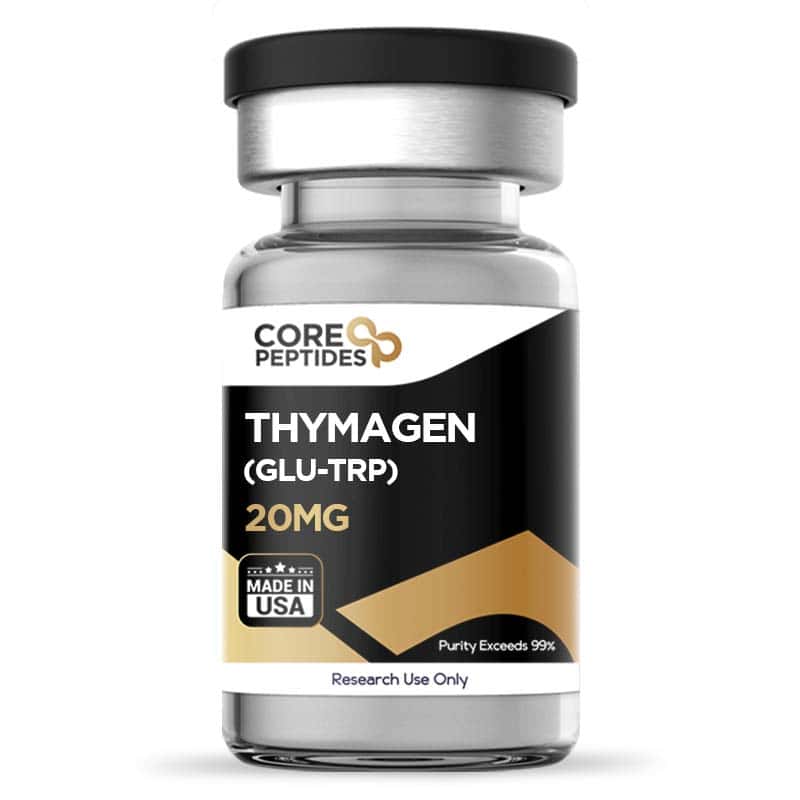
Thymagen (20mg), also known as Thymogen, Oglufanide or EW (Glu-Trp), is a synthetic dipeptide belonging to the group of Khavinson peptide bioregulators.
It is composed of two amino acids, glutamic acid and tryptophan, and has been investigated in experimental research concerning thymic biology, immune-cell signalling and cellular regulation.
According to the Core Peptides product specification, this research material contains 20mg of Thymagen and is supplied as a lyophilised powder with a stated purity of >99%.
The listed peptide sequence is Glu-Trp, with a molecular formula of C16H19N3O5 and a molecular weight of approximately 333.3 g/mol.
Research into Thymagen has explored its potential relationship with immune-cell activity, cyclic nucleotide signalling, inflammatory and hypersensitivity models, infectious-disease models, cardiac-cell responses and tumour-related experimental systems.
Much of the evidence cited for these areas comes from older laboratory and animal research, so the findings should be treated as research observations rather than established clinical effects.
For research, laboratory and analytical purposes only. Not for human or animal consumption.
What Is Thymagen?
Thymagen is a small synthetic dipeptide consisting of the amino acids glutamic acid and tryptophan. It is commonly represented by the sequence Glu-Trp (EW) and is associated with the Khavinson family of peptide bioregulators.
The peptide is described as a synthetic analogue of peptide material associated with the thymus. Research interest has focused particularly on potential interactions with immune-cell function and cellular signalling mechanisms.
Because Thymagen consists of only two amino acids, it represents a highly defined molecular structure that can be investigated in controlled peptide, cellular and biochemical research models.
Thymagen (20mg) Product Specifications
| Specification | Details |
|---|---|
| Product Name | Thymagen |
| Alternative Names | Thymogen, Oglufanide, EW, Glu-Trp |
| Quantity | 20mg |
| Peptide Type | Dipeptide |
| Sequence | Glu-Trp |
| Form | Lyophilised powder |
| Stated Purity | >99% |
| Molecular Formula | C16H19N3O5 |
| Molecular Weight | 333.3 g/mol |
| Research Category | Peptide Research |
| Research Focus | Thymic biology, immune signalling and cellular research |
| Intended Use | Laboratory, analytical and in-vitro research |
The specifications above correspond to the information published on the Core Peptides Thymagen product page.
Thymagen Chemical Structure
Thymagen is a particularly small peptide because it contains only two amino-acid residues. Its sequence is:
Glu-Trp
- Glu: Glutamic acid
- Trp: Tryptophan
The Core Peptides listing identifies Thymagen’s molecular formula as C16H19N3O5 and its molecular weight as approximately 333.3 g/mol.
The short structure makes Thymagen useful for researchers interested in studying the biological behaviour of small regulatory peptides and their potential interactions with cellular signalling pathways.
Thymagen and Immune-System Research
One of the principal areas of scientific interest surrounding Thymagen is its relationship with immune-cell regulation. Research cited by Core Peptides has investigated the peptide in experimental models involving lymphocytes, immune sensitisation and inflammatory responses.
Experimental work has examined potential changes in cyclic nucleotide signalling, particularly the relationship between cyclic adenosine monophosphate (cAMP) and cyclic guanosine monophosphate (cGMP). Studies in sensitised animal models investigated Thymagen alongside related thymic peptides and observed changes in cyclic-nucleotide metabolism in lymphocytes.
These findings provide a basis for further investigation into the relationship between short thymic peptides and intracellular signalling. They do not, however, establish a clinically proven immunomodulatory effect for research-grade Thymagen.
Thymagen and Lymphocyte Research
Lymphocytes are immune cells involved in adaptive and cellular immune responses. T lymphocytes, B lymphocytes and natural killer cells perform different roles within the immune system.
Research involving Thymagen has explored potential changes in lymphocyte-related processes under experimental conditions. Particular attention has been given to enzyme activity involved in the metabolism of cyclic nucleotides.
Such research is relevant to laboratories investigating how small peptides may influence intracellular signalling and immune-cell behaviour. The observed effects remain dependent on the experimental model, concentration, exposure conditions and biological system used.
Thymagen and T-Cell Research
The thymus plays an important role in the development and maturation of T lymphocytes. Because Thymagen is associated with thymic peptide research, investigators have examined its potential relationship with T-cell differentiation and immune responses.
Research cited by Core Peptides has investigated Thymogen in experimental models of secondary immunodeficiency and autoimmune disease. Reported observations included changes in immune-function markers and T-cell-related parameters.
These studies may provide useful hypotheses for further laboratory investigation, but results from experimental models should not be interpreted as evidence that Thymagen is an established treatment for immunodeficiency or autoimmune conditions.
Thymagen and Cytokine Research
Cytokines are signalling proteins that help coordinate immune and inflammatory responses. Changes in cytokine activity can influence communication between immune cells and other tissues.
Thymagen has been discussed in research concerning immune modulation and potential changes in immune-cell activity. This has led to interest in whether the peptide may influence cytokine-associated signalling pathways.
However, cytokine responses are highly dependent on the experimental context. Researchers should therefore evaluate individual cytokine measurements using appropriate controls and validated analytical methods rather than assuming a universal immunological response.
Thymagen and Experimental Infection Models
Experimental studies have also investigated Thymagen-related peptides in models of infection.
One study cited by Core Peptides investigated Thymogen in an experimental model involving Yersinia enterocolitica. The research explored potential changes in immune responses, including delayed hypersensitivity and nonspecific resistance to infection.
Other research cited on the product page examined Thymogen in animal models of candidiasis under conditions of experimentally induced immunodeficiency. The researchers investigated whether the peptide could influence immune responses and the severity of the experimental infection.
These findings are relevant to preclinical immunology research but cannot be directly translated into recommendations for treating human infections.
Thymagen and Cellular Signalling
The biological interest in very short peptides extends beyond immune-cell research. Small peptides may be investigated as potential signalling molecules capable of interacting with cellular proteins and intracellular pathways.
Research into Thymagen has examined changes in cyclic nucleotide metabolism, particularly in lymphocytes. Such work provides a framework for studying how peptide exposure may influence intracellular signalling networks.
For laboratory researchers, this makes Thymagen a potential model compound for examining relationships between peptide structure, cell signalling and immune-cell behaviour.
Thymagen and Cardiac Research
Experimental studies have also investigated Thymagen in cardiac models, including several experimental models of arrhythmia and ischaemia.
The Core Peptides product page references research in which Thymogen was investigated across different animal models of arrhythmia, including models induced through pharmacological and physiological mechanisms. The cited research explored potential effects on cardiac function and ischaemia-related mechanisms.
These findings are preclinical and require careful interpretation. Experimental cardiac effects should not be regarded as evidence that research-grade Thymagen is suitable for cardiovascular treatment or human use.
Thymagen and Tumour-Related Research
Some of the research cited by Core Peptides has investigated Thymagen in experimental models involving tumour development.
Studies have explored the peptide in animal models of chemically induced and radiation-associated carcinogenesis. Reported observations included differences in tumour incidence and tumour multiplicity between experimental groups.
Another study examined Thymogen in subjects with solid tumours and investigated changes in cellular immune parameters surrounding surgical intervention. The study reported potential changes in immune-related measurements and postoperative outcomes.
These findings are historical research observations and should not be presented as evidence that Thymagen prevents or treats cancer. Cancer biology is complex, and conclusions about therapeutic efficacy require rigorous, contemporary clinical evidence.
Research into Thymagen and Immune Regulation
Research interest in Thymagen largely centres on the possibility that short thymic peptides may influence aspects of immune regulation.
Potential research themes include:
- T-lymphocyte differentiation.
- Lymphocyte signalling.
- Immune-cell activation.
- Cyclic nucleotide metabolism.
- Cytokine-associated signalling.
- Experimental immune deficiency.
- Thymic peptide biology.
- Cellular responses to infectious challenges.
- Immune responses associated with experimental tumour models.
These areas represent potential research applications rather than established clinical indications.
Thymagen vs Thymalin
Thymagen and Thymalin are related within the broader field of thymic peptide research but are chemically distinct materials.
| Feature | Thymagen | Thymalin |
|---|---|---|
| General type | Synthetic dipeptide | Thymic peptide preparation / peptide complex |
| Sequence | Glu-Trp | Complex peptide composition |
| Structure | Two amino acids | Multiple peptide components |
| Research focus | Thymic and immune signalling | Thymic peptide biology |
| Product format | Lyophilised powder | Depends on formulation |
Thymagen is therefore a defined small-molecule peptide, whereas Thymalin represents a broader thymic peptide preparation. The two should not be treated as chemically interchangeable.
Thymagen vs Other Short Peptides
Thymagen is part of a wider group of short peptides studied for their potential biological signalling properties. Its two-residue structure distinguishes it from longer peptides and peptide complexes.
Researchers comparing short peptides may consider:
- Peptide sequence.
- Molecular weight.
- Purity.
- Stability.
- Receptor or molecular targets.
- Cellular uptake.
- Experimental model.
- Analytical characteristics.
These factors can influence experimental outcomes and should be considered when comparing Thymagen with other research peptides.
Lyophilised Thymagen Powder
Core Peptides supplies Thymagen (20mg) as a lyophilised powder. Lyophilisation, or freeze-drying, is commonly used for research peptides because it produces a dry formulation that can be handled and stored according to product-specific laboratory requirements.
The product should be handled according to the manufacturer’s documentation and the requirements of the applicable research protocol. Researchers should consult the current batch documentation and Certificate of Analysis for appropriate storage and handling information.
Analytical Research and Quality Control
Analytical characterisation is an important consideration when working with research-grade peptides. Researchers may need to confirm identity, purity and stability before incorporating a peptide into an experimental protocol.
Common analytical approaches include:
- Reverse-phase HPLC: Used to evaluate chromatographic purity and related substances.
- Mass spectrometry: Used to determine molecular mass and support peptide identification.
- LC-MS: Combines chromatographic separation with mass-based peptide analysis.
- Stability testing: Used to monitor changes in peptide composition under defined conditions.
- Peptide characterisation: Used to confirm that the material corresponds to the intended molecular structure.
Researchers should review the applicable batch-specific Certificate of Analysis and use validated laboratory methods appropriate to their research objectives.
Potential Research Applications for Thymagen (20mg)
Thymagen may be relevant to qualified researchers studying several areas of experimental biology:
- Thymic peptide signalling.
- Immune-cell biology.
- T-lymphocyte differentiation.
- Lymphocyte intracellular signalling.
- Cyclic nucleotide pathways.
- Cytokine research.
- Experimental immunodeficiency.
- Infection and host-response models.
- Cardiac-cell and arrhythmia research.
- Tumour and cellular-immunity research.
- Peptide stability and analytical chemistry.
- Short-peptide structure-function studies.
Research outcomes can vary considerably according to species, cell type, experimental conditions and study design. Findings should therefore be evaluated within their original experimental context.
Thymagen (20mg) Research Summary
| Research Characteristic | Information |
|---|---|
| Compound | Thymagen |
| Other Names | Thymogen, Oglufanide, EW, Glu-Trp |
| Peptide Length | 2 amino acids |
| Sequence | Glu-Trp |
| Quantity | 20mg |
| Molecular Formula | C16H19N3O5 |
| Molecular Weight | 333.3 g/mol |
| Physical Form | Lyophilised powder |
| Stated Purity | >99% |
| Primary Research Areas | Thymic biology, immune signalling and cellular research |
Frequently Asked Questions About Thymagen (20mg)
What is Thymagen?
Thymagen is a synthetic dipeptide consisting of glutamic acid and tryptophan. It is also known as Thymogen, Oglufanide or EW (Glu-Trp) and is associated with research into thymic peptide biology and immune regulation.
What is the sequence of Thymagen?
The peptide sequence is Glu-Trp (EW).
How much Thymagen is supplied?
This product contains 20mg of Thymagen. The 20mg specification refers to the amount of research material supplied and should not be interpreted as a dosage recommendation.
What is the molecular weight of Thymagen?
The molecular weight listed by Core Peptides is approximately 333.3 g/mol.
What is the molecular formula of Thymagen?
The listed molecular formula is C16H19N3O5.
What is Thymogen?
Thymogen is another name used for the same Glu-Trp dipeptide associated with Thymagen. Core Peptides lists Thymogen and Oglufanide among the alternative names for the compound.
What research areas involve Thymagen?
Research involving Thymagen has explored immune-cell signalling, lymphocyte activity, cyclic nucleotide metabolism, experimental infection models, cardiac research and tumour-related experimental systems.
Is Thymagen an immune-system treatment?
This research-grade product should not be described as a treatment for immune disorders or infections. Experimental studies have investigated potential immunological effects, but research findings do not establish a therapeutic indication for this product.
Is Thymagen the same as Thymalin?
No. Although both are associated with thymic peptide research, Thymagen is a defined two-amino-acid dipeptide, whereas Thymalin is a more complex thymic peptide preparation.
Is Thymagen supplied as a liquid?
No. The Core Peptides product page specifies a lyophilised powder.
What is the stated purity of Thymagen?
The product listing states a purity of >99%. Researchers should refer to the applicable batch-specific Certificate of Analysis for detailed analytical information.
Is Thymagen approved for medical use?
This research-grade product should not be represented as an approved medicinal product. Core Peptides states that its products are intended for research, laboratory or analytical purposes and are not for human consumption.
Can Thymagen be used for self-administration?
No. The product is intended for laboratory and research use only and is not intended for human or animal consumption or self-administration.
Storage and Laboratory Handling
Researchers should follow the current product documentation and Certificate of Analysis for specific storage and handling requirements.
- Keep the peptide in its original labelled container.
- Protect the lyophilised material from unnecessary exposure to moisture.
- Follow supplier-specified storage requirements.
- Minimise unnecessary temperature fluctuations.
- Use suitable laboratory protective equipment.
- Prevent contamination during laboratory handling.
- Maintain appropriate batch and experimental records.
- Dispose of research materials according to applicable institutional procedures.
General peptide-handling practices should not replace product-specific instructions supplied with the material.
Why Choose Thymagen (20mg) for Research?
Thymagen (20mg) provides laboratories with a defined synthetic dipeptide for controlled investigation of thymic peptide biology and immune-related signalling. Its short Glu-Trp sequence, lyophilised format and stated >99% purity make it suitable for appropriate analytical and experimental research where this compound is relevant to the study design.
Researchers can investigate Thymagen as an individual peptide while comparing its behaviour with other thymic or regulatory peptides. Its documented molecular composition also supports analytical studies involving peptide identification, purity assessment and stability.
Important Research Disclaimer
Thymagen (20mg) is supplied strictly for research, laboratory and analytical purposes.
This product is not intended for human or animal consumption, self-administration, diagnosis, treatment, cure or prevention of any disease. References to immune function, infections, cancer, cardiovascular biology, ageing or other biological processes describe areas of scientific investigation and should not be interpreted as medical advice or therapeutic claims.
Many of the studies associated with Thymagen cited by the supplier involve animal models or historical experimental research. Results from these studies should not automatically be extrapolated to humans or interpreted as proof of clinical efficacy.
Researchers are responsible for complying with all applicable laws, institutional requirements, laboratory safety procedures and appropriate handling protocols when working with Thymagen.
For research use only. Not for human or animal consumption.
Be the first to review “Thymagen (20mg)”
Related products
Peptides for Sale
Peptides for Sale
Peptides for Sale
Peptides for Sale
Peptides for Sale
Peptides for Sale
Peptides for Sale
Peptides for Sale
Reviews
There are no reviews yet.