
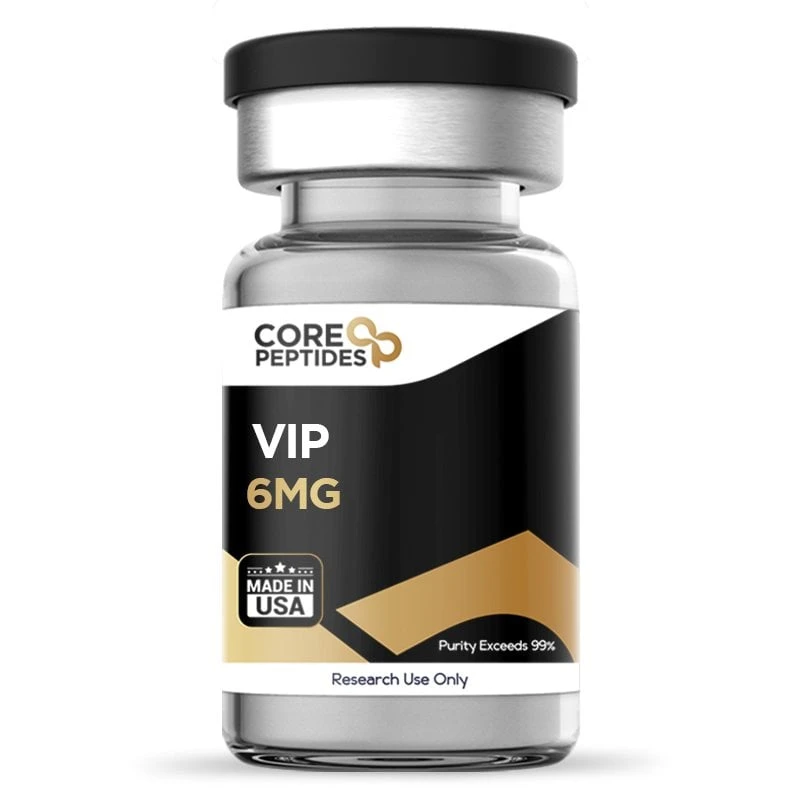
VIP (6mg) – Vasoactive Intestinal Peptide Research Peptide
VIP (6mg), short for Vasoactive Intestinal Peptide, is a naturally occurring 28-amino-acid peptide belonging to the glucagon/secretin peptide superfamily. VIP has been extensively studied for its role in gastrointestinal, neurological, vascular, endocrine and cellular signalling.
Research has established that VIP interacts primarily with two high-affinity receptors, VPAC1 and VPAC2, which are members of the class B G-protein-coupled receptor family.
Activation of these receptors can influence intracellular signalling pathways, including cyclic AMP (cAMP), and contributes to the diverse physiological actions associated with VIP.
VIP (6mg) is intended for research, laboratory and analytical applications only. It is not intended for human or animal consumption, self-administration, diagnosis or treatment of any medical condition.
What Is VIP?
Vasoactive Intestinal Peptide (VIP) is a 28-amino-acid neuropeptide and peptide hormone originally identified in intestinal tissue. Subsequent research demonstrated that VIP is widely distributed throughout the central and peripheral nervous systems and is involved in a broad range of biological processes.
VIP belongs to a structurally related family that includes peptides such as secretin, glucagon, growth hormone-releasing hormone (GHRH) and pituitary adenylate cyclase-activating polypeptide (PACAP). VIP and PACAP share significant structural similarities and interact with overlapping receptor systems.
Because VIP participates in signalling across multiple tissues, it has become an important research molecule for studying peptide-receptor interactions, intracellular signalling, gastrointestinal physiology, vascular responses, neuroendocrine communication and inflammatory pathways.
VIP (6mg) Product Overview
| Specification | Details |
|---|---|
| Product Name | VIP |
| Full Name | Vasoactive Intestinal Peptide |
| Quantity | 6mg |
| Peptide Length | 28 amino acids |
| Peptide Class | Neuropeptide / peptide hormone |
| Receptors | VPAC1 and VPAC2 |
| Receptor Family | Class B G-protein-coupled receptors |
| Primary Research Areas | Gastrointestinal, vascular, neurological, endocrine and cellular research |
| Research Format | Research-grade peptide material |
| Intended Use | Laboratory, analytical and scientific research |
VIP Peptide Sequence and Structure
VIP consists of 28 amino acids and is synthesised biologically from the larger prepro-VIP precursor. During processing, the precursor undergoes cleavage and C-terminal amidation to produce mature VIP.
The mature peptide has a structure that can change according to its environment. Research has shown that VIP can adopt an alpha-helical conformation when associated with anionic lipid membranes or receptor environments, a structural feature relevant to studies of peptide-receptor recognition.
The sequence and structural characteristics of VIP make it a useful reference molecule for researchers investigating peptide hormones and class B GPCR signalling.
How Does VIP Work?
VIP exerts its biological activity primarily through the VPAC1 and VPAC2 receptors. These receptors belong to the class B family of G-protein-coupled receptors and respond to both VIP and PACAP.
Receptor activation can stimulate Gs-coupled signalling, leading to activation of adenylyl cyclase and increases in intracellular cyclic AMP (cAMP). Downstream signalling can then influence cellular processes in a tissue-dependent manner.
The distribution of VPAC1 and VPAC2 differs between tissues, helping to explain why VIP can produce different physiological responses depending on the biological system being studied.
VIP and VPAC1 Research
VPAC1 is one of the principal receptors through which VIP produces its biological effects. Research has identified VPAC1 in numerous tissues, including the intestine, lungs, liver, brain and immune-cell populations.
Within the gastrointestinal system, VPAC1 is associated with processes including intestinal secretion and neural regulation. Activation of VPAC1 can stimulate cAMP-dependent signalling and influence epithelial ion transport.
Researchers can therefore use VIP as a molecular tool for studying VPAC1-dependent signalling in controlled cellular and tissue models.
VIP and VPAC2 Research
VPAC2 is the second major high-affinity receptor for VIP. It is expressed in a variety of tissues, including regions of the central nervous system, smooth muscle, endocrine tissues and pancreatic islets.
VPAC2 signalling has been investigated in relation to smooth-muscle relaxation, vascular biology, neuroendocrine processes and circadian regulation. The receptor is particularly interesting in research examining how VIP signalling affects different tissues.
The presence of VPAC2 in multiple biological systems makes VIP a valuable research molecule for studying receptor distribution and downstream signalling.
VIP and Gastrointestinal Research
VIP was originally identified in intestinal tissue, and gastrointestinal research remains one of the most established areas of VIP biology.
Studies have shown that VIP participates in intestinal secretion, smooth-muscle activity, pancreatic secretion and regulation of gastrointestinal blood flow. Through VPAC receptors, VIP can influence epithelial ion transport and stimulate the secretion of chloride and bicarbonate.
VIP also participates in the regulation of gastrointestinal motility. Its effects on smooth muscle can vary according to the specific tissue and receptor distribution, making it an important molecule for research into gastrointestinal physiology.
VIP and Intestinal Secretion
One well-characterised action of VIP involves stimulation of intestinal electrolyte secretion. Activation of VPAC1 on intestinal epithelial cells can increase intracellular cAMP, activate protein kinase A and influence the cystic fibrosis transmembrane conductance regulator (CFTR).
These signalling events can increase chloride and bicarbonate secretion in intestinal tissues. Researchers study this pathway to better understand epithelial transport, fluid regulation and gastrointestinal physiology.
Importantly, the physiological activity of VIP also demonstrates why experimental handling requires appropriate laboratory controls. Excessive endogenous VIP activity can produce profound gastrointestinal effects in pathological conditions such as VIP-secreting tumours.
VIP and Vascular Research
VIP is also recognised for its vasodilatory activity. Experimental research has investigated how VIP influences vascular tone and blood flow through VPAC receptor signalling.
In vascular tissues, VIP can activate VPAC1 and VPAC2 receptors, with downstream mechanisms involving endothelial nitric oxide signalling and direct effects on vascular smooth muscle depending on the tissue studied.
These properties make VIP useful in laboratory investigations involving vascular signalling, smooth-muscle biology and peptide-mediated regulation of vascular tone.
VIP and Smooth-Muscle Research
VIP has been extensively studied for its effects on smooth muscle, particularly within the gastrointestinal and vascular systems.
Research indicates that VIP can promote relaxation of certain gastrointestinal smooth-muscle tissues through VPAC2-associated mechanisms. However, responses can differ between tissues because receptor expression and neuronal signalling pathways vary throughout the gastrointestinal tract.
This tissue-specific activity makes VIP an interesting experimental tool for studying receptor distribution and the relationship between peptide signalling and smooth-muscle function.
VIP and Neurological Research
VIP is widely distributed throughout the nervous system and has been investigated as both a neurotransmitter and neuromodulator.
Research has linked VIP signalling to several central nervous system processes, including circadian regulation, learning and memory, responses to stress and broader neuroendocrine signalling. These effects are mediated through VIP and PACAP receptor systems distributed throughout the brain and peripheral nervous system.
The distribution of VPAC1 and VPAC2 across different brain regions has helped researchers investigate the role of VIP in neuronal communication and neuroendocrine biology.
VIP and Circadian Rhythm Research
VIP is particularly relevant to research into the biological clock because VPAC2 receptors are highly expressed in the suprachiasmatic nucleus (SCN), the principal circadian pacemaker in mammals.
Research has therefore investigated VIP and VPAC2 signalling in relation to communication between neurons within the SCN and the maintenance of circadian rhythms.
This provides an important experimental model for studying how neuropeptide signalling contributes to the synchronisation of biological rhythms.
VIP and Neuroendocrine Research
VIP participates in communication between the nervous and endocrine systems. Its receptors are distributed in several neuroendocrine tissues, including regions of the hypothalamus, pituitary and pancreatic islets.
Researchers have investigated VIP signalling in relation to hormone secretion, pancreatic function and neuroendocrine regulation.
These studies demonstrate the broad biological relevance of VIP while also highlighting the importance of considering tissue-specific receptor expression when interpreting experimental findings.
VIP and Pancreatic Research
VIP has been investigated in pancreatic physiology, including research into exocrine and endocrine functions.
Experimental studies indicate that VIP can stimulate pancreatic fluid and bicarbonate secretion and influence enzyme release. VIP and PACAP signalling can also interact with pancreatic islet pathways involved in glucose-regulated hormone secretion.
These properties make VIP relevant to research investigating pancreatic secretion, endocrine signalling and peptide-regulated cellular responses.
VIP and Inflammatory Research
VIP has attracted scientific interest in inflammatory biology because of its effects on immune cells and inflammatory signalling pathways.
Experimental research has described VIP as having immunomodulatory and anti-inflammatory properties in certain models. VIP receptors are expressed on several immune-cell populations, providing a molecular basis for investigating VIP-mediated regulation of immune responses.
These findings are relevant to basic research into peptide-mediated immune signalling but should not be interpreted as evidence that research-grade VIP is a treatment for inflammatory or immune disorders.
VIP and Cellular Signalling
VIP provides a useful model for studying G-protein-coupled receptor signalling. Following receptor activation, intracellular cAMP pathways can regulate a range of downstream cellular events.
Research has shown that VIP can activate cAMP-dependent pathways in intestinal epithelial cells and influence downstream signalling involving protein kinase A, ERK and other molecular intermediates.
This makes VIP useful for experimental research involving receptor pharmacology, second-messenger signalling and cellular communication.
VIP and MUC2 Research
Research has also examined the relationship between VIP signalling and intestinal mucin production. In human colonic epithelial cells, VIP was reported to increase MUC2 transcription through cAMP-associated signalling pathways involving CREB/ATF1.
MUC2 is a major intestinal mucin that contributes to the protective mucus layer of the gastrointestinal tract. Studies of VIP-mediated MUC2 regulation therefore provide an experimental model for investigating neuropeptide communication with intestinal epithelial cells.
VIP and Peptide-Receptor Research
VIP is particularly useful in receptor pharmacology because its activity is mediated through defined receptor systems. The two major receptors, VPAC1 and VPAC2, are closely related class B GPCRs that respond to VIP and PACAP.
Researchers can investigate differences in receptor distribution, ligand binding, downstream signalling and receptor regulation using VIP and related peptide analogues.
Studies of VIP analogues have also contributed to understanding which regions of the 28-amino-acid peptide are important for receptor recognition and activation.
VIP Research Applications
Qualified researchers may consider VIP (6mg) for controlled laboratory studies involving:
- Vasoactive intestinal peptide receptor research.
- VPAC1 receptor signalling.
- VPAC2 receptor signalling.
- Class B GPCR pharmacology.
- cAMP-mediated cellular signalling.
- Gastrointestinal physiology.
- Intestinal epithelial research.
- Vascular and smooth-muscle research.
- Neuroendocrine signalling.
- Neuropeptide research.
- Circadian rhythm research.
- Pancreatic and endocrine studies.
- Inflammatory and immune-cell research.
- Peptide-receptor binding studies.
- Comparative research involving VIP analogues and PACAP.
These are scientific research areas rather than therapeutic indications.
VIP Compared With PACAP
| Characteristic | VIP | PACAP |
|---|---|---|
| Full Name | Vasoactive Intestinal Peptide | Pituitary Adenylate Cyclase-Activating Polypeptide |
| Peptide Family | Glucagon/secretin superfamily | Glucagon/secretin superfamily |
| Primary Receptors | VPAC1 and VPAC2 | PAC1, VPAC1 and VPAC2 |
| Receptor Class | Class B GPCRs | Class B GPCRs |
| Research Areas | GI, vascular, neurological, endocrine and cellular research | Neural, endocrine and cellular signalling research |
VIP and PACAP share substantial structural similarity and can activate VPAC1 and VPAC2, while PACAP also has the selective PAC1 receptor.
Why Research VIP (6mg)?
VIP is one of the better-characterised neuropeptides in peptide physiology. Its extensive distribution and well-established receptor systems provide researchers with a useful model for studying communication between neurons, endocrine tissues, smooth muscle and epithelial cells.
The interaction of VIP with VPAC1 and VPAC2 also makes it valuable for investigating class B GPCR pharmacology and intracellular cAMP signalling.
Its established role in gastrointestinal secretion, vascular signalling, smooth-muscle activity and neuroendocrine regulation provides multiple opportunities for controlled experimental investigation.
VIP (6mg) for Analytical Research
Analytical characterisation is an important component of peptide research. Laboratories may use validated analytical techniques to confirm peptide identity, evaluate purity and investigate stability.
- HPLC: Can be used to assess chromatographic purity and identify related substances.
- Mass spectrometry: Can support molecular-mass confirmation and peptide identification.
- LC-MS: Can combine chromatographic separation with mass-based analysis.
- Receptor-binding assays: Can investigate interactions between VIP and VPAC receptors.
- Cell-based assays: Can examine cAMP signalling and other cellular responses.
- Immunological assays: Can support research into VIP distribution and peptide-related signalling.
Researchers should use validated laboratory procedures and consult current batch-specific documentation when performing analytical work.
VIP (6mg) Research Summary
| Research Characteristic | Information |
|---|---|
| Product | VIP (6mg) |
| Full Name | Vasoactive Intestinal Peptide |
| Peptide Length | 28 amino acids |
| Primary Receptors | VPAC1 and VPAC2 |
| Receptor Family | Class B G-protein-coupled receptors |
| Primary Research Areas | Gastrointestinal, neurological, vascular and endocrine research |
| Additional Research Areas | Immune, inflammatory, cellular and receptor-signalling research |
| Product Format | Research-grade peptide |
| Intended Use | Laboratory, analytical and scientific research |
Frequently Asked Questions About VIP (6mg)
What is VIP?
VIP stands for Vasoactive Intestinal Peptide. It is a 28-amino-acid neuropeptide and peptide hormone involved in a wide range of physiological signalling processes.
What does VIP stand for in peptide research?
In peptide research, VIP refers to Vasoactive Intestinal Peptide. It is sometimes also called vasoactive intestinal polypeptide.
How many amino acids are in VIP?
Mature VIP contains 28 amino acids. Human and porcine VIP have been reported to have the same amino-acid sequence.
Which receptors does VIP activate?
VIP primarily activates the VPAC1 and VPAC2 receptors. Both belong to the class B family of G-protein-coupled receptors.
What is the difference between VPAC1 and VPAC2?
VPAC1 and VPAC2 are related receptors with different tissue distributions. VPAC1 is widely distributed in tissues including the intestine and brain, while VPAC2 is particularly prominent in certain neuroendocrine, smooth-muscle and circadian-regulation systems.
What is VIP studied for?
VIP is studied in gastrointestinal physiology, vascular biology, smooth-muscle signalling, neurobiology, neuroendocrine communication, immune signalling and peptide-receptor pharmacology.
Does VIP affect cAMP signalling?
Yes. Activation of VPAC receptors can stimulate Gs-coupled signalling and increase intracellular cAMP, which can activate downstream signalling pathways such as protein kinase A.
Has VIP been studied in intestinal cells?
Yes. Research has examined VIP-mediated regulation of intestinal epithelial secretion, ion transport and MUC2 expression.
Has VIP been studied in neurological research?
Yes. VIP is widely distributed in the central and peripheral nervous systems and has been studied in relation to circadian rhythms, learning and memory, stress responses and neuroendocrine signalling.
Is VIP the same as PACAP?
No. VIP and PACAP are structurally related peptides but are distinct molecules. They share VPAC1 and VPAC2 receptors, while PACAP also activates the selective PAC1 receptor.
Is VIP intended for human use?
No. The research-grade VIP (6mg) product is intended for laboratory and scientific research only and is not intended for human or animal consumption.
Is VIP a medicine?
Research-grade VIP should not be represented as an authorised medicine or as a treatment for any medical condition. Experimental research findings do not establish clinical safety or efficacy.
Storage and Laboratory Handling
Researchers should consult the applicable product documentation and batch-specific Certificate of Analysis for exact storage requirements.
- Keep the peptide in its original labelled container.
- Follow the supplier’s stated storage conditions.
- Protect the material from unnecessary exposure to moisture and environmental contaminants.
- Minimise unnecessary temperature fluctuations.
- Use appropriate laboratory protective equipment when handling research material.
- Maintain suitable sample-identification and laboratory records.
- Use validated procedures when preparing or analysing experimental samples.
- Dispose of unused material according to applicable laboratory procedures and local requirements.
No dosing, administration or self-use instructions are provided because this product is intended exclusively for laboratory research.
Important Research Disclaimer
VIP (6mg) is supplied strictly for research, laboratory and analytical purposes. This product is not intended for human or animal consumption, self-administration, diagnosis, treatment, cure or prevention of any disease.
References to gastrointestinal function, vascular activity, neurological signalling, immune pathways, inflammation, endocrine processes or other biological effects describe areas of scientific investigation and should not be interpreted as therapeutic claims.
VIP has extensive documented biological activity, and excessive endogenous VIP secretion can produce significant physiological effects. Research involving VIP should therefore be conducted by appropriately qualified personnel using suitable laboratory controls and applicable safety procedures.
Researchers are responsible for complying with applicable legislation, institutional requirements, laboratory safety procedures and appropriate handling protocols when working with this material.
For research use only. Not for human or animal consumption.
Be the first to review “VIP (6mg)”
Related products
Peptides for Sale
Peptides for Sale
Peptides for Sale
Peptides for Sale
Peptide Blends for Sale
Peptides for Sale
Peptides for Sale
Peptides for Sale
Reviews
There are no reviews yet.