
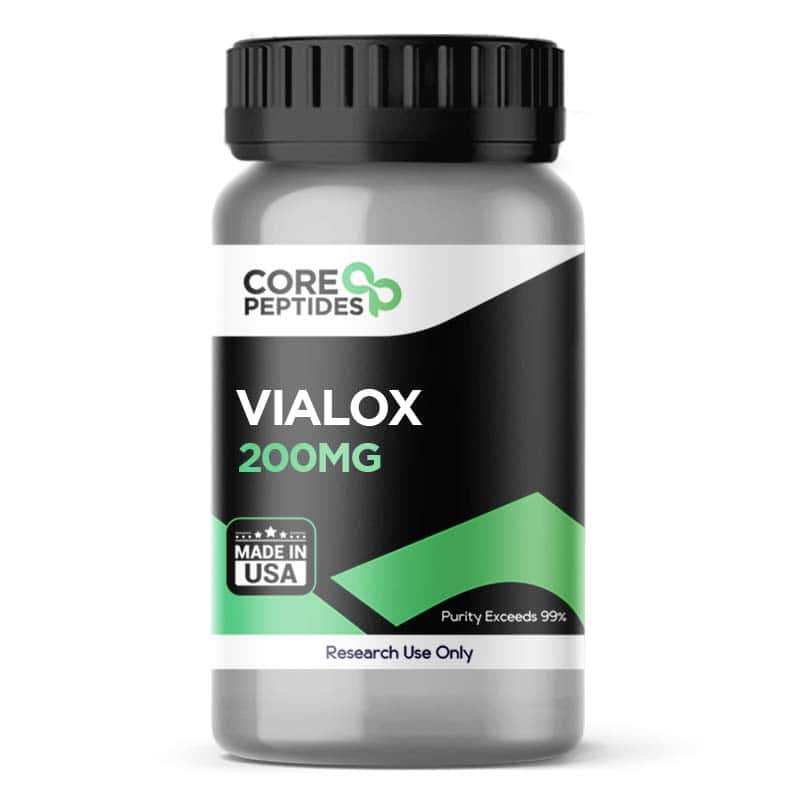
Vialox (Pentapeptide-3V) (200mg) – Research Peptide
Vialox (Pentapeptide-3V) (200mg) is a synthetic pentapeptide investigated primarily in research relating to neuromuscular signalling, acetylcholine receptor activity, muscle contraction and skin-texture biology.
The compound is associated with the peptide sequence Gly-Pro-Arg-Pro-Ala (GPRPA) and has attracted particular interest in cosmetic peptide research because of its proposed ability to interfere with signalling at postsynaptic nicotinic acetylcholine receptors.
Core Peptides supplies Vialox as a lyophilised powder with a stated purity of greater than 99%. The product is intended exclusively for research, laboratory and analytical applications and is not intended for human or animal consumption.
Research literature has described Pentapeptide-3/Vialox as a competitive antagonist at postsynaptic acetylcholine receptors, providing a scientific basis for investigating its effects on neuromuscular transmission and muscle-cell contraction.
A 2012 review of bioactive oligopeptides in dermatology also discussed Vialox in connection with experimental wrinkle and skin-roughness research. For research, laboratory and analytical purposes only. Not for human or animal consumption.
What Is Vialox (Pentapeptide-3V)?
Vialox, also referred to as Pentapeptide-3V or Pentapeptide-3, is a synthetic short peptide consisting of five amino-acid residues. Core Peptides identifies its sequence as Gly-Pro-Arg-Pro-Ala (GPRPA).
The compound is primarily researched for its interaction with the signalling mechanisms involved in neuromuscular transmission. In particular, published literature describes Pentapeptide-3 as a competitive antagonist at the postsynaptic acetylcholine receptor, meaning that it can be investigated for its ability to interfere with the normal transmission of signals between nerves and muscle cells.
This mechanism has also made Vialox relevant to cosmetic-peptide research, where researchers have investigated whether reducing local muscle contraction may influence the appearance and development of expression-related lines in experimental settings.
Vialox (Pentapeptide-3V) (200mg) Product Overview
| Specification | Details |
|---|---|
| Product Name | Vialox (Pentapeptide-3V) |
| Quantity | 200mg |
| Peptide Type | Synthetic pentapeptide |
| Sequence | Gly-Pro-Arg-Pro-Ala (GPRPA) |
| Molecular Formula | C21H37N9O5 |
| Molecular Weight | 495.58 g/mol |
| Form | Lyophilised powder |
| Stated Purity | >99% |
| Research Areas | Neuromuscular signalling, receptor research and skin biology |
| Intended Use | Laboratory, analytical and in-vitro research |
The product specifications above are based on the current Core Peptides listing.
Vialox Peptide Sequence and Chemical Structure
The reported sequence of Vialox is Gly-Pro-Arg-Pro-Ala (GPRPA). As a pentapeptide, the molecule contains five amino-acid residues arranged in a defined sequence.
The molecular formula listed by Core Peptides is C21H37N9O5, with a molecular weight of approximately 495.58 g/mol.
Its relatively small molecular structure makes Vialox a useful compound for researchers investigating the relationship between peptide sequence and receptor-associated biological activity.
How Is Vialox Studied?
Vialox has been investigated primarily through studies examining its proposed interaction with nicotinic acetylcholine receptors. These receptors participate in signal transmission at the neuromuscular junction, where communication between nerve cells and muscle cells ultimately contributes to muscle contraction.
According to the research literature, Pentapeptide-3 may act as a competitive antagonist at postsynaptic acetylcholine receptors. In experimental terms, receptor antagonism can be studied to determine how blocking or competing with acetylcholine influences downstream cellular responses.
This provides a mechanistic basis for investigating Vialox in controlled laboratory models involving receptor binding, neuromuscular transmission and muscle-cell contraction.
Vialox and Nicotinic Acetylcholine Receptor Research
Nicotinic acetylcholine receptors (nAChRs) are membrane proteins involved in fast signalling between neurons and other excitable cells, including skeletal muscle cells.
At the neuromuscular junction, acetylcholine released from a motor nerve normally binds to receptors on the muscle-cell membrane. This receptor activation contributes to membrane depolarisation and subsequent muscle contraction.
Research into Vialox has focused on the possibility that the peptide can compete with acetylcholine at postsynaptic receptor sites. By studying this interaction, researchers can investigate how a short synthetic peptide influences receptor-mediated signalling in experimental systems.
Importantly, these mechanistic observations should not be interpreted as instructions for therapeutic or cosmetic use.
Vialox and Neuromuscular Transmission
Neuromuscular transmission is the biological process through which motor nerves communicate with muscle cells. It is a tightly regulated process involving neurotransmitter release, receptor activation and changes in the electrical state of the muscle-cell membrane.
Vialox is of interest because published literature describes Pentapeptide-3 as a competitive antagonist of the postsynaptic acetylcholine receptor. This makes it a useful research molecule for studying how receptor blockade can influence muscle-cell signalling.
Experimental investigations can therefore examine changes in muscle contraction or receptor-associated activity under controlled conditions.
Vialox and Muscle Contraction Research
Muscle contraction depends on successful transmission of signals from motor neurons to muscle fibres. When acetylcholine activates postsynaptic receptors, downstream ion-channel activity contributes to depolarisation and muscle contraction.
Research cited by Core Peptides describes Vialox as capable of interfering with this signalling process through interaction with acetylcholine receptors. Experimental work has consequently examined changes in muscle-cell contraction following exposure to the peptide.
These studies provide a basis for further investigation into receptor pharmacology and peptide-mediated modulation of neuromuscular signalling.
Vialox and Skin-Texture Research
One of the most prominent research interests surrounding Vialox concerns its potential relevance to skin texture and expression-related wrinkles.
The rationale behind this research is that repeated muscle contraction contributes to the formation and visibility of certain dynamic facial lines. If a research compound can influence neuromuscular signalling, investigators can examine whether reduced contraction is accompanied by measurable changes in skin-surface characteristics.
A review published in Experimental Dermatology discussed Pentapeptide-3/Vialox in connection with experimental reductions in wrinkle size and skin roughness.
These findings should be viewed as cosmetic research observations rather than evidence that Vialox is an approved anti-wrinkle medicine.
Vialox and Wrinkle Research
Research into Vialox has included experimental assessment of wrinkle size and skin roughness. The proposed mechanism is different from that of conventional moisturising ingredients because it focuses on neuromuscular signalling rather than simply increasing hydration at the skin surface.
A review of bioactive oligopeptides in dermatology reported that in-vivo studies of Vialox showed a 49% reduction in wrinkle size and a 47% reduction in skin roughness after 28 days in the reported study context.
These figures originate from a specific research context and should not be interpreted as a guaranteed result for every formulation, concentration, skin type or experimental condition.
Vialox and Skin Roughness Research
Skin roughness is one measurable characteristic used in cosmetic and dermatological research. Instrumental measurements can be used to determine whether an experimental formulation produces detectable changes in surface texture over a defined period.
Published literature has described Vialox as a peptide investigated for its effects on skin roughness alongside its proposed neuromuscular mechanism. The reported research observed changes in skin roughness following repeated topical application in an experimental setting.
Further research is required to determine how factors such as formulation, delivery system, concentration and study population influence these observations.
Vialox in Cosmetic Peptide Research
Cosmetic peptides are a broad class of short peptide ingredients investigated for their potential effects on the appearance or function of the skin. Different cosmetic peptides target different biological processes, including extracellular-matrix signalling, pigmentation pathways, inflammation and neuromuscular communication.
Vialox occupies a distinct area within this field because its proposed activity centres on neuromuscular receptor signalling. This differentiates it from peptides primarily investigated for collagen synthesis or extracellular-matrix support.
A recent 2026 study combined computational modelling and in-vitro testing to investigate Vialox and Leuphasyl in the context of ageing-related pathways. The researchers reported no cytotoxicity in HaCaT cells at the concentrations tested and identified different predicted molecular interactions for the two peptides.
Recent Vialox Research
Research into Vialox continues to explore mechanisms beyond its historically described receptor activity. A 2026 study used molecular docking, molecular-dynamics simulations and in-vitro cytotoxicity testing to investigate Vialox alongside Leuphasyl. The study examined interactions with proteins including MMP-1, MMP-8, MMP-13 and SIRT-1.
The researchers reported that Vialox showed a preferential interaction with SIRT-1 in their computational analysis, while both peptides showed no cytotoxicity in the tested HaCaT cell model at concentrations up to 1 mg/mL. These findings are early-stage mechanistic evidence and do not establish clinical efficacy.
Vialox Research Applications
Qualified researchers may consider Vialox (Pentapeptide-3V) for controlled laboratory studies involving:
- Nicotinic acetylcholine receptor research.
- Postsynaptic receptor activity.
- Neuromuscular signalling.
- Muscle-cell contraction models.
- Peptide–receptor interactions.
- Cosmetic peptide research.
- Skin-texture studies.
- Wrinkle and expression-line research.
- Cellular ageing models.
- In-vitro skin-cell research.
- Computational peptide-binding studies.
- Comparative research involving other cosmetic peptides.
These represent potential research areas and should not be interpreted as therapeutic indications or recommendations for personal use.
Vialox Chemical Profile
| Property | Information |
|---|---|
| Compound | Vialox |
| Alternative Name | Pentapeptide-3V / Pentapeptide-3 |
| Sequence | Gly-Pro-Arg-Pro-Ala (GPRPA) |
| Peptide Length | 5 amino-acid residues |
| Molecular Formula | C21H37N9O5 |
| Molecular Weight | 495.58 g/mol |
| Physical Form | Lyophilised powder |
| Product Quantity | 200mg |
| Stated Purity | >99% |
Core Peptides lists Vialox as a 200mg lyophilised preparation with a stated purity exceeding 99%.
Vialox Compared With Other Cosmetic Peptides
| Peptide | General Research Focus | Research Mechanism |
|---|---|---|
| Vialox (Pentapeptide-3V) | Neuromuscular and skin-texture research | Investigated as a competitive antagonist of postsynaptic acetylcholine receptors |
| Leuphasyl (Pentapeptide-18) | Expression-line and cosmetic peptide research | Investigated in relation to neuronal signalling |
| Syn-AKE | Cosmetic skin research | Investigated for snake-venom-inspired peptide activity |
| Syn-Coll | Skin and extracellular-matrix research | Investigated in relation to collagen-associated pathways |
Although these peptides may all appear in cosmetic peptide research, their sequences, molecular targets and proposed mechanisms differ. They should therefore not be considered interchangeable.
Why Research Vialox (Pentapeptide-3V)?
Vialox offers researchers a defined synthetic pentapeptide for investigating the relationship between peptide structure, receptor activity and cellular responses.
Its proposed interaction with postsynaptic nicotinic acetylcholine receptors makes it particularly relevant to laboratories studying neuromuscular signalling and receptor antagonism. Its history in cosmetic peptide research also provides an additional research pathway involving muscle contraction, wrinkle formation and skin texture.
More recent computational and in-vitro research has expanded interest in Vialox towards molecular interactions associated with ageing-related pathways, providing additional hypotheses for future experimental work.
Vialox (200mg) for Analytical Research
Analytical characterisation is an important part of research involving synthetic peptides. Laboratories may use validated analytical methods to confirm identity, assess purity and monitor sample characteristics.
- HPLC: Can be used to assess chromatographic purity and identify related substances.
- Mass spectrometry: Can support molecular-mass confirmation and peptide identification.
- LC-MS: Combines chromatographic separation with mass-based detection.
- In-vitro receptor assays: Can be used to investigate receptor-associated activity under controlled conditions.
- Cell-based assays: Can evaluate cellular responses to defined experimental concentrations.
- Computational modelling: Can investigate possible peptide–protein interactions and binding behaviour.
Researchers should use validated laboratory protocols and consult current batch-specific documentation when analysing Vialox.
Vialox (Pentapeptide-3V) Research Summary
| Research Characteristic | Information |
|---|---|
| Product | Vialox (Pentapeptide-3V) (200mg) |
| Sequence | Gly-Pro-Arg-Pro-Ala (GPRPA) |
| Peptide Length | 5 amino-acid residues |
| Molecular Weight | 495.58 g/mol |
| Primary Research Area | Neuromuscular signalling and acetylcholine receptor research |
| Additional Research Areas | Muscle contraction, skin texture, wrinkle and cosmetic peptide research |
| Physical Form | Lyophilised powder |
| Stated Purity | >99% |
| Intended Use | Laboratory, analytical and in-vitro research |
Frequently Asked Questions About Vialox (Pentapeptide-3V)
What is Vialox?
Vialox is a synthetic pentapeptide also known as Pentapeptide-3V or Pentapeptide-3. Core Peptides identifies its sequence as Gly-Pro-Arg-Pro-Ala (GPRPA).
What is Pentapeptide-3V?
Pentapeptide-3V is another name used for Vialox. It refers to the same short synthetic peptide investigated in receptor, neuromuscular and cosmetic skin research.
What is the molecular weight of Vialox?
Core Peptides lists the molecular weight of Vialox as 495.58 g/mol.
What is Vialox researched for?
Research has investigated Vialox in relation to postsynaptic acetylcholine receptor activity, neuromuscular signalling, muscle contraction, wrinkle appearance and skin texture.
How does Vialox appear to work in research models?
Published literature describes Pentapeptide-3/Vialox as a competitive antagonist at the postsynaptic acetylcholine receptor. This mechanism has been investigated for its potential influence on neuromuscular signalling and muscle contraction.
Is Vialox the same as botulinum toxin?
No. Vialox and botulinum toxin are chemically different compounds and have different molecular structures and mechanisms. Vialox is a synthetic pentapeptide, whereas botulinum toxin is a bacterial protein neurotoxin. Similarities discussed in cosmetic research relate to their potential influence on muscle activity, not chemical identity.
Is Vialox the same as Leuphasyl?
No. Vialox is Pentapeptide-3V, whereas Leuphasyl is Pentapeptide-18. They are different peptide compounds with different structures and proposed mechanisms, although both have been investigated in cosmetic and anti-ageing research.
Has Vialox been studied in skin research?
Yes. Published dermatological literature has discussed Vialox in experimental research involving wrinkle size and skin roughness.
Is there recent research on Vialox?
Yes. A 2026 study investigated Vialox and Leuphasyl using computational modelling and in-vitro cytotoxicity testing, including research into possible interactions with ageing-related molecular targets.
Is Vialox intended for human use?
No. The Vialox product supplied by Core Peptides is intended exclusively for research, laboratory and analytical purposes and is not intended for human or animal consumption.
Is Vialox a medicine?
No. Research-grade Vialox should not be represented as an authorised medicinal product or as a treatment for any medical or cosmetic condition.
Storage and Laboratory Handling
Researchers should consult the current supplier documentation and batch-specific Certificate of Analysis for the applicable storage and handling requirements.
- Keep Vialox in its original labelled container.
- Follow the storage conditions stated in the applicable product documentation.
- Protect the material from unnecessary exposure to moisture and environmental contaminants.
- Minimise unnecessary temperature fluctuations.
- Use suitable laboratory protective equipment when handling research materials.
- Prevent contamination during experimental preparation and analysis.
- Maintain appropriate batch and laboratory records.
- Dispose of unused research material in accordance with applicable laboratory procedures and local requirements.
No dosing, administration or personal-use instructions are provided because this product is intended exclusively for laboratory research.
Important Research Disclaimer
Vialox (Pentapeptide-3V) (200mg) is supplied strictly for research, laboratory and analytical purposes. This product is not intended for human or animal consumption, self-administration, diagnosis, treatment, cure or prevention of any disease.
References to acetylcholine receptors, neuromuscular signalling, muscle contraction, wrinkles, skin texture or ageing-related pathways describe areas of scientific investigation and should not be interpreted as therapeutic or cosmetic treatment claims.
Although published research has reported experimental findings involving Vialox, the available evidence should be considered in the context of the specific experimental models, formulations and study designs used. A 2026 study provides additional in-vitro and computational evidence, but such findings do not establish clinical efficacy or safety in humans.
Researchers are responsible for complying with applicable legislation, institutional requirements, laboratory safety procedures and appropriate handling protocols when working with this material.
For research use only. Not for human or animal consumption.
Be the first to review “Vialox (Pentapeptide-3V) (200mg)”
Related products
Peptides for Sale
Peptides for Sale
Peptide Blends for Sale
Peptides for Sale
Peptides for Sale
Peptides for Sale
Peptides for Sale
Peptides for Sale
Reviews
There are no reviews yet.