
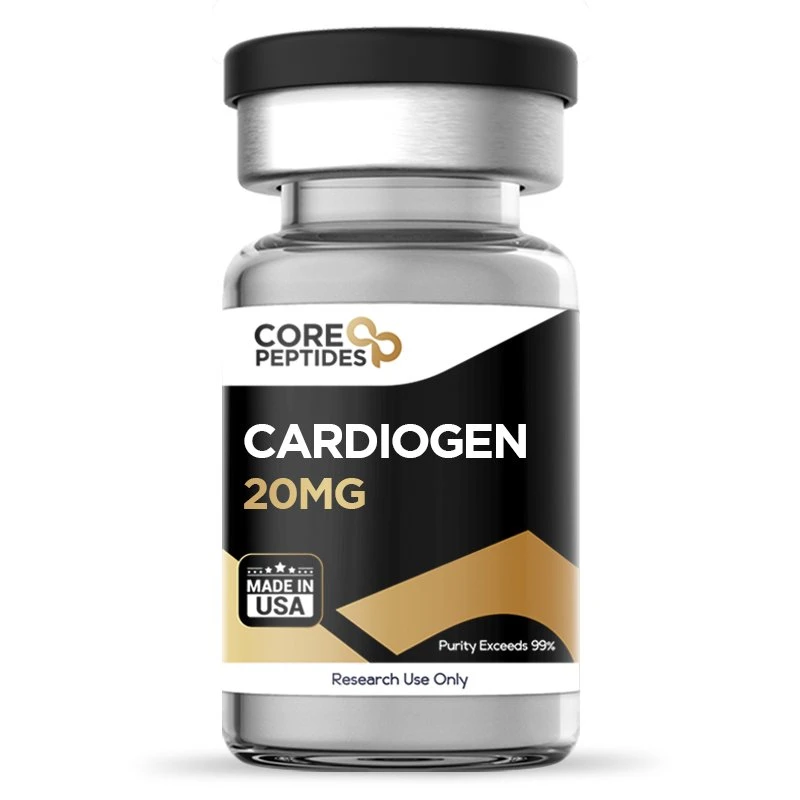

Cardiogen (20mg) – Research Peptide
Cardiogen (20mg) is a synthetic short peptide belonging to the group of peptide bioregulators investigated for their relationship with cardiovascular and cellular biology. Also known as Ala-Glu-Asp-Arg (AEDR), Cardiogen is a four-amino-acid peptide that has been studied in experimental models involving myocardial tissue, fibroblast activity, gene expression and cellular responses.
The referenced product is supplied as a 20mg lyophilised powder with a stated purity of >99%. Its molecular formula is C18H31N7O9, with an approximate molecular weight of 489.5 g/mol.
Research into Cardiogen remains experimental. Available evidence includes laboratory and preclinical studies examining cardiac-cell biology and related molecular processes, while robust human clinical evidence demonstrating safety or therapeutic efficacy is not established. Cardiogen should therefore be regarded as a research compound rather than an approved medicinal product.
What Is Cardiogen?
Cardiogen is a synthetic tetrapeptide with the amino-acid sequence Ala-Glu-Asp-Arg (AEDR). It is associated with the Khavinson family of short peptide bioregulators and has been investigated primarily in relation to cardiac and cellular research.
The peptide contains four amino acids:
- Ala: Alanine
- Glu: Glutamic acid
- Asp: Aspartic acid
- Arg: Arginine
The short sequence and defined molecular structure make Cardiogen useful as an experimental material for investigating how small peptides may interact with cellular and molecular processes.
Research interest has included possible relationships between Cardiogen and cardiac tissue, fibroblasts, apoptosis, gene regulation and tissue remodelling. However, these areas represent subjects of investigation rather than established therapeutic applications.
Cardiogen (20mg) Product Highlights
- Product name: Cardiogen
- Quantity: 20mg
- Alternative designation: AEDR
- Peptide classification: Synthetic tetrapeptide
- Amino-acid sequence: Ala-Glu-Asp-Arg
- Peptide length: 4 amino acids
- Form: Lyophilised powder
- Stated purity: >99%
- Molecular formula: C18H31N7O9
- Molecular weight: Approximately 489.5 g/mol
- Primary research area: Cardiovascular and myocardial cell biology
- Additional research areas: Fibroblast biology, apoptosis, gene expression and tissue remodelling
- Research status: Experimental / preclinical
- Intended purpose: Laboratory and scientific research
The product specifications above are based on the referenced Core Peptides listing.
Cardiogen Chemical Profile
| Property | Specification |
|---|---|
| Common name | Cardiogen |
| Alternative name | AEDR peptide |
| Sequence | Ala-Glu-Asp-Arg |
| Peptide length | 4 amino acids |
| Classification | Synthetic tetrapeptide |
| Molecular formula | C18H31N7O9 |
| Molecular weight | Approximately 489.5 g/mol |
| Product quantity | 20mg |
| Physical form | Lyophilised powder |
| Stated purity | >99% |
The molecular specifications correspond with the information provided by the referenced supplier listing.
Cardiogen and Cardiovascular Research
Cardiogen has primarily attracted research interest because of its proposed relationship with cardiovascular and myocardial tissue. Experimental studies have investigated whether the short peptide can influence cellular processes associated with cardiac tissue maintenance and response.
Research has included myocardial tissue-culture models in which investigators examined changes in cardiac-cell behaviour. The available literature suggests possible effects on cellular proliferation and survival, although the evidence base remains relatively small and requires further independent replication.
It is important to distinguish these experimental findings from clinical claims. Current evidence does not establish Cardiogen as a treatment for cardiovascular disease, heart failure, arrhythmias or other cardiac conditions.
Cardiogen and Myocardial Cell Research
Myocardial tissue consists primarily of cardiomyocytes together with fibroblasts, vascular cells and other supporting cell populations. Maintaining the balance between cellular proliferation, survival and extracellular-matrix activity is an important area of cardiovascular research.
Experimental Cardiogen research has investigated cellular responses in myocardial tissue cultures. Some studies have reported changes associated with cardiomyocyte proliferation and apoptosis, providing a basis for further investigation into short-peptide regulation of cardiac-cell biology.
However, available evidence is largely derived from experimental models rather than controlled human clinical research.
Cardiogen and Fibroblast Research
Fibroblasts are connective-tissue cells that contribute to extracellular-matrix production and tissue remodelling. Within cardiac tissue, fibroblast activity is particularly relevant to the formation and organisation of scar tissue following injury.
Cardiogen has been described as a peptide bioregulator potentially associated with fibroblast activity. Research has also examined the peptide in relation to fibroblast-related cellular processes outside the cardiovascular system.
These observations make Cardiogen relevant to experimental research investigating the relationship between short peptides, fibroblast behaviour and tissue remodelling.
Cardiogen and Apoptosis Research
Apoptosis is a regulated form of programmed cell death that plays an essential role in normal tissue development and cellular homeostasis.
Experimental Cardiogen research has examined pathways associated with apoptosis, including investigations into the tumour-suppressor protein p53. Some research has proposed that Cardiogen may influence p53-related signalling in particular experimental models.
Because p53 is involved in multiple biological processes, including cell-cycle regulation and programmed cell death, studying peptide interactions with this pathway may be relevant to cellular biology research.
These findings should not be interpreted as evidence that Cardiogen has an established anti-cancer or therapeutic effect in humans.
Cardiogen and Gene-Expression Research
Short peptide bioregulators have attracted interest for their proposed ability to influence cellular gene-regulatory processes. Cardiogen has similarly been investigated in relation to gene expression and molecular regulation.
The proposed mechanisms involve the possibility that very short peptides may interact with nucleic acids or nuclear proteins and thereby influence the expression of particular genes. Such mechanisms remain an area of experimental research.
Researchers should distinguish between experimentally observed molecular effects and established clinical mechanisms. Evidence for specific gene-regulatory activity does not demonstrate a predictable therapeutic outcome in humans.
Cardiogen and Cardiac Tissue Remodelling
Cardiac tissue remodelling involves changes to cardiomyocytes, fibroblasts, extracellular matrix and vascular structures. Following tissue injury, excessive fibroblast activity and extracellular-matrix deposition can contribute to structural changes in the myocardium.
Cardiogen research has therefore examined cellular pathways that may be relevant to tissue remodelling and fibroblast activity. This provides a potential experimental framework for studying how short peptides interact with cardiac-cell and connective-tissue biology.
However, there is currently insufficient evidence to conclude that Cardiogen prevents or reverses cardiac fibrosis or other forms of pathological remodelling in humans.
Cardiogen and Tumour Research
In addition to cardiovascular research, Cardiogen has been investigated in experimental tumour models. The referenced supplier describes research involving M-1 sarcoma in mice, in which investigators examined tumour growth and cellular apoptosis following experimental exposure to the peptide.
Reported observations included tumour necrosis, haemorrhagic changes and increased tumour-cell apoptosis. The research proposed that changes in the tumour’s vascular environment could contribute to the observed effects.
This area of research should be interpreted cautiously. A result observed in an animal tumour model does not establish that Cardiogen is an anti-cancer treatment or that similar effects would occur in humans.
Cardiogen and Cellular Signalling
One of the reasons short peptides such as Cardiogen are of interest to molecular researchers is their potential involvement in cellular signalling and gene regulation.
The peptide contains acidic residues, glutamic acid and aspartic acid, together with the basic amino acid arginine. Researchers have proposed that this molecular composition may influence interactions with nucleic acids or nuclear proteins.
Such proposed interactions provide potential avenues for studying peptide-mediated regulation at the cellular level. Nevertheless, the molecular mechanism of Cardiogen has not been comprehensively established.
Cardiogen as a Short Peptide Bioregulator
Cardiogen belongs to a family of very short synthetic peptides commonly described as peptide bioregulators. These compounds generally consist of only a small number of amino acids and have been investigated for their potential tissue-associated biological effects.
Cardiogen contains only four amino acids: Ala-Glu-Asp-Arg. Other members of the broader research family contain related sequences with different terminal amino acids. This structural relationship has contributed to interest in whether changes in short peptide sequences influence tissue-specific activity.
The proposed tissue specificity of Cardiogen remains an experimental concept rather than a clinically established property.
Cardiogen Research Applications
Cardiogen may be relevant to controlled laboratory investigations involving:
- Cardiac-cell biology: Investigation of myocardial cell responses in experimental models.
- Cardiomyocyte research: Study of cellular proliferation, survival and signalling.
- Fibroblast research: Investigation of connective-tissue cell activity and remodelling.
- Apoptosis research: Examination of programmed cell-death pathways.
- p53 research: Investigation of cellular pathways associated with p53 expression and regulation.
- Gene-expression research: Study of short-peptide interactions with cellular regulatory processes.
- Cardiac tissue research: Examination of myocardial tissue responses in controlled experimental systems.
- Extracellular-matrix research: Investigation of fibroblast-associated tissue remodelling.
- Tumour biology: Experimental investigation of peptide effects in animal tumour models.
- Peptide bioregulator research: Study of the biological activity of ultra-short peptide sequences.
Cardiogen (20mg) and Experimental Research
The 20mg quantity provides a defined amount of Cardiogen research material for laboratory applications. The quantity refers to the total peptide supplied and should not be interpreted as a human dose or treatment recommendation.
| Product Attribute | Specification |
|---|---|
| Peptide | Cardiogen |
| Sequence | Ala-Glu-Asp-Arg (AEDR) |
| Quantity | 20mg |
| Peptide length | 4 amino acids |
| Form | Lyophilised powder |
| Stated purity | >99% |
| Molecular formula | C18H31N7O9 |
| Molecular weight | 489.5 g/mol |
The product specifications are based on the referenced Core Peptides listing.
Understanding Lyophilised Cardiogen
The Cardiogen (20mg) formulation is supplied as lyophilised powder. Lyophilisation, commonly known as freeze-drying, is frequently used for laboratory peptide materials because it provides a dry preparation suitable for controlled storage and analytical workflows.
Researchers should follow the supplier’s product documentation and their own validated laboratory procedures when handling lyophilised peptide materials. Storage conditions can influence the stability of peptide preparations and should therefore be carefully controlled.
Cardiogen and Research Evidence
The scientific evidence surrounding Cardiogen is substantially more limited than that available for many established pharmaceutical compounds.
Recent reviews describe Cardiogen as a synthetic tetrapeptide whose cardiac evidence is based on a relatively small number of experimental studies, including myocardial tissue-culture research. There are currently no established human clinical trials demonstrating Cardiogen’s safety or therapeutic efficacy.
This distinction is particularly important when evaluating claims about cardiovascular benefits. Experimental observations can help researchers develop hypotheses, but they cannot substitute for appropriately controlled human clinical trials.
Cardiogen and Cardiovascular Health – Scientific Limitations
Cardiogen should not be presented as a proven cardiovascular treatment. Current evidence has several important limitations:
- Limited human evidence: Human clinical data are not established.
- Small experimental literature: The cardiac research base consists of a relatively limited number of studies.
- Limited independent replication: Recent evidence reviews highlight the lack of broad independent replication.
- Predominantly preclinical evidence: Much of the available research involves cells or animal models.
- Uncertain mechanism: Proposed molecular mechanisms require further validation.
- No established therapeutic protocol: A clinically validated human treatment regimen has not been established.
- Unknown long-term safety: Long-term human safety has not been adequately characterised.
Recent scientific commentary specifically describes the cardiovascular evidence as limited and notes the absence of human clinical trials and live-heart disease models.
Cardiogen and Fibroblast Biology
Fibroblasts contribute to the formation and maintenance of connective tissue. Within the heart, cardiac fibroblasts participate in extracellular-matrix production and tissue remodelling.
Because Cardiogen has been investigated in relation to fibroblast activity, the peptide may provide an experimental model for examining how short peptide sequences influence connective-tissue cell behaviour.
Researchers can investigate fibroblast proliferation, gene expression, extracellular-matrix markers and cellular signalling under controlled experimental conditions without assuming that observations automatically translate into clinical outcomes.
Cardiogen and Apoptosis: Research Context
Programmed cell death, or apoptosis, is essential for maintaining cellular balance. Abnormal regulation of apoptosis is relevant to numerous areas of biomedical research, including cardiovascular biology and oncology.
Cardiogen has been investigated in experimental models in which researchers examined markers associated with apoptosis and p53 signalling. This has generated interest in whether the peptide could influence cell-survival pathways under specific experimental conditions.
However, the relationship between Cardiogen and apoptosis is not sufficiently characterised to support clinical claims. Findings should be interpreted within the specific experimental models in which they were observed.
Cardiogen and Gene Regulation Research
Short peptides are being investigated in molecular biology for their potential interactions with DNA, chromatin and regulatory proteins. Cardiogen’s small size makes it an interesting candidate for this type of research.
The peptide’s sequence contains both acidic and basic amino-acid residues, a characteristic that has prompted hypotheses concerning interactions with nucleic acids and nuclear components.
Researchers should note that proposed molecular mechanisms for Cardiogen are not equivalent to clinically validated mechanisms of action. Further biochemical and molecular studies are required to determine how the peptide behaves at the molecular level.
Cardiogen Research Quality and Analytical Testing
Reliable peptide research requires confidence in the identity and purity of the experimental material. Analytical characterisation can help researchers determine whether a peptide preparation corresponds to its stated molecular identity.
Common analytical techniques include:
- High-performance liquid chromatography (HPLC): Used to evaluate peptide purity and chromatographic profile.
- Mass spectrometry: Used to support molecular-weight and identity confirmation.
- Certificate of Analysis: Provides batch-specific analytical information where available.
- Lot documentation: Helps maintain traceability and experimental reproducibility.
The referenced Core Peptides listing provides HPLC and mass-spectrometry documentation for the product. :contentReference[oaicite:15]{index=15}
Frequently Asked Questions About Cardiogen (20mg)
What is Cardiogen?
Cardiogen is a synthetic tetrapeptide commonly identified by the sequence Ala-Glu-Asp-Arg (AEDR). It has been studied as a short peptide bioregulator with a particular focus on cardiac and cellular research.
What does AEDR mean?
AEDR represents the four amino acids that make up Cardiogen: Alanine, Glutamic acid, Aspartic acid and Arginine.
How many amino acids are in Cardiogen?
Cardiogen is a tetrapeptide, meaning that it contains four amino acids.
What is Cardiogen studied for?
Research has examined Cardiogen in areas including myocardial tissue biology, fibroblast activity, apoptosis, gene expression and experimental tumour biology.
What is the Cardiogen (20mg) product?
It is a 20mg research preparation containing Cardiogen peptide in lyophilised powder form.
What is the stated purity of Cardiogen (20mg)?
The referenced product listing states a purity of greater than 99%.
What is the molecular weight of Cardiogen?
Cardiogen has a molecular weight of approximately 489.5 g/mol, according to the referenced product information.
Is Cardiogen an approved medicine?
No. Cardiogen is an experimental research peptide and is not established as an approved medicinal treatment.
Has Cardiogen been clinically proven for cardiovascular conditions?
No. Current evidence does not establish Cardiogen as a clinically proven treatment for cardiovascular disease. Recent reviews note the absence of human clinical trials specifically establishing Cardiogen’s efficacy.
Is Cardiogen an anti-cancer treatment?
No. Although Cardiogen has been investigated in experimental tumour models, these findings do not establish it as an anti-cancer medicine or treatment for cancer in humans.
What form is Cardiogen supplied in?
The referenced 20mg product is supplied as a lyophilised powder. :contentReference[oaicite:20]{index=20}
Does 20mg refer to a recommended human dose?
No. The 20mg figure represents the amount of research material supplied in the product and should not be interpreted as a human dosage recommendation.
Why is Cardiogen of interest to researchers?
Its defined four-amino-acid structure and proposed relationship with cardiac-cell biology, fibroblasts, apoptosis and gene regulation make Cardiogen an interesting subject for experimental peptide research.
Cardiogen (20mg) Research Summary
Cardiogen (20mg) is a synthetic tetrapeptide with the sequence Ala-Glu-Asp-Arg (AEDR). It belongs to the short peptide bioregulator research field and has attracted scientific interest primarily because of its proposed relationship with cardiovascular and myocardial tissue.
Experimental research has investigated Cardiogen in areas including myocardial cell biology, fibroblast activity, apoptosis, p53-related signalling, gene expression, tissue remodelling and tumour biology. These studies provide potential avenues for further research into short peptide regulation of cellular processes.
At the same time, the current evidence base is limited. Recent reviews describe the cardiac literature as consisting of a small number of preclinical studies and highlight the absence of human clinical trials and independent replication.
The referenced product is supplied as 20mg of lyophilised Cardiogen powder with a stated purity above 99%, making it a defined material for laboratory and analytical research.
Research-Use Disclaimer
Cardiogen (20mg) is intended for laboratory and research use only. It is not a medicine, dietary supplement, food product or approved treatment.
The information provided in this description summarises areas of scientific investigation and should not be interpreted as evidence that Cardiogen can diagnose, treat, cure or prevent any disease or medical condition.
Available evidence concerning Cardiogen is predominantly preclinical, and controlled human clinical evidence establishing its safety, efficacy, pharmacokinetics or therapeutic dosing is not currently established.
This description does not provide instructions for human administration, dosing, injection, reconstitution for human use or self-experimentation. Researchers should consult relevant scientific literature, batch-specific analytical documentation, institutional procedures and applicable laws and regulations when working with experimental peptide materials.
Be the first to review “Cardiogen (20mg)”
Related products
Peptides for Sale
Peptides for Sale
Peptides for Sale
Peptides for Sale
Peptides for Sale

Peptide Blends for Sale
Peptides for Sale
Peptides for Sale
Reviews
There are no reviews yet.