
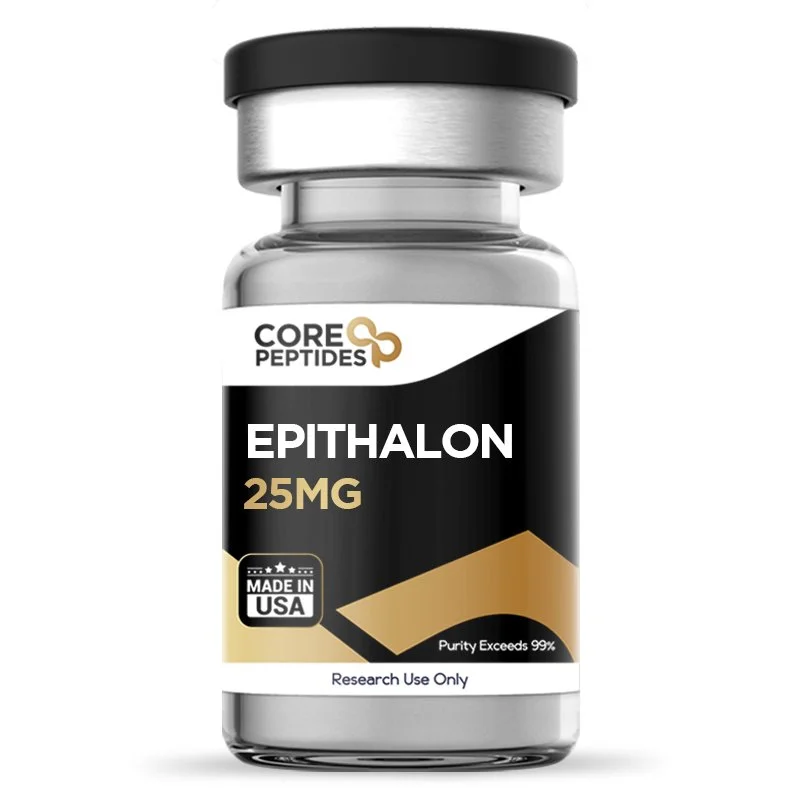


Epithalon (25mg) – Synthetic Tetrapeptide for Research
Epithalon (25mg), also known as Epitalon, Epithalone or the AEDG peptide, is a synthetic tetrapeptide consisting of the amino-acid sequence Ala-Glu-Asp-Gly. It was developed from research into peptide compounds associated with the pineal gland and has become a subject of investigation in ageing biology, telomere research, cellular senescence, circadian biology and neuroendocrine research.
The referenced product contains 25mg of Epithalon in a lyophilised powder format, with the supplier listing a stated purity of >99%. It is presented as a research material for laboratory and scientific applications.
Epithalon has attracted particular scientific interest because experimental research has investigated its potential relationship with telomerase activity, telomere length, melatonin production, circadian rhythms, oxidative stress and cellular ageing mechanisms. More recent research has continued to examine the peptide in human cell models, including investigations into telomerase and telomere biology.
What Is Epithalon?
Epithalon is a short synthetic peptide made up of four amino acids: alanine, glutamic acid, aspartic acid and glycine. Its sequence is commonly abbreviated as AEDG.
The peptide was developed from research into Epithalamin, a peptide preparation associated with the pineal gland. Modern scientific literature describes Epitalon as a synthetic tetrapeptide based on the amino-acid composition of Epithalamin.
Because of its origin in pineal peptide research, Epithalon has been investigated in connection with biological processes involving the pineal gland, including melatonin production and circadian regulation. Other research has focused on cellular ageing, telomerase activity and telomere maintenance.
Epithalon (25mg) Product Highlights
- Product name: Epithalon
- Alternative names: Epitalon, Epithalone, AEDG peptide
- Quantity: 25mg
- Peptide classification: Synthetic tetrapeptide
- Peptide sequence: Ala-Glu-Asp-Gly
- Abbreviation: AEDG
- Physical form: Lyophilised powder
- Stated purity: >99%
- Primary research areas: Ageing biology and telomere research
- Additional research areas: Pineal biology, melatonin, circadian rhythms and cellular senescence
- Intended application: Laboratory and scientific research
The 25mg quantity, lyophilised format and stated purity are based on the referenced Core Peptides product listing.
Epithalon Peptide Sequence
Epithalon is a particularly short peptide consisting of only four amino acids:
Ala-Glu-Asp-Gly
| Property | Details |
|---|---|
| Peptide | Epithalon |
| Alternative name | Epitalon |
| Sequence | Ala-Glu-Asp-Gly |
| Sequence abbreviation | AEDG |
| Peptide length | 4 amino acids |
| Molecular formula | C14H22N4O9 |
| Molecular weight | 390.34 g/mol |
| Quantity | 25mg |
| Physical form | Lyophilised powder |
| Stated purity | >99% |
The sequence, molecular formula and molecular weight correspond with the referenced product information.
Epithalon and Pineal Gland Research
The pineal gland is a small endocrine structure in the brain that plays an important role in the regulation of melatonin secretion and biological timing.
Epithalon was developed from research into peptide preparations associated with the pineal gland. Consequently, much of the early scientific interest surrounding the compound concerned the potential relationship between pineal peptides, melatonin production and age-related changes in neuroendocrine function.
Research has investigated whether Epitalon can influence pineal function and circadian hormone patterns. A study indexed by PubMed reported research into the effects of Epitalon and Epithalamin on the daily melatonin rhythm in older monkeys and elderly people.
These findings provide a scientific basis for continued investigation into the relationship between short pineal-derived peptides and biological timing mechanisms, although they should not be interpreted as proof of a therapeutic effect from every Epithalon preparation.
Epithalon and Telomerase Research
One of the most prominent areas of modern Epithalon research concerns telomerase and telomere biology.
Telomeres are protective DNA-protein structures located at the ends of chromosomes. They help protect chromosome ends during cell division. Telomerase is an enzyme complex capable of maintaining or extending telomeric DNA in certain cell types.
Research has investigated whether Epitalon can influence telomerase activity and related molecular pathways. A 2025 review summarised research reporting effects on telomerase, while also noting that the precise mechanisms underlying the peptide’s biological activity remain incompletely understood.
A separate 2025 study investigated Epitalon in several human cell lines and reported dose-dependent telomere length increases in normal cells alongside increased expression of hTERT and telomerase activity. The same study observed alternative lengthening of telomeres in certain cancer cell lines, highlighting why telomere biology requires careful interpretation and further investigation.
These findings are scientifically relevant but should not be presented as evidence that Epithalon has been established as an anti-ageing treatment in humans.
Epithalon and Telomere Biology
Telomere length is one of several biological characteristics studied in connection with cellular ageing. Telomeres generally shorten during repeated cell division in many somatic cells, although the relationship between telomere length, ageing and disease is complex.
Epithalon has become a research interest because studies have explored whether it can affect pathways associated with telomerase and telomere maintenance.
Current research questions include:
- Whether Epithalon alters telomerase activity in specific cell types.
- Whether the peptide affects hTERT gene expression.
- Whether changes in telomerase activity translate into measurable changes in telomere length.
- Whether responses differ between normal and transformed cells.
- Which molecular pathways are responsible for observed effects.
The recent human-cell study provides additional data for these questions, but it remains laboratory research rather than definitive evidence of a clinical longevity effect.
Epithalon and Cellular Ageing Research
Cellular ageing, or senescence, is a complex biological process involving changes in cell proliferation, gene expression, metabolism, DNA maintenance and cellular signalling.
Epithalon has been investigated as part of broader research into compounds that may influence age-associated cellular pathways. A recent review described research involving antioxidant, neuroprotective and antimutagenic properties, alongside investigations into telomerase and other cellular processes.
Researchers therefore study Epithalon not as a single-purpose compound but as a potential experimental tool for investigating several interconnected aspects of ageing biology.
Epithalon and Melatonin Research
Melatonin is a hormone produced primarily by the pineal gland and is closely involved in the regulation of the sleep-wake cycle and circadian timing.
Because Epithalon originated from pineal peptide research, investigators have examined its potential relationship with melatonin production and circadian hormone rhythms.
Earlier research involving pineal peptide preparations reported effects on the night-time release of endogenous melatonin and the circadian rhythm of melatonin in older subjects.
The relationship between Epithalon and melatonin remains an area of scientific interest, particularly in research examining age-associated changes in pineal function.
Epithalon and Circadian Rhythm Research
The circadian rhythm is an approximately 24-hour biological timing system that influences sleep-wake cycles, hormone secretion, body temperature and numerous metabolic processes.
Ageing can be associated with changes in circadian organisation and hormone rhythms. Consequently, researchers have investigated pineal peptides such as Epithalon in relation to these processes.
Experimental research has reported effects involving melatonin and cortisol rhythms in ageing models, while earlier reviews described Epitalon’s relationship with circadian regulation.
These observations make Epithalon relevant to experimental research into the interaction between peptide signalling, the pineal gland and biological timing.
Epithalon and Oxidative Stress Research
Oxidative stress occurs when the production of reactive molecules exceeds the capacity of biological systems to neutralise them effectively.
Oxidative stress is an important research topic in ageing biology because it has been associated with cellular damage and changes in multiple biological pathways.
The 2025 scientific review of Epitalon describes research investigating antioxidant-related properties of the peptide. However, the review also emphasises that the precise mechanisms behind the compound’s various reported effects are not fully established.
Consequently, Epithalon remains an experimental subject for investigating the relationship between short peptides and cellular stress responses.
Epithalon and Neuroendocrine Research
The neuroendocrine system connects the nervous and endocrine systems and regulates processes including hormone secretion, metabolism, stress responses and biological timing.
Because the pineal gland is part of this wider neuroendocrine network, Epithalon has been investigated in research exploring age-related neuroendocrine changes.
Scientific literature has described research involving melatonin, cortisol and other endocrine markers in relation to pineal peptide preparations.
This makes Epithalon relevant to laboratory investigations into the interaction between peptide signalling, endocrine function and ageing.
Epithalon and Retina Research
Epithalon research has also extended beyond the pineal gland. The peptide has been investigated in relation to the retina, partly because the pineal gland and retina share developmental and biological characteristics.
Experimental research has investigated Epitalon in models of retinal degeneration. One PubMed-indexed study reported research involving congenital retinal degeneration and described effects on retinal bioelectric and functional activity in animal models, as well as observations in patients with retinal lesions.
These historical findings are of scientific interest but should not be interpreted as establishing Epithalon as an approved treatment for retinal disease.
Epithalon in Longevity Research
Epithalon is frequently discussed in the context of longevity research because of experimental findings involving telomerase, telomeres, pineal function and ageing-related biological processes.
Animal and cellular studies have investigated whether Epitalon can influence markers associated with ageing. Earlier literature reported lifespan-related observations in experimental organisms, while more recent research has focused on molecular mechanisms such as telomerase activity and telomere maintenance.
It is important, however, to distinguish longevity research from a proven human anti-ageing intervention. The current evidence does not establish that an Epithalon product will extend human lifespan.
Potential Research Applications of Epithalon
Due to its diverse research history, Epithalon may be investigated in several laboratory fields:
- Telomere biology: Investigation of telomere length and maintenance.
- Telomerase research: Study of telomerase activity and hTERT expression.
- Cellular ageing: Investigation of senescence and age-associated cellular changes.
- Pineal biology: Research into pineal peptide signalling.
- Melatonin research: Investigation of melatonin secretion and circadian patterns.
- Circadian biology: Study of biological timing and hormone rhythms.
- Oxidative stress: Investigation of cellular responses to oxidative challenges.
- Neuroendocrine research: Study of interactions between peptide and endocrine signalling.
- Retinal research: Experimental investigation of retinal integrity and function.
- Ageing biology: Investigation of molecular and physiological characteristics associated with ageing.
Epithalon (25mg) Research Specifications
| Specification | Details |
|---|---|
| Product | Epithalon |
| Alternative names | Epitalon, Epithalone, AEDG peptide |
| Quantity | 25mg |
| Peptide type | Synthetic tetrapeptide |
| Sequence | Ala-Glu-Asp-Gly |
| Sequence abbreviation | AEDG |
| Number of amino acids | 4 |
| Molecular formula | C14H22N4O9 |
| Molecular weight | 390.34 g/mol |
| Physical form | Lyophilised powder |
| Stated purity | >99% |
| Primary research areas | Ageing, telomeres and telomerase |
| Additional research areas | Pineal biology, melatonin, circadian rhythms and cellular research |
The product specifications are based on the referenced Core Peptides listing.
Lyophilised Epithalon Powder
The referenced Epithalon (25mg) product is supplied as a lyophilised powder. Lyophilisation, or freeze-drying, is widely used for laboratory peptide materials because it produces a dry preparation that can be more convenient for controlled storage and analytical handling.
Researchers should follow the supplier’s batch-specific documentation and appropriate laboratory procedures when handling peptide materials.
This product description does not provide instructions for reconstitution, dosing, injection or human administration.
Epithalon Purity and Analytical Research
Reliable peptide research depends on accurate identification and characterisation of the material being investigated.
The referenced product listing states a purity of >99%.
Depending on the research application, peptide identity and purity can be assessed using analytical methods such as high-performance liquid chromatography (HPLC) and mass spectrometry (MS).
Researchers should consult the relevant batch-specific Certificate of Analysis where available rather than relying solely on a general product specification.
What Makes Epithalon Interesting for Research?
Epithalon is unusual among short research peptides because a very small four-amino-acid sequence has been investigated across several biological systems.
Its research profile combines:
- A well-defined four-amino-acid sequence.
- A history rooted in pineal peptide research.
- Investigations into melatonin and circadian rhythms.
- Research involving telomerase and telomere biology.
- Cellular and animal studies examining ageing-related mechanisms.
- Recent human-cell research providing additional information about telomere-related pathways.
A 2025 review highlights the extensive experimental literature surrounding Epitalon while also noting that important questions remain regarding its precise molecular mechanisms.
Current Research and Evidence
Epithalon research spans several decades, but the evidence base should be considered in terms of the type and quality of each study.
| Research area | Type of evidence | Scientific interest |
|---|---|---|
| Telomerase | Cellular and experimental research | hTERT expression and telomerase activity |
| Telomeres | Cellular research | Telomere length and maintenance |
| Melatonin | Animal and human research | Pineal hormone rhythms |
| Circadian rhythms | Animal and human research | Biological timing |
| Ageing biology | Preclinical and cellular research | Age-associated biological changes |
| Retina | Experimental and clinical research | Retinal function and degeneration |
The most recent literature continues to expand the molecular understanding of Epitalon, including research into telomere length, telomerase and cellular responses.
Limitations of Epithalon Research
Although Epithalon has a substantial research history, several limitations should be considered when evaluating the scientific evidence.
- Different research models: Results from cell cultures, animals and humans cannot automatically be considered equivalent.
- Historical evidence: A significant proportion of the literature originates from earlier decades.
- Limited large-scale modern trials: Evidence supporting broad clinical claims remains insufficient.
- Mechanistic uncertainty: The complete molecular mechanism of Epithalon has not been definitively established.
- Cell-specific effects: Responses to telomerase-related pathways can differ between normal and transformed cells.
- Product-specific variation: Research performed with one preparation does not necessarily apply to every Epithalon product.
The 2025 review specifically notes that, despite extensive research into the biological and pharmacodynamic characteristics of Epitalon, important aspects of its physicochemical and structural biology remain comparatively limited.
Frequently Asked Questions About Epithalon (25mg)
What is Epithalon?
Epithalon, also known as Epitalon or Epithalone, is a synthetic tetrapeptide consisting of the amino-acid sequence Ala-Glu-Asp-Gly (AEDG). It was developed from research into pineal peptide preparations.
What is the Epithalon peptide sequence?
The sequence is Ala-Glu-Asp-Gly, commonly abbreviated as AEDG.
What does the 25mg specification mean?
The 25mg specification refers to the quantity of Epithalon research material supplied. It should not be interpreted as a recommended human dose.
What is Epithalon researched for?
Research areas include telomerase and telomere biology, cellular ageing, pineal function, melatonin, circadian rhythms, oxidative stress and neuroendocrine processes.
Why is Epithalon associated with telomeres?
Experimental research has investigated whether Epithalon can influence telomerase activity and telomere length. A 2025 study reported telomere-length changes and increased hTERT/telomerase activity in certain normal human cell models.
Has Epithalon been studied in humans?
Yes. Earlier research investigated pineal peptide preparations and Epitalon in human subjects, including studies examining melatonin rhythms and retinal conditions. However, the existing clinical literature should not be equated with modern evidence establishing Epithalon as an approved medical treatment.
Is Epithalon the same as Epitalon?
Yes. Epithalon and Epitalon are commonly used names for the same synthetic tetrapeptide, with Epithalone and AEDG peptide also appearing in scientific and commercial literature.
What is the molecular weight of Epithalon?
The molecular weight listed for Epithalon is approximately 390.34 g/mol.
What form is Epithalon (25mg) supplied in?
The referenced product is supplied as a lyophilised powder.
What is the stated purity of Epithalon (25mg)?
The referenced Core Peptides listing states a purity of >99%. Researchers should refer to batch-specific analytical documentation where available.
Is Epithalon an approved anti-ageing treatment?
The research literature does not establish the isolated Epithalon research material as an approved anti-ageing medicine. Experimental findings involving telomerase, telomeres or animal longevity should not be presented as proof of human lifespan extension.
Is Epithalon intended for human consumption?
No. The referenced product is presented as a research material for laboratory and scientific applications, not as a food, dietary supplement or approved medicinal product.
Epithalon (25mg) Research Summary
Epithalon (25mg) is a synthetic tetrapeptide with the sequence Ala-Glu-Asp-Gly (AEDG). Also known as Epitalon and Epithalone, it originated from research into pineal gland peptide biology and has subsequently become a prominent subject in experimental ageing and longevity research.
Research has examined Epithalon in relation to telomerase activity, telomere maintenance, melatonin production, circadian rhythms, oxidative stress, cellular ageing and neuroendocrine function. More recent laboratory research has provided additional evidence concerning telomerase and telomere-related effects in human cell models.
Earlier studies have also investigated the peptide in relation to pineal function and retinal biology. These findings contribute to the scientific interest surrounding Epithalon but do not establish the research material as a proven therapy for ageing, sleep disorders, retinal disease or other medical conditions.
For researchers working in ageing biology, telomere research, cellular senescence, pineal physiology, circadian biology and peptide science, Epithalon provides a well-defined four-amino-acid model for controlled laboratory investigation.
Research-Use Disclaimer
Epithalon (25mg) is intended for laboratory and scientific research purposes only. It is not a medicine, dietary supplement, food product or approved therapeutic treatment.
The information provided in this product description is intended for scientific and educational purposes. Experimental findings involving Epithalon should not be interpreted as evidence that the isolated research material can diagnose, treat, cure or prevent any disease or medical condition.
Findings from cellular, animal or historical human studies should not automatically be attributed to a specific Epithalon preparation, as results can depend on peptide quality, experimental model, formulation and study conditions.
This description does not provide instructions for human administration, dosing, injection, reconstitution for human use or self-experimentation. Researchers should consult relevant scientific literature, batch-specific analytical documentation, institutional laboratory procedures and applicable laws and regulations when working with experimental peptide materials.
Be the first to review “Epithalon (25mg)”
Related products
Peptides for Sale

Peptides for Sale
Peptides for Sale

Peptide Blends for Sale
Peptides for Sale
Peptides for Sale
Peptides for Sale
Peptides for Sale
Reviews
There are no reviews yet.