
ACE-031 (1mg) Peptide – Research-Grade ActRIIB Research Compound
ACE-031 (1mg) is a research compound associated with the activin receptor type IIB (ActRIIB/ACVR2B) pathway and the study of myostatin and related signalling mechanisms involved in skeletal-muscle biology. It is a soluble ActRIIB-IgG1 fusion protein that has been investigated for its ability to bind myostatin and other ligands within the transforming growth factor-beta (TGF-β) superfamily.
The compound has attracted scientific interest because ActRIIB signalling plays an important role in the regulation of muscle growth. Preclinical and early clinical research has examined ACE-031 in relation to lean body mass, muscle volume, bone metabolism and other physiological pathways. However, ACE-031 is not an approved medicine, and clinical development was discontinued after safety concerns emerged in a study involving boys with Duchenne muscular dystrophy (DMD).
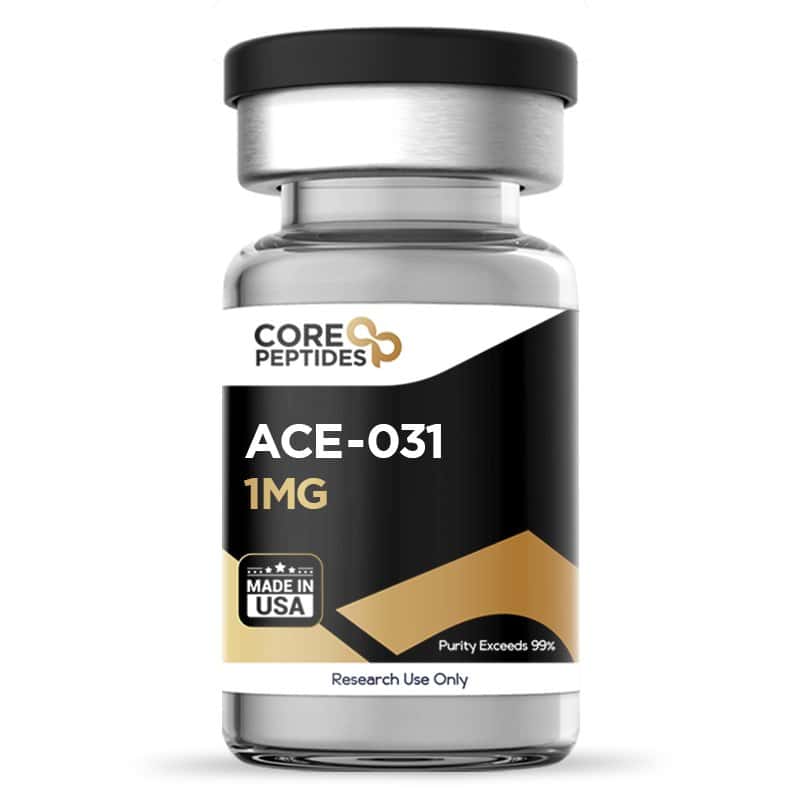
The Core Peptides ACE-031 (1mg) listing describes the product as a 1mg lyophilised powder with a stated purity of >99% and SKU P-ACE031-1. The supplier specifies that its ACE-031 material is intended exclusively for research, laboratory and in vitro applications and is not intended for human or veterinary consumption.
What Is ACE-031 Peptide?
ACE-031 is a recombinant soluble form of activin receptor type IIB (ActRIIB). Rather than being a conventional short-chain peptide, it is a larger fusion protein incorporating an ActRIIB extracellular domain and an immunoglobulin G1 Fc region. For this reason, ACE-031 is more accurately described scientifically as an ActRIIB-Fc fusion protein or soluble receptor fusion protein.
The compound was developed as a potential regulator of signalling pathways involved in muscle growth. ActRIIB interacts with several ligands, including myostatin (GDF-8), activins and other members of the TGF-β superfamily. ACE-031 was investigated because its soluble receptor structure can bind circulating ligands and alter their interaction with endogenous receptors.
This mechanism made ACE-031 an important research tool for studying how ActRIIB-associated signalling influences muscle and other biological systems.
ACE-031 (1mg) Product Highlights
- Product: ACE-031
- Quantity: 1mg
- Product type: ActRIIB-IgG1 fusion protein
- Alternative designation: Soluble activin receptor type IIB (ActRIIB-Fc)
- Form: Lyophilised powder
- Stated purity: >99%
- SKU: P-ACE031-1
- Research classification: Laboratory and in vitro research material
- Human use: Not intended for human consumption
- Veterinary use: Not intended for veterinary consumption
These specifications are based on the ACE-031 (1mg) product information published by Core Peptides.
How Does ACE-031 Work?
ACE-031 is primarily studied through its interaction with the ActRIIB signalling pathway. ActRIIB is a receptor involved in signalling from several TGF-β superfamily ligands, including myostatin. Myostatin is also known as growth and differentiation factor 8 (GDF-8) and is recognised as an important negative regulator of skeletal-muscle growth.
In research models, ACE-031 functions as a soluble receptor that can bind myostatin and other relevant ligands before they interact with cell-surface receptors. This makes it useful for investigating how disruption of ActRIIB-associated signalling affects muscle biology.
Importantly, ACE-031 is not a selective myostatin-only inhibitor. Its interaction with multiple ligands helps explain both the scientific interest surrounding the compound and the safety concerns observed during clinical development.
ACE-031 and Myostatin Research
Myostatin is a member of the TGF-β superfamily that acts as a regulator of skeletal-muscle growth. It interacts with receptors including ActRIIB and contributes to signalling pathways involving intracellular Smad proteins.
Because ACE-031 can bind myostatin and other ActRIIB ligands, researchers have investigated whether disrupting this signalling pathway can alter muscle mass and related biological processes. Early human research demonstrated measurable changes in lean body mass and muscle volume following exposure to ACE-031 in healthy volunteers.
These observations helped establish ACE-031 as a significant research compound for studying the relationship between ActRIIB signalling and muscle physiology.
ACE-031 and Muscle Biology Research
One of the principal areas of ACE-031 research has been skeletal-muscle biology. A double-blind, placebo-controlled study involving healthy postmenopausal women evaluated single doses ranging from 0.02 to 3mg/kg and assessed pharmacokinetic and pharmacodynamic outcomes.
In the highest-dose group, researchers reported statistically significant increases in total body lean mass and thigh muscle volume at day 29. The study reported a 3.3% increase in total body lean mass and a 5.1% increase in thigh muscle volume in the 3mg/kg group.
These findings demonstrate biological activity in a controlled research setting, but they do not establish ACE-031 as a safe or effective treatment for muscle-related conditions or for general muscle enhancement.
ACE-031 Research in Duchenne Muscular Dystrophy
ACE-031 was also investigated in boys with Duchenne muscular dystrophy, a genetic disorder characterised by progressive muscle weakness. A randomised, double-blind, placebo-controlled study examined the compound’s safety, tolerability, pharmacokinetics and pharmacodynamics.
The study was ultimately stopped because of potential safety concerns. Published results identified epistaxis (nosebleeds) and telangiectasias among the concerns associated with treatment, contributing to the decision to discontinue the study.
The trial did report trends involving lean body mass, bone mineral density, fat mass and the six-minute walk test, but these findings did not overcome the safety issues that led to discontinuation.
This clinical history is particularly important when evaluating ACE-031: the compound has demonstrated measurable biological effects, but its development as a therapeutic candidate was halted because its broader biological activity created safety concerns.
ACE-031 Safety and Clinical Development
ACE-031 should not be presented simply as a muscle-growth compound without acknowledging its clinical safety history. The compound’s ability to interact with multiple ActRIIB ligands was central to its research rationale, but broad ligand binding may also influence physiological pathways beyond myostatin.
In the clinical study involving boys with Duchenne muscular dystrophy, treatment was stopped after safety concerns including nosebleeds and telangiectasias emerged. The published trial concluded that non-muscle-related adverse events contributed to the decision to discontinue the study.
As a result, ACE-031 should be treated as an experimental research compound rather than an established therapeutic. No claims of human safety, efficacy or appropriate clinical use should be inferred from preclinical findings.
ACE-031 Pharmacokinetic Research
Pharmacokinetic analysis has also been an important part of ACE-031 research. In the single-dose study conducted in healthy volunteers, the reported mean terminal half-life was approximately 10–15 days, with exposure increasing in relation to dose.
These findings are useful for researchers investigating the duration and biological behaviour of the compound in controlled experimental settings. They should not, however, be interpreted as a recommendation for human dosing or administration.
ACE-031 and Bone Research
Beyond skeletal-muscle research, the ActRIIB pathway has been investigated in relation to bone metabolism. Experimental research has examined how modulation of ActRIIB-associated signalling may affect bone mass and bone-related biomarkers.
Core Peptides’ product literature discusses preclinical research reporting changes in bone parameters in animal models exposed to ACE-031. Such findings have contributed to interest in the broader relationship between ActRIIB signalling, muscle and skeletal biology.
These observations remain experimental and should not be interpreted as evidence that ACE-031 is an established treatment for osteoporosis, low bone density or other skeletal disorders.
ACE-031 and Metabolic Research
Researchers have also examined the potential effects of ActRIIB pathway modulation on metabolic processes. Changes in fat mass, energy metabolism and related biomarkers have been reported in experimental research involving ACE-031.
Such findings illustrate the broad biological consequences that can arise from altering TGF-β superfamily signalling. They also reinforce why ACE-031 should not be characterised solely as a myostatin-specific compound.
ACE-031 Research Applications
Because ACE-031 interacts with the ActRIIB signalling system, it can be relevant to laboratory investigations covering several areas of molecular and cellular biology.
- Myostatin research: Investigation of GDF-8 signalling and its role in muscle regulation.
- ActRIIB biology: Study of receptor-mediated signalling within the TGF-β superfamily.
- Skeletal-muscle research: Examination of pathways associated with muscle growth and maintenance.
- Muscle-wasting models: Experimental investigation of mechanisms associated with loss of muscle mass.
- Bone biology: Research into relationships between ActRIIB signalling and skeletal tissue.
- Metabolic research: Investigation of changes in fat metabolism and related biomarkers.
- Signal-transduction studies: Examination of pathways downstream of activin and myostatin receptors.
- Comparative research: Evaluation of ActRIIB pathway modulation alongside other experimental compounds.
ACE-031 (1mg) vs Short-Chain Research Peptides
ACE-031 is sometimes grouped together with research peptides, but its molecular structure is substantially different from many conventional laboratory peptides.
| Characteristic | ACE-031 |
|---|---|
| Molecular type | Recombinant soluble receptor fusion protein |
| Receptor component | Activin receptor type IIB (ActRIIB) |
| Fc component | Human IgG1 Fc domain |
| Primary research pathway | ActRIIB / TGF-β superfamily signalling |
| Key research target | Myostatin and related ligands |
| Product quantity | 1mg |
| Physical form | Lyophilised powder |
| Stated purity | >99% |
| Intended application | Laboratory and in vitro research |
Because ACE-031 is a fusion protein rather than a simple short peptide, researchers should consider its molecular structure when designing analytical or biological experiments.
ACE-031 (1mg) Quality and Specifications
| Specification | Details |
|---|---|
| Product name | ACE-031 (1mg) |
| Contents | ACE-031, 1mg |
| Form | Lyophilised powder |
| Stated purity | >99% |
| SKU | P-ACE031-1 |
| Research category | Peptides / research compounds |
| Intended use | Research, laboratory and in vitro applications only |
The product specifications above are based on Core Peptides’ ACE-031 (1mg) listing.
Why Is ACE-031 Important in Peptide Research?
ACE-031 is scientifically interesting because it provides a way to investigate the consequences of modifying signalling through the ActRIIB receptor system. Rather than targeting a single downstream process, the compound interacts with multiple ligands associated with the TGF-β superfamily.
This broad mechanism has made ACE-031 valuable in research exploring the connections between myostatin, muscle tissue, bone metabolism and other biological processes. At the same time, the same broad activity provides an important lesson in drug development: altering a central biological signalling pathway can produce effects beyond the intended target.
For researchers, ACE-031 therefore represents both a tool for studying muscle-regulatory biology and a case study in the challenges associated with systemic ActRIIB pathway modulation.
Frequently Asked Questions About ACE-031 (1mg)
What is ACE-031?
ACE-031 is a soluble form of activin receptor type IIB (ActRIIB) fused to an IgG1 Fc domain. It has been investigated as a regulator of myostatin and related TGF-β superfamily signalling.
Is ACE-031 a peptide?
ACE-031 is commonly sold within research-peptide catalogues, but structurally it is more accurately described as a recombinant ActRIIB-IgG1 Fc fusion protein rather than a conventional short peptide.
What is ACE-031 used for in research?
ACE-031 has been investigated in studies involving myostatin signalling, skeletal-muscle biology, muscle mass, bone metabolism and related ActRIIB pathways. Research has included both animal models and human clinical studies.
Does ACE-031 inhibit myostatin?
ACE-031 can bind myostatin and other ligands associated with ActRIIB signalling. It is therefore studied as a soluble receptor-based approach to modifying myostatin-related signalling. However, it should not be described as a selective myostatin-only inhibitor.
What does the 1mg designation mean?
The 1mg designation refers to the quantity of ACE-031 supplied in the listed product format. It is a product quantity, not a recommended clinical dose or dosing instruction.
Has ACE-031 been studied in humans?
Yes. ACE-031 was evaluated in clinical research involving healthy volunteers and boys with Duchenne muscular dystrophy. A single-dose study in healthy postmenopausal women reported increases in lean body mass and thigh muscle volume at the highest studied dose.
Why was ACE-031 clinical development discontinued?
A clinical trial in boys with Duchenne muscular dystrophy was stopped because of potential safety concerns. Published results specifically identified epistaxis and telangiectasias among the concerns that contributed to discontinuation.
Is ACE-031 approved for human use?
No. ACE-031 is not an approved human medicine. Core Peptides identifies its ACE-031 product as intended for research, laboratory and in vitro purposes only and states that it is not intended for human or veterinary consumption.
Can ACE-031 be used as a muscle-building product?
Clinical and preclinical research has investigated ACE-031 in relation to muscle mass, but these findings do not establish the compound as an approved or safe muscle-building treatment. In particular, its clinical development was discontinued following safety concerns.
What form is ACE-031 (1mg) supplied in?
According to the Core Peptides product listing, ACE-031 (1mg) is supplied as a lyophilised powder with a stated purity of greater than 99%.
Research Background: ACE-031 and the ActRIIB Pathway
The scientific rationale for ACE-031 originates from research into the regulation of skeletal-muscle mass. Myostatin, identified as a member of the TGF-β superfamily, acts as an important regulator of muscle development and growth. Its interaction with ActRIIB forms part of a signalling network that can influence muscle-cell behaviour.
By providing a soluble form of ActRIIB, ACE-031 was designed to interact with circulating ligands before they could activate endogenous receptors. This approach generated substantial research interest because it offered a means of studying the systemic effects of ActRIIB ligand trapping.
Research subsequently demonstrated that modifying this pathway can affect more than muscle tissue alone. The clinical safety findings associated with ACE-031 underline the complexity of the TGF-β superfamily and the importance of evaluating off-target or pathway-wide biological effects during therapeutic development.
Important Research-Use Disclaimer
ACE-031 (1mg) is a research-use compound and is not intended for human or veterinary consumption. The product should not be presented as a medicine, dietary supplement, performance-enhancement product or approved treatment.
The information on this page describes published research and the scientific background of ACE-031. References to muscle growth, lean body mass, bone density, metabolism or other biological effects refer to specific experimental or clinical research settings and do not constitute claims of therapeutic efficacy.
ACE-031 clinical development was discontinued following safety concerns in a Duchenne muscular dystrophy study, including reports involving epistaxis and telangiectasias.
Researchers should consult primary literature, institutional protocols, applicable regulations and appropriate laboratory safety documentation before conducting experiments involving ACE-031 or related ActRIIB compounds.
ACE-031 (1mg) – Research-Grade ActRIIB Compound
ACE-031 (1mg) is a well-characterised research compound for investigating the ActRIIB signalling pathway and its relationship with myostatin, skeletal-muscle biology and related TGF-β superfamily processes. Its soluble receptor-Fc structure distinguishes it from conventional short-chain peptides and makes it particularly relevant to receptor-ligand research.
Human and preclinical research has demonstrated that ACE-031 can produce measurable biological effects, including changes in lean body mass and muscle volume. However, its clinical development was discontinued because of safety concerns, making it essential to distinguish scientific research findings from claims of therapeutic benefit.
The ACE-031 (1mg) format from Core Peptides is listed as a lyophilised, greater-than-99%-purity research material for laboratory and in vitro applications.
Be the first to review “ACE-031 (1mg)”
Related products
Peptides for Sale

Peptides for Sale

Peptides for Sale

Peptides for Sale
Peptides for Sale
Peptides for Sale

Peptides for Sale

Peptides for Sale
Reviews
There are no reviews yet.