
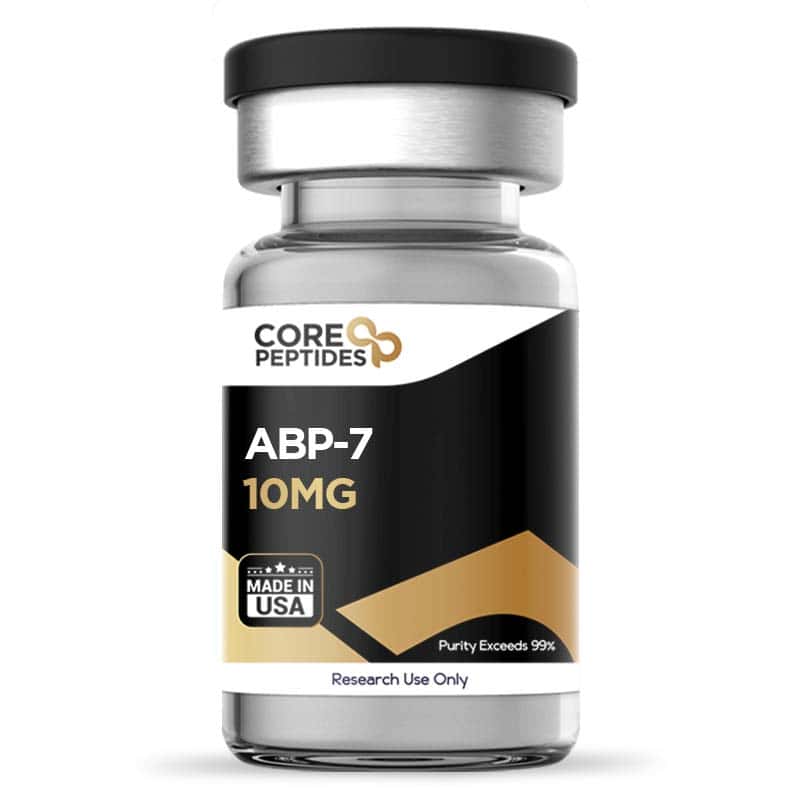
ABP-7 (10mg) Peptide – Research-Grade Actin-Binding Peptide
ABP-7 (10mg), also known as Actin-Binding Peptide-7, is a synthetic heptapeptide consisting of seven amino acids with the sequence Acetyl-LKKTETQ. It represents the actin-binding region corresponding to residues 17–23 of Thymosin Beta-4 (Tβ4) and is commonly discussed in research literature as the TB-500 fragment.
This research peptide is of interest because the LKKTETQ sequence has been associated with actin binding and cellular processes involving cytoskeletal organisation, cell migration and angiogenic activity in preclinical research models. Studies have investigated the peptide in in vitro, ex vivo and animal models, although findings from these models should not be interpreted as evidence of established human therapeutic efficacy.
The ABP-7 (10mg) product is supplied as a lyophilised powder with a stated purity of >99% by Core Peptides. The supplier specifies that the material is intended exclusively for research, laboratory and in vitro experimental purposes and is not intended for human or veterinary consumption.
What Is ABP-7 Peptide?
ABP-7 is a short synthetic peptide made up of seven amino acids. Its sequence, Ac-LKKTETQ, corresponds to the actin-binding region of Thymosin Beta-4. Because of this relationship, ABP-7 is frequently described as an actin-binding fragment of Thymosin Beta-4 or a TB-500 fragment.
Thymosin Beta-4 is a naturally occurring 43-amino-acid peptide associated with the regulation of actin dynamics. Researchers have identified several biologically active regions within the molecule, with the LKKTETQ sequence representing an important actin-binding domain. Research on this short sequence has therefore focused on how modulation of actin-associated processes may influence cellular movement and structural organisation.
Importantly, ABP-7 should not automatically be considered equivalent to full-length Thymosin Beta-4. The isolated seven-amino-acid fragment is a distinct synthetic molecule, and results obtained with full-length Tβ4 cannot necessarily be transferred directly to ABP-7.
ABP-7 (10mg) Product Highlights
- Compound: ABP-7
- Alternative description: Actin-Binding Peptide-7
- Common research reference: TB-500 fragment
- Sequence: Acetyl-LKKTETQ
- Peptide length: 7 amino acids
- Quantity: 10mg
- Physical form: Lyophilised powder
- Stated purity: >99%
- SKU: P-ABP-7
- Intended application: Laboratory and in vitro research only
ABP-7 and the Thymosin Beta-4 Actin-Binding Domain
One of the principal reasons ABP-7 attracts scientific interest is its relationship with the actin-binding domain of Thymosin Beta-4. Actin is a fundamental cytoskeletal protein involved in cell shape, movement, intracellular transport and other cellular processes. The dynamic conversion between globular actin (G-actin) and filamentous actin (F-actin) is an important component of cellular remodelling.
Research indicates that the LKKTETQ sequence can interact with actin and may influence actin-related cellular processes. The proposed biological relevance of this interaction has made ABP-7 a subject of investigation in models examining cellular migration, vascular sprouting and tissue-repair mechanisms.
Rather than viewing ABP-7 as a conventional therapeutic peptide, it is more appropriate to regard it as a molecular research tool for investigating the biological functions associated with the actin-binding region of Thymosin Beta-4.
ABP-7 Research and Cellular Migration
Cell migration is a complex biological process requiring coordinated changes in the cytoskeleton, cell adhesion and signalling pathways. Because actin is central to cytoskeletal remodelling, researchers have investigated whether the LKKTETQ sequence can influence cellular migration.
Published research has reported that LKKTETQ can promote endothelial cell migration and tube formation in laboratory models. These findings have contributed to interest in the peptide’s potential role in studies of vascular biology and angiogenesis.
These observations are preclinical findings. They demonstrate biological activity in specific experimental systems but do not establish that ABP-7 is effective or safe for treating medical conditions in humans.
ABP-7 and Angiogenesis Research
Angiogenesis refers to the formation of new blood vessels from existing vascular structures. This process involves endothelial-cell migration, proliferation, alignment and the formation of organised tubular structures.
Research involving the LKKTETQ sequence has examined several aspects of angiogenic behaviour. In laboratory experiments, the peptide has been associated with endothelial migration and tube formation, while ex vivo studies have reported vessel sprouting from aortic-ring preparations.
These results provide a basis for further investigation into how the actin-binding domain of Thymosin Beta-4 may participate in vascular remodelling. However, the existence of angiogenic activity in experimental models should not be interpreted as proof of a therapeutic application.
ABP-7 in Tissue-Repair Research
The actin cytoskeleton plays an important role in tissue repair because cells must change shape, migrate and reorganise their structures during the repair process. Consequently, researchers have examined the LKKTETQ sequence in experimental models of wound repair.
A published study reported that a seven-amino-acid synthetic peptide corresponding to LKKTETQ promoted dermal repair in aged animal models at levels comparable to the parent molecule in that particular experimental setting.
Earlier research has similarly associated the LKKTETQ-containing region with wound healing and cellular migration. These findings are useful for understanding the biological activity of the peptide fragment, but they remain preclinical evidence rather than evidence of an approved human treatment.
Potential Research Areas for ABP-7
ABP-7 can be investigated as a research compound in experimental systems focused on the biological functions of actin and cellular movement. Areas of scientific interest include:
- Actin biology: Investigating interactions between the LKKTETQ sequence and actin.
- Cytoskeletal dynamics: Studying mechanisms involved in cellular structure and movement.
- Cell migration: Examining how actin-associated processes influence cellular motility.
- Angiogenesis: Investigating endothelial migration, tube formation and vascular sprouting.
- Wound-repair models: Exploring cellular mechanisms associated with experimental tissue repair.
- Cell signalling: Examining downstream cellular responses associated with actin-dependent processes.
- Comparative peptide research: Comparing the isolated actin-binding fragment with full-length Thymosin Beta-4 in appropriate laboratory models.
How Does ABP-7 Work in Research Models?
The proposed mechanism of ABP-7 is centred on its LKKTETQ actin-binding sequence. Thymosin Beta-4 is recognised as an actin-sequestering protein, and the LKKTETQ region has been identified as an important actin-binding site.
Actin exists in different structural states within cells, and the regulation of actin polymerisation is essential for cytoskeletal remodelling. By investigating the interaction between ABP-7 and actin, researchers can study how this short peptide sequence may influence processes associated with cellular architecture and motility.
Research has also suggested that the LKKTETQ region may contribute to biological responses extending beyond direct actin binding, including cellular migration and angiogenic activity. The precise mechanisms underlying these observations remain an area of scientific investigation.
ABP-7 vs Thymosin Beta-4
| Characteristic | ABP-7 | Thymosin Beta-4 |
|---|---|---|
| Structure | Short synthetic heptapeptide | Full-length 43-amino-acid peptide |
| Sequence discussed in research | Ac-LKKTETQ | Full-length Tβ4 sequence containing the LKKTETQ domain |
| Actin-binding region | Represents the principal actin-binding fragment | Contains the actin-binding domain within the larger molecule |
| Research focus | Actin interaction, cellular migration and angiogenic models | Broader biological functions involving actin, repair and cellular signalling |
| Molecular identity | Distinct synthetic fragment | Full-length peptide |
Although ABP-7 corresponds to an important functional region of Thymosin Beta-4, the two compounds should be treated as separate research entities. Results involving the complete protein cannot automatically be attributed to the isolated seven-amino-acid fragment.
Why Choose ABP-7 (10mg) for Laboratory Research?
The 10mg ABP-7 format provides researchers with a defined quantity of synthetic peptide for laboratory investigations. According to the supplier’s product information, the material is supplied as a lyophilised powder with a stated purity greater than 99%.
Its clearly defined sequence also makes ABP-7 useful when research requires investigation of the specific actin-binding region of Thymosin Beta-4 rather than the biological activity of the entire parent peptide.
For laboratories investigating cytoskeletal biology, endothelial-cell behaviour or peptide–protein interactions, ABP-7 can serve as a focused research compound for studying the biological properties associated with the LKKTETQ motif.
ABP-7 (10mg) Quality and Specification
| Specification | Details |
|---|---|
| Product Name | ABP-7 (10mg) |
| Peptide Type | Actin-binding heptapeptide |
| Sequence | Acetyl-LKKTETQ |
| Quantity | 10mg |
| Form | Lyophilised powder |
| Stated Purity | >99% |
| Supplier SKU | P-ABP-7 |
| Research Classification | Research, laboratory and in vitro use only |
The specifications above reflect the product information published by Core Peptides for its ABP-7 (10mg) listing.
ABP-7 Research Applications
ABP-7 is particularly relevant to research programmes investigating the relationship between short peptide sequences and cellular behaviour. Its defined structure allows researchers to focus on the biological role of the LKKTETQ motif without working with the complete Thymosin Beta-4 molecule.
Potential laboratory applications may include controlled investigations into:
- Actin-binding behaviour
- G-actin and F-actin dynamics
- Cytoskeletal remodelling
- Endothelial-cell migration
- In vitro tube-formation models
- Ex vivo vascular-sprouting models
- Cell adhesion and motility
- Peptide–protein interactions
- Cellular signalling pathways associated with cytoskeletal activity
- Comparative studies involving Thymosin Beta-4-derived sequences
Research Evidence for the LKKTETQ Sequence
The scientific literature provides a useful foundation for understanding why ABP-7 is investigated. A review published in The FASEB Journal described LKKTETQ as a biologically active region of Thymosin Beta-4 and summarised research involving actin binding, endothelial-cell migration, tube formation, vascular sprouting and wound-repair models.
Other experimental work has examined the actin-binding region in cellular models, including research investigating its effects on human hepatic stellate-cell behaviour and signalling. Such studies demonstrate the broad research interest surrounding the sequence but should not be interpreted as evidence that ABP-7 is an established medicine.
The available evidence is therefore best understood as a foundation for continued laboratory and preclinical investigation.
ABP-7 (10mg) Frequently Asked Questions
What is ABP-7?
ABP-7, or Actin-Binding Peptide-7, is a synthetic seven-amino-acid peptide with the sequence Acetyl-LKKTETQ. It corresponds to the actin-binding region of Thymosin Beta-4 and is studied for its potential biological effects on actin-related cellular processes.
Is ABP-7 the same as Thymosin Beta-4?
No. ABP-7 is a short fragment corresponding to the actin-binding region of Thymosin Beta-4, whereas Thymosin Beta-4 is a substantially larger 43-amino-acid peptide. They are distinct research compounds.
What is the ABP-7 sequence?
The sequence supplied for ABP-7 is Acetyl-LKKTETQ. This seven-amino-acid sequence corresponds to residues 17–23 of Thymosin Beta-4.
Why is ABP-7 studied?
ABP-7 is studied primarily because its LKKTETQ sequence represents an important actin-binding region of Thymosin Beta-4. Research has examined its relationship with actin dynamics, cellular migration, angiogenesis and experimental tissue-repair processes.
What does the 10mg designation mean?
The 10mg designation refers to the quantity of ABP-7 supplied in the product format. It does not represent a recommended dose or establish a clinical dosage.
Is ABP-7 approved for human use?
ABP-7 is not presented by Core Peptides as an approved human medicine. The supplier specifies that its ABP-7 product is intended exclusively for research, laboratory and in vitro experimental use and is not intended for human or veterinary consumption.
Is ABP-7 suitable for clinical treatment?
No clinical treatment claims should be inferred from the available preclinical literature. Research findings involving cells or animal models do not establish safety, effectiveness or appropriate use in humans.
Is ABP-7 the same as the TB-500 fragment?
ABP-7 is commonly described in research and commercial contexts as the TB-500 fragment because its Ac-LKKTETQ sequence corresponds to the actin-binding region of Thymosin Beta-4. However, terminology surrounding TB-500 can vary between suppliers, so researchers should always verify the exact molecular sequence and specifications of the material being studied.
What form is ABP-7 supplied in?
The Core Peptides ABP-7 (10mg) listing specifies a lyophilised powder and a stated purity of greater than 99%.
Important Research-Use Disclaimer
ABP-7 (10mg) is supplied for research and laboratory purposes only. It is not a food, dietary supplement, cosmetic, medical treatment or approved pharmaceutical product. It is not intended for human or veterinary consumption.
The information presented on this page is intended to describe the scientific background and research relevance of ABP-7. References to cellular migration, angiogenesis, wound repair, actin binding or other biological processes describe findings from laboratory or preclinical research and should not be interpreted as claims that ABP-7 can diagnose, treat, cure or prevent any disease or medical condition.
Researchers should follow appropriate institutional laboratory procedures, applicable regulations, safety requirements and supplier documentation when handling research peptides. No human-use dosing, administration or therapeutic protocol is implied or recommended.
ABP-7 (10mg) – A Focused Peptide for Actin Research
ABP-7 (10mg) provides researchers with access to the short Ac-LKKTETQ sequence associated with the actin-binding domain of Thymosin Beta-4. Its defined seven-amino-acid structure makes it a focused research material for investigations into actin interactions, cytoskeletal dynamics, cellular migration and angiogenic mechanisms.
Published research has established a scientific rationale for studying the LKKTETQ sequence in cellular and animal models, particularly in relation to actin-dependent processes. At the same time, the available evidence remains predominantly preclinical, making careful distinction between experimental findings and established human applications essential.
For qualified laboratories seeking a research-grade ABP-7 material in a 10mg lyophilised format, this product provides a defined peptide sequence suitable for controlled laboratory investigation, subject to the applicable research-use requirements and supplier specifications.
Be the first to review “ABP-7 (10mg)”
Related products
Peptides for Sale
Peptides for Sale
Peptides for Sale
Peptides for Sale
Peptides for Sale
Peptide Blends for Sale

Peptides for Sale
Peptides for Sale
Reviews
There are no reviews yet.