
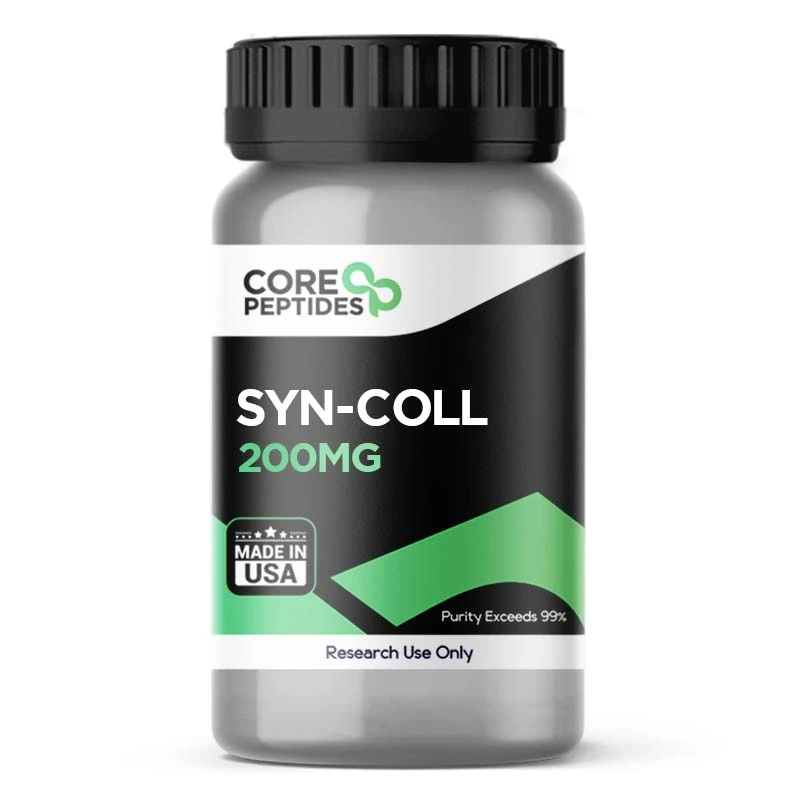

Syn-Coll (Palmitoyl Tripeptide-5) – 200MG
Syn-Coll (Palmitoyl Tripeptide-5) – 200MG is a synthetic peptide material widely studied in cosmetic science and skin research. Also known as Palmitoyl Tripeptide-5 or Palmitoyl-Lys-Val-Lys, Syn-Coll is a lipidated signal peptide developed for research into extracellular matrix biology, collagen synthesis and the appearance of age-related skin changes.
Syn-Coll is particularly interesting because its structure was designed to mimic part of the activity associated with thrombospondin-1 (TSP-1), an extracellular matrix protein involved in the activation of transforming growth factor beta (TGF-β).
Research has investigated whether this pathway can influence collagen production by dermal fibroblasts and whether Palmitoyl Tripeptide-5 may also affect enzymes involved in extracellular matrix degradation.
The 200MG format provides a substantial quantity of Syn-Coll for appropriate laboratory, analytical, formulation and cosmetic-science research. The material supplied by Core Peptides is listed as a lyophilised powder with >99% purity.
For research, laboratory and analytical purposes only. Not for human or animal consumption.
What Is Syn-Coll (Palmitoyl Tripeptide-5)?
Syn-Coll is a synthetic lipidated tripeptide commonly identified as Palmitoyl Tripeptide-5. It consists of a short peptide sequence linked to a palmitoyl group, a fatty-acid chain that contributes to the compound’s lipophilic characteristics.
Scientific literature describes Palmitoyl Tripeptide-5 as Palmitoyl-Lys-Val-Lys. It is studied as a cosmetic signal peptide because of its proposed relationship with TGF-β signalling and collagen biosynthesis.
Unlike naturally occurring collagen, Syn-Coll is not itself a collagen protein. Instead, it is investigated as a signalling peptide that may influence biological pathways associated with extracellular matrix production.
This distinction is important when evaluating research involving Syn-Coll: the peptide is studied for its potential influence on collagen-related processes rather than being a source of collagen itself.
Syn-Coll (Palmitoyl Tripeptide-5) Product Specifications
| Specification | Details |
|---|---|
| Product Name | Syn-Coll (Palmitoyl Tripeptide-5) |
| Quantity | 200MG |
| Other Name | Palmitoyl Tripeptide-5 |
| Peptide Sequence | Palmitoyl-Lys-Val-Lys |
| Alternative Name | Palmitoyl-Lysyl-Valyl-Lysine |
| Molecular Formula | C33H65N5O5 |
| Molecular Weight | 611.9 g/mol |
| Form | Lyophilised powder |
| Purity | >99% |
| Primary Research Area | Cosmetic peptide and extracellular matrix research |
| Research Focus | Collagen synthesis, TGF-β signalling and matrix remodelling |
| Intended Use | Laboratory, analytical and research applications |
The product specifications above reflect the information currently provided on the Core Peptides product page.
How Does Syn-Coll Work?
The proposed mechanism of Palmitoyl Tripeptide-5 is centred on signalling pathways involved in the extracellular matrix, particularly transforming growth factor beta (TGF-β).
Syn-Coll was designed to mimic a short sequence associated with thrombospondin-1. TSP-1 is an extracellular matrix protein that can participate in the activation of latent TGF-β. TGF-β is an important signalling molecule involved in regulating extracellular matrix processes, including collagen synthesis.
Research into Syn-Coll therefore examines whether the peptide can influence TGF-β-related signalling and subsequently affect collagen production in dermal fibroblast models.
Studies cited by Core Peptides and reviews of cosmetic peptides report that Palmitoyl Tripeptide-5 has been investigated for its potential to increase the production of type I and type III collagen.
These findings provide a scientific basis for further research into Syn-Coll as a cosmetic peptide, while laboratory and formulation findings should not automatically be interpreted as proof of a therapeutic or clinical effect.
Syn-Coll and TGF-β Research
Transforming growth factor beta (TGF-β) is a multifunctional signalling molecule with an important role in extracellular matrix biology. In skin research, TGF-β has been associated with fibroblast activity and the regulation of collagen production.
Syn-Coll research focuses on the possibility that Palmitoyl Tripeptide-5 can influence this pathway by mimicking part of the TSP-1 signalling sequence.
Core Peptides’ referenced research describes Syn-Coll as potentially activating latent TGF-β and increasing collagen-related activity in dermal fibroblast models. A peer-reviewed review of cosmeceutical peptides similarly identifies Palmitoyl Tripeptide-5 as a peptide associated with TGF-β stimulation and collagen biosynthesis.
Because TGF-β has broad biological functions, research involving this pathway should be interpreted carefully and within the specific experimental model being studied.
Syn-Coll and Collagen Synthesis
Collagen is a major structural protein within the extracellular matrix of the skin. Dermal collagen contributes to the structural properties of skin tissue, including firmness and mechanical support.
As skin ages, collagen turnover and extracellular matrix organisation change. This has contributed to significant research interest in peptides that may influence collagen-related signalling pathways.
Palmitoyl Tripeptide-5 is investigated as a signal peptide rather than as a collagen replacement. Research suggests that its proposed activity may involve stimulating collagen synthesis through TGF-β-related mechanisms. In particular, studies have examined its relationship with type I and type III collagen production in dermal fibroblast systems.
These mechanisms make Syn-Coll relevant to research involving:
- Dermal fibroblast biology.
- Extracellular matrix synthesis.
- Collagen turnover.
- TGF-β signalling.
- Skin ageing research.
- Cosmetic peptide formulation.
- Topical delivery systems.
Syn-Coll and Type I & Type III Collagen
Research into Palmitoyl Tripeptide-5 has focused particularly on type I and type III collagen.
Type I collagen is one of the principal structural collagens found in the dermis, while type III collagen is also an important component of connective tissue. Changes in the composition and organisation of these collagen types are relevant to research into skin structure and ageing.
According to the research summarised on the Core Peptides product page, Syn-Coll may stimulate production of both type I and type III collagen through TGF-β-related activity in dermal fibroblast models.
These findings make the peptide a useful research tool for investigating how short synthetic peptides may interact with extracellular matrix signalling pathways.
Syn-Coll and Collagen Breakdown
Collagen research is not limited to synthesis. The extracellular matrix is continuously remodelled through a balance between production and degradation.
Matrix metalloproteinases (MMPs) are a family of enzymes involved in extracellular matrix remodelling. Some MMPs can break down collagen and other matrix components.
Research cited by Core Peptides suggests that Palmitoyl Tripeptide-5 may also influence collagen degradation by interacting with pathways involving MMP-1 and MMP-3. MMP-1 is associated with the degradation of type I collagen, while MMP-3 has broader extracellular matrix substrate activity.
A review of cosmetic peptides likewise describes Palmitoyl Tripeptide-5 as being investigated for both stimulation of collagen biosynthesis and inhibition of matrix metalloproteases involved in collagen degradation.
This dual research interest makes Syn-Coll relevant to studies examining both sides of extracellular matrix turnover.
Syn-Coll for Cosmetic Peptide Research
Syn-Coll is widely associated with cosmetic peptide research, particularly research into formulations intended to support the appearance of mature or photoaged skin.
The peptide’s research profile is based on its proposed influence on collagen-related signalling rather than direct physical replacement of lost collagen. This makes it an example of a signal peptide used in cosmetic science.
Potential areas of cosmetic research include:
- Skin firmness and elasticity research.
- Wrinkle and skin-texture studies.
- Extracellular matrix research.
- Topical peptide formulation.
- Dermal fibroblast studies.
- Skin-barrier and hydration research.
- Peptide stability and compatibility testing.
A 2026 systematic review of oral and topical peptides for skin ageing concluded that peptide research is promising but also highlighted substantial variation between peptide types, formulations, dosing approaches and study designs. The authors noted that evidence for topical formulations remains comparatively limited.
Syn-Coll and Skin Ageing Research
Skin ageing involves multiple biological processes, including changes in collagen turnover, extracellular matrix organisation, hydration, elasticity and barrier function.
Because Syn-Coll is researched in relation to collagen synthesis and matrix remodelling, it has become a compound of interest in experimental studies of age-related skin changes.
However, it is important to distinguish between biological plausibility, laboratory findings and demonstrated clinical outcomes. Evidence for peptides as a broad category is developing, but results from one peptide, formulation or delivery system cannot automatically be applied to every Palmitoyl Tripeptide-5 preparation.
For research purposes, Syn-Coll can therefore be evaluated as an individual peptide with its own structure, formulation properties and experimental evidence.
Syn-Coll and Wrinkle Research
Syn-Coll has been investigated in cosmetic research relating to the appearance of wrinkles and skin roughness. The Core Peptides reference page cites studies reporting improvements in wrinkle-related measurements following topical formulations containing Syn-Coll.
These findings are relevant to research into how collagen-associated peptides may influence measurable skin-surface parameters.
At the same time, the scientific literature should be interpreted according to study design. Evidence from a specific cosmetic formulation cannot necessarily be used to establish the performance of isolated Palmitoyl Tripeptide-5 in every formulation or delivery system.
For this reason, researchers should consider variables including peptide concentration, vehicle, skin penetration, exposure time, measurement methodology and study population when assessing results.
Syn-Coll and Topical Delivery Research
One of the most important considerations in topical peptide research is delivery through the skin.
The stratum corneum provides a strong barrier against many substances. Consequently, the biological activity of a peptide in a laboratory assay does not necessarily demonstrate that the same peptide will reach the relevant target at the same concentration following topical application.
Researchers studying Syn-Coll may therefore investigate:
- Peptide penetration through model skin systems.
- Formulation-dependent peptide stability.
- Vehicle selection.
- Concentration-dependent activity.
- Peptide recovery from formulations.
- Skin retention.
- Release profiles.
- Compatibility with other cosmetic ingredients.
These variables can be particularly important when comparing isolated research material with finished cosmetic products containing Palmitoyl Tripeptide-5.
Syn-Coll vs Other Cosmetic Peptides
| Peptide | Primary Research Focus | Research Classification |
|---|---|---|
| Syn-Coll | TGF-β signalling and collagen-related pathways | Signal peptide |
| Palmitoyl Tripeptide-1 | Extracellular matrix and collagen-related signalling | Signal peptide |
| Palmitoyl Tetrapeptide-7 | Inflammation and extracellular matrix research | Signal peptide |
| SNAP-8 | SNARE complex and neurotransmitter-release research | Expression-line peptide |
| Syn-AKE | Nicotinic acetylcholine receptor research | Neuromodulating cosmetic peptide |
Although these peptides can appear together in cosmetic formulations and anti-ageing research, they have different molecular structures and proposed mechanisms. Syn-Coll is particularly associated with collagen and extracellular matrix signalling, rather than neurotransmitter-related pathways.
Potential Research Applications of Syn-Coll (200MG)
Syn-Coll (Palmitoyl Tripeptide-5) – 200MG can be relevant to qualified researchers investigating a range of cosmetic and biochemical questions.
- Collagen research: Investigation of peptide-associated pathways influencing collagen synthesis.
- TGF-β research: Study of peptide interactions with TGF-β-related signalling.
- Dermal fibroblast research: Evaluation of cellular responses to Palmitoyl Tripeptide-5.
- Extracellular matrix research: Investigation of collagen turnover and matrix remodelling.
- MMP research: Study of pathways associated with collagen-degrading enzymes.
- Cosmetic formulation research: Development and evaluation of topical peptide formulations.
- Skin ageing research: Investigation of mechanisms associated with age-related changes in the dermal matrix.
- Analytical research: Identification, purity testing and characterisation of the peptide.
- Stability research: Evaluation of peptide stability under controlled conditions.
- Comparative peptide research: Comparison with other signal peptides and cosmetic ingredients.
Syn-Coll in Analytical Research
Analytical characterisation is an important part of working with synthetic peptide materials. Researchers can use validated analytical methods to confirm identity, assess purity and investigate degradation or formulation recovery.
Potential analytical techniques may include:
- High-performance liquid chromatography (HPLC): Assessment of chromatographic purity and related substances.
- Liquid chromatography–mass spectrometry (LC-MS): Analytical identification and molecular characterisation.
- Mass spectrometry: Confirmation of molecular mass and peptide identity.
- Stability studies: Monitoring degradation under defined storage conditions.
- Formulation analysis: Measurement of peptide recovery from experimental cosmetic preparations.
Researchers should rely on validated methods and the applicable batch-specific documentation when assessing the quality and identity of the material.
Why Choose Syn-Coll (Palmitoyl Tripeptide-5) – 200MG?
Syn-Coll (Palmitoyl Tripeptide-5) – 200MG offers researchers a defined quantity of a well-established cosmetic research peptide for laboratory and formulation applications.
- 200MG format: Provides a substantial quantity for research programmes and experimental formulation work.
- High stated purity: The Core Peptides product is listed at >99% purity.
- Lyophilised powder: Supplied in a research-friendly solid format.
- Defined peptide: Palmitoyl Tripeptide-5 / Palmitoyl-Lys-Val-Lys.
- Established research profile: Extensively discussed within cosmetic peptide literature.
- Collagen research relevance: Studied in relation to collagen synthesis and extracellular matrix pathways.
- TGF-β research: Provides a model for investigating growth-factor-related signalling.
- Analytical applications: Suitable for qualified identity, purity and stability investigations.
The product page currently identifies the material as 200mg, lyophilised powder and >99% purity.
Storage and Handling of Syn-Coll
Researchers should follow the current product label, Certificate of Analysis and supplier documentation for specific storage requirements.
- Keep the peptide in its original, correctly labelled container.
- Protect the material from unnecessary exposure to moisture.
- Follow the recommended storage temperature and conditions supplied with the product.
- Minimise repeated temperature fluctuations.
- Prevent contamination during laboratory handling.
- Use appropriate laboratory personal protective equipment.
- Follow institutional procedures for handling and disposal of research chemicals.
Storage requirements can vary according to the specific formulation, packaging and research application. Researchers should therefore use the batch-specific documentation supplied with their material rather than relying on generic peptide-storage assumptions.
Frequently Asked Questions About Syn-Coll (200MG)
What is Syn-Coll?
Syn-Coll is a synthetic peptide commonly known as Palmitoyl Tripeptide-5. It is a lipidated signal peptide studied primarily in cosmetic science and extracellular matrix research.
What is Palmitoyl Tripeptide-5?
Palmitoyl Tripeptide-5 is a synthetic peptide consisting of a palmitoyl group attached to the tripeptide sequence Lys-Val-Lys. It is also known as Palmitoyl-Lys-Val-Lys.
What does Syn-Coll do in research?
Syn-Coll is investigated for its potential relationship with TGF-β signalling, collagen synthesis, extracellular matrix remodelling and matrix metalloproteinase activity.
Does Syn-Coll stimulate collagen?
Research has suggested that Palmitoyl Tripeptide-5 may stimulate collagen-related activity through TGF-β-associated pathways. Studies have particularly examined type I and type III collagen production in dermal fibroblast models.
What is the relationship between Syn-Coll and TGF-β?
Syn-Coll was designed to mimic part of the activity associated with thrombospondin-1, which is involved in TGF-β activation. Research therefore investigates whether Palmitoyl Tripeptide-5 can influence TGF-β-related signalling and downstream collagen production.
Is Syn-Coll the same as collagen?
No. Syn-Coll is a synthetic signalling peptide and is not a collagen protein. It is researched for its potential influence on biological pathways associated with collagen synthesis.
Is Syn-Coll suitable for cosmetic formulation research?
Yes. Palmitoyl Tripeptide-5 is widely discussed in cosmetic peptide literature and can be investigated in topical formulation research, including studies of peptide stability, delivery and compatibility.
Can Syn-Coll be used to treat wrinkles?
This research material should not be presented as a treatment for wrinkles or any medical condition. Although cosmetic studies have investigated wrinkle-related outcomes, evidence varies according to formulation and study design. A recent systematic review also noted that the evidence base for topical peptide formulations remains limited and heterogeneous.
What does the 200MG quantity mean?
The 200MG designation refers to the quantity of Syn-Coll research material supplied. It is not a recommended human dose or instruction for administration.
What form is Syn-Coll supplied in?
The Core Peptides product is listed as a lyophilised powder with a stated purity of >99%.
Is Syn-Coll intended for human consumption?
No. Syn-Coll supplied as a research material is intended for laboratory, analytical and experimental applications only and should not be consumed or self-administered.
Syn-Coll (Palmitoyl Tripeptide-5) – 200MG Research Summary
Syn-Coll (Palmitoyl Tripeptide-5) – 200MG is a synthetic lipidated tripeptide studied extensively within cosmetic peptide and extracellular matrix research. Its sequence is commonly described as Palmitoyl-Lys-Val-Lys, and its research profile centres on TGF-β-related signalling, collagen biosynthesis and matrix remodelling.
The peptide was designed to mimic part of the activity associated with thrombospondin-1, providing a research model for investigating how short synthetic peptides can influence growth-factor signalling and collagen-related pathways.
Research has also examined potential interactions with matrix metalloproteinases involved in collagen degradation. The 200MG format is suitable for appropriately qualified researchers conducting analytical testing, peptide characterisation, formulation development, stability studies, extracellular matrix research and controlled laboratory experiments.
While Syn-Coll has a substantial cosmetic-science research profile, findings should be interpreted according to the specific experimental model and formulation. Laboratory or formulation findings should not be represented as established medical or therapeutic outcomes.
Research-Use Disclaimer
Syn-Coll (Palmitoyl Tripeptide-5) – 200MG is intended solely for qualified research, laboratory, analytical and formulation-development purposes. It is not intended for human or veterinary consumption, self-administration, diagnosis, treatment, cure or prevention of any disease.
References to collagen synthesis, TGF-β signalling, extracellular matrix activity, skin ageing, wrinkles or other biological mechanisms describe areas of scientific research and should not be interpreted as medical advice or proof of a therapeutic benefit.
Researchers are responsible for ensuring that all work involving this material complies with applicable laws, regulations, institutional requirements and laboratory safety procedures. Always consult the current product documentation and applicable Certificate of Analysis before conducting experiments.
For research use only. Not for human or animal consumption.
Be the first to review “Syn-Coll (Palmitoyl Tripeptide-5) – 200MG”
Related products
Peptides for Sale
Peptides for Sale
Peptides for Sale
Peptide Blends for Sale
Peptides for Sale
Peptides for Sale

Peptides for Sale
Peptides for Sale
Reviews
There are no reviews yet.