
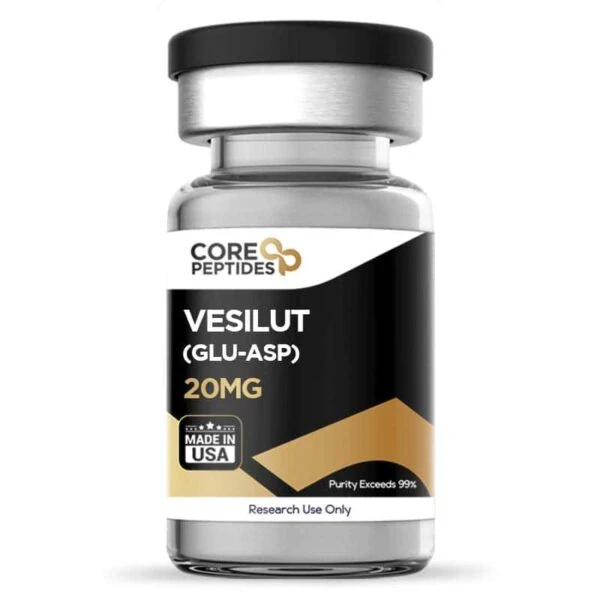
Vesilut (20mg) – Glu-Asp Research Peptide
Vesilut (20mg) is a synthetic dipeptide composed of the amino-acid sequence Glu-Asp (glutamic acid–aspartic acid). It is classified within the group of short peptide bioregulators associated with the Khavinson peptide research tradition and is primarily of interest to researchers investigating short-peptide biology, cellular signalling, chromatin regulation and tissue-specific biological processes.
Vesilut is also identified as ED, reflecting its Glu-Asp sequence. Core Peptides supplies this material as a lyophilised research preparation with a stated purity of greater than 99%.
The supplier’s product information also notes that direct published research specifically addressing Vesilut is limited, so findings involving related peptides should be distinguished clearly from evidence concerning Vesilut itself.
Research into related short peptides has examined cellular differentiation, gene expression and chromatin organisation in experimental models. For example, published studies have investigated Glu-Asp-containing peptides and other short bioregulators in cultured cells and chromatin systems.
For research, laboratory and analytical purposes only. Not for human or animal consumption.
What Is Vesilut?
Vesilut is a short synthetic dipeptide consisting of glutamic acid and aspartic acid, represented by the sequence Glu-Asp. Short peptides of this type are investigated as simplified molecular systems for studying peptide–cell interactions and biological regulation.
According to the Core Peptides product information, Vesilut is also referred to as ED, alpha-glutamylaspartic acid and Vesilute. The listed molecular formula is C9H14N2O7, with a molecular weight of approximately 262.2 g/mol.
Because direct research on Vesilut itself is limited, it is important to separate studies performed specifically with Vesilut from research involving other Glu-Asp-containing peptides or related Khavinson bioregulators.
Vesilut (20mg) Product Overview
| Specification | Details |
|---|---|
| Product Name | Vesilut |
| Quantity | 20mg |
| Sequence | Glu-Asp |
| Sequence Abbreviation | ED |
| Alternative Name | Alpha-glutamylaspartic acid |
| Molecular Formula | C9H14N2O7 |
| Molecular Weight | 262.2 g/mol |
| Form | Lyophilised powder |
| Stated Purity | >99% |
| Peptide Type | Synthetic dipeptide |
| Research Category | Short-peptide and bioregulator research |
| Intended Use | Laboratory, analytical and in-vitro research |
The product specifications above are based on the information published on the Core Peptides Vesilut product page.
Vesilut and the Glu-Asp Sequence
The defining characteristic of Vesilut is its Glu-Asp sequence. Glutamic acid and aspartic acid are both acidic amino acids, and their combination creates a compact dipeptide model that can be investigated independently from larger proteins or longer peptide chains.
Research into short peptide bioregulators has explored whether particular amino-acid sequences are associated with tissue-specific cellular effects. Studies have included peptides such as Vesugen, which contains the sequence Lys-Glu-Asp, and other Glu-Asp-containing peptides.
These studies provide scientific context for research into short peptide sequences, but they should not be interpreted as direct evidence that Vesilut produces the same biological effects.
Vesilut and Short Peptide Bioregulator Research
Short peptide bioregulators have been investigated in a range of experimental systems involving cellular differentiation, proliferation, gene expression and chromatin organisation.
One published study examined tissue-specific effects of several short peptides in ageing cell cultures. The researchers reported that specific peptides were associated with changes in expression of differentiation-related factors in pancreatic, bronchial and prostatic fibroblast cell cultures.
Such work forms part of the broader scientific background surrounding short peptide bioregulators. However, the study investigated specific peptides rather than Vesilut itself, so the findings should not be presented as clinical or direct evidence for Vesilut.
Vesilut and Cellular Research
Cell-based research provides one potential framework for investigating short peptides. In controlled laboratory models, researchers can examine how defined peptide sequences interact with cells and whether measurable changes occur in cellular markers or signalling pathways.
Published research involving related Glu-Asp-containing peptides has investigated cellular differentiation and gene expression. For example, studies have examined peptides such as Glu-Asp-Ala and Lys-Glu-Asp in human or animal-derived cell systems.
Vesilut can therefore be considered within the broader field of short-peptide research, while maintaining a clear distinction between direct evidence and extrapolation from structurally related compounds.
Vesilut and Chromatin Research
Chromatin is the complex of DNA and associated proteins that packages genetic material inside cells. Changes in chromatin organisation can influence how genes are made accessible for transcription.
Research into short peptide bioregulators has investigated whether selected peptides can influence chromatin organisation in experimental cellular models. A PubMed-indexed study examined several short peptide bioregulators and reported changes in heterochromatin organisation in lymphocytes obtained from older individuals.
Another study published in 2023 examined peptide bioregulators and epigenetic modification of condensed chromatin, reporting selective effects on chromosome regions in cultured lymphocytes.
These studies are relevant to the scientific context of peptide bioregulator research, but they did not establish Vesilut as a clinical epigenetic treatment.
Vesilut and Gene Expression Research
Gene expression research examines how genetic information is selectively activated or suppressed within cells. Short peptide bioregulators have been investigated as possible modulators of gene-expression-related processes in experimental systems.
Research involving other short peptides has reported changes in the expression of specific differentiation markers in ageing cell cultures.
Studies involving Glu-Asp-containing sequences have also explored molecular mechanisms associated with gene regulation. One study reported effects of Glu-Asp-Arg and Lys-Glu-Asp on serotonin-related gene expression in ageing brain-cortex cell cultures.
These findings demonstrate the wider research interest in acidic short-peptide sequences but should not be interpreted as evidence of an equivalent effect from isolated Vesilut.
Vesilut and Prostate-Related Research
The Core Peptides product page discusses Vesilut in the context of research involving prostate and urinary bladder tissues, primarily because of its structural relationship to other Glu-Asp-containing bioregulators.
Research into the related peptide Prostamax, which contains the sequence Lys-Glu-Asp-Pro, has investigated experimental models of chronic aseptic prostatitis. The Core Peptides page references this work as related evidence rather than direct research on Vesilut.
Accordingly, Vesilut should not be described as a proven treatment for prostate or urinary conditions. The available evidence does not justify transferring clinical or therapeutic conclusions from related peptides to Vesilut.
Vesilut and Urinary Bladder Research
The urinary bladder is closely connected physiologically and anatomically with surrounding tissues, including the prostate in males. Consequently, experimental research involving prostate tissue can also be relevant when investigating mechanisms associated with urinary function.
Core Peptides notes that Vesilut’s potential relevance to bladder-related research is inferred from its structural similarity to other bioregulator peptides rather than established through a substantial body of direct Vesilut studies.
This distinction is particularly important for scientific and commercial product descriptions: related-peptide research may provide a hypothesis for future investigation, but it does not establish efficacy for Vesilut.
Vesilut and Cellular Ageing Research
Age-associated changes in cellular function and gene regulation have been investigated using various short peptide bioregulators. Experimental research has examined chromatin organisation, cellular differentiation and gene expression in ageing cell models.
For example, published work has investigated short peptides in cultures of cells from older subjects and reported changes in chromatin organisation and gene-associated markers.
These findings contribute to the broader research field surrounding peptide bioregulators, but they should not be interpreted as evidence that Vesilut itself has demonstrated anti-ageing or therapeutic activity in humans.
Vesilut Research Applications
Qualified laboratories may consider short Glu-Asp peptides such as Vesilut for exploratory research involving:
- Short-peptide structure and function.
- Peptide–cell interactions.
- Cellular signalling research.
- Gene-expression studies.
- Chromatin biology.
- Epigenetic research models.
- Cellular differentiation research.
- Age-associated cellular models.
- Prostate and urinary-tissue research models.
- Comparative studies of peptide bioregulators.
- Structure–activity relationship research.
- Analytical peptide research.
These areas describe potential laboratory research applications and do not constitute medical indications or recommendations for use.
Vesilut Chemical Profile
| Property | Information |
|---|---|
| Compound | Vesilut |
| Sequence | Glu-Asp |
| Sequence Abbreviation | ED |
| Alternative Name | Alpha-glutamylaspartic acid |
| Molecular Formula | C9H14N2O7 |
| Molecular Weight | 262.2 g/mol |
| Residue Count | 2 amino-acid residues |
| Material Form | Lyophilised powder |
These chemical specifications are taken from the current Core Peptides product information.
Vesilut Compared With Longer Bioregulator Peptides
Vesilut is a dipeptide, meaning it contains two amino-acid residues. Other compounds in the broader Khavinson peptide research field are longer sequences.
| Characteristic | Vesilut | Longer Peptide Bioregulators |
|---|---|---|
| Peptide length | 2 residues | Typically 3–4 or more residues |
| Sequence | Glu-Asp | Varies by compound |
| Research focus | Short-peptide and bioregulator research | Tissue-specific and cellular research |
| Molecular complexity | Very short dipeptide | Greater sequence complexity |
Differences in peptide length and sequence can substantially affect molecular behaviour, so related compounds should not be regarded as interchangeable.
Why Research Vesilut?
Vesilut offers researchers a simple, defined Glu-Asp dipeptide model for exploratory investigations into short-peptide biology.
Its small size and defined molecular composition make it suitable for analytical studies and comparative research examining how short peptide sequences differ from longer bioregulators.
Because direct literature concerning Vesilut is limited, it may be particularly useful for researchers interested in characterising the compound itself and determining whether observations associated with related Glu-Asp-containing peptides can be reproduced under controlled experimental conditions.
Vesilut (20mg) and Analytical Research
Analytical characterisation is an important part of peptide research. Laboratories may use validated analytical techniques to verify compound identity, assess purity and monitor material stability.
- HPLC: Can be used to assess chromatographic purity and identify related components.
- Mass spectrometry: Can support molecular-mass confirmation and compound identification.
- LC-MS: Provides combined chromatographic and mass-based analysis.
- Stability testing: Can monitor changes under defined storage conditions.
- In-vitro assays: Can be used to explore peptide behaviour in controlled experimental systems.
Researchers should use validated analytical procedures and consult current batch-specific documentation when characterising Vesilut.
Vesilut (20mg) Research Summary
| Research Characteristic | Information |
|---|---|
| Product | Vesilut (20mg) |
| Sequence | Glu-Asp |
| Sequence Abbreviation | ED |
| Peptide Length | Dipeptide |
| Molecular Formula | C9H14N2O7 |
| Molecular Weight | 262.2 g/mol |
| Physical Form | Lyophilised powder |
| Stated Purity | >99% |
| Primary Research Area | Short-peptide and bioregulator research |
| Intended Use | Laboratory, analytical and in-vitro research |
Frequently Asked Questions About Vesilut (20mg)
What is Vesilut?
Vesilut is a synthetic dipeptide consisting of the amino-acid sequence Glu-Asp. It is investigated within the broader field of short peptide bioregulator research.
What is the sequence of Vesilut?
The sequence of Vesilut is Glu-Asp (ED), representing glutamic acid followed by aspartic acid.
What is the molecular weight of Vesilut?
Core Peptides lists the molecular weight of Vesilut as approximately 262.2 g/mol.
What is Vesilut studied for?
Vesilut is of interest in exploratory research involving short peptides, cellular regulation, gene-expression models, chromatin biology and tissue-related peptide research. Direct published research specifically addressing Vesilut remains limited.
Is Vesilut the same as Prostamax?
No. Vesilut is a Glu-Asp dipeptide, whereas Prostamax is a longer peptide containing the sequence Lys-Glu-Asp-Pro. Their different sequences and structures mean they should not be treated as the same compound.
Why is Prostamax research sometimes discussed alongside Vesilut?
The Core Peptides product page discusses Prostamax because it contains the Glu-Asp sequence found in Vesilut. Research involving Prostamax may therefore provide contextual information for hypotheses concerning related peptide sequences, but it does not constitute direct evidence for Vesilut.
Has Vesilut been extensively studied?
No. The Core Peptides product page explicitly notes a lack of published research directly addressing Vesilut’s research potential. Much of the available scientific context comes from studies of related short peptides.
What does research say about related Glu-Asp peptides?
Published studies have investigated several Glu-Asp-containing peptides in experimental models involving cellular differentiation, chromatin organisation and gene expression. For example, Glu-Asp-containing peptides have been studied in cell cultures and chromatin systems.
Is Vesilut intended for human use?
No. Vesilut supplied by Core Peptides is intended for laboratory, analytical and research purposes only and is not intended for human or animal consumption.
Is Vesilut a medicine?
No. A research-grade Vesilut preparation should not be represented as an authorised medicinal product. Research findings should not be interpreted as evidence of a therapeutic indication.
Storage and Laboratory Handling
Researchers should follow the supplier’s current product documentation and batch-specific Certificate of Analysis for exact storage and handling requirements.
- Keep the material in its original labelled container.
- Follow the storage conditions specified in the applicable product documentation.
- Protect the material from unnecessary environmental exposure.
- Minimise unnecessary temperature fluctuations.
- Use appropriate laboratory protective equipment when handling the material.
- Prevent contamination during experimental preparation.
- Maintain appropriate batch and experimental records.
- Dispose of research material according to applicable laboratory procedures.
No dosing, administration or self-use instructions are provided because this product is intended exclusively for laboratory research.
Important Research Disclaimer
Vesilut (20mg) is supplied strictly for research, laboratory and analytical purposes.
This product is not intended for human or animal consumption, self-administration, diagnosis, treatment, cure or prevention of any disease. References to cellular regulation, chromatin, gene expression, prostate tissue, urinary bladder function or ageing describe areas of scientific investigation and should not be interpreted as therapeutic claims.
Importantly, direct published research on Vesilut itself is limited. Research involving related peptides, including other Glu-Asp-containing sequences, should not automatically be extrapolated to isolated Vesilut.
Researchers are responsible for complying with applicable legislation, institutional requirements, laboratory safety procedures and appropriate handling protocols when working with this material.
For research use only. Not for human or animal consumption.
Be the first to review “Vesilut (20mg)”
Related products
Peptides for Sale
Peptides for Sale
Peptides for Sale
Peptides for Sale
Peptides for Sale
Peptides for Sale
Peptides for Sale
Peptides for Sale
Reviews
There are no reviews yet.