
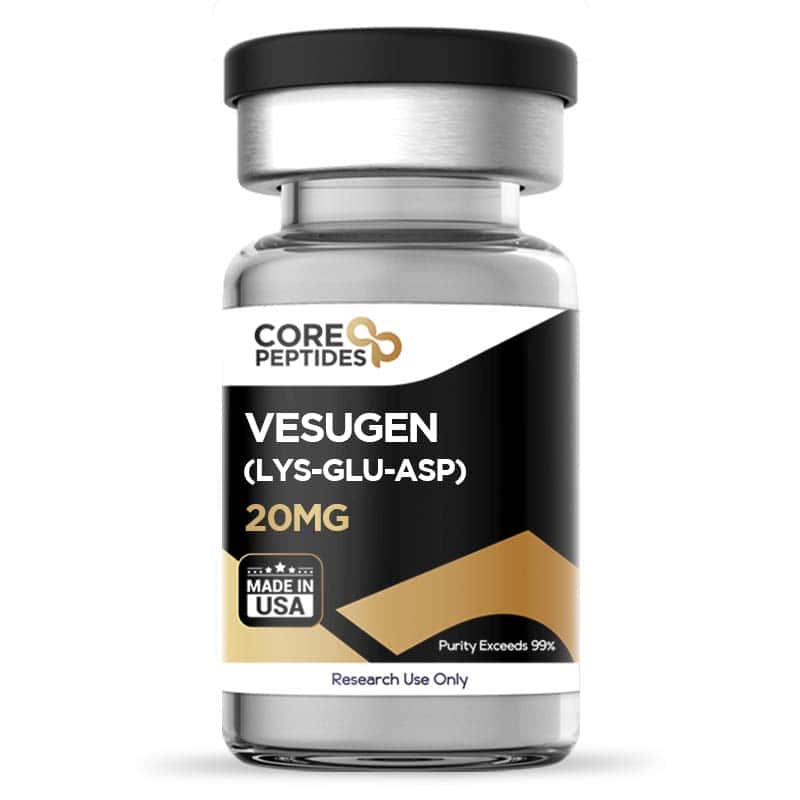
Vesugen (20mg) – Lys-Glu-Asp Research Peptide
Vesugen (20mg) is a synthetic tripeptide composed of the amino-acid sequence Lys-Glu-Asp (KED). It belongs to the short-peptide bioregulator research family associated with the work of Vladimir Khavinson and colleagues and has been investigated primarily in experimental models involving vascular endothelial cells, cellular ageing, gene expression and chromatin-related mechanisms.
Research published on Vesugen has explored its relationship with vascular endothelial cell biology and age-associated cellular changes.
One study reported that Vesugen (Lys-Glu-Asp) stimulated the expression of differentiation-related factors in human prostatic fibroblasts, while other short peptides in the same research programme were investigated in tissue-specific cell models.
Additional experimental work has examined Vesugen in relation to endothelial-cell proliferation and proposed epigenetic mechanisms involving gene regulation.
These findings remain primarily preclinical, and the available evidence should not be interpreted as establishing Vesugen as an approved medical treatment.
For research, laboratory and analytical purposes only. Not for human or animal consumption.
What Is Vesugen?
Vesugen is a short synthetic tripeptide with the amino-acid sequence Lys-Glu-Asp, commonly abbreviated as KED. It is one of the short peptide compounds developed within the Khavinson bioregulator research programme and is commonly associated with vascular and endothelial research.
The compound is substantially smaller than conventional therapeutic peptides and proteins. Its defined three-residue sequence makes it suitable for researchers investigating how very short peptide structures may interact with cellular systems and influence measurable biological processes.
Research into Vesugen has particularly focused on vascular endothelial cells, cellular proliferation, ageing-related changes and gene-expression pathways. However, the evidence base remains limited and should be evaluated according to the experimental model and study design.
Vesugen (20mg) Product Overview
| Specification | Details |
|---|---|
| Product Name | Vesugen |
| Quantity | 20mg |
| Sequence | Lys-Glu-Asp |
| Abbreviation | KED |
| Peptide Type | Synthetic tripeptide |
| Molecular Formula | C15H26N4O8 |
| Molecular Weight | Approximately 390.39 g/mol |
| Physical Form | Lyophilised peptide powder |
| Research Category | Short-peptide and vascular bioregulator research |
| Intended Use | Laboratory, analytical and in-vitro research |
The molecular formula, molecular weight and Lys-Glu-Asp sequence are consistent with published research-product specifications for Vesugen/KED.
Vesugen and the Lys-Glu-Asp Sequence
The defining structural feature of Vesugen is its Lys-Glu-Asp sequence. The three amino acids are arranged as lysine, glutamic acid and aspartic acid, producing a compact peptide model for laboratory investigation.
Short peptide research has generated interest in whether specific amino-acid sequences can produce biological effects that differ from those of individual amino acids or longer peptide molecules. Vesugen represents one such sequence-defined compound.
Researchers can therefore study KED as an individual molecular entity, compare it with other short peptide sequences and investigate whether structural differences correlate with different experimental outcomes.
Vesugen and Vascular Research
Vesugen is most commonly associated with research involving the vascular system and endothelial cells. The vascular endothelium forms the cellular lining of blood vessels and plays an important role in maintaining vascular homeostasis.
Experimental studies have investigated Vesugen in vascular endothelial cell models, including research examining cellular proliferation and age-associated changes. A published study reported effects of Vesugen and another short peptide on the proliferation marker Ki-67 in vascular endothelial cells from experimental models.
These observations provide a basis for further laboratory investigation but do not establish a therapeutic effect in humans.
Vesugen and Endothelial Cell Research
Endothelial cells provide a useful model for investigating vascular biology because they participate in processes involving vessel structure, cellular signalling and tissue maintenance.
Research on Vesugen has examined whether exposure to the KED tripeptide can influence measurable markers associated with endothelial-cell proliferation and gene expression. Such experiments can help researchers explore relationships between short peptide sequences and cellular responses.
Research findings can vary according to cell type, culture conditions, peptide concentration, exposure duration and analytical method. Consequently, individual experimental results should be interpreted within the specific context of the study.
Vesugen and Cellular Ageing Research
Cellular ageing is associated with changes in gene expression, chromatin organisation, proliferation and cellular function. Short peptide bioregulators have been investigated as experimental tools for examining some of these age-associated changes.
Studies involving Vesugen and related peptides have used cellular models to investigate age-dependent changes in gene expression and cell behaviour. Research involving short peptide bioregulators has reported tissue-specific changes in differentiation-related factors, including work involving Vesugen in human fibroblast cultures.
Such research is useful for understanding potential biological mechanisms but should not be presented as evidence that Vesugen is an anti-ageing medicine or treatment.
Vesugen and Gene Expression Research
One of the major research interests surrounding short peptide bioregulators is their proposed relationship with gene expression.
Experimental research has investigated whether Vesugen and related peptides can influence the expression of selected genes or transcription-associated markers in cellular systems.
A study involving human mesenchymal stem-cell ageing cultures reported changes in gene-expression patterns following exposure to short peptides including KED.
These findings are experimental and do not demonstrate that Vesugen selectively regulates genes in humans. Further independent research is required to establish the reproducibility, biological significance and mechanism of such observations.
Vesugen and Epigenetic Research
Epigenetics refers to mechanisms that influence gene activity without changing the underlying DNA sequence. Chromatin structure, DNA methylation and histone-associated processes are examples of mechanisms studied within this field.
Research from the Khavinson peptide programme has proposed that Vesugen may interact with regulatory regions associated with genes involved in endothelial-cell biology. Experimental work has included molecular modelling and studies of proliferation-associated markers such as Ki-67.
These proposed mechanisms remain an area of scientific investigation. Independent confirmation is important when evaluating mechanistic claims surrounding very short peptides.
Vesugen and Ki-67 Research
Ki-67 is a commonly used laboratory marker associated with cellular proliferation. Researchers can measure Ki-67 to investigate changes in cell-cycle activity and proliferative behaviour.
Experimental research has reported that Vesugen was associated with changes in Ki-67 levels in vascular endothelial cells from young and older animal models. The same research investigated potential interactions between the peptide and promoter regions of the MKI67 gene.
Such findings can help generate hypotheses for future studies but should not be interpreted as proof of a clinical benefit or therapeutic action in humans.
Vesugen and Tissue-Specific Peptide Research
Vesugen is part of a broader research programme involving short peptides designed around tissue-associated sequences. Related compounds include peptides such as Pancragen, Bronchogen and other short sequences investigated in different cellular models.
A 2012 study examined several short peptides and reported tissue-specific stimulation of differentiation-associated transcription factors. In that study, Vesugen (Lys-Glu-Asp) was investigated in human prostatic fibroblast cultures, while other peptides were examined in pancreatic and bronchial cell models.
This work illustrates the broader scientific interest in sequence-specific short peptides, while also demonstrating why findings from one peptide should not automatically be transferred to another.
Vesugen and Fibroblast Research
Fibroblasts are connective-tissue cells involved in maintaining extracellular structures and tissue architecture. They are commonly used in laboratory research investigating cellular differentiation and age-associated changes.
In one published study, Vesugen was among several short peptides tested in human prostatic fibroblast cultures. The researchers observed tissue-specific stimulation of the expression of selected differentiation factors.
This provides a specific example of Vesugen being investigated experimentally in a human-derived cell culture model, although it does not establish a therapeutic application.
Vesugen and Vascular Endothelial Biology
Vascular endothelial biology encompasses research into the cells lining blood vessels and the molecular pathways involved in their maintenance, proliferation and response to environmental signals.
Vesugen has been investigated in this context because of its proposed association with vascular tissue and endothelial-cell regulation. Experimental studies have examined proliferation-related markers and possible gene-regulatory mechanisms.
For researchers, this makes KED a potentially useful compound for exploratory work involving endothelial-cell models, provided that appropriate experimental controls and validated analytical procedures are used.
Vesugen and Neuronal Research
Recent experimental work has also examined short peptides including KED in neuronal models. A 2024 study investigated short peptides in fibroblast-derived induced neurons and reported changes in dendritic branching following exposure to the tested peptide combinations.
These findings extend the research interest surrounding short peptides beyond vascular models. However, the results were generated in experimental systems and should not be interpreted as evidence that Vesugen provides neuroprotective or neurological benefits in humans.
Vesugen Research Applications
Qualified laboratories may investigate Vesugen (20mg) in areas including:
- Vascular endothelial cell research.
- Short-peptide structure and function.
- Cellular proliferation studies.
- Gene-expression research.
- Chromatin and epigenetic research.
- Cellular ageing models.
- Fibroblast research.
- Stem-cell ageing models.
- Comparative peptide research.
- Endothelial signalling studies.
- Peptide-receptor and peptide-cell interaction research.
- Analytical peptide research.
These are potential laboratory research areas rather than medical indications or recommendations for human use.
Vesugen Chemical Profile
| Property | Information |
|---|---|
| Compound | Vesugen |
| Sequence | Lys-Glu-Asp |
| Abbreviation | KED |
| Peptide Length | 3 amino-acid residues |
| Molecular Formula | C15H26N4O8 |
| Molecular Weight | Approximately 390.39 g/mol |
| CAS Number | 204271-66-9 |
| Physical Form | Lyophilised powder |
| Research Classification | Short-peptide bioregulator |
Published supplier specifications identify Vesugen as the linear Lys-Glu-Asp tripeptide and report the molecular formula C15H26N4O8 with a molecular weight of approximately 390.39 g/mol.
Vesugen Compared With Other Short Peptides
| Compound | Sequence | General Research Area |
|---|---|---|
| Vesugen | Lys-Glu-Asp (KED) | Vascular and endothelial research |
| Pancragen | Lys-Glu-Asp-Trp | Pancreatic-cell research |
| Bronchogen | Ala-Glu-Asp-Leu | Bronchial-cell research |
| Vesilut | Glu-Asp (ED) | Short-peptide and bioregulator research |
These compounds share related acidic peptide residues but have different sequences and molecular structures. Published research has specifically investigated the compounds in different cellular models, demonstrating the importance of sequence when interpreting experimental findings.
Why Research Vesugen?
Vesugen provides researchers with a defined Lys-Glu-Asp tripeptide for investigating short-peptide biology. Its small and well-defined structure makes it suitable for comparative studies examining how specific peptide sequences interact with cellular systems.
The compound may be particularly relevant to laboratories studying endothelial biology, cellular proliferation, gene expression and ageing-related molecular changes.
At the same time, the scientific evidence should be considered carefully. Much of the published work comes from a relatively specialised research programme, and independent confirmation of proposed mechanisms remains an important area for future investigation.
Vesugen (20mg) for Analytical Research
Analytical characterisation is an important part of synthetic peptide research. Laboratories can use established analytical techniques to confirm identity, assess purity and monitor sample characteristics.
- HPLC: Used to assess chromatographic purity and identify related substances.
- Mass spectrometry: Used to confirm molecular mass and support compound identification.
- LC-MS: Combines chromatographic separation with mass-based detection.
- Cell-based assays: Used to investigate biological responses in controlled experimental systems.
- Molecular studies: Used to examine potential relationships between peptide exposure and selected gene-expression markers.
Researchers should use validated laboratory methods and consult current batch-specific documentation when evaluating Vesugen.
Vesugen (20mg) Research Summary
| Research Characteristic | Information |
|---|---|
| Product | Vesugen (20mg) |
| Sequence | Lys-Glu-Asp |
| Abbreviation | KED |
| Peptide Length | 3 amino-acid residues |
| Molecular Formula | C15H26N4O8 |
| Molecular Weight | Approximately 390.39 g/mol |
| Primary Research Focus | Vascular, endothelial and short-peptide biology |
| Additional Research Areas | Gene expression, cellular ageing and chromatin-related studies |
| Intended Use | Laboratory, analytical and in-vitro research |
Frequently Asked Questions About Vesugen (20mg)
What is Vesugen?
Vesugen is a synthetic short tripeptide with the sequence Lys-Glu-Asp (KED). It is studied within the broader field of short peptide bioregulator research.
What is the sequence of Vesugen?
The sequence is Lys-Glu-Asp, commonly abbreviated as KED.
What is Vesugen studied for?
Research involving Vesugen has focused primarily on vascular endothelial biology, cellular proliferation, gene expression, chromatin-related mechanisms and age-associated cellular changes.
What is the molecular weight of Vesugen?
The free peptide has a molecular weight of approximately 390.39 g/mol, with the molecular formula C15H26N4O8.
Is Vesugen a vascular peptide?
Vesugen is commonly described in research literature and commercial research materials as a vascular-associated short peptide because much of the experimental work has focused on endothelial and vascular biology. This terminology should not be interpreted as evidence of an approved vascular treatment.
Does Vesugen have human clinical evidence?
The available evidence base is limited compared with established pharmaceutical compounds. Current research summaries characterise Vesugen primarily as a preclinical research compound, with much of the literature originating from the Khavinson research programme.
Is Vesugen FDA-approved?
Vesugen is not an FDA-approved medicine. It should be treated as a research compound rather than an authorised pharmaceutical product.
Is Vesugen the same as Vesilut?
No. Vesugen is the Lys-Glu-Asp tripeptide, whereas Vesilut is a shorter Glu-Asp dipeptide. Their different sequences mean they should not be considered interchangeable.
Is Vesugen the same as Pancragen?
No. Vesugen has the sequence Lys-Glu-Asp, while Pancragen contains Lys-Glu-Asp-Trp. Published research has investigated these peptides in different tissue-specific cellular models.
Is Vesugen intended for human use?
No. This research-grade material is intended for laboratory and analytical research and should not be used for human or animal consumption.
Can Vesugen be used as a treatment?
This product should not be represented as a treatment for any disease or medical condition. Research findings should not be interpreted as clinical recommendations.
Storage and Laboratory Handling
Researchers should follow the current supplier documentation and batch-specific Certificate of Analysis for exact storage and handling requirements.
- Keep the material in its original labelled container.
- Follow the storage conditions specified in the applicable product documentation.
- Protect the material from unnecessary exposure to light, moisture and environmental contaminants.
- Minimise unnecessary temperature fluctuations.
- Use appropriate laboratory protective equipment when handling the material.
- Prevent contamination during laboratory procedures.
- Maintain appropriate batch and experimental records.
- Dispose of research material according to applicable institutional and laboratory procedures.
No dosing, administration or self-use instructions are provided because Vesugen is intended exclusively for laboratory research.
Important Research Disclaimer
Vesugen (20mg) is supplied strictly for research, laboratory and analytical purposes. This product is not intended for human or animal consumption, self-administration, diagnosis, treatment, cure or prevention of any disease.
References to vascular biology, endothelial function, cellular ageing, gene expression, epigenetics or other biological processes describe areas of scientific investigation and should not be interpreted as therapeutic claims.
Published research has reported experimental findings involving Vesugen and related short peptides, but the evidence remains predominantly preclinical and does not establish the product as an authorised medical treatment.
Researchers are responsible for complying with all applicable legislation, institutional requirements, laboratory safety procedures and appropriate handling protocols when working with this material.
For research use only. Not for human or animal consumption.
Be the first to review “Vesugen (20mg)”
Related products

Peptides for Sale
Peptides for Sale
Peptides for Sale
Peptide Blends for Sale
Peptides for Sale
Peptides for Sale
Peptides for Sale
Peptides for Sale
Reviews
There are no reviews yet.