
Mod GRF 1-29 & GHRP-2 Blend (10mg) – Research Peptide Blend
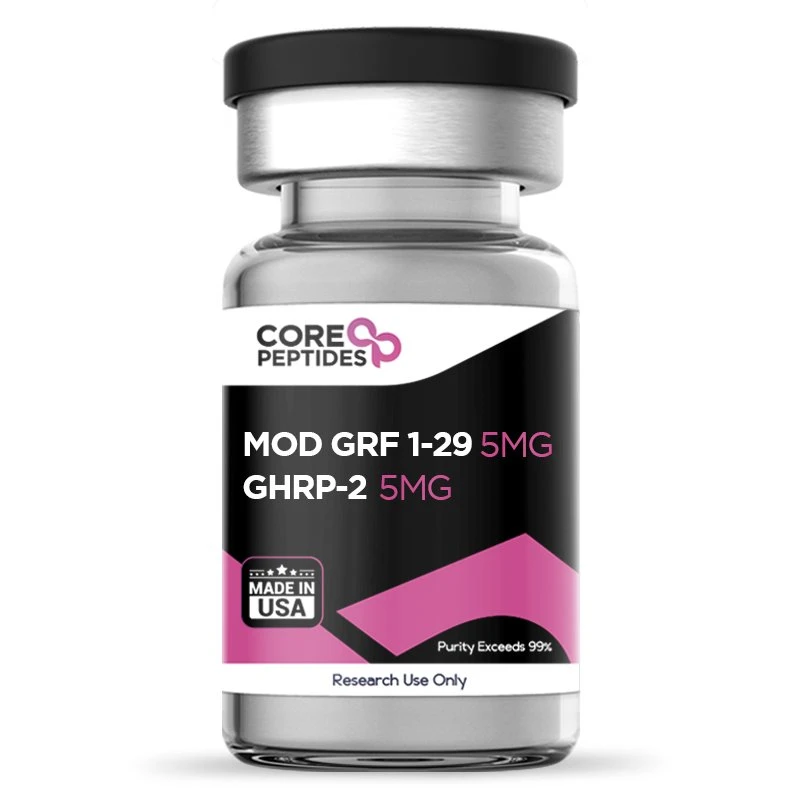
Mod GRF 1-29 & GHRP-2 Blend (10mg) is a research peptide formulation combining two synthetic compounds associated with the study of growth-hormone signalling: Modified GRF 1-29 and GHRP-2. The referenced product contains 5mg of each peptide, supplied as a lyophilised powder with a stated purity of greater than 99%.
Modified GRF 1-29 is a synthetic analogue related to growth hormone-releasing hormone (GHRH), while GHRP-2 is a growth hormone secretagogue associated with the ghrelin receptor pathway.
Because the two compounds interact with complementary signalling systems, their combination has been investigated in research examining pulsatile growth hormone release and the regulation of the somatotropic axis.
This product is supplied for research and laboratory use only. It is not intended for human or animal consumption, self-administration, diagnosis or treatment.
What Is Mod GRF 1-29 & GHRP-2 Blend?
Mod GRF 1-29 & GHRP-2 Blend combines two different classes of research peptides in a single formulation.
Mod GRF 1-29 is a modified 29-amino-acid analogue of GHRH. It is also commonly described as CJC-1295 without DAC. Its primary research interest is its interaction with GHRH receptors on somatotroph cells in the anterior pituitary.
GHRP-2, also known as growth hormone-releasing peptide-2, is a synthetic growth hormone secretagogue. Research indicates that it interacts with the growth hormone secretagogue receptor, commonly designated GHS-R1a, which is also activated by the endogenous peptide hormone ghrelin.
Studying these compounds together allows researchers to investigate two complementary mechanisms involved in growth hormone regulation rather than examining either signalling pathway in isolation.
Mod GRF 1-29 & GHRP-2 Blend (10mg) Product Specifications
| Specification | Details |
|---|---|
| Product Name | Mod GRF 1-29 & GHRP-2 Blend |
| Total Quantity | 10mg |
| Mod GRF 1-29 | 5mg |
| GHRP-2 | 5mg |
| Blend Ratio | 1:1 by stated mass |
| Form | Lyophilised powder |
| Stated Purity | >99% |
| Research Classification | Peptide blend |
| Intended Use | Research and laboratory applications only |
The product listing identifies the 10mg formulation as containing 5mg Mod GRF 1-29 and 5mg GHRP-2, with a stated purity above 99%. Researchers should refer to the applicable batch-specific certificate of analysis for current analytical information.
Mod GRF 1-29: Overview
Modified GRF 1-29 is a synthetic analogue based on the first 29 amino acids of naturally occurring GHRH.
GHRH is an endogenous hypothalamic peptide involved in the regulation of growth hormone secretion. Mod GRF 1-29 is designed as a modified form of the biologically active N-terminal portion of GHRH, with amino-acid substitutions intended to alter its stability and pharmacokinetic characteristics.
In experimental systems, Mod GRF 1-29 is studied for its ability to engage GHRH receptors on pituitary somatotroph cells. Receptor activation is associated with intracellular signalling involving cyclic AMP and protein kinase A, ultimately contributing to growth hormone secretion.
Mod GRF 1-29 and GHRH Receptors
GHRH receptors are found on growth-hormone-producing somatotroph cells in the anterior pituitary. Research into Mod GRF 1-29 examines how activation of these receptors influences intracellular signalling and growth hormone release.
The classical pathway involves stimulation of adenylyl cyclase, an increase in intracellular cyclic AMP and activation of protein kinase A. Downstream signalling can influence calcium-channel activity and the secretion of growth hormone-containing vesicles.
GHRP-2: Overview
GHRP-2 is a synthetic growth hormone-releasing peptide that has been investigated extensively in endocrine and pharmacological research.
Unlike GHRH analogues, GHRP-2 is associated with the growth hormone secretagogue receptor GHS-R1a. This receptor is also activated by ghrelin, an endogenous peptide involved in growth hormone regulation and appetite signalling.
Research into GHRP-2 has therefore provided a useful model for examining how ghrelin-related signalling interacts with the pituitary growth hormone system.
GHRP-2 and Ghrelin Signalling
Ghrelin is sometimes described as the “hunger hormone” because of its involvement in appetite regulation. GHRP-2 can interact with the same receptor family, which means experimental administration may influence both growth hormone secretion and other physiological pathways associated with GHS-R1a activation.
This receptor profile is an important consideration when interpreting research involving GHRP-2 because its effects are not necessarily limited to growth hormone signalling.
How the Mod GRF 1-29 & GHRP-2 Blend Is Studied
The scientific interest in combining Mod GRF 1-29 with GHRP-2 comes from their complementary receptor mechanisms.
Mod GRF 1-29 is associated with GHRH receptor signalling, whereas GHRP-2 interacts with GHS-R1a. These pathways can converge on the pituitary somatotroph and influence growth hormone secretion through different mechanisms.
This makes the combination useful for experimental studies examining:
- Growth hormone secretion.
- Pulsatile endocrine signalling.
- GHRH receptor activity.
- Growth hormone secretagogue receptor activity.
- Pituitary somatotroph responses.
- Interactions between GHRH and ghrelin-related pathways.
- Downstream IGF-1-related endocrine responses.
Potential Synergistic Signalling
One of the principal research questions surrounding this combination is whether stimulation of both GHRH and GHS-R1a pathways produces a greater growth hormone response than stimulation of either pathway individually.
Research has reported that GHRH and GHRP-2 can produce substantially greater pulsatile growth hormone responses when administered together than when either compound is evaluated alone under particular experimental conditions.
However, results depend on the experimental population, timing, peptide preparation and study design. Such findings should not be interpreted as evidence that a commercial research blend has a predictable or clinically established effect in humans.
Mod GRF 1-29 & GHRP-2 and Growth Hormone Research
Growth hormone, or GH, is a peptide hormone produced primarily by somatotroph cells in the anterior pituitary. Its secretion occurs naturally in pulses and is regulated by several hypothalamic and peripheral signals.
GHRH promotes GH secretion, while somatostatin inhibits it. Ghrelin and synthetic growth hormone secretagogues such as GHRP-2 can also influence GH release. The Mod GRF 1-29 and GHRP-2 combination therefore provides an experimental model for studying multiple components of this regulatory system.
Research involving GHRP-2 has demonstrated stimulation of GH secretion in several experimental settings, including investigations involving individuals with growth hormone deficiency.
Mod GRF 1-29 & GHRP-2 and IGF-1 Research
Insulin-like growth factor-1 (IGF-1) is one of the principal downstream mediators associated with growth hormone activity.
Because growth hormone can stimulate IGF-1 production, researchers investigating GHRH analogues and growth hormone secretagogues may also examine IGF-1 as a downstream biomarker.
Studies reviewed by the product source have reported increases in IGF-1 following experimental stimulation of the growth hormone axis. However, the magnitude of any response depends on the study design, participant characteristics and experimental conditions.
For laboratory research, monitoring both GH and IGF-1 can provide a broader picture of endocrine-axis responses than measuring either marker alone.
Mod GRF 1-29 & GHRP-2 and Appetite Research
Because GHRP-2 interacts with the ghrelin receptor, researchers have also examined its relationship with appetite and food intake.
In a small human research study cited by Core Peptides, GHRP-2 administration was associated with increased food intake compared with saline under the study conditions.
This finding is relevant when studying GHRP-2 because the peptide’s pharmacological activity may extend beyond pituitary growth hormone secretion. It also highlights why research involving GHS-R1a agonists should consider multiple physiological endpoints.
Mod GRF 1-29 & GHRP-2 and Hormonal Research
GHRP-2 has been investigated for its effects on several endocrine hormones in addition to GH.
Research involving younger and older adult male subjects found that GHRP-2 increased GH concentrations in both groups. The study also reported changes in ACTH and cortisol, with a mild increase in prolactin.
These findings are important because they demonstrate that growth hormone secretagogue research should not focus exclusively on GH. Changes in related endocrine pathways can be relevant when interpreting experimental results.
Chemical Characteristics
| Compound | Mod GRF 1-29 | GHRP-2 |
|---|---|---|
| Peptide Class | GHRH analogue | Growth hormone secretagogue |
| Common Alternative Name | CJC-1295 without DAC | Growth Hormone-Releasing Peptide-2 |
| Approx. Molecular Weight | 3367.9 g/mol | 817.9 g/mol |
| Molecular Formula | C152H252N44O42 | C45H55N9O6 |
| Primary Receptor/System | GHRH receptor | GHS-R1a / ghrelin receptor |
| Primary Research Interest | GHRH-mediated GH signalling | Ghrelin-related GH secretagogue signalling |
The molecular formulae and molecular weights above are based on the referenced product information.
Research Applications for Mod GRF 1-29 & GHRP-2
This peptide blend may be relevant to qualified laboratories studying:
- Endocrinology: Investigating regulation of the somatotropic axis.
- Pituitary biology: Studying somatotroph responses to peptide stimulation.
- GHRH signalling: Examining receptor-mediated growth hormone release.
- Ghrelin research: Investigating GHS-R1a receptor activity.
- Growth hormone secretion: Measuring changes in pulsatile GH release.
- IGF-1 research: Examining downstream endocrine responses to GH signalling.
- Appetite research: Investigating ghrelin-related effects of GHRP-2.
- Ageing research: Comparing endocrine responses across age groups.
- Peptide pharmacology: Comparing GHRH analogues and secretagogues.
- Signal-transduction research: Investigating cAMP, calcium and related intracellular pathways.
Mod GRF 1-29 & GHRP-2 vs Individual Peptides
| Characteristic | Mod GRF 1-29 | GHRP-2 | Combined Blend |
|---|---|---|---|
| Peptide Type | GHRH analogue | GHS peptide | Two-peptide formulation |
| Primary Target | GHRH receptor | GHS-R1a | Both pathways |
| Research Focus | GH release through GHRH signalling | GH release through ghrelin-related signalling | Interaction between complementary pathways |
| Other Research Areas | Pituitary signalling | Appetite and endocrine signalling | Integrated GH-axis research |
Why Researchers Study the Combination
Studying Mod GRF 1-29 and GHRP-2 together can provide a useful model for investigating how two distinct endocrine signalling pathways interact.
Rather than simply examining a single receptor system, researchers can investigate the relationship between GHRH receptor signalling and growth hormone secretagogue receptor signalling. This can be particularly relevant to experiments involving pulsatile GH secretion and endocrine feedback.
The combination may also help researchers compare responses to individual peptides against responses produced when both pathways are stimulated simultaneously.
Important Research Considerations
Several factors should be considered when interpreting studies involving Mod GRF 1-29 & GHRP-2:
- GH secretion naturally varies according to age, sex, sleep, nutrition and other physiological factors.
- GHRP-2 can affect pathways associated with ghrelin and appetite in addition to GH secretion.
- Hormonal responses may differ substantially between healthy and GH-deficient research populations.
- Animal findings cannot automatically be extrapolated to humans.
- Results obtained with individual peptides may not accurately predict results from a fixed-ratio blend.
- The exact composition and analytical purity of a research material should be verified using batch-specific documentation.
Frequently Asked Questions
What is Mod GRF 1-29 & GHRP-2 Blend?
It is a research peptide combination containing Modified GRF 1-29 and GHRP-2. The referenced 10mg product contains 5mg of each peptide.
What does Mod GRF 1-29 do in research?
Mod GRF 1-29 is studied as a GHRH analogue that interacts with GHRH receptors on pituitary somatotroph cells and can influence growth hormone secretion in experimental systems.
What is GHRP-2?
GHRP-2 is a synthetic growth hormone secretagogue associated with the GHS-R1a receptor, which is also activated by ghrelin. It has been studied for its effects on growth hormone and related endocrine pathways.
Why are Mod GRF 1-29 and GHRP-2 combined?
The two peptides act through complementary signalling systems. Researchers have investigated whether simultaneous stimulation of GHRH and GHS-R1a pathways can produce a stronger or more coordinated growth hormone response than either pathway alone.
How much of each peptide is in the 10mg blend?
The referenced product contains 5mg of Mod GRF 1-29 and 5mg of GHRP-2, giving a total formulation size of 10mg.
Is Mod GRF 1-29 the same as CJC-1295?
Mod GRF 1-29 is commonly referred to as CJC-1295 without DAC. It should not be confused with CJC-1295 containing DAC, which is a distinct modified peptide with different pharmacological characteristics.
Does GHRP-2 affect appetite?
Research has investigated GHRP-2’s relationship with appetite because it activates the ghrelin receptor. A small human study cited by the supplier reported increased food intake following experimental GHRP-2 exposure.
Is the blend intended for human use?
No. The referenced product is designated for research and laboratory purposes only and is not intended for human or animal consumption or self-administration.
What form is the product supplied in?
The product is listed as a lyophilised powder with a stated purity of greater than 99%.
Can research results with GHRP-2 be applied directly to the blend?
Not necessarily. Results obtained with isolated GHRP-2 cannot automatically predict the behaviour of a fixed-ratio formulation containing both GHRP-2 and Mod GRF 1-29. Experimental results should be evaluated for the exact formulation and research model used.
Mod GRF 1-29 & GHRP-2 Blend (10mg) Summary
Mod GRF 1-29 & GHRP-2 Blend (10mg) combines two research peptides associated with growth hormone regulation. The formulation contains 5mg of Modified GRF 1-29 and 5mg of GHRP-2 in a lyophilised powder format, with a stated purity above 99%.
Mod GRF 1-29 is a GHRH analogue studied for its interaction with GHRH receptors, while GHRP-2 is a growth hormone secretagogue associated with GHS-R1a and ghrelin signalling.
Their complementary mechanisms make the combination relevant to experimental research into pituitary signalling, pulsatile growth hormone release, endocrine regulation, IGF-1 responses and ghrelin-related pathways.
For qualified researchers, this blend can provide a useful model for investigating interactions between distinct components of the somatotropic axis. Research conclusions should remain specific to the experimental model, formulation and analytical conditions used.
Research-Use Disclaimer
Mod GRF 1-29 & GHRP-2 Blend (10mg) is intended exclusively for research, laboratory and analytical purposes. It is not intended for human or animal consumption, self-administration, diagnosis, treatment, cure or prevention of any disease.
The research discussed above does not establish this product as an approved medicine or therapeutic treatment. Findings from animal models, cell cultures or controlled clinical research involving individual compounds should not be interpreted as proof of safety or efficacy for this specific commercial blend.
Researchers should review the current certificate of analysis, safety documentation and applicable regulatory requirements before conducting laboratory work with this material.
Be the first to review “Mod GRF 1-29 & GHRP-2 Blend (10mg)”
Related products
Peptides for Sale
Peptides for Sale
Peptides for Sale
Peptides for Sale
Peptides for Sale
Peptide Blends for Sale
Peptides for Sale
Peptides for Sale
Reviews
There are no reviews yet.