
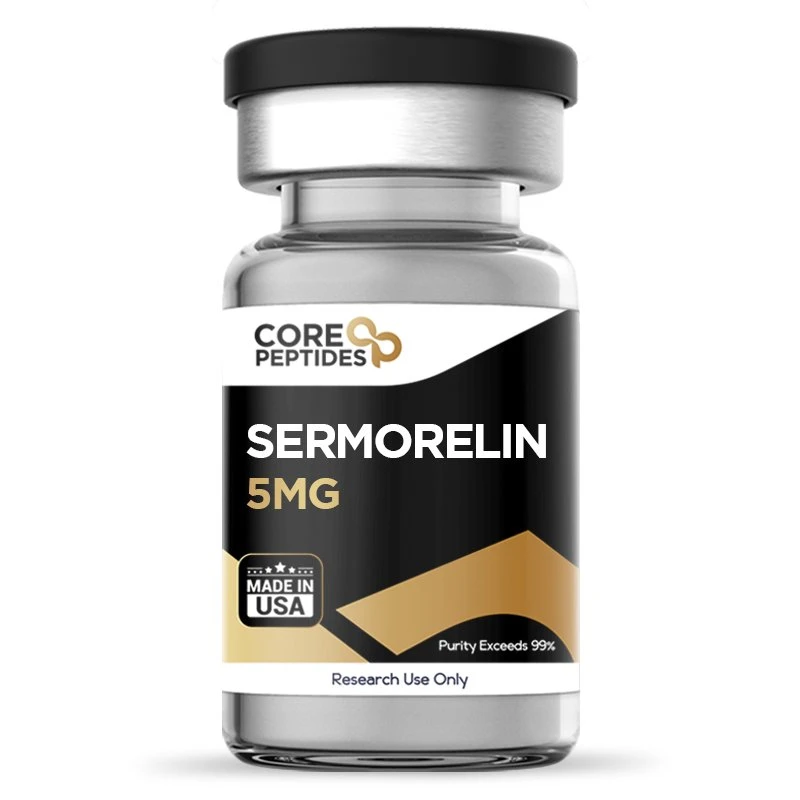
Sermorelin – 5MG – High-Purity Research Peptide
Sermorelin – 5MG is a synthetic 29-amino-acid peptide and analogue of human growth hormone-releasing hormone (GHRH). It corresponds to the biologically active N-terminal fragment GHRH(1-29)-amide and has been extensively investigated in research concerning growth hormone signalling, pituitary function, the growth hormone/IGF-1 axis and endocrine physiology.
This 5mg Sermorelin presentation is supplied as a lyophilised powder and is listed by Core Peptides with a purity of >99%. The product is intended for qualified research, laboratory and analytical applications only and is not intended for human or animal consumption.
What Is Sermorelin?
Sermorelin is a synthetic peptide consisting of the first 29 amino acids of human growth hormone-releasing hormone. It is commonly identified as GHRH(1-29)-amide, GRF(1-29) or growth hormone-releasing factor 1-29. The peptide was developed to reproduce the biologically active portion of GHRH while using a substantially shorter sequence than the naturally occurring 44-amino-acid hormone.
Research has shown that Sermorelin can interact with GHRH receptors associated with anterior pituitary cells. Activation of these receptors is linked to intracellular signalling pathways involved in the regulated secretion of growth hormone.
Because of this mechanism, Sermorelin has been studied as a useful research compound for examining the growth hormone-releasing hormone–growth hormone axis and related endocrine pathways.
Sermorelin – 5MG Product Specifications
| Specification | Details |
|---|---|
| Product Name | Sermorelin |
| Quantity | 5mg |
| Peptide Type | Synthetic GHRH analogue |
| Sequence Length | 29 amino acids |
| Common Name | GHRH(1-29)-amide |
| Alternative Name | GRF 1-29 |
| Form | Lyophilised powder |
| Listed Purity | >99% |
| SKU | P-SERMORELIN-5 |
| CAS Registry Number | 86168-78-7 |
| Molecular Formula | C149H246N44O42S |
| Molecular Weight | 3357.93 g/mol |
| Intended Use | Research, laboratory and analytical purposes |
The product specifications are based on Core Peptides’ current product information, while the identity of Sermorelin as GHRH(1-29)-amide and its CAS number are also documented by the US National Library of Medicine’s MeSH database.
Sermorelin Peptide Structure
Sermorelin is a 29-amino-acid peptide derived from the N-terminal region of human GHRH. The natural human GHRH peptide contains 44 amino acids, whereas Sermorelin represents the shorter biologically active fragment used in research.
The C-terminal amidation of Sermorelin is an important structural characteristic. It is commonly written as GHRH(1-29)-NH2 and is associated with the peptide’s biological activity and molecular stability.
From a research perspective, the shortened structure makes Sermorelin particularly useful for studying the relationship between peptide sequence, receptor binding and downstream endocrine signalling.
How Sermorelin Relates to GHRH
Growth hormone-releasing hormone (GHRH) is a hypothalamic peptide involved in regulating the secretion of growth hormone from the anterior pituitary. Sermorelin represents the first 29 amino acids of the endogenous GHRH sequence and is designed to retain the key biological characteristics of this region.
Research describes Sermorelin as the shortest synthetic peptide with full biological activity associated with GHRH. Its interaction with GHRH receptors makes it an important experimental tool for investigating the hypothalamic-pituitary-somatotropic axis.
Sermorelin and GHRH Receptor Research
One of the primary areas of Sermorelin research concerns the GHRH receptor. These receptors are expressed on somatotroph cells within the anterior pituitary and play a central role in growth hormone secretion.
When a GHRH analogue such as Sermorelin interacts with the receptor, researchers have investigated downstream signalling involving Gs proteins, adenylate cyclase and cyclic AMP (cAMP). These pathways can ultimately influence the secretory activity of pituitary somatotroph cells.
This receptor-level mechanism makes Sermorelin valuable for controlled experiments examining how GHRH receptor activation affects endocrine signalling.
Sermorelin and the Growth Hormone Axis
The growth hormone (GH) axis is a complex endocrine system involving the hypothalamus, pituitary gland, growth hormone and downstream mediators such as insulin-like growth factor-1 (IGF-1).
Sermorelin has been investigated because its interaction with GHRH receptors can stimulate the release of endogenous growth hormone from pituitary cells. This differs mechanistically from administering growth hormone itself because Sermorelin acts upstream of GH secretion.
Research into this pathway can therefore help scientists distinguish between direct hormone replacement and stimulation of endogenous pituitary hormone release.
Sermorelin and IGF-1 Research
Insulin-like growth factor-1 (IGF-1) is an important downstream mediator of growth hormone activity. Research involving Sermorelin has consequently examined changes in circulating IGF-1 alongside growth hormone responses.
Clinical and experimental studies have reported increases in growth hormone and IGF-1 under certain research conditions. However, the magnitude of these responses depends on factors such as study population, experimental design, age, baseline endocrine function and exposure conditions.
For laboratory researchers, the relationship between Sermorelin, GH and IGF-1 provides an opportunity to investigate the regulation of the somatotropic axis in controlled models.
Sermorelin and Growth Hormone Deficiency Research
Sermorelin has a long history of research involving growth hormone deficiency. Published clinical literature has examined the peptide both as a diagnostic stimulus and as an experimental treatment in selected growth hormone-deficient populations.
A review published in BioDrugs described Sermorelin as a GHRH analogue that can stimulate growth hormone secretion from the anterior pituitary. The review also discussed research involving children with idiopathic growth hormone deficiency and reported increases in height velocity in selected study populations.
These historical clinical findings provide important background for researchers investigating GHRH biology, while not establishing the Core Peptides research product as an approved medicine.
Sermorelin and Pituitary Function
The pituitary gland is a central component of the endocrine system and regulates the release of numerous hormones. Sermorelin research focuses particularly on somatotroph cells, which are responsible for producing and releasing growth hormone.
Because Sermorelin acts through GHRH receptors, it has been used in experimental research to examine whether pituitary tissue retains the capacity to respond appropriately to GHRH stimulation.
This characteristic has also made Sermorelin relevant to research into diagnostic approaches for evaluating growth hormone secretion.
Sermorelin as a Research Tool for GHRH Signalling
Sermorelin offers researchers a defined peptide system for studying GHRH receptor activation without requiring the complete 44-amino-acid endogenous hormone.
Potential experimental applications include:
- GHRH receptor binding studies.
- cAMP signalling research.
- Pituitary somatotroph studies.
- Growth hormone secretion research.
- GH and IGF-1 pathway investigations.
- Structure–activity relationship studies.
- Endocrine physiology research.
- Growth hormone deficiency models.
Sermorelin and Body Composition Research
Research has also examined GHRH analogues in relation to body composition and metabolic physiology. Some clinical investigations involving Sermorelin or related GHRH-based approaches have evaluated parameters such as lean body mass, visceral adipose tissue and IGF-1.
For example, a randomised controlled trial published in JAMA investigated GHRH treatment in men with HIV-associated lipodystrophy and reported changes in growth hormone and IGF-1 alongside body-composition measures.
Such findings are relevant to research into the interaction between the GH/IGF-1 axis and body composition, but should not be interpreted as evidence for using research peptides for physique enhancement.
Sermorelin and Metabolic Research
Growth hormone signalling interacts with several metabolic pathways involving glucose, lipids and protein metabolism. Sermorelin research can therefore be used to investigate how activation of the GHRH-GH axis may influence downstream metabolic markers.
Researchers have examined parameters including glucose and insulin responses in clinical studies. Findings vary according to population and experimental design, highlighting the importance of controlled study conditions when evaluating endocrine effects.
Sermorelin and Hormonal Signalling
Because GHRH receptor activation can influence the release of growth hormone, researchers have investigated whether Sermorelin affects other endocrine markers alongside GH and IGF-1.
Studies have examined markers including prolactin, insulin, cortisol, glucose, thyroid hormones, FSH and LH. Results differ between experimental models and study populations, so individual findings should be interpreted within their original research context.
This makes Sermorelin particularly relevant to researchers studying the specificity and broader endocrine consequences of GHRH receptor activation.
Sermorelin and Growth Velocity Research
Historical research into Sermorelin investigated growth velocity in children with idiopathic growth hormone deficiency. A published review reported that selected children experienced increased height velocity during Sermorelin treatment, with some research indicating sustained responses during continued treatment.
These studies are part of the scientific history of Sermorelin and provide evidence that the peptide has been extensively investigated in the context of the GH axis. They should not, however, be used as a basis for self-treatment or unapproved medical use.
Sermorelin and Endocrine Research in Adults
Research has also investigated age-related changes in growth hormone secretion. Adult studies have examined whether GHRH analogues such as Sermorelin can stimulate GH secretion in older populations.
These investigations are relevant to the study of the naturally occurring decline in GH secretion with age and the mechanisms controlling pituitary responsiveness to hypothalamic signals.
Pharmacological Research on Sermorelin
Sermorelin has a relatively short duration of action compared with some longer-acting GHRH analogues. Core Peptides cites an estimated half-life of approximately 11–12 minutes.
The relatively short exposure period makes Sermorelin useful for investigating acute GHRH receptor stimulation and pulsatile endocrine responses.
Researchers should distinguish between pharmacokinetic characteristics observed in published studies and any specific experimental assumptions regarding a particular batch or formulation.
Sermorelin vs Growth Hormone
| Characteristic | Sermorelin | Growth Hormone |
|---|---|---|
| Type | GHRH analogue | Peptide hormone |
| Primary target | GHRH receptor | Growth hormone receptor |
| Primary biological role | Stimulates endogenous GH secretion | Acts directly as growth hormone |
| Sequence | 29 amino acids | 191 amino acids |
| Research focus | GHRH-GH axis | GH receptor signalling |
The distinction between these compounds is important in laboratory research. Sermorelin is designed to act upstream by interacting with GHRH receptors, whereas growth hormone itself acts directly on growth hormone receptors.
Sermorelin vs Other GHRH Analogues
Sermorelin belongs to a broader family of compounds used in research into the growth hormone-releasing hormone pathway. Other compounds include longer-acting GHRH analogues such as tesamorelin and modified forms of GHRH.
The primary structural distinction is the peptide sequence and the modifications introduced to influence receptor activity, stability or pharmacokinetic properties. Sermorelin remains particularly useful as a comparatively short GHRH analogue and reference compound.
Potential Research Applications of Sermorelin – 5MG
Qualified laboratories may investigate Sermorelin in a broad range of controlled research applications, including:
- GHRH receptor research and receptor-ligand interactions.
- Growth hormone secretion studies.
- Anterior pituitary research.
- GH and IGF-1 axis investigations.
- Growth hormone deficiency models.
- Endocrine signalling research.
- cAMP and PKA pathway studies.
- Structure–activity relationship investigations.
- Pituitary responsiveness research.
- Metabolic and body-composition studies.
- Age-related endocrine research.
- Comparative studies involving GHRH analogues.
Why Choose Sermorelin – 5MG?
Sermorelin – 5MG provides researchers with a defined quantity of a well-established GHRH analogue for controlled laboratory investigations.
- 5mg quantity: A practical research format for laboratory workflows.
- >99% listed purity: Suitable for research requiring high-purity peptide material.
- 29-amino-acid structure: Represents the biologically active N-terminal region of GHRH.
- Lyophilised presentation: Supplied in a dry research format.
- Well-established research profile: Sermorelin has been investigated for decades in endocrine and growth hormone research.
- Defined chemical identity: Documented as GHRH(1-29)-amide with CAS 86168-78-7.
Sermorelin Chemical Information
| Property | Information |
|---|---|
| Compound | Sermorelin |
| Peptide Class | GHRH analogue |
| Sequence Length | 29 amino acids |
| Common Chemical Description | GHRH(1-29)-amide |
| Alternative Name | GRF 1-29 |
| CAS Number | 86168-78-7 |
| Molecular Formula | C149H246N44O42S |
| Molecular Weight | 3357.93 g/mol |
| Product Quantity | 5mg |
| Physical Form | Lyophilised powder |
The chemical identity and registry information are supported by the NCBI MeSH database, which lists Sermorelin as the biologically active fragment of human growth hormone-releasing factor consisting of GHRH(1-29)-amide.
Analytical Testing of Sermorelin
High-purity research peptides can be characterised using analytical techniques designed to confirm identity and evaluate purity. For laboratory research, commonly used methods include:
- HPLC for chromatographic purity assessment.
- Mass spectrometry for molecular-mass and identity confirmation.
- Peptide mapping where appropriate.
- Receptor-binding assays for mechanistic investigations.
- Cell-based assays for evaluating biological responses.
- Hormone-response assays in suitable experimental models.
Researchers should review the relevant batch-specific Certificate of Analysis and technical documentation before beginning experimental work.
Laboratory Handling and Storage
Sermorelin – 5MG is supplied as a lyophilised powder. Laboratories should follow the supplier’s current technical documentation and their own validated procedures for peptide storage, handling and experimental preparation.
- Keep the product in its original labelled container.
- Protect the lyophilised material from unnecessary exposure to moisture.
- Follow the supplier’s recommended storage conditions.
- Minimise unnecessary temperature fluctuations.
- Use appropriate laboratory protective equipment.
- Follow institutional procedures for handling and disposal.
- Review batch-specific analytical documentation before use.
Storage requirements can vary depending on formulation, packaging and experimental protocol. Always prioritise the supplier’s current documentation and applicable laboratory requirements.
Frequently Asked Questions About Sermorelin – 5MG
What is Sermorelin?
Sermorelin is a synthetic 29-amino-acid analogue of human growth hormone-releasing hormone. It corresponds to GHRH(1-29)-amide and has been extensively studied in growth hormone and endocrine research.
How much Sermorelin is in this product?
This product contains 5mg of Sermorelin and is supplied as a lyophilised powder. Core Peptides lists the product with a purity of greater than 99%.
What is the purity of Sermorelin – 5MG?
Core Peptides currently lists the Sermorelin 5mg product with a purity of >99%.
What is Sermorelin researched for?
Sermorelin has been researched in relation to GHRH receptor signalling, pituitary growth hormone secretion, growth hormone deficiency, the GH/IGF-1 axis, endocrine physiology and body-composition research.
How does Sermorelin differ from growth hormone?
Sermorelin is a GHRH analogue that acts on GHRH receptors and can stimulate endogenous growth hormone secretion. Growth hormone is a separate hormone that acts directly through the growth hormone receptor.
What is the molecular weight of Sermorelin?
Core Peptides lists the molecular weight of Sermorelin as approximately 3357.93 g/mol.
What is the CAS number for Sermorelin?
The NCBI MeSH database lists the CAS Registry Number for Sermorelin as 86168-78-7.
What is GHRH(1-29)-amide?
GHRH(1-29)-amide is the standard chemical description for Sermorelin. It refers to the first 29 amino acids of growth hormone-releasing hormone with an amidated C-terminus.
Has Sermorelin been studied in humans?
Yes. Sermorelin has been investigated in human clinical research, including studies involving growth hormone deficiency and endocrine function. A published review describes its use as a diagnostic stimulus and discusses clinical research in children with idiopathic growth hormone deficiency.
Has Sermorelin been studied in children?
Yes. Historical research investigated Sermorelin in children with idiopathic growth hormone deficiency, including studies assessing growth velocity and pituitary growth hormone responses.
Is Sermorelin approved as a medicine in the EU?
This research product should not be represented as an EU-approved medicinal product. Regulatory status varies by jurisdiction and intended use. The Core Peptides product is explicitly marketed for research, laboratory and analytical purposes rather than human consumption.
Is Sermorelin suitable for bodybuilding or performance enhancement?
The Core Peptides product is intended for research purposes only and should not be promoted for bodybuilding, athletic performance or self-administration. GHRH compounds are also subject to anti-doping restrictions in sport; the World Anti-Doping Agency prohibits growth hormone-releasing hormones in sport.
Can Sermorelin be used for self-treatment?
No. This product is supplied for research, laboratory and analytical purposes only and is not intended for human or animal consumption. Research findings should not be interpreted as instructions for self-treatment.
Sermorelin – 5MG Research Summary
Sermorelin – 5MG is a synthetic 29-amino-acid GHRH analogue supplied as a lyophilised research peptide. Its structure corresponds to GHRH(1-29)-amide, the biologically active N-terminal fragment of human growth hormone-releasing hormone.
The peptide has an extensive research history involving GHRH receptor activation, pituitary growth hormone secretion, GH and IGF-1 signalling, growth hormone deficiency, endocrine physiology and metabolic research.
With a listed purity of >99% and a 5mg quantity, this product provides a defined research material for qualified laboratory, analytical and in-vitro investigations.
Research-Use Disclaimer
Sermorelin – 5MG is intended solely for qualified research, laboratory, analytical and in-vitro experimental purposes. It is not intended for human or veterinary consumption, self-administration, diagnosis, treatment, cure or prevention of any disease.
References to growth hormone, IGF-1, body composition, growth, endocrine or other biological effects describe areas of scientific investigation and should not be interpreted as established clinical benefits or medical advice.
Researchers should review the applicable Certificate of Analysis, product documentation, safety information and relevant legislation before working with this material. Handling, storage and disposal should be performed by appropriately trained personnel using suitable laboratory procedures.
For research use only. Human and animal consumption prohibited.
Product specifications and availability should be verified against the current supplier listing before publication or purchase.
Be the first to review “Sermorelin – 5MG”
Related products
Peptides for Sale
Peptides for Sale
Peptides for Sale
Peptides for Sale
Peptides for Sale
Peptides for Sale
Peptides for Sale
Peptides for Sale
Reviews
There are no reviews yet.