
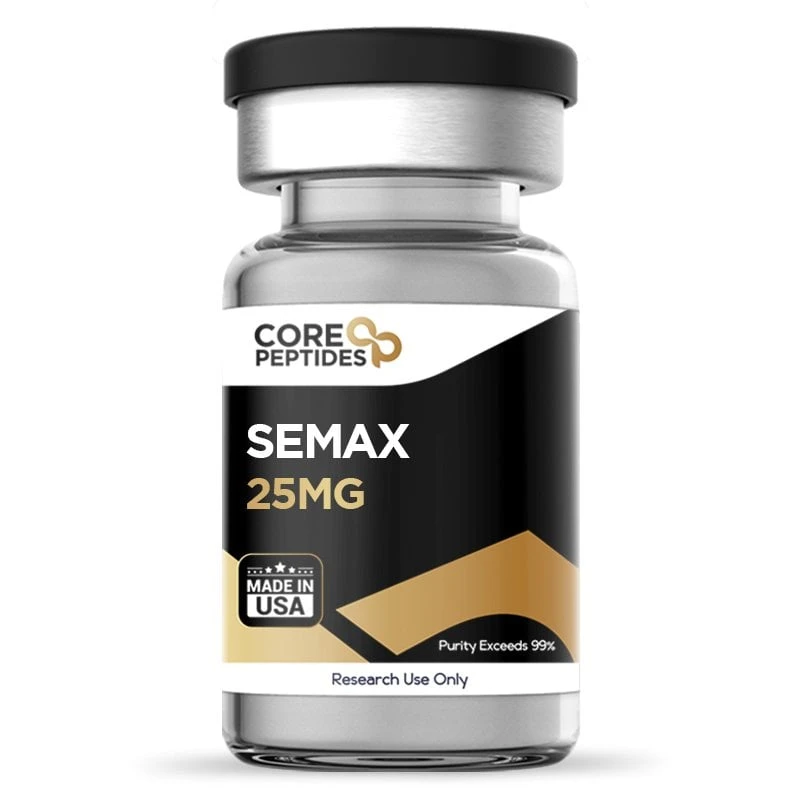

Semax – 25MG – High-Purity Research Peptide
Semax – 25MG is a synthetic heptapeptide and analogue of the ACTH(4–10) region of adrenocorticotropic hormone. Its sequence is Met-Glu-His-Phe-Pro-Gly-Pro, combining the N-terminal ACTH(4–7) sequence with a C-terminal Pro-Gly-Pro (PGP) extension.
This distinctive structure has made Semax a subject of laboratory and preclinical research focused on neurotrophic signalling, BDNF and TrkB pathways, neurotransmission, gene expression, neuronal responses and peptide biochemistry.
This 25mg Semax presentation is supplied as a lyophilised powder and is listed by Core Peptides as a research peptide. The product is intended exclusively for laboratory, analytical and in-vitro research and is not intended for human or animal consumption.
Core Peptides lists Semax among its research peptide products and states that its products are for laboratory or analytical purposes only.
What Is Semax?
Semax is a short synthetic peptide derived from research into fragments of adrenocorticotropic hormone (ACTH). It is commonly described as an ACTH(4–10) analogue or ACTH(4–7)PGP. The peptide consists of seven amino acids and contains the sequence Met-Glu-His-Phe-Pro-Gly-Pro.
The structure is particularly notable because the ACTH-derived Met-Glu-His-Phe sequence is followed by the Pro-Gly-Pro tripeptide. Scientific literature has investigated this modification in connection with peptide stability and resistance to enzymatic degradation.
Semax has attracted research interest primarily within neuropeptide and neuroscience research. Studies have explored its relationship with neurotrophic factors, neurotransmitter systems, inflammatory signalling and molecular responses in experimental models.
Semax – 25MG Product Specifications
| Specification | Details |
|---|---|
| Product Name | Semax |
| Quantity | 25mg |
| Peptide Type | Synthetic heptapeptide |
| Form | Lyophilised powder |
| Sequence | Met-Glu-His-Phe-Pro-Gly-Pro |
| Common Description | ACTH(4–10) analogue / ACTH(4–7)PGP |
| CAS Number | 80714-61-0 |
| Molecular Formula | C37H51N9O10S |
| Molecular Weight | 813.9 g/mol |
| Intended Application | Research, laboratory and analytical use |
The molecular identity and analytical characteristics of Semax are consistent with published chemical information describing the compound as ACTH4-7-PGP, with a molecular weight of approximately 813.9 g/mol.
Semax Peptide Structure
The molecular structure of Semax is central to its research profile. It contains the four-amino-acid sequence Met-Glu-His-Phe, corresponding to the ACTH(4–7) region, followed by Pro-Gly-Pro. The resulting seven-amino-acid sequence is commonly written as Met-Glu-His-Phe-Pro-Gly-Pro.
The C-terminal PGP extension is one of the defining characteristics separating Semax from the corresponding ACTH fragment. Researchers have examined this structural feature in relation to metabolic stability and enzymatic resistance, making Semax useful in comparative peptide research.
Semax and ACTH Research
Semax originates from research into biologically active fragments of adrenocorticotropic hormone. ACTH is a naturally occurring peptide hormone, whereas Semax is a synthetic peptide analogue designed around a specific ACTH-derived sequence.
Research into short ACTH fragments has investigated whether specific portions of the hormone can retain biological activity associated with neural systems without reproducing all of the endocrine functions of full-length ACTH. Semax therefore represents an important example of structure–function research involving short regulatory peptides.
For laboratory researchers, this makes Semax relevant to investigations comparing naturally occurring peptide hormones, truncated peptide fragments and synthetic analogues.
Semax and Neurotrophic Signalling
One of the most extensively investigated areas surrounding Semax is its relationship with neurotrophic signalling. Neurotrophic factors are proteins involved in neuronal survival, development, differentiation and communication.
Research has examined Semax in relation to brain-derived neurotrophic factor (BDNF) and its receptor TrkB. Experimental work has investigated changes in neurotrophin-related gene expression and signalling in brain tissue, particularly in rodent models.
Related research has also considered nerve growth factor (NGF) and other molecular markers associated with neuronal responses. These investigations are useful for studying how short synthetic peptides may interact with neurotrophic pathways.
Semax and BDNF Research
BDNF is a neurotrophin widely studied for its role in neuronal maintenance, synaptic plasticity and nervous-system signalling. Semax research has examined changes in BDNF expression and related signalling pathways in experimental brain models.
Researchers have used molecular techniques including gene-expression analysis to investigate whether exposure to Semax is associated with changes in neurotrophic signalling. Such studies provide mechanistic information that can be used to develop further research questions concerning peptide-mediated regulation of neuronal pathways.
Importantly, experimental observations involving BDNF should not be interpreted as proof that Semax produces a particular clinical outcome in humans.
Semax and TrkB Research
TrkB is a high-affinity receptor associated with BDNF signalling. Because BDNF and TrkB form an important neurotrophic signalling system, researchers have investigated both components when studying the molecular effects associated with Semax.
Laboratory studies examining BDNF and TrkB can help researchers understand whether changes in neurotrophic factor expression are accompanied by alterations in downstream signalling. This makes the BDNF–TrkB axis a relevant area for controlled Semax research.
Semax and Neuroprotection Research
Semax has been extensively investigated in experimental models relating to neuronal stress and cerebral ischaemia. In a rat model of cerebral ischaemia–reperfusion, researchers used RNA sequencing to investigate changes in gene expression following Semax exposure. The study identified hundreds of differentially expressed genes and reported changes in genes associated with inflammatory processes and neurotransmission.
A separate protein-expression study in a rat model examined markers associated with inflammation, cell death and recovery. The researchers reported changes involving proteins such as MMP-9, c-Fos, JNK and CREB following Semax exposure.
These findings make Semax relevant to preclinical research into neuronal responses to ischaemic and inflammatory conditions. However, animal-model findings should not automatically be extrapolated to human therapeutic outcomes.
Semax and Gene Expression Research
Transcriptomic research has become an important part of the Semax literature. Researchers have used RNA sequencing and related molecular techniques to examine how the peptide may influence gene-expression profiles under experimental conditions.
In cerebral ischaemia–reperfusion research, Semax exposure was associated with altered expression of genes involved in inflammatory processes and neurotransmission. Such findings can help researchers identify molecular pathways potentially associated with peptide-mediated responses.
Gene-expression studies are particularly valuable because they can provide a broad view of biological responses rather than focusing on a single receptor or protein.
Semax and Neurotransmitter Research
Experimental research has investigated Semax in relation to several neurotransmitter systems. Published work has examined possible associations with dopaminergic and serotonergic pathways, providing researchers with a basis for studying how Semax may influence central nervous-system biochemistry.
These studies are relevant to molecular neuroscience because dopamine and serotonin participate in numerous neurological processes. However, findings from experimental models should be considered within the context of the specific species, tissue, concentration and experimental design used.
Semax and Enkephalin Research
Enkephalins are endogenous opioid peptides involved in signalling processes associated with nociception, stress and other physiological functions. Research has investigated whether Semax and related peptides can influence enzymes involved in enkephalin degradation.
This research area is useful for understanding potential interactions between synthetic regulatory peptides and endogenous peptide signalling systems. It also provides an example of how Semax research extends beyond a single neurotransmitter pathway.
Semax and Intracellular Calcium Research
More recent research has investigated the effects of Semax on intracellular calcium dynamics in neuronal preparations. A 2025 study examined spontaneous calcium fluctuations in hippocampal pyramidal neurons and proton-induced calcium responses in cerebellar granule cells.
The researchers reported that Semax increased the frequency of spontaneous intracellular calcium fluctuations in hippocampal CA1 pyramidal neurons under the experimental conditions used, while not significantly affecting the proton-stimulated response in cerebellar granule cells.
These findings provide additional molecular information for researchers studying the initial cellular responses associated with Semax.
Semax and Metal-Ion Research
Semax has also been investigated from a biochemical perspective for its interaction with copper(II) ions. A study published in the Journal of Inorganic Biochemistry examined the ability of Semax to form copper complexes and investigated the effects of these interactions in cellular models exposed to copper-related toxicity.
Further research has examined Semax in model membrane systems involving copper and amyloid-beta aggregation. These studies demonstrate that Semax research encompasses not only neurotrophic signalling but also peptide–metal interactions and biophysical chemistry.
Potential Research Applications of Semax – 25MG
Qualified laboratories may investigate Semax in a range of controlled research areas, including:
- Neurotrophic signalling and growth-factor pathways.
- BDNF and TrkB research in neuronal models.
- NGF expression and neurobiology studies.
- Neurotransmitter signalling, including dopaminergic and serotonergic pathways.
- Gene-expression analysis and transcriptomic research.
- Cerebral ischaemia models and neuronal stress research.
- Neuroinflammation research and inflammatory gene expression.
- Intracellular calcium dynamics in neuronal preparations.
- Peptide stability and enzymatic degradation studies.
- Enkephalin metabolism and endogenous peptide signalling.
- Metal-ion binding research involving copper(II).
- Structure–activity relationship studies involving ACTH-derived peptides.
- In-vitro and preclinical neuroscience research.
Why Choose Semax – 25MG?
Semax – 25MG provides researchers with a defined quantity of a well-characterised synthetic heptapeptide for laboratory and analytical investigations.
- 25mg research quantity: A defined format for controlled laboratory work.
- Recognised peptide sequence: Met-Glu-His-Phe-Pro-Gly-Pro.
- ACTH-derived structure: Based on the ACTH(4–7) sequence with a PGP extension.
- Lyophilised format: Supplied as a dry peptide material.
- Broad research interest: Investigated across neurotrophic, molecular, cellular and biochemical research.
- Established analytical identity: Semax is associated with CAS 80714-61-0 and a molecular weight of approximately 813.9 g/mol.
Semax Chemical Information
| Property | Information |
|---|---|
| Compound | Semax |
| Peptide Class | Synthetic linear heptapeptide |
| Sequence | Met-Glu-His-Phe-Pro-Gly-Pro |
| Alternative Name | ACTH(4–7)PGP |
| ACTH Relationship | ACTH(4–10) analogue |
| CAS Number | 80714-61-0 |
| Molecular Formula | C37H51N9O10S |
| Molecular Weight | 813.9 g/mol |
| Product Quantity | 25mg |
| Physical Form | Lyophilised powder |
Published product information independently identifies Semax as L-methionyl-L-α-glutamyl-L-histidyl-L-phenylalanyl-L-prolylglycyl-L-proline, with the molecular formula C37H51N9O10S and molecular weight of 813.9 g/mol.
Semax vs ACTH(4–10)
| Characteristic | ACTH(4–10) | Semax |
|---|---|---|
| Peptide relationship | Native ACTH fragment | Synthetic analogue |
| Core sequence | ACTH-derived | Met-Glu-His-Phe |
| C-terminal structure | Native ACTH fragment sequence | Pro-Gly-Pro extension |
| Research focus | ACTH fragment biology | Neuropeptide, neurotrophic and molecular research |
| Analytical interest | Structure and biological activity | Structure, stability and signalling responses |
The PGP extension is an important structural distinction in Semax research and has been investigated for its contribution to the peptide’s metabolic stability.
Semax and Related Peptide Research
Semax is often studied alongside other synthetic regulatory peptides because researchers are interested in how small sequence modifications influence biological behaviour. Its ACTH-derived structure makes it particularly relevant to comparative studies involving melanocortin-related peptides and short neuropeptide analogues.
For example, researchers may compare Semax with related peptide structures to investigate differences in stability, gene-expression responses, neurotrophic signalling or interactions with neurotransmitter pathways.
The related compound N-Acetyl Semax represents a further structural modification in which the N-terminal group is acetylated. Comparative research can therefore examine how N-terminal modification affects peptide stability and biochemical behaviour.
Semax Research Evidence
The Semax literature includes a mixture of in-vitro, animal and human research. Recent publications continue to investigate the molecular mechanisms associated with the peptide, including gene expression, neuronal signalling and intracellular calcium dynamics.
For example, transcriptomic research in rats has examined Semax during cerebral ischaemia–reperfusion and reported changes in inflammatory and neurotransmission-related genes.
Other experimental studies have investigated Semax’s interactions with copper ions, peptide aggregation and neuronal cell systems.
Although some historical human research exists, the evidence base is not equivalent to the extensive regulatory and clinical evidence required for broad therapeutic claims. Research findings should therefore be evaluated according to study design, population, methodology and limitations.
Laboratory Handling and Storage of Semax
Semax – 25MG is supplied in lyophilised form. Researchers should follow the supplier’s current documentation and their laboratory’s validated procedures for storage, handling and experimental preparation.
- Keep the material in its original, clearly labelled container.
- Protect the lyophilised peptide from unnecessary moisture exposure.
- Follow the supplier’s recommended storage conditions.
- Minimise unnecessary temperature fluctuations.
- Use appropriate laboratory protective equipment and handling procedures.
- Review batch-specific analytical documentation before beginning experiments.
Storage conditions can depend on the peptide, packaging and experimental requirements. Laboratories should always follow the current supplier documentation and applicable institutional procedures.
Analytical Testing of Semax
Research laboratories can characterise synthetic peptides using analytical methods designed to assess molecular identity and purity. Semax is commonly characterised using reversed-phase high-performance liquid chromatography (HPLC) and mass spectrometry.
Depending on the experimental objective, researchers may also use:
- HPLC for chromatographic purity assessment.
- Mass spectrometry for molecular mass and identity confirmation.
- Peptide sequencing methods where required by the analytical protocol.
- Cell-based assays to investigate biological responses.
- Gene-expression analysis to examine transcriptional changes.
- Protein-expression analysis to investigate downstream cellular markers.
For controlled research, laboratories should review the applicable batch-specific Certificate of Analysis before use.
Frequently Asked Questions About Semax – 25MG
What is Semax?
Semax is a synthetic seven-amino-acid peptide based on an ACTH-derived sequence. It is commonly described as an ACTH(4–10) analogue or ACTH(4–7)PGP and has been studied extensively in neuropeptide and neuroscience research.
What is the sequence of Semax?
The sequence of Semax is Met-Glu-His-Phe-Pro-Gly-Pro. The first four amino acids correspond to the ACTH(4–7) region, while the C-terminal Pro-Gly-Pro sequence is the defining extension used in Semax.
How much Semax is in this product?
The product is supplied in a 25mg format.
What form is Semax supplied in?
Semax research material is commonly supplied as a lyophilised powder.
What is the molecular weight of Semax?
Published analytical information lists the molecular weight of Semax at approximately 813.9 g/mol.
What is the CAS number for Semax?
The CAS Registry Number for Semax is 80714-61-0.
What is Semax researched for?
Research has investigated Semax in relation to neurotrophic signalling, BDNF and TrkB pathways, neurotransmission, gene expression, cerebral ischaemia models, neuronal responses, peptide stability and metal-ion interactions.
What is the relationship between Semax and ACTH?
Semax is a synthetic analogue based on the ACTH(4–10) region. Its structure incorporates the ACTH(4–7) sequence followed by a Pro-Gly-Pro extension.
What is the PGP sequence in Semax?
PGP stands for Pro-Gly-Pro, a three-amino-acid sequence attached to the C-terminal portion of Semax. Research has examined this structural feature in relation to metabolic stability and resistance to enzymatic cleavage.
Has Semax been studied in animal models?
Yes. Semax has been investigated in numerous animal models, including studies examining cerebral ischaemia, gene expression, neurotrophic signalling and neuronal responses.
Has Semax been studied in humans?
Historical human research has been published, including studies examining neurological and cognitive-related outcomes. However, evidence from individual clinical studies should not be treated as equivalent to broad regulatory approval or established efficacy for every proposed application.
Is Semax approved for general medical use in the EU?
This product should not be presented as an EU-approved medicine. The Core Peptides product is marketed for laboratory and research purposes, not as a medicinal product for human consumption. Researchers should verify applicable EU and national regulatory requirements before handling or using research compounds.
Is Semax the same as N-Acetyl Semax?
No. N-Acetyl Semax is a chemically modified analogue with an acetyl group at the N-terminus. It is a distinct molecular entity and is investigated separately from standard Semax.
Semax – 25MG Research Summary
Semax – 25MG is a synthetic heptapeptide based on the ACTH(4–7) sequence and characterised by its C-terminal Pro-Gly-Pro extension. The peptide has become a significant subject of research in neurobiology and peptide biochemistry because of its associations with neurotrophic signalling, neurotransmission, gene expression and neuronal responses.
Research has examined Semax in relation to BDNF and TrkB signalling, NGF expression, dopaminergic and serotonergic systems, enkephalin metabolism, inflammatory gene expression, cerebral ischaemia models, intracellular calcium dynamics and copper-ion interactions.
The 25mg format provides a defined quantity of synthetic peptide for qualified laboratory, analytical and in-vitro research. Because the scientific literature includes different experimental models and study designs, individual findings should always be assessed in their appropriate research context rather than presented as established therapeutic claims.
Research-Use Disclaimer
Semax – 25MG is intended solely for qualified research, laboratory, analytical and in-vitro experimental purposes. It is not intended for human or veterinary consumption, self-administration, diagnosis, treatment, cure or prevention of any disease.
References to neuroprotective, nootropic, cognitive, anti-inflammatory, metabolic or other biological effects describe areas of scientific investigation and should not be interpreted as established clinical benefits.
Researchers should review the applicable Certificate of Analysis, product documentation, safety information and relevant legislation before working with this material. Handling, storage and disposal should be performed by appropriately trained personnel using suitable laboratory procedures.
For research use only. Human and animal consumption prohibited.
Be the first to review “Semax – 25MG”
Related products
Peptides for Sale
Peptides for Sale
Peptides for Sale
Peptides for Sale
Peptides for Sale
Peptides for Sale
Peptides for Sale
Peptides for Sale
Reviews
There are no reviews yet.