
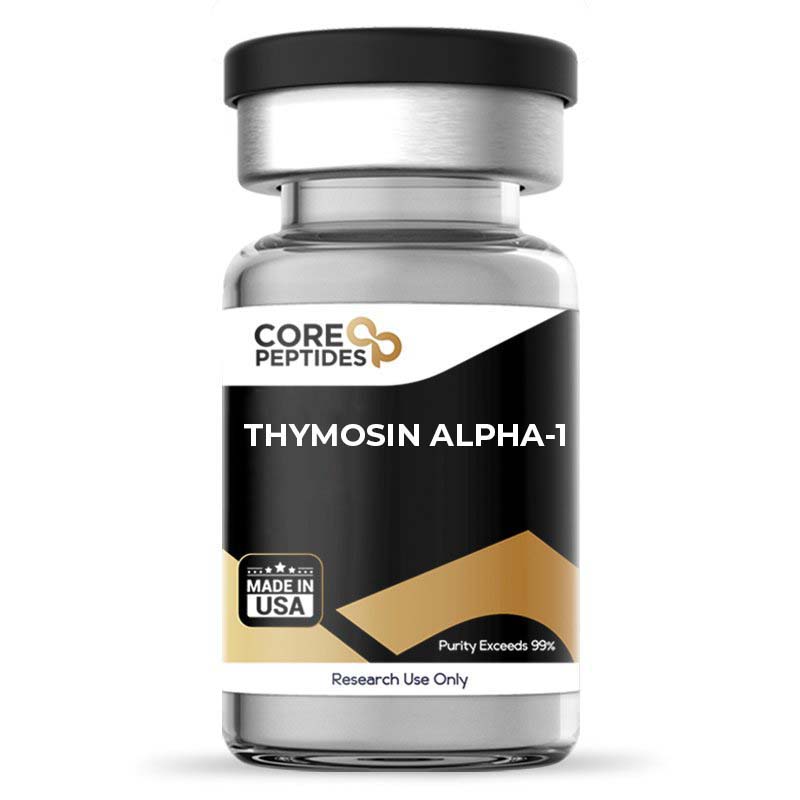
Thymosin Alpha-1 (5mg / 10mg) – Research Peptide
Thymosin Alpha-1 (5mg / 10mg) is a synthetic peptide widely investigated in laboratory and scientific research relating to immune-cell signalling, T-cell biology, cytokine activity and cellular responses.
Also known as TA1, Tα1 and Thymalfasin, Thymosin Alpha-1 is a 28-amino-acid peptide derived from the larger precursor protein prothymosin alpha.
Core Peptides supplies Thymosin Alpha-1 in 5mg and 10mg options as a lyophilised powder with a stated purity of >99%. The product listing gives the molecular formula as C129H215N33O55 and the molecular weight as approximately 3108.31 g/mol.
Scientific research into Thymosin Alpha-1 has examined its relationship with innate and adaptive immune responses, including T-cell activity, natural killer cell function, cytokine signalling and antigen-presenting cell responses.
Research has also investigated the peptide in experimental models involving viral infection, sepsis, immune reconstitution and cancer-cell biology. These studies provide a basis for continued research but should not be interpreted as evidence of a therapeutic effect for this research-grade product.
For research, laboratory and analytical purposes only. Not for human or animal consumption.
What Is Thymosin Alpha-1?
Thymosin Alpha-1 is a naturally occurring peptide associated with the thymus and immune-system research. It is a 28-amino-acid peptide derived from the longer 113-amino-acid protein known as prothymosin alpha. The synthetic form is also referred to as Thymalfasin.
The peptide has attracted scientific interest because of its potential involvement in multiple immune pathways. Research has investigated possible effects on T lymphocytes, natural killer cells, macrophages, cytokine production and antigen-presenting cells.
Rather than being associated with a single biological pathway, Thymosin Alpha-1 has been investigated as a potential immunomodulatory peptide with activity across several components of the innate and adaptive immune systems.
Thymosin Alpha-1 (5mg / 10mg) Product Specifications
| Specification | Details |
|---|---|
| Product Name | Thymosin Alpha-1 |
| Alternative Names | TA1, Tα1, Thymalfasin |
| Available Sizes | 5mg / 10mg |
| Form | Lyophilised powder |
| Stated Purity | >99% |
| Molecular Formula | C129H215N33O55 |
| Molecular Weight | 3108.31 g/mol |
| Peptide Length | 28 amino acids |
| Research Category | Peptide and immunology research |
| Research Focus | Immune signalling, T-cell biology, cytokines and cellular responses |
| Intended Use | Laboratory, analytical and in-vitro research |
Product specifications are based on the information published by Core Peptides.
Thymosin Alpha-1 and Immune-System Research
One of the principal areas of research surrounding Thymosin Alpha-1 is immune-system biology. Researchers have investigated the peptide’s possible interactions with both innate and adaptive immune mechanisms.
Research has examined potential changes in T-cell activity, natural killer cell function, cytokine production and antigen-presenting cell signalling. Studies have also investigated whether Thymosin Alpha-1 can influence the expression of immune-related receptors and cellular markers.
The complexity of the immune system means that results can differ according to the biological model, cell population, experimental concentration and exposure conditions. Consequently, individual research findings should be evaluated within their original experimental context.
Thymosin Alpha-1 and T-Cell Research
T lymphocytes are central components of adaptive immunity. They include different populations with specialised roles in recognising antigens, coordinating immune responses and destroying affected cells.
Thymosin Alpha-1 has been studied in relation to T-cell maturation and differentiation. Researchers have proposed that the peptide may influence the development of thymocytes and the differentiation of certain blood lymphocyte populations.
Laboratory research has therefore investigated Thymosin Alpha-1 as a model for studying the interaction between peptide signalling and T-cell biology.
Thymosin Alpha-1 and Natural Killer Cells
Natural killer (NK) cells are immune cells involved in the recognition and destruction of certain abnormal or infected cells. Their activity is an important area of immunological research.
Thymosin Alpha-1 has been investigated for its potential effects on NK-cell activity. However, findings have not been uniformly positive. For example, a small study involving subjects with primary immunodeficiencies reported that Thymosin Alpha-1 did not significantly improve overall NK or lymphokine-activated killer cell activity, although some individuals showed changes in LAK-cell activity.
These findings illustrate why controlled studies and appropriate experimental controls are important when evaluating immunomodulatory peptides.
Thymosin Alpha-1 and Cytokine Signalling
Cytokines are signalling proteins involved in communication between immune cells. They regulate numerous processes, including inflammation, immune-cell activation and adaptive immune responses.
Research into Thymosin Alpha-1 has examined its possible relationship with cytokines including interleukin-2 (IL-2), interleukin-10 (IL-10) and interferon-gamma (IFN-γ). Researchers have also investigated potential interactions with toll-like receptors, including TLR-2 and TLR-9, on dendritic and other antigen-presenting cells.
These pathways make Thymosin Alpha-1 a relevant compound for laboratory research into immune signalling and host-response mechanisms.
Thymosin Alpha-1 and Antigen-Presenting Cells
Antigen-presenting cells help initiate and regulate adaptive immune responses. Dendritic cells and macrophages are examples of cells involved in presenting antigens and coordinating immune signalling.
Experimental research has investigated whether Thymosin Alpha-1 may influence the activity of these cells and their associated signalling pathways. Particular interest has focused on toll-like receptor interactions and downstream cytokine responses.
This research provides a framework for investigating how peptide-based signalling may influence communication between innate and adaptive immune mechanisms.
Thymosin Alpha-1 and Viral Research
Thymosin Alpha-1 has been investigated extensively in research relating to viral infections and immune responses.
Clinical research has examined the peptide in subjects with hepatitis B and hepatitis C. The Core Peptides product reference describes studies in which Thymosin Alpha-1 was investigated both independently and alongside interferon-based treatment.
These studies are part of the wider scientific literature surrounding Thymosin Alpha-1. They should not be interpreted as evidence that a research-grade peptide product is an approved treatment for viral infection.
Thymosin Alpha-1 and Sepsis Research
Sepsis involves complex and changing immune responses, including periods of excessive inflammation and potential immune suppression. This complexity has prompted research into immunomodulatory approaches.
A 2015 systematic review and meta-analysis examined controlled trials investigating Thymosin Alpha-1 in relation to sepsis. The review reported a significant reduction in mortality across the analysed trials, while also noting limitations in the available evidence.
Because the clinical evidence has limitations and sepsis is a serious medical condition requiring specialist treatment, these findings should be regarded as research evidence rather than a recommendation for self-directed use.
Thymosin Alpha-1 and Immune Reconstitution Research
Researchers have also investigated Thymosin Alpha-1 in the context of immune reconstitution.
A pilot study involving clinically stable subjects receiving antiretroviral therapy investigated Thymosin Alpha-1 alongside standard treatment. The study monitored markers including CD4/CD8 cells, CD45 cells and signal-joint T-cell receptor excision circles (sjTREC). The researchers reported an increase in sjTREC levels but did not observe corresponding significant changes in overall T-cell numbers during the study period.
This research is relevant to studies of thymic output and T-cell development, while also demonstrating the importance of distinguishing individual biomarkers from broader changes in immune-cell populations.
Thymosin Alpha-1 and Cancer-Cell Research
Laboratory research has examined Thymosin Alpha-1 in experimental cancer-cell models, including studies involving liver and lung cancer cells.
Research involving liver carcinoma models investigated potential relationships between Thymosin Alpha-1, reactive oxygen species and cellular signalling. The study explored changes in oxidative status and Akt signalling in HepG2 cells.
Separate laboratory research involving A549 lung adenocarcinoma cells investigated potential effects on cell proliferation, migration, reactive oxygen species and antioxidant enzyme activity.
These findings are derived from laboratory and experimental models. They should not be interpreted as evidence that Thymosin Alpha-1 treats or prevents cancer in humans.
Thymosin Alpha-1 and Oxidative Stress Research
Reactive oxygen species (ROS) are chemically reactive molecules involved in normal cellular signalling but can contribute to oxidative stress when their production and antioxidant defences become unbalanced.
Research has investigated Thymosin Alpha-1 in relation to ROS levels and antioxidant enzymes, including catalase, superoxide dismutase (SOD) and glutathione peroxidase (GPx).
Such studies can help researchers examine how peptide exposure interacts with cellular redox pathways and stress responses.
Thymosin Alpha-1 and Cellular Signalling
Thymosin Alpha-1 has been studied as a peptide capable of influencing multiple signalling processes. Research has examined its potential relationship with toll-like receptors, cytokine pathways, immune-cell receptors and intracellular signalling mechanisms.
The diversity of these research areas makes Thymosin Alpha-1 relevant to laboratories investigating the relationship between peptide structure and complex cellular responses.
Researchers should consider appropriate controls and validated analytical methods when studying the peptide’s effects in cell-based or biochemical systems.
Thymosin Alpha-1 vs Thymosin Beta-4
Despite sharing the word “Thymosin”, Thymosin Alpha-1 and Thymosin Beta-4 are different peptides with distinct structures and research profiles.
| Feature | Thymosin Alpha-1 | Thymosin Beta-4 |
|---|---|---|
| Common abbreviation | TA1 / Tα1 | Tβ4 |
| Length | 28 amino acids | 43 amino acids |
| Research emphasis | Immune and cellular signalling | Cellular and tissue biology |
| Research areas | T cells, cytokines, NK cells and immune responses | Cell migration, cytoskeletal biology and tissue-related research |
The two peptides should not be considered interchangeable. Researchers should select a compound according to the specific molecular and biological question being investigated.
Thymosin Alpha-1 vs Thymalin
Thymosin Alpha-1 and Thymalin are both associated with thymic research but represent distinct research materials.
Thymosin Alpha-1 is a defined 28-amino-acid peptide, whereas Thymalin is associated with a thymic peptide preparation. Their molecular structures, research applications and experimental characteristics differ.
Researchers should therefore verify the identity and specifications of each compound before designing experiments or comparing results.
Thymosin Alpha-1 Chemical Profile
The Core Peptides product page identifies the following chemical characteristics for Thymosin Alpha-1:
| Property | Value |
|---|---|
| Molecular Formula | C129H215N33O55 |
| Molecular Weight | 3108.31 g/mol |
| Peptide Length | 28 amino acids |
| Other Names | TA1, Tα1, Thymalfasin |
| Available Quantities | 5mg / 10mg |
| Physical Form | Lyophilised powder |
| Stated Purity | >99% |
These specifications are based on the current Core Peptides product listing.
Lyophilised Thymosin Alpha-1
Thymosin Alpha-1 is supplied as a lyophilised powder. Lyophilisation, or freeze-drying, is commonly used for research peptides to produce a dry material suitable for controlled laboratory storage and handling.
Researchers should always consult the current product documentation and applicable batch-specific Certificate of Analysis for storage and handling requirements. Product-specific instructions should take precedence over general peptide-handling practices.
Analytical Research and Quality Control
Analytical characterisation is an important part of peptide research. Depending on the experimental objective, researchers may use several complementary techniques to assess peptide identity, purity and stability.
- HPLC: Used to assess chromatographic purity and related compounds.
- Mass spectrometry: Used to confirm molecular mass and support compound identification.
- LC-MS: Combines chromatographic separation with mass-based identification.
- Stability studies: Used to investigate changes in peptide characteristics under defined conditions.
- Cell-based assays: Used to investigate biological responses in controlled experimental models.
Researchers should review the relevant Certificate of Analysis and use validated methods appropriate to their experimental objectives.
Potential Research Applications for Thymosin Alpha-1
Qualified researchers may investigate Thymosin Alpha-1 across several areas of experimental biology, including:
- Immune-system signalling.
- T-cell biology and differentiation.
- Natural killer cell research.
- Cytokine signalling.
- Dendritic-cell and antigen-presenting cell research.
- Toll-like receptor signalling.
- Host-response research.
- Viral infection models.
- Sepsis and immune-dysregulation research.
- Immune reconstitution research.
- Oxidative-stress studies.
- Cancer-cell and cellular-signalling research.
- Peptide characterisation and analytical chemistry.
These areas represent scientific research applications and should not be interpreted as approved medical indications.
Thymosin Alpha-1 (5mg / 10mg) Research Summary
| Research Characteristic | Information |
|---|---|
| Compound | Thymosin Alpha-1 |
| Alternative Names | TA1, Tα1, Thymalfasin |
| Peptide Length | 28 amino acids |
| Available Sizes | 5mg / 10mg |
| Physical Form | Lyophilised powder |
| Stated Purity | >99% |
| Molecular Formula | C129H215N33O55 |
| Molecular Weight | 3108.31 g/mol |
| Primary Research Areas | Immune signalling, T-cell biology, cytokines and cellular research |
| Intended Use | Laboratory, analytical and in-vitro research |
Frequently Asked Questions About Thymosin Alpha-1 (5mg / 10mg)
What is Thymosin Alpha-1?
Thymosin Alpha-1 is a 28-amino-acid peptide associated with research into immune-cell signalling, T-cell biology, cytokines and cellular responses. It is also known as TA1, Tα1 and Thymalfasin.
What are the available Thymosin Alpha-1 sizes?
The Core Peptides product is available in 5mg and 10mg options.
What is the purity of Thymosin Alpha-1?
The product listing states a purity of >99%. Researchers should consult the relevant batch-specific Certificate of Analysis for detailed analytical information.
What is the molecular weight of Thymosin Alpha-1?
The listed molecular weight is approximately 3108.31 g/mol.
What is Thymalfasin?
Thymalfasin is the name used for the synthetic form of Thymosin Alpha-1. The peptide is composed of 28 amino acids and is derived from the larger precursor protein prothymosin alpha.
What is Thymosin Alpha-1 studied for?
Research has examined Thymosin Alpha-1 in relation to immune signalling, T-cell biology, natural killer cells, cytokines, antigen-presenting cells, viral-response models, sepsis, immune reconstitution and cancer-cell biology.
Is Thymosin Alpha-1 the same as Thymosin Beta-4?
No. Thymosin Alpha-1 and Thymosin Beta-4 are distinct peptides with different amino-acid lengths, structures and research profiles.
Is Thymosin Alpha-1 supplied as a liquid?
No. The Core Peptides product is supplied as a lyophilised powder.
Is Thymosin Alpha-1 approved as a medicine?
This product is supplied as a research-grade material and should not be represented as an approved medicinal product. Core Peptides states that its products are intended for research, laboratory or analytical purposes only and are not for human consumption.
Can Thymosin Alpha-1 be used for self-administration?
No. This research product is intended solely for appropriate laboratory, analytical and in-vitro research and is not intended for human or animal consumption or self-administration.
Storage and Laboratory Handling
Researchers should follow the current manufacturer documentation and batch-specific Certificate of Analysis for exact storage and handling requirements.
- Keep the material in its original labelled container.
- Protect the lyophilised powder from unnecessary moisture exposure.
- Follow the supplier’s specified storage conditions.
- Minimise unnecessary temperature fluctuations.
- Use appropriate laboratory protective equipment.
- Prevent contamination during handling.
- Maintain suitable batch and experimental records.
- Dispose of research materials according to applicable institutional procedures.
Why Choose Thymosin Alpha-1 (5mg / 10mg) for Research?
Thymosin Alpha-1 (5mg / 10mg) provides researchers with a high-purity peptide material for controlled investigation of immune signalling and cellular biology. With a stated purity of >99%, a defined 28-amino-acid structure and a convenient lyophilised format, it can serve as a useful research material for appropriately designed laboratory studies.
Its extensive research history across T-cell biology, cytokine signalling, natural killer cell activity and cellular responses also makes Thymosin Alpha-1 a relevant compound for researchers investigating interactions between peptide signalling and immune-system pathways.
Important Research Disclaimer
Thymosin Alpha-1 (5mg / 10mg) is supplied strictly for research, laboratory and analytical purposes.
This product is not intended for human or animal consumption, self-administration, diagnosis, treatment, cure or prevention of any disease. References to immune function, viral infections, sepsis, cancer or other biological processes describe areas of scientific investigation and should not be interpreted as medical advice or therapeutic claims.
Some studies referenced in connection with Thymosin Alpha-1 involve animal models, cell cultures or small clinical studies. Findings from these studies should not automatically be extrapolated to humans or interpreted as proof of efficacy for this research-grade product.
Researchers are responsible for complying with all applicable laws, institutional requirements, laboratory safety procedures and appropriate handling protocols when working with Thymosin Alpha-1.
For research use only. Not for human or animal consumption.
| Please select a size | 5MG, 10MG |
|---|
Be the first to review “Thymosin Alpha-1 (5mg / 10mg)”
Related products
Peptides for Sale
Peptides for Sale
Peptides for Sale
Peptides for Sale
Peptide Blends for Sale
Peptides for Sale
Peptides for Sale
Peptides for Sale
Reviews
There are no reviews yet.