
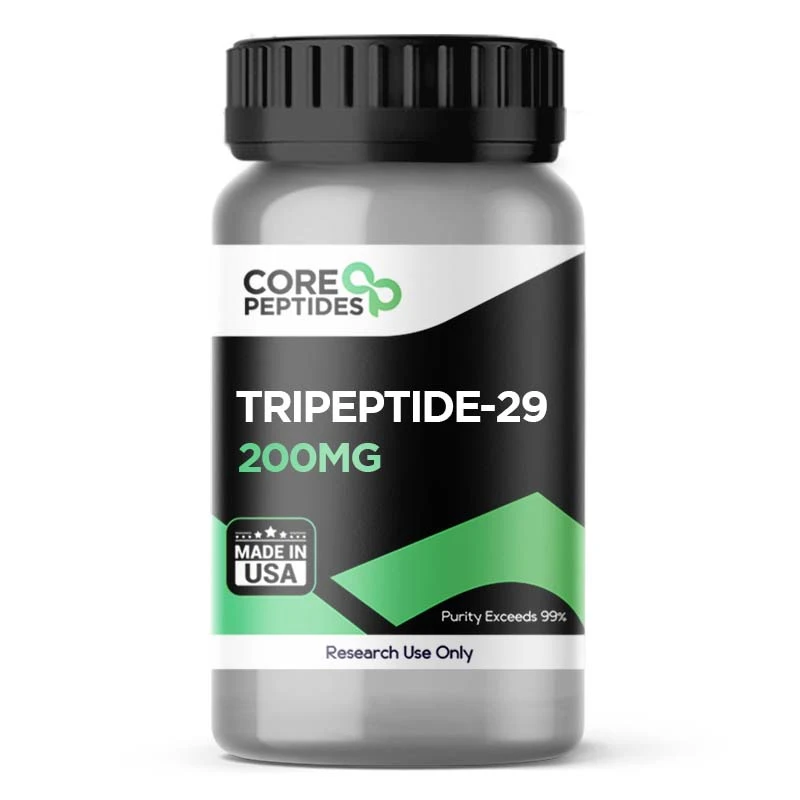
Tripeptide-29 (200mg) – Collagen Research Peptide
Tripeptide-29 (200mg) is a synthetic collagen-derived tripeptide investigated in research involving collagen structure, extracellular matrix (ECM) biology, peptide-receptor interactions and dermal cellular signalling.
Also known as Gly-Pro-Hyp or glycylprolylhydroxyproline, Tripeptide-29 represents a short sequence associated with the repeating structural motifs found in collagen. Research into Tripeptide-29 has focused on how collagen-derived peptide sequences interact with collagen-associated systems and biological signalling pathways.
Its compact structure makes it useful as a defined molecular model for researchers studying collagen-related interactions, extracellular matrix communication and peptide structure–function relationships.
Core Peptides supplies Tripeptide-29 (200mg) as a topical research peptide preparation. The compound is intended for controlled laboratory, analytical and in-vitro research rather than human or veterinary use.
For research, laboratory and analytical purposes only. Not for human or animal consumption.
What Is Tripeptide-29?
Tripeptide-29 is a short synthetic peptide corresponding to the collagen-associated sequence Gly-Pro-Hyp, consisting of glycine, proline and hydroxyproline. This sequence is commonly encountered within collagen’s repeating structural framework.
Collagen contains characteristic Gly-X-Y sequence repeats, with proline and hydroxyproline frequently occupying the X and Y positions. Because of this structural relationship, Tripeptide-29 has attracted interest as a model compound for investigating collagen stability, molecular recognition and extracellular matrix biology.
Research should distinguish Tripeptide-29 from larger collagen proteins and from other cosmetic peptides. A short collagen-derived tripeptide does not possess all of the structural characteristics or biological functions of intact collagen.
Tripeptide-29 (200mg) Product Overview
| Specification | Details |
|---|---|
| Product Name | Tripeptide-29 |
| Quantity | 200mg |
| Alternative Name | Gly-Pro-Hyp / Glycylprolylhydroxyproline |
| Peptide Class | Synthetic collagen-derived tripeptide |
| Sequence | Gly-Pro-Hyp |
| Molecular Formula | C12H19N3O5 |
| Molecular Weight | Approximately 285.3 g/mol |
| Format | Topical research preparation |
| Research Areas | Collagen biology, extracellular matrix research and dermal peptide signalling |
| Intended Use | Laboratory, analytical and in-vitro research |
The molecular formula and molecular weight correspond to published product information for Tripeptide-29/Gly-Pro-Hyp.
Tripeptide-29 and Collagen Research
Collagen is a major structural protein found throughout connective tissues. It contributes to the architecture of skin, cartilage, bone, tendons, ligaments and numerous other biological structures.
At the molecular level, collagen contains repeating sequences that form characteristic triple-helical structures. Hydroxyproline is particularly important to collagen structure because it can contribute to the stability of the collagen triple helix. Research into collagen model peptides has therefore examined how individual amino-acid sequences influence higher-order collagen structure.
Tripeptide-29 provides researchers with a compact model for investigating these collagen-associated molecular interactions without requiring the use of an entire collagen molecule.
Tripeptide-29 and the Gly-Pro-Hyp Sequence
The Gly-Pro-Hyp sequence is closely associated with collagen’s repeating structural motifs. Glycine, the smallest amino acid, can occupy positions within the tightly packed collagen triple helix, while proline and hydroxyproline contribute to the conformational characteristics of the peptide chain.
Studies of collagen-like peptides have demonstrated the importance of hydroxyproline in collagen fibril and triple-helix stability. This makes Gly-Pro-Hyp an important sequence for structural biology research.
Researchers can use short collagen-derived peptides such as Tripeptide-29 to investigate sequence-dependent structural behaviour, molecular interactions and collagen-related signalling systems.
Tripeptide-29 and Extracellular Matrix Research
The extracellular matrix is a complex network of proteins and other molecules surrounding cells. Collagen is one of its most important structural components.
Changes in extracellular matrix composition and organisation are relevant to numerous areas of biological research. Researchers therefore investigate collagen-derived peptides to better understand how short peptide fragments interact with matrix components and cellular signalling pathways.
Tripeptide-29 is particularly relevant to experimental systems examining collagen-associated communication, fibroblast responses and matrix-related cellular processes.
Recent cosmetic research has also investigated formulations containing Tripeptide-29 alongside other active ingredients, although findings from a finished multi-ingredient formulation should not be attributed exclusively to the peptide itself.
Tripeptide-29 and Dermal Research
Because collagen is a major structural component of skin, collagen-derived peptides have become an area of interest in dermal and cosmetic research.
Experimental work has investigated collagen tripeptides in relation to fibroblast activity, collagen-associated signalling, skin structure and extracellular matrix processes.
A 2026 study evaluated a cosmetic formulation containing 0.1% Tripeptide-29 together with niacinamide and botanical extracts and reported improvements in several measured skin parameters over four weeks.
However, the study evaluated the complete multi-ingredient formulation, rather than isolated Tripeptide-29, so its results should not be interpreted as clinical evidence for the peptide alone.
This distinction is important when evaluating research concerning individual cosmetic peptides.
Tripeptide-29 and Fibroblast Research
Fibroblasts are connective-tissue cells responsible for producing and maintaining components of the extracellular matrix, including collagen and other structural proteins.
Research into collagen-derived peptides has examined how short peptide fragments may influence fibroblast activity and extracellular matrix signalling. These studies provide a scientific basis for investigating peptide-mediated communication between collagen fragments and dermal cells.
Tripeptide-29 can therefore be used as a defined molecular component in laboratory models designed to investigate collagen-related cellular responses.
Tripeptide-29 and Collagen Stability
One area of research involving Tripeptide-29 concerns the relationship between hydroxyproline-containing sequences and collagen structural stability.
Hydroxyproline is a characteristic amino acid in collagen and contributes to the conformational stability of collagen’s triple-helical architecture.
Structural studies of collagen-like peptides have helped researchers understand how individual residues and short repeating sequences affect molecular organisation.
Tripeptide-29 therefore provides a useful simplified model for investigating the molecular principles underlying collagen structure.
Tripeptide-29 and UV-Related Collagen Research
Ultraviolet radiation is an important research model for studying changes in collagen and extracellular matrix components. Experimental studies have examined how UV exposure can affect collagen structure and degradation.
Research involving collagen model peptides has investigated UV-induced structural changes and the molecular characteristics that influence collagen stability. These studies provide context for understanding the behaviour of collagen-associated sequences such as Gly-Pro-Hyp.
However, laboratory observations involving collagen peptides should not be interpreted as proof that isolated topical Tripeptide-29 provides sunscreen or UV protection in humans.
Tripeptide-29 and Collagen Receptor Research
Collagen-derived sequences can also interact with proteins and receptors involved in cell adhesion and signalling. Research has examined collagen-related peptide interactions with glycoprotein VI (GPVI), a collagen receptor expressed on platelets.
Experimental research involving repeated Gly-Pro-Hyp sequences has reported partial agonist activity at GPVI, illustrating how collagen-like peptide structures can participate in receptor-mediated biological interactions.
These findings are useful for understanding peptide–receptor relationships but should not be interpreted as evidence for a therapeutic effect of topical Tripeptide-29.
Tripeptide-29 Research Applications
Qualified laboratories may investigate Tripeptide-29 in a variety of experimental areas, including:
- Collagen structure and stability research.
- Extracellular matrix biology.
- Dermal cellular signalling.
- Fibroblast research.
- Collagen-derived peptide interactions.
- Peptide–receptor interaction studies.
- Structure–function relationship research.
- Collagen triple-helix models.
- UV-related collagen research.
- Cosmetic peptide research.
- Cellular communication studies.
- Analytical peptide research.
These are scientific research areas and should not be interpreted as approved medical or cosmetic indications.
Tripeptide-29 Chemical Profile
| Property | Information |
|---|---|
| Compound | Tripeptide-29 |
| Sequence | Gly-Pro-Hyp |
| Full Name | Glycylprolylhydroxyproline |
| Molecular Formula | C12H19N3O5 |
| Molecular Weight | 285.3 g/mol |
| Peptide Length | 3 amino-acid residues |
| Peptide Category | Collagen-derived tripeptide |
Tripeptide-29’s short sequence and defined molecular composition make it suitable as a model compound in biochemical and structural research involving collagen-related systems.
Tripeptide-29 vs Collagen
Tripeptide-29 should not be confused with intact collagen.
| Feature | Tripeptide-29 | Collagen |
|---|---|---|
| Structure | Short three-residue peptide | Large structural protein |
| Sequence | Gly-Pro-Hyp | Long repeating Gly-X-Y sequences |
| Research Use | Defined molecular model | Structural and biological protein research |
| Research Focus | Peptide interactions and collagen-associated signalling | Matrix structure, mechanics and cellular interactions |
While Tripeptide-29 represents a collagen-associated sequence, the isolated tripeptide does not reproduce the complete three-dimensional structure or biological complexity of intact collagen.
Tripeptide-29 vs Other Cosmetic Peptides
Tripeptide-29 belongs to a broad category of peptides investigated in cosmetic and dermal research. Different peptides may have different sequences, structures and proposed mechanisms.
For example, Palmitoyl Tripeptide-5 is a different peptide commonly investigated in cosmetic research. Palmitoyl Tetrapeptide-7 and other peptide ingredients are also structurally distinct from Tripeptide-29.
Researchers should therefore avoid treating different cosmetic peptides as interchangeable simply because they are all described as collagen or anti-ageing peptides.
Topical Tripeptide-29 Research
The topical format of Tripeptide-29 makes it particularly relevant to laboratories studying peptide-containing dermal formulations.
Topical research may examine formulation stability, peptide compatibility, skin-model interactions and changes in measurable markers associated with extracellular matrix biology.
Research on finished cosmetic formulations requires careful interpretation because factors such as concentration, delivery system, vehicle composition, skin condition and the presence of other active ingredients can influence observed results.
Analytical Research and Quality Control
Peptide research benefits from appropriate analytical characterisation. Depending on the purpose of the study, laboratories may use complementary techniques to verify peptide identity, purity and formulation stability.
- High-performance liquid chromatography (HPLC): Used to assess chromatographic purity and related substances.
- Mass spectrometry: Used to support molecular identification and mass confirmation.
- LC-MS: Combines chromatographic separation with mass-based detection.
- Stability testing: Used to monitor changes under defined storage or formulation conditions.
- In-vitro assays: Used to investigate peptide interactions with cells or molecular targets.
Researchers should rely on current batch-specific documentation and validated laboratory methods when assessing a research material.
Why Study Tripeptide-29?
Tripeptide-29 provides researchers with a simple, well-defined model for investigating collagen-associated peptide biology. Its Gly-Pro-Hyp sequence is closely related to recurring motifs in collagen, making it particularly relevant to structural and extracellular matrix research.
Its small molecular size also allows researchers to investigate specific sequence-dependent interactions without the complexity of working with an entire collagen protein.
For laboratories studying collagen structure, extracellular matrix communication, dermal signalling and cosmetic peptide systems, Tripeptide-29 can provide a useful research model.
Tripeptide-29 (200mg) Research Summary
| Research Characteristic | Information |
|---|---|
| Compound | Tripeptide-29 |
| Quantity | 200mg |
| Sequence | Gly-Pro-Hyp |
| Alternative Name | Glycylprolylhydroxyproline |
| Molecular Formula | C12H19N3O5 |
| Molecular Weight | 285.3 g/mol |
| Peptide Type | Synthetic collagen-derived tripeptide |
| Research Focus | Collagen, extracellular matrix and dermal peptide research |
| Format | Topical research preparation |
| Intended Use | Laboratory, analytical and in-vitro research |
Frequently Asked Questions About Tripeptide-29 (200mg)
What is Tripeptide-29?
Tripeptide-29 is a short synthetic collagen-derived tripeptide associated with the sequence Gly-Pro-Hyp. It is studied in collagen structure, extracellular matrix and dermal peptide research.
What is the sequence of Tripeptide-29?
Tripeptide-29 corresponds to the Gly-Pro-Hyp sequence: glycine, proline and hydroxyproline.
What is the molecular weight of Tripeptide-29?
Tripeptide-29 has a molecular weight of approximately 285.3 g/mol.
What is Tripeptide-29 studied for?
Research has investigated Tripeptide-29 in relation to collagen structure, extracellular matrix signalling, fibroblast-related research, peptide–receptor interactions and dermal research.
Is Tripeptide-29 the same as collagen?
No. Tripeptide-29 is a short three-residue peptide, whereas collagen is a large structural protein composed of extensive amino-acid chains and complex higher-order structures.
Is Tripeptide-29 the same as Palmitoyl Tripeptide-5?
No. They are different peptides. Tripeptide-29 is associated with the Gly-Pro-Hyp collagen-derived sequence, whereas Palmitoyl Tripeptide-5 is a structurally distinct peptide used in other cosmetic research applications.
What is Tripeptide-29 used for in laboratory research?
It may be used as a defined model compound in research involving collagen-associated molecular interactions, extracellular matrix biology, dermal cellular signalling and peptide structure–function relationships.
Is there clinical research on Tripeptide-29?
Research exists on collagen tripeptides and cosmetic formulations containing Tripeptide-29. A 2026 study evaluated a multi-ingredient formulation containing 0.1% Tripeptide-29 and reported improvements in several skin measurements. However, the study tested the complete formulation, so its findings cannot be attributed solely to isolated Tripeptide-29.
Is Tripeptide-29 intended for human use?
No. The Core Peptides research material is intended for laboratory, analytical and in-vitro research and is not intended for human or animal consumption or self-administration.
Storage and Laboratory Handling
Researchers should follow the current supplier documentation and batch-specific Certificate of Analysis for product-specific storage and handling requirements.
- Keep the material in its original labelled container.
- Protect the research preparation from unnecessary environmental exposure.
- Follow the storage conditions specified in the current product documentation.
- Minimise unnecessary temperature fluctuations.
- Use suitable laboratory protective equipment during handling.
- Prevent contamination during experimental preparation.
- Maintain appropriate batch and experimental records.
- Dispose of research material according to applicable laboratory and institutional procedures.
No dosing, administration or self-use instructions are provided because this product is intended for laboratory research rather than human or veterinary use.
Important Research Disclaimer
Tripeptide-29 (200mg) is supplied strictly for research, laboratory and analytical purposes.
This product is not intended for human or animal consumption, self-administration, diagnosis, treatment, cure or prevention of any disease. References to collagen production, skin structure, extracellular matrix activity, fibroblast responses or other biological effects describe areas of scientific research and should not be interpreted as medical advice or therapeutic claims.
Evidence concerning topical Tripeptide-29 remains dependent on the specific formulation, experimental model and study design. Results observed in cell culture or multi-ingredient cosmetic formulations should not automatically be attributed to isolated Tripeptide-29 or extrapolated to clinical outcomes.
Researchers are responsible for complying with applicable legislation, institutional requirements, laboratory safety procedures and appropriate handling protocols when working with this material.
For research use only. Not for human or animal consumption.
Be the first to review “Tripeptide-29 (200mg)”
Related products
Peptides for Sale
Peptide Blends for Sale
Peptides for Sale
Peptides for Sale
Peptides for Sale
Peptides for Sale
Peptides for Sale

Peptides for Sale
Reviews
There are no reviews yet.