

ARA-290 (16mg) Peptide – Research-Grade Cibinetide Peptide
ARA-290 (16mg), also known as cibinetide and helix B surface peptide (HBSP), is an 11-amino-acid synthetic peptide derived from a specific region of erythropoietin (EPO). Unlike full-length erythropoietin, ARA-290 was designed to investigate the tissue-protective and repair-related signalling associated with EPO without stimulating erythropoiesis.
ARA-290 has attracted scientific interest primarily because of its interaction with the innate repair receptor (IRR), a receptor complex associated with tissue protection, cellular repair and inflammatory signalling. Preclinical and early clinical research has investigated ARA-290 in areas including neuropathic pain, small-fibre neuropathy, neuroinflammation, tissue protection and metabolic disorders.
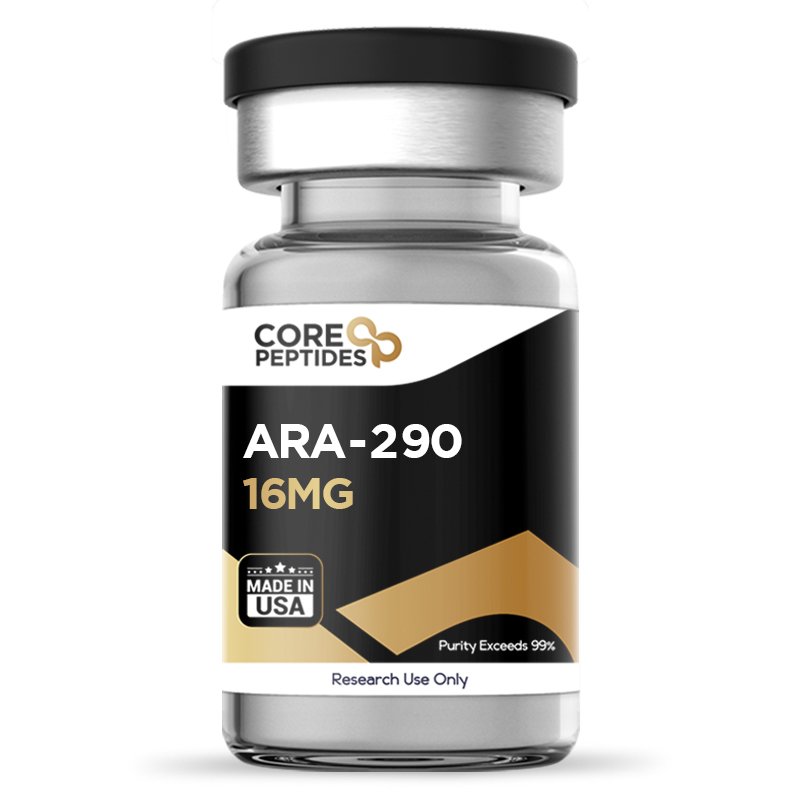
The 16mg format contains lyophilised ARA-290 intended for laboratory research. The supplier page identifies the product as a lyophilised powder with a stated purity of greater than 99%.
ARA-290 should be regarded as an experimental research peptide, rather than an approved medicine or established treatment for neuropathic pain, nerve injury, diabetes, inflammation or any other medical condition.
What Is ARA-290?
ARA-290 is a synthetic peptide consisting of 11 amino acids and derived from the tertiary structure of erythropoietin. It is also referred to as cibinetide or helix B surface peptide (HBSP).
Erythropoietin is best known for its role in regulating red-blood-cell production. Researchers developed ARA-290 to investigate a different aspect of EPO biology: its tissue-protective signalling.
ARA-290 was designed to activate the tissue-protective receptor pathway without producing the classical erythropoietic response associated with EPO.
This distinction is central to ARA-290 research. Rather than functioning as a replacement for EPO, the peptide is studied as a separate molecular tool for examining signalling associated with tissue protection, repair and inflammation.
ARA-290 (16mg) Product Highlights
- Product name: ARA-290
- Alternative name: Cibinetide
- Other designation: Helix B surface peptide (HBSP)
- Quantity: 16mg
- Peptide length: 11 amino acids
- Origin: Derived from a region of erythropoietin
- Product form: Lyophilised powder
- Stated purity: >99%
- Primary research area: Tissue-protective and repair signalling
- Additional research areas: Neuropathic pain, neuroinflammation, small-fibre neuropathy and metabolic research
- Research application: Laboratory and scientific research
The product specifications above are based on the referenced supplier listing. :contentReference[oaicite:5]{index=5}
How Does ARA-290 Work?
Research suggests that ARA-290 interacts with the innate repair receptor, commonly described as a receptor complex involving the erythropoietin receptor and the beta-common receptor (CD131). This signalling system has been investigated for its role in tissue protection and the regulation of inflammatory responses following injury.
The innate repair receptor differs functionally from the classical EPO receptor pathway responsible for stimulating red-blood-cell production. ARA-290 was engineered to selectively investigate the tissue-protective side of EPO-related signalling rather than its haematopoietic activity.
Experimental research has consequently focused on whether activation of this pathway can influence inflammatory signalling, nerve function, cellular survival and tissue repair processes.
ARA-290 and the Innate Repair Receptor
The innate repair receptor (IRR) is a receptor complex formed by the erythropoietin receptor and beta-common receptor. Research suggests that this receptor can activate signalling pathways associated with anti-inflammatory and tissue-repair responses.
Following tissue injury, signalling through this receptor system has been investigated in relation to the body’s response to inflammation and damage. ARA-290 is of interest because it was engineered to selectively target this tissue-protective signalling pathway.
Research in animal models has provided evidence supporting the involvement of the beta-common receptor in ARA-290 activity. In one neuropathic-pain study, ARA-290 produced significant relief of mechanical and cold allodynia in normal animals, whereas the effect was absent in beta-common-receptor knockout mice.
ARA-290 and Neuropathic Pain Research
One of the most extensively investigated areas for ARA-290 is neuropathic pain research. Neuropathic pain can arise from injury or dysfunction affecting peripheral or central nervous-system pathways.
Preclinical research has investigated whether ARA-290 can influence pain-related responses following nerve injury. In a rat model of spared nerve injury, repeated ARA-290 treatment reduced mechanical and cold allodynia, with effects reported for as long as 20 weeks in the experimental setting. The study also associated treatment with suppression of spinal microglial responses.
Earlier experimental work similarly reported long-term reductions in tactile and cold allodynia following ARA-290 treatment. The lack of an effect in beta-common-receptor knockout mice supported the proposed role of the innate repair receptor in the observed response.
These results are scientifically relevant to research into the relationship between nerve injury, neuroinflammation and pain signalling, but animal findings should not be interpreted as proof of clinical efficacy.
ARA-290 and Neuroinflammation
Neuroinflammation refers to inflammatory activity within the nervous system. Microglia and astrocytes are important cellular components of this response and can influence neuronal function following injury.
ARA-290 research has examined the relationship between the peptide, spinal microglial activation and neuropathic pain. In a rat model, ARA-290-associated reductions in allodynia were accompanied by suppression of spinal microglial responses.
This has contributed to interest in ARA-290 as an experimental tool for studying how tissue-protective signalling interacts with inflammatory processes in the nervous system.
ARA-290 and Small-Fibre Neuropathy Research
Small-fibre neuropathy affects small sensory and autonomic nerve fibres and can produce symptoms involving pain, altered sensation and autonomic dysfunction. ARA-290 has been investigated in clinical research involving patients with small-fibre neuropathy associated with conditions including sarcoidosis and type 2 diabetes.
A review of Phase II clinical trials reported improvements in neuropathic symptoms among sarcoidosis patients receiving ARA-290 and described changes in measures of corneal nerve fibres and sensory function.
These findings represent clinical research rather than regulatory approval. Further evidence is required to determine the clinical role, effectiveness and safety profile of ARA-290 across different patient populations.
ARA-290 and Nerve Regeneration Research
Research into ARA-290 has extended beyond pain signalling to the biology of peripheral nerve repair. The peptide is of interest because the innate repair receptor is involved in cellular responses to tissue injury.
Clinical research involving small-fibre neuropathy has reported changes in measures of corneal nerve fibres following ARA-290 treatment. A review of the clinical literature noted that treatment for 28 days initiated regrowth of small nerve fibres in the cornea, although a corresponding effect was not observed in epidermal nerve fibres in that study.
Such findings provide an area for continued investigation into nerve repair and regeneration, while also illustrating why individual biological endpoints should be evaluated separately rather than assuming that improvement in one tissue necessarily translates to another.
ARA-290 and Erythropoietin
ARA-290 is derived from erythropoietin but should not be confused with full-length EPO.
| Characteristic | ARA-290 | Erythropoietin (EPO) |
|---|---|---|
| Structure | Short synthetic peptide | Full-length glycoprotein hormone |
| Research focus | Tissue protection, repair and inflammatory signalling | Haematopoiesis and broader EPO biology |
| Red-blood-cell stimulation | Designed to avoid classical erythropoietic activity | Primary physiological function |
| Receptor research | Innate repair receptor | Classical EPO receptor and related signalling |
| Research areas | Neuropathy, tissue repair and neuroinflammation | Red-blood-cell production, tissue signalling and other biological processes |
The distinction between the two compounds is important when interpreting scientific literature. ARA-290 was specifically engineered to investigate tissue-protective EPO-related signalling without the conventional erythropoietic response.
ARA-290 and Nociception Research
Nociception refers to the neural processing of potentially damaging stimuli. Researchers studying neuropathic pain often investigate how sensory receptors, nerve pathways and inflammatory mediators contribute to altered pain responses.
ARA-290 has been examined in experimental models of allodynia, a condition in which normally non-painful stimuli can produce pain-like responses. Studies in rodents have reported reductions in mechanical and cold allodynia following experimental ARA-290 administration.
These models provide a framework for studying how tissue-protective signalling can affect the nervous system following peripheral nerve injury.
ARA-290 and TRPV1 Research
TRPV1 is a transient receptor potential channel involved in sensory signalling and responses to thermal and chemical stimuli. Because TRPV1 contributes to nociceptive pathways, it has been investigated in studies exploring the mechanisms of neuropathic pain.
Experimental research has examined whether ARA-290 can influence TRPV1-related signalling and thereby alter sensory responses. This represents a mechanistic area of investigation rather than an established therapeutic mechanism in humans.
Research into ARA-290 therefore encompasses several interconnected areas, including receptor signalling, neuroinflammation, sensory processing and tissue protection.
ARA-290 and Metabolic Research
ARA-290 has also been investigated in the context of metabolic disease. A Phase II study examined ARA-290 in individuals with type 2 diabetes and neuropathic symptoms. The study evaluated both metabolic control and neuropathic outcomes following experimental treatment.
The published study reported that ARA-290 was investigated as a non-haematopoietic peptide designed to interact selectively with the innate repair receptor. The researchers assessed its potential activity in type 2 diabetes and painful neuropathy.
This research is relevant to investigations into the intersection between metabolic dysfunction, nerve injury and tissue-protective signalling.
ARA-290 and Tissue Protection
The concept of tissue protection is central to ARA-290 research. The peptide was developed from the tissue-protective region of erythropoietin and is intended to activate signalling pathways associated with repair and cellular protection.
Experimental studies have explored these effects in models involving nerve injury and inflammatory responses. The proposed mechanism involves activation of the innate repair receptor, which can influence pathways associated with inflammation and tissue recovery.
Research into tissue-protective peptides such as ARA-290 may help clarify how endogenous repair mechanisms respond to injury and metabolic stress.
ARA-290 Research Applications
ARA-290 may be relevant to controlled laboratory investigations involving:
- Neuropathic pain research: Investigation of molecular pathways associated with pain following nerve injury.
- Small-fibre neuropathy: Study of sensory and autonomic nerve dysfunction.
- Neuroinflammation: Investigation of microglial and inflammatory responses within the nervous system.
- Nerve repair: Research into mechanisms associated with peripheral nerve protection and regeneration.
- Innate repair receptor research: Study of EPOR/CD131 receptor signalling.
- Tissue-protection research: Investigation of cellular responses to injury and stress.
- Nociception: Study of altered sensory signalling and allodynia.
- Metabolic research: Investigation of interactions between metabolic dysfunction and tissue-protective pathways.
- Inflammatory signalling: Examination of mechanisms linking tissue injury and inflammatory responses.
- Comparative peptide research: Comparison of ARA-290 with other experimental tissue-protective peptides.
ARA-290 (16mg) Research Specifications
| Specification | Details |
|---|---|
| Product name | ARA-290 |
| Alternative name | Cibinetide |
| Other designation | Helix B surface peptide (HBSP) |
| Quantity | 16mg |
| Peptide length | 11 amino acids |
| Compound type | Synthetic erythropoietin-derived peptide |
| Product form | Lyophilised powder |
| Stated purity | >99% |
| Primary research pathway | Innate repair receptor signalling |
| Research focus | Tissue protection, nerve function and inflammatory signalling |
| Research application | Laboratory research |
Product-specific specifications are based on the referenced Core Peptides listing. :contentReference[oaicite:20]{index=20}
Why Researchers Study ARA-290
ARA-290 is particularly interesting because it represents a different approach to investigating erythropoietin biology. Instead of studying EPO primarily through its role in red-blood-cell production, researchers can use ARA-290 to examine tissue-protective signalling associated with the EPO-derived helix B region.
The peptide’s interaction with the innate repair receptor provides a research model for investigating how receptor activation may influence inflammation, nerve function and tissue recovery.
Its research history also spans both preclinical and early clinical studies, making ARA-290 relevant to researchers interested in translating molecular findings into more complex biological models.
ARA-290 Research Evidence
Preclinical evidence has demonstrated notable activity in experimental models of neuropathic pain. In a rat spared-nerve-injury model, ARA-290 produced dose-dependent reductions in mechanical allodynia and reduced cold allodynia, with effects persisting for extended periods in the experimental model. Suppression of spinal microglial activity was also observed.
Another study found that ARA-290 reduced tactile and cold allodynia in normal mice but did not produce the same effect in mice lacking the beta-common receptor. This supported the proposed involvement of the innate repair receptor in ARA-290 signalling.
Clinical research has subsequently investigated ARA-290 in small-fibre neuropathy and type 2 diabetes. A Phase II study evaluated a 28-day treatment period in patients with type 2 diabetes and neuropathic symptoms, while other clinical research investigated patients with sarcoidosis-associated small-fibre neuropathy.
Although these findings are scientifically significant, they do not establish ARA-290 as an approved treatment. Clinical evidence must be evaluated according to study size, endpoints, follow-up duration, safety data and regulatory status.
ARA-290 and Sarcoidosis Research
Sarcoidosis is one of the conditions in which ARA-290 has been investigated because some patients develop small-fibre neuropathy and associated sensory or autonomic symptoms.
A review of Phase II studies reported that ARA-290 treatment was associated with improvements in neuropathic symptoms in patients with sarcoidosis. The research also reported changes in corneal nerve fibres, sensory pain thresholds, quality of life and physical functioning.
These observations have contributed to interest in ARA-290 as a research candidate for studying small-fibre nerve dysfunction and tissue repair.
ARA-290 and Diabetes Research
Diabetes can be associated with peripheral nerve dysfunction, making diabetic neuropathy an important area of metabolic and neurological research.
A Phase II clinical study investigated ARA-290 in patients with type 2 diabetes and neuropathic symptoms. The researchers described ARA-290 as a non-haematopoietic peptide designed to selectively interact with the innate repair receptor and evaluated its effects on metabolic control and neuropathic symptoms.
This research illustrates the broader scientific interest in targeting tissue-protective pathways in conditions where metabolic dysfunction and nerve damage occur together.
Frequently Asked Questions About ARA-290 (16mg)
What is ARA-290?
ARA-290 is an 11-amino-acid synthetic peptide derived from a region of erythropoietin. It is also known as cibinetide and helix B surface peptide (HBSP).
What is ARA-290 also called?
ARA-290 is also known as cibinetide and helix B surface peptide (HBSP).
What is ARA-290 studied for?
Research has investigated ARA-290 in relation to tissue protection, neuropathic pain, small-fibre neuropathy, neuroinflammation, nerve repair and metabolic disorders.
Is ARA-290 derived from EPO?
Yes. ARA-290 is derived from a specific structural region of erythropoietin. It is not the same as full-length EPO and was designed to investigate tissue-protective signalling rather than classical erythropoietic activity.
Does ARA-290 stimulate red-blood-cell production?
ARA-290 was specifically designed as a non-haematopoietic EPO-derived peptide, meaning its development focused on tissue-protective signalling without the classical erythropoietic action of EPO.
What is the innate repair receptor?
The innate repair receptor is a receptor complex involving the erythropoietin receptor and beta-common receptor (CD131). Research suggests that it participates in signalling associated with tissue protection and repair.
Has ARA-290 been studied for neuropathic pain?
Yes. Both animal studies and early clinical research have investigated ARA-290 in relation to neuropathic pain and small-fibre neuropathy.
Has ARA-290 been studied in humans?
Yes. ARA-290 has been evaluated in clinical research, including Phase II studies involving type 2 diabetes-associated neuropathic symptoms and sarcoidosis-associated small-fibre neuropathy.
What does the 16mg designation mean?
The 16mg designation refers to the quantity of ARA-290 in the listed research product. It is a product specification and should not be interpreted as a recommended human dose.
Is ARA-290 an approved medicine?
The existence of preclinical and clinical studies does not mean that ARA-290 is an approved medicine. Its research status and regulatory position should be verified with the relevant medicines authority before any clinical claims are made.
What form is ARA-290 (16mg) supplied in?
The referenced product listing identifies ARA-290 (16mg) as a lyophilised powder and states a purity of greater than 99%.
Research-Use Disclaimer
ARA-290 (16mg) is intended for laboratory and research applications only. It should not be presented as an approved medicine, dietary supplement or established treatment for neuropathic pain, nerve injury, diabetes, sarcoidosis, inflammation or any other medical condition.
The research discussed on this page includes animal studies and early-stage human clinical investigations. Experimental findings may not translate directly into clinical efficacy or safety, and the results of one disease model should not automatically be applied to another.
This product description does not provide dosing, administration or treatment instructions. Qualified researchers should consult the relevant scientific literature, product documentation, analytical information, institutional procedures and applicable regulations before undertaking research involving ARA-290.
ARA-290 (16mg) – Research Summary
ARA-290 (16mg) is a synthetic 11-amino-acid peptide derived from erythropoietin and also known as cibinetide or helix B surface peptide. Its primary scientific interest lies in its ability to interact with the innate repair receptor, a tissue-protective signalling system involving the erythropoietin receptor and beta-common receptor.
Research has investigated ARA-290 in neuropathic pain, neuroinflammation, small-fibre neuropathy, nerve repair and metabolic disorders. Animal studies have reported reductions in mechanical and cold allodynia alongside changes in spinal microglial responses, while early clinical studies have explored its potential relevance to small-fibre neuropathy associated with sarcoidosis and type 2 diabetes.
The distinction between ARA-290 and full-length erythropoietin is central to understanding the compound. ARA-290 was developed to investigate tissue-protective EPO-related signalling without the classical erythropoietic activity of EPO. This makes it a specialised research tool for studying the relationship between receptor signalling, inflammation, nerve function and tissue repair.
For appropriately equipped laboratories, ARA-290 (16mg) provides a defined research peptide for controlled investigations into tissue-protective signalling and related biological pathways.
Be the first to review “ARA-290 (16mg)”
Related products
Peptides for Sale

Peptides for Sale

Peptide Blends for Sale

Peptides for Sale
Peptides for Sale
Peptides for Sale

Peptides for Sale

Peptides for Sale
Reviews
There are no reviews yet.