
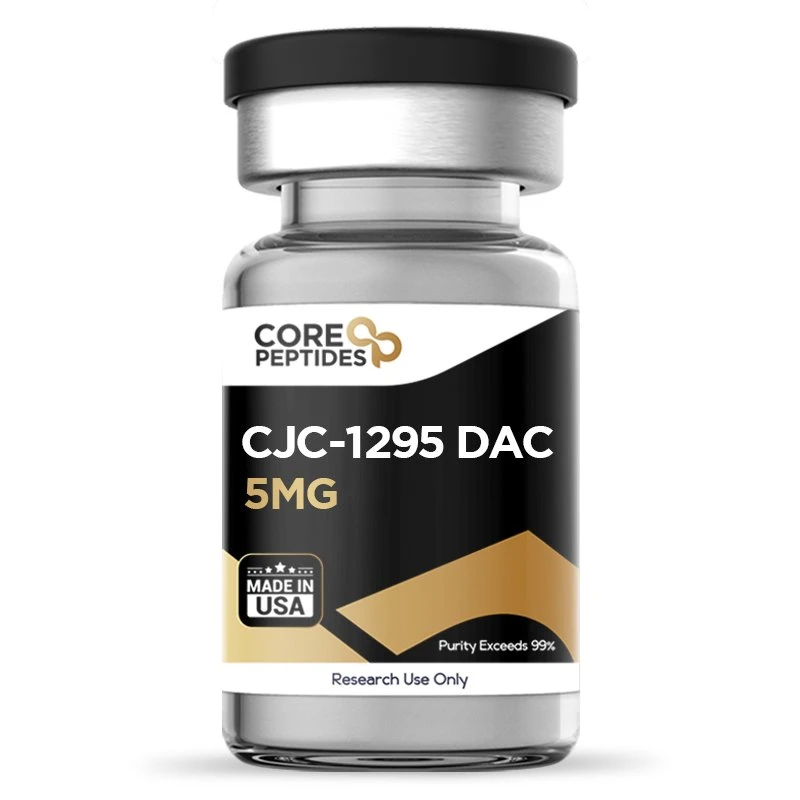

CJC-1295 DAC (5mg) – Long-Acting GHRH Analogue for Research
CJC-1295 DAC (5mg) is an experimental peptide based on a modified form of growth hormone-releasing hormone (GHRH). The DAC component, meaning Drug Affinity Complex, was developed to extend the peptide’s circulating duration and support sustained interaction with the GHRH signalling pathway.
CJC-1295 has been investigated in human pharmacology studies examining its pharmacokinetic properties and effects on growth hormone (GH) and insulin-like growth factor 1 (IGF-1).
In a randomised, placebo-controlled study involving healthy adults, CJC-1295 produced sustained increases in GH and IGF-1 following administration, with an estimated half-life of approximately 5.8–8.1 days in that study.
The 5mg specification refers to the quantity of research material supplied. This product is intended for laboratory and research use only and should not be presented as an approved medicine, dietary supplement or treatment.
What Is CJC-1295 DAC?
CJC-1295 DAC is a synthetic analogue related to growth hormone-releasing hormone. It was designed to provide a substantially longer duration of exposure than native GHRH by incorporating a Drug Affinity Complex into the peptide structure.
The DAC modification is particularly important because it distinguishes this compound from products marketed as CJC-1295 No DAC or Mod GRF 1-29. These are different research materials with different pharmacological characteristics and should not be treated as interchangeable.
Research has shown that the DAC form can interact with circulating albumin, contributing to its extended pharmacokinetic profile. This extended exposure is one of the defining characteristics of CJC-1295 DAC research.
CJC-1295 DAC (5mg) Product Highlights
- Product: CJC-1295 DAC
- Quantity: 5mg
- Classification: Synthetic GHRH analogue
- DAC: Drug Affinity Complex
- Research area: Growth hormone and endocrine signalling
- Primary pathway: GHRH receptor signalling
- Research format: Peptide research material
- Intended use: Laboratory research only
CJC-1295 DAC and the GHRH Pathway
Growth hormone-releasing hormone is a naturally occurring hypothalamic peptide involved in the regulation of growth hormone secretion by the anterior pituitary.
CJC-1295 was developed as a modified GHRH analogue. Its research profile centres on interaction with the GHRH receptor and subsequent signalling processes within pituitary somatotroph cells.
By investigating CJC-1295 DAC, researchers can examine how modification of a GHRH-related peptide influences peptide stability, pharmacokinetics and downstream endocrine signalling.
What Does DAC Mean?
DAC stands for Drug Affinity Complex. It is the defining modification that differentiates CJC-1295 DAC from CJC-1295 formulations without DAC.
The modification enables the peptide to associate with albumin in circulation. This interaction helps protect the peptide from rapid clearance and contributes to a considerably longer exposure profile.
Human research has reported an estimated CJC-1295 half-life of approximately 5.8–8.1 days under the conditions studied.
The extended pharmacokinetic profile is therefore an important consideration when interpreting scientific literature involving CJC-1295 DAC.
CJC-1295 DAC vs CJC-1295 No DAC
| Feature | CJC-1295 DAC | CJC-1295 No DAC |
|---|---|---|
| DAC modification | Present | Absent |
| Common research name | CJC-1295 with DAC | Mod GRF 1-29 |
| General profile | Long-acting GHRH analogue | Shorter-acting GHRH-related analogue |
| Research focus | Sustained GHRH-related signalling | GHRH-related signalling and shorter exposure |
| Research consideration | Should be evaluated independently | Should be evaluated independently |
This distinction is important when comparing research results. Evidence involving CJC-1295 DAC should not automatically be applied to No-DAC preparations, and vice versa.
CJC-1295 DAC and Growth Hormone Research
Growth hormone is regulated by a complex endocrine network involving the hypothalamus, pituitary gland and peripheral tissues.
GHRH is one of the principal stimulatory signals controlling GH secretion. It acts on receptors located on pituitary somatotroph cells and contributes to the regulation of GH release.
Research into CJC-1295 DAC provides an experimental model for studying this pathway while examining how structural modification can alter the duration and magnitude of peptide exposure.
Human Research on CJC-1295 DAC
CJC-1295 DAC has been investigated in controlled human pharmacology studies. A randomised, placebo-controlled, double-blind study examined CJC-1295 in healthy adults between 21 and 61 years of age.
Following a single administration, researchers reported dose-dependent increases in mean plasma GH concentrations of approximately 2- to 10-fold for six days or more. Mean IGF-1 concentrations increased by approximately 1.5- to 3-fold for nine to eleven days. The estimated half-life was approximately 5.8–8.1 days.
These findings demonstrate the prolonged pharmacodynamic profile observed in that specific experimental setting. They do not establish that a commercially supplied 5mg vial produces the same results or that CJC-1295 DAC is appropriate for self-administration.
CJC-1295 DAC and IGF-1 Research
Insulin-like growth factor 1 (IGF-1) is an important downstream component of the growth hormone axis.
Growth hormone released by the pituitary can stimulate IGF-1 production in peripheral tissues, particularly the liver. Consequently, measurements of GH and IGF-1 are commonly used in experimental research investigating the GH–IGF-1 axis.
The clinical pharmacology study of CJC-1295 reported sustained increases in IGF-1 following administration, with levels remaining above baseline for an extended period following repeated exposure in the study protocol.
Why Is CJC-1295 DAC Scientifically Interesting?
CJC-1295 DAC is of research interest because it combines a GHRH-related mechanism with an extended pharmacokinetic profile.
The DAC modification provides researchers with an opportunity to study:
- Longer-lasting peptide exposure
- GHRH receptor signalling
- Growth hormone regulation
- IGF-1 responses
- Peptide pharmacokinetics
- Peptide stability and clearance
- Relationships between peptide structure and biological duration
The compound therefore has relevance to both peptide pharmacology and endocrine research.
Potential Research Applications
CJC-1295 DAC may be investigated in controlled laboratory settings involving:
- GHRH receptor research: Investigation of receptor-mediated signalling.
- Pituitary research: Study of somatotroph activity and GH secretion.
- Growth hormone research: Investigation of endocrine regulation.
- IGF-1 research: Examination of downstream GH-axis responses.
- Pharmacokinetic studies: Investigation of peptide exposure and clearance.
- Peptide stability research: Evaluation of structural modifications and persistence.
- Analytical research: Characterisation of peptide identity and purity.
- Receptor biology: Investigation of GHRH-related signalling pathways.
CJC-1295 DAC Chemical and Research Profile
| Property | Details |
|---|---|
| Peptide | CJC-1295 DAC |
| Quantity | 5mg |
| Peptide class | GHRH analogue |
| Modification | Drug Affinity Complex (DAC) |
| Primary research pathway | GHRH receptor |
| Research area | GH–IGF-1 axis and endocrine signalling |
| Pharmacokinetic characteristic | Extended exposure |
| Research status | Experimental |
Understanding the 5mg Quantity
The 5mg specification refers to the amount of CJC-1295 DAC contained in the research product.
It is important to distinguish a product quantity from a dosage recommendation. The amount supplied in a research vial does not constitute a recommended human dose, and this product description does not provide dosing or administration instructions.
Long-Acting Characteristics of CJC-1295 DAC
One of the defining features of CJC-1295 DAC is its prolonged pharmacokinetic behaviour.
In the published human study, the estimated half-life ranged from approximately 5.8 to 8.1 days. The researchers also observed sustained GH and IGF-1 responses following administration.
The prolonged profile makes CJC-1295 DAC particularly useful as an experimental model for studying how modifications designed to increase peptide persistence affect endocrine signalling.
Research Quality and Analytical Characterisation
Reliable peptide research depends on accurate identification and characterisation of the experimental material.
Common analytical methods used for peptide characterisation include:
- High-performance liquid chromatography (HPLC): Used to assess chromatographic purity.
- Mass spectrometry: Used to support molecular identity and molecular-mass determination.
- Certificate of Analysis: Used to document batch-specific analytical results where available.
- Lot tracking: Supports traceability and reproducibility between experiments.
Researchers should evaluate batch-specific analytical documentation rather than relying solely on general product descriptions when experimental accuracy is important.
Research Into the GH–IGF-1 Axis
The GH–IGF-1 axis involves several interconnected endocrine signals.
- Hypothalamus: Produces GHRH and somatostatin, which regulate pituitary GH secretion.
- Pituitary gland: Releases growth hormone in response to regulatory signals.
- Liver and peripheral tissues: Produce IGF-1 in response to GH and other regulatory factors.
- Feedback mechanisms: Help maintain endocrine balance through interactions between GH, IGF-1 and hypothalamic signals.
CJC-1295 DAC is primarily relevant to research involving the GHRH side of this regulatory network.
Research Limitations
Despite the availability of human pharmacology data, important limitations remain when evaluating CJC-1295 DAC.
- Limited clinical evidence: Published human studies are relatively small and primarily examine pharmacokinetics and hormonal biomarkers.
- Research formulation differences: Commercial products may differ in formulation, purity and analytical characteristics.
- No automatic therapeutic conclusion: Increases in GH or IGF-1 do not establish a clinical benefit for a particular condition.
- Long-term uncertainty: Long-term effects of experimental CJC-1295 DAC use are not adequately established.
- DAC vs No DAC: Evidence for one form should not automatically be applied to the other.
A recent review of the peptide literature similarly characterises the human evidence as limited and emphasises the distinction between experimental evidence and established clinical outcomes.
Frequently Asked Questions About CJC-1295 DAC (5mg)
What is CJC-1295 DAC?
CJC-1295 DAC is a synthetic GHRH analogue modified with a Drug Affinity Complex to extend its circulating duration.
What does DAC stand for?
DAC stands for Drug Affinity Complex. The modification contributes to the prolonged pharmacokinetic characteristics associated with CJC-1295 DAC.
What does 5mg mean?
The 5mg specification refers to the quantity of research peptide supplied. It is not a recommended human dosage.
What is CJC-1295 studied for?
CJC-1295 has been studied primarily in relation to GHRH signalling, growth hormone secretion, IGF-1 responses and peptide pharmacokinetics.
Is CJC-1295 DAC the same as CJC-1295 No DAC?
No. CJC-1295 DAC contains the Drug Affinity Complex, whereas CJC-1295 No DAC, commonly referred to as Mod GRF 1-29, does not. Their pharmacokinetic profiles differ substantially.
How long does CJC-1295 DAC remain in circulation?
A controlled human study estimated the half-life of CJC-1295 at approximately 5.8–8.1 days under the conditions examined. :contentReference[oaicite:6]{index=6}
Has CJC-1295 DAC been studied in humans?
Yes. Randomised, placebo-controlled studies have examined its pharmacokinetics, GH and IGF-1 responses in healthy adults.
Does CJC-1295 DAC increase growth hormone?
In the published human pharmacology study, CJC-1295 produced dose-dependent increases in plasma GH. This finding demonstrates an experimental hormonal response but should not be interpreted as proof of therapeutic benefit. :contentReference[oaicite:8]{index=8}
Does CJC-1295 DAC increase IGF-1?
The same controlled study reported increases in mean plasma IGF-1 following CJC-1295 administration. :contentReference[oaicite:9]{index=9}
Is CJC-1295 DAC an approved medicine?
This product is presented as an experimental research peptide and should not be represented as an approved medicinal product or established treatment.
Is CJC-1295 DAC intended for human use?
No. This product description is intended for laboratory research purposes and does not provide instructions for human administration, dosing or self-experimentation.
CJC-1295 DAC (5mg) Research Summary
CJC-1295 DAC (5mg) is an experimental, long-acting GHRH analogue of interest in peptide pharmacology and endocrine research. Its defining Drug Affinity Complex modification contributes to an extended pharmacokinetic profile, distinguishing it from CJC-1295 No DAC.
Controlled human research has demonstrated that CJC-1295 can produce sustained, dose-dependent increases in GH and IGF-1, with an estimated half-life of approximately 5.8–8.1 days in the study population.
These characteristics make CJC-1295 DAC relevant to research into GHRH receptor signalling, pituitary biology, growth-hormone regulation, IGF-1 responses and peptide pharmacokinetics. However, the available evidence remains primarily experimental and should not be interpreted as establishing a therapeutic use for this research material.
Research-Use Disclaimer
CJC-1295 DAC (5mg) is intended for laboratory and research use only. It is not a medicine, dietary supplement, food product or approved therapeutic treatment.
The information in this product description is provided for scientific and educational purposes. Research findings concerning CJC-1295 should not be interpreted as evidence that this product can diagnose, treat, cure or prevent any disease or medical condition.
Human studies have investigated CJC-1295 under controlled research conditions, but those findings do not establish the safety, efficacy or suitability of a commercially supplied research product for self-administration.
This description does not provide instructions for human administration, dosing, injection, reconstitution for human use or self-experimentation. Researchers should consult relevant scientific literature, batch-specific analytical documentation, institutional procedures and applicable laws and regulations when working with experimental peptide materials.
Be the first to review “CJC-1295 DAC (5mg)”
Related products

Peptides for Sale
Peptides for Sale
Peptides for Sale
Peptides for Sale
Peptides for Sale
Peptides for Sale
Peptides for Sale
Peptides for Sale
Reviews
There are no reviews yet.