
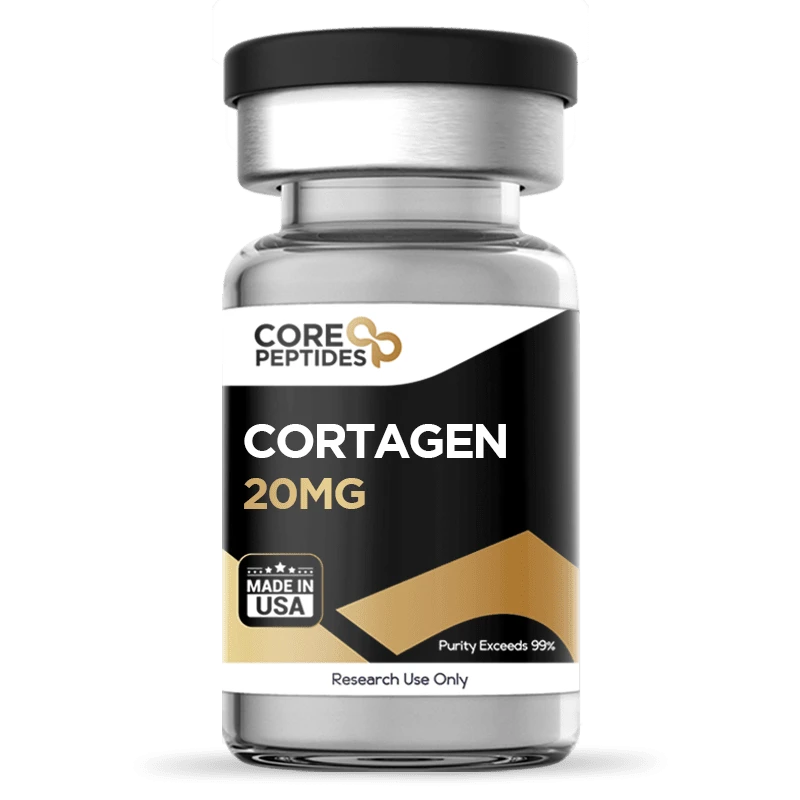
Cortagen (20mg) – Research Peptide
Cortagen (20mg) is an experimental synthetic tetrapeptide studied within the field of peptide bioregulator research. Also known as Ala-Glu-Asp-Pro (AEDP), Cortagen is associated with research into the cerebral cortex, neuronal biology, tissue-specific gene expression and age-related cellular changes.
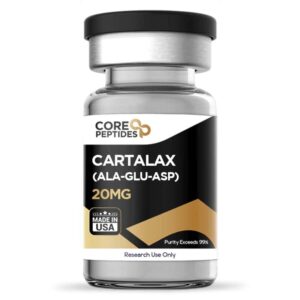
The referenced product is supplied as a 20mg lyophilised research peptide and is intended for laboratory and in-vitro research rather than human or veterinary use.
The supplier’s product information describes Cortagen as a research-grade material with stated purity of greater than 99% based on HPLC analysis and identity confirmation by mass spectrometry.
Cortagen is particularly notable because it is an extremely short peptide consisting of only four amino acids. Published research has investigated the synthetic tetrapeptide Ala-Glu-Asp-Pro in relation to tissue-specific biological effects and gene-expression changes.
What Is Cortagen?
Cortagen is a synthetic tetrapeptide with the amino-acid sequence Ala-Glu-Asp-Pro (AEDP). It belongs to the group of short peptide bioregulators associated with research originating from the Khavinson peptide research programme.
The compound was developed through directed synthesis based on amino-acid analysis of Cortexin, a preparation containing peptides derived from cerebral cortex tissue. Research published in 2004 identified Cortagen as the synthetic tetrapeptide Ala-Glu-Asp-Pro and investigated its effects on gene expression in mouse heart tissue. :contentReference[oaicite:2]{index=2}
Unlike longer peptides that may interact with specific cell-surface receptors, Cortagen is a particularly small peptide. Research into this class of compounds has explored potential tissue-specific interactions and changes in cellular gene-expression patterns, although the precise biological mechanisms remain an area of investigation.
Cortagen (20mg) Product Highlights
- Product name: Cortagen
- Quantity: 20mg
- Alternative designation: AEDP
- Peptide sequence: Ala-Glu-Asp-Pro
- Peptide type: Synthetic tetrapeptide
- Physical form: Lyophilised powder
- Stated purity: >99%
- Research category: Peptide bioregulator research
- Research areas: Cerebral cortex biology, gene expression and cellular research
- Intended application: Laboratory and in-vitro research
The product quantity and supplier specifications are based on the referenced Core Peptides listing.
Cortagen Peptide Sequence
| Property | Details |
|---|---|
| Name | Cortagen |
| Sequence | Ala-Glu-Asp-Pro |
| Abbreviation | AEDP |
| Peptide length | 4 amino acids |
| Classification | Synthetic tetrapeptide |
| Research field | Peptide bioregulator research |
| Product quantity | 20mg |
| Physical format | Lyophilised powder |
Understanding the AEDP Sequence
The abbreviation AEDP represents the four amino acids that make up Cortagen:
- Ala: Alanine
- Glu: Glutamic acid
- Asp: Aspartic acid
- Pro: Proline
The sequence is therefore written as Ala-Glu-Asp-Pro. Its exceptionally short structure places Cortagen within the category of low-molecular-weight peptide bioregulators.
Published research specifically identifies synthetic Cortagen as the tetrapeptide Ala-Glu-Asp-Pro.
Cortagen and Peptide Bioregulator Research
Cortagen is associated with a research tradition involving short synthetic peptides sometimes referred to as tissue-specific peptide bioregulators.
Research in this field has investigated whether short peptide sequences derived from tissue-associated peptide preparations can influence cellular processes in a tissue-selective manner. A publication examining several synthetic peptides reported tissue-specific effects in organotypic cultures, including Cortagen in relation to rat brain cortex and subcortical tissue.
These findings provide a basis for continued laboratory investigation, but they should not be interpreted as establishing a clinically proven mechanism or therapeutic effect.
Cortagen and Cerebral Cortex Research
The name Cortagen reflects its association with research into the cerebral cortex. The peptide originated from work involving Cortexin-derived peptide material and was subsequently synthesised as the defined tetrapeptide Ala-Glu-Asp-Pro.
Research interest has included the effects of Cortagen on cortical and related tissues, particularly in experimental models examining cellular regulation.
One early study reported that synthetic Cortagen stimulated the growth of explants from rat brain cortex and subcortical structures in organotypic culture. The same study described tissue-specific effects among several short peptides examined.
Such findings are useful for understanding the historical research surrounding Cortagen, although results obtained in organotypic cultures cannot automatically be translated into effects in humans.
Cortagen and Gene Expression Research
One notable area of Cortagen research concerns gene expression.
A 2004 study investigated the effects of Cortagen on gene expression in mouse heart tissue using microarray analysis. The researchers examined changes associated with administration of the synthetic tetrapeptide and investigated potential molecular targets of peptide bioregulator activity.
Gene-expression research is relevant because it can provide information about how an experimental compound may influence cellular pathways without requiring researchers to assume a single conventional receptor-mediated mechanism.
However, changes in gene expression observed in an experimental model do not necessarily demonstrate a beneficial physiological effect, and they cannot by themselves establish clinical efficacy.
Potential Research Applications of Cortagen
Cortagen may be of interest to researchers studying several areas of peptide biology, including:
- Cerebral cortex research: Investigation of peptide interactions with cortical tissue.
- Neurobiology: Study of cellular processes associated with nervous-system tissues.
- Gene-expression research: Examination of changes in gene-expression profiles following experimental exposure.
- Cellular biology: Investigation of peptide-related changes in experimental cell and tissue models.
- Peptide bioregulators: Study of short tissue-associated peptide sequences.
- Tissue-specific research: Comparison of responses between different tissue types.
- Ageing research: Investigation of molecular changes associated with ageing in experimental models.
- Analytical peptide research: Characterisation of peptide identity, purity and stability.
Cortagen and Tissue-Specific Peptide Research
Short peptide bioregulators have been investigated for their potential tissue-specific effects. In one published study, synthetic Cortagen, Epithalon, Livagen and Vilon were examined in organotypic cultures derived from different tissues.
The study reported that each peptide produced effects associated with the tissue from which its corresponding cytomedin preparation had been derived. Cortagen was associated with brain cortex and subcortical structures in the experimental model.
This work forms part of the scientific background surrounding Cortagen, although the underlying mechanism of tissue specificity remains incompletely established.
Cortagen and Experimental Neurobiology
The cerebral cortex is a highly complex region of the central nervous system involved in sensory processing, cognition, memory, language and voluntary motor functions.
Because Cortagen was developed in connection with cortex-derived peptide research, it has attracted interest within experimental neurobiology. Researchers have investigated whether short peptide sequences can influence cellular processes associated with cortical tissue.
Published work should nevertheless be interpreted according to the experimental model used. Evidence from isolated tissues, cell cultures or animal studies does not establish equivalent effects in humans.
Cortagen Research and Ischaemia Models
Research has also examined Cortagen in experimental models involving cerebral ischaemia.
A publication indexed by PubMed investigated Cortexin and Cortagen in relation to functional and metabolic disorders in the brain during chronic ischaemia. The study reported effects on recovery of disturbed behaviour in rats with differing resistance to hypoxia.
Such findings may be relevant to experimental investigations of peptide activity under conditions of altered oxygen availability. However, animal-model results should not be presented as evidence that Cortagen treats neurological or vascular disorders in humans.
Research Evidence for Cortagen
The available literature provides a historical foundation for investigating Cortagen, particularly in Russian peptide-bioregulator research.
Research has included:
- Organotypic tissue culture experiments
- Animal studies
- Gene-expression analysis
- Studies of cortical and subcortical tissue
- Experimental models of ischaemia
A PubMed-indexed study identified Cortagen as the synthetic tetrapeptide Ala-Glu-Asp-Pro and investigated its effects on gene expression. Another study reported tissue-specific effects of Cortagen in organotypic cultures.
The evidence base should, however, be considered preclinical and exploratory. Published experimental findings do not establish Cortagen as an approved therapeutic product.
Cortagen (20mg) Research Specifications
| Specification | Information |
|---|---|
| Compound | Cortagen |
| Sequence | Ala-Glu-Asp-Pro |
| Abbreviation | AEDP |
| Peptide length | 4 amino acids |
| Quantity | 20mg |
| Format | Lyophilised powder |
| Stated purity | >99% |
| Research classification | Synthetic peptide bioregulator |
| Primary research interest | Cortical and cellular biology |
The 20mg quantity and stated purity correspond to the referenced supplier listing. :contentReference[oaicite:13]{index=13}
Lyophilised Cortagen Powder
The referenced Cortagen product is supplied in a lyophilised powder format. Lyophilisation, or freeze-drying, is widely used for laboratory peptide materials because it allows peptides to be supplied in a dry, concentrated form.
Researchers should follow the product’s batch-specific documentation and institutional laboratory procedures when determining appropriate storage and handling conditions.
This description intentionally does not provide instructions for reconstitution, dosing or human administration.
Purity and Analytical Characterisation
Analytical verification is an important consideration when working with research peptides.
Common analytical techniques include:
- HPLC: Used to evaluate chromatographic purity.
- Mass spectrometry: Used to support peptide identity and molecular-mass determination.
- Certificate of Analysis: Provides batch-specific quality information where supplied.
- Lot identification: Helps researchers maintain traceability between experiments and analytical records.
The referenced Core Peptides product listing states that Cortagen is assessed using HPLC and mass spectrometry and reports greater than 99% purity.
Cortagen Compared with Longer Peptides
Cortagen is structurally unusual because it contains only four amino acids.
| Characteristic | Cortagen |
|---|---|
| Peptide length | 4 amino acids |
| Sequence | Ala-Glu-Asp-Pro |
| Classification | Tetrapeptide |
| Research family | Short peptide bioregulator |
| Primary research interest | Tissue-specific and cellular effects |
The short sequence makes Cortagen particularly interesting for researchers investigating how very small peptide molecules may interact with biological systems.
Why Researchers Study Short Peptides
Short peptides offer researchers an opportunity to investigate biological activity associated with very small molecular sequences. Research into short peptides can include questions such as:
- How does peptide sequence influence biological activity?
- Can small peptides interact selectively with particular tissues or cell types?
- How do peptide modifications affect stability?
- Can peptide exposure alter cellular gene-expression profiles?
- What molecular pathways respond to short peptide sequences?
Cortagen provides a defined four-amino-acid sequence for investigating these questions under controlled experimental conditions.
Research Limitations and Considerations
Although Cortagen has been investigated in several experimental studies, important limitations should be considered.
- Limited modern clinical evidence: Much of the published research is preclinical or originates from a relatively narrow research tradition.
- Animal-model limitations: Findings in rodents cannot automatically be extrapolated to humans.
- In-vitro limitations: Cellular and organotypic culture findings may not reproduce the complexity of a living organism.
- Mechanistic uncertainty: The precise molecular mechanism underlying proposed tissue-specific effects remains incompletely established.
- Product differences: Research compounds and commercially supplied materials may differ in purity, formulation and analytical characteristics.
- Therapeutic claims: Experimental findings should not be presented as proof that Cortagen treats a disease or medical condition.
Current evidence summaries describe Cortagen research as predominantly preclinical, with animal and in-vitro evidence forming much of the available scientific foundation.
Frequently Asked Questions About Cortagen (20mg)
What is Cortagen?
Cortagen is a synthetic tetrapeptide consisting of the amino-acid sequence Ala-Glu-Asp-Pro (AEDP). It is studied within the field of short peptide bioregulator research.
What is the amino-acid sequence of Cortagen?
The sequence is Ala-Glu-Asp-Pro, abbreviated as AEDP.
How many amino acids does Cortagen contain?
Cortagen contains four amino acids, making it a tetrapeptide.
What does the 20mg specification mean?
The 20mg specification refers to the quantity of research material supplied. It should not be interpreted as a recommended human dose.
What is Cortagen researched for?
Research has examined Cortagen in relation to cerebral cortex biology, tissue-specific peptide effects, gene expression and experimental models of neurological and cellular function.
Is Cortagen derived directly from brain tissue?
The synthetic Cortagen molecule is the defined tetrapeptide Ala-Glu-Asp-Pro. Published research describes it as being obtained through directed synthesis based on amino-acid analysis of the Cortexin peptide preparation.
Is Cortagen the same as Cortexin?
No. Cortagen is a defined synthetic tetrapeptide, whereas Cortexin is a peptide preparation containing multiple low-molecular-weight peptides. Cortagen was developed through research involving Cortexin-derived peptide material.
Has Cortagen been studied in animals?
Yes. Published research has investigated Cortagen in animal and tissue-culture models, including studies involving rat cortical tissue and experimental ischaemia.
Has Cortagen been studied for gene expression?
Yes. A 2004 study used microarray analysis to investigate the effects of Cortagen on gene expression in mouse heart tissue.
What form is Cortagen (20mg) supplied in?
The referenced product is supplied as a lyophilised powder.
What is the stated purity?
The referenced Core Peptides listing states a purity of >99%, with HPLC and mass-spectrometry testing described for the product.
Is Cortagen an approved medicine?
No. The referenced product is marketed as a research material and is not presented as an approved medicinal product.
Is Cortagen intended for human consumption?
No. The supplier’s product information specifies laboratory and in-vitro research use and states that the product is not intended for human or veterinary consumption.
Cortagen (20mg) Research Summary
Cortagen (20mg) is a research-grade synthetic tetrapeptide composed of Ala-Glu-Asp-Pro (AEDP). Its exceptionally short sequence places it within the group of low-molecular-weight peptide bioregulators investigated for tissue-specific and cellular effects.
Published research has examined Cortagen in relation to cerebral cortex and subcortical tissue, gene-expression changes and experimental models involving neurological and metabolic disturbances. A 2004 microarray study specifically identified Cortagen as the synthetic tetrapeptide Ala-Glu-Asp-Pro and investigated its influence on gene expression.
The available literature remains predominantly experimental. Research findings from animal models, organotypic cultures and gene-expression studies provide useful scientific context but do not establish Cortagen as a clinically proven treatment or demonstrate that the effects observed in experimental systems will occur in humans.
For laboratory researchers interested in short peptide sequences, tissue-specific peptide biology, cortical research and cellular gene-expression studies, Cortagen provides a defined four-amino-acid compound for controlled experimental investigation.
Research-Use Disclaimer
Cortagen (20mg) is intended for laboratory and in-vitro research purposes only. It is not a medicine, dietary supplement, food product or approved therapeutic treatment.
The information provided in this product description is intended for scientific and educational purposes. Research findings concerning Cortagen should not be interpreted as evidence that this product can diagnose, treat, cure or prevent any disease or medical condition.
Results obtained from animal models, cell cultures or related peptide preparations should not automatically be attributed to the exact Cortagen (20mg) research material.
This description does not provide instructions for human administration, dosing, injection, reconstitution for human use or self-experimentation. Researchers should consult relevant scientific literature, batch-specific analytical documentation, institutional procedures and applicable laws and regulations when working with experimental peptide materials.
Be the first to review “Cortagen (20mg)”
Related products
Peptides for Sale
Peptides for Sale
Peptides for Sale
Peptides for Sale
Peptides for Sale
Peptides for Sale
Peptide Blends for Sale
Peptides for Sale
Reviews
There are no reviews yet.