
Sermorelin & Ipamorelin Blend (10mg) – Research Peptide
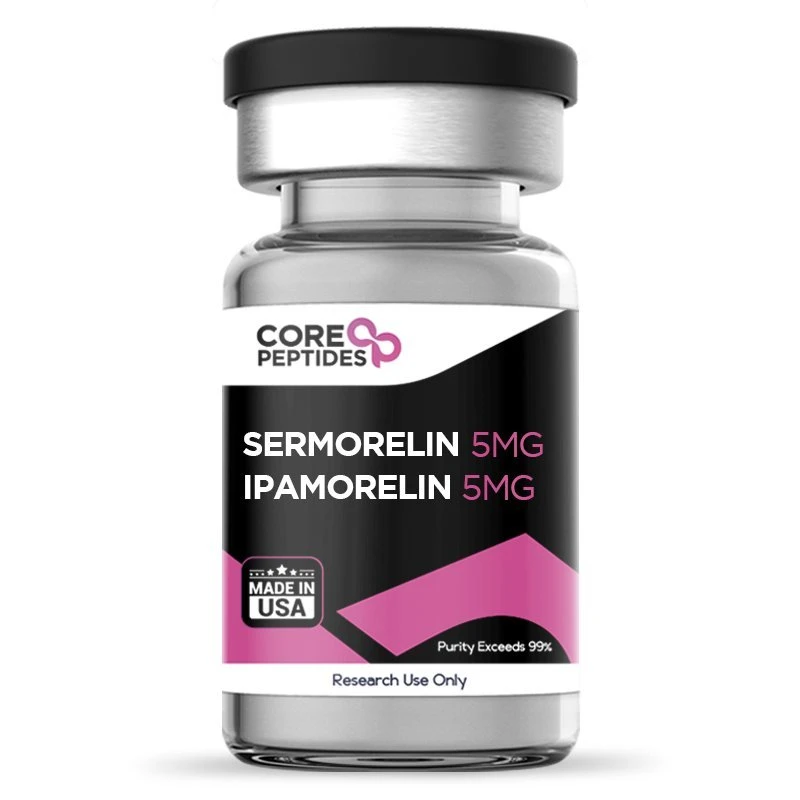
Sermorelin & Ipamorelin Blend (10mg) is a research peptide combination containing 5mg of Sermorelin and 5mg of Ipamorelin. The two peptides are studied in connection with growth hormone signalling and provide researchers with an experimental model for examining different pathways involved in pituitary signalling.
Sermorelin is a synthetic 29-amino-acid analogue of growth hormone-releasing hormone (GHRH), while Ipamorelin is a synthetic pentapeptide investigated as a selective growth hormone secretagogue.
Because the two compounds interact with different signalling systems, their combination may be of interest in laboratory research focused on growth hormone regulation, receptor activity and endocrine signalling.
According to the current Core Peptides listing, this product contains 10mg total peptide, consisting of 5mg Sermorelin and 5mg Ipamorelin. It is supplied as a lyophilised powder and is listed with a purity of >99%.
For research, laboratory, analytical and in-vitro experimental use only. Not intended for human or animal consumption.
What Is Sermorelin & Ipamorelin Blend?
Sermorelin & Ipamorelin Blend combines two synthetic peptides that have been individually investigated for their relationship with the growth hormone axis.
The formulation contains:
- Sermorelin – 5mg: A synthetic 29-amino-acid fragment of GHRH, commonly identified as GRF (1-29), investigated primarily in relation to GHRH receptor signalling.
- Ipamorelin – 5mg: A synthetic five-amino-acid peptide investigated as a growth hormone secretagogue and in relation to the growth hormone secretagogue receptor.
The equal quantities create a 1:1 research blend, providing a convenient format for laboratory investigations involving both peptide pathways.
Product Specifications
| Specification | Details |
|---|---|
| Product Name | Sermorelin & Ipamorelin Blend |
| Total Quantity | 10mg |
| Sermorelin | 5mg |
| Ipamorelin | 5mg |
| Blend Ratio | 1:1 |
| Form | Lyophilised powder |
| Listed Purity | >99% |
| Sermorelin Alternative Name | GRF 1-29 |
| Ipamorelin Alternative Name | NNC 26-0161 |
| Intended Application | Research and laboratory use |
What Is Sermorelin?
Sermorelin is a synthetic peptide consisting of 29 amino acids and corresponds to the biologically active N-terminal portion of growth hormone-releasing hormone. It is commonly referred to as GHRH (1-29) or GRF (1-29).
Unlike naturally occurring GHRH, which contains 44 amino acids, Sermorelin represents a shorter peptide sequence that has been investigated for its interaction with the GHRH receptor.
Research involving Sermorelin has focused on pituitary signalling and the mechanisms by which GHRH-related peptides influence growth hormone secretion. This makes it a useful research compound for studies involving the growth hormone axis and receptor-mediated signalling.
What Is Ipamorelin?
Ipamorelin is a synthetic pentapeptide consisting of five amino acids. It has been investigated as a selective growth hormone secretagogue and is associated with the growth hormone secretagogue receptor, commonly referred to as GHS-R1a.
Ipamorelin differs from Sermorelin in both structure and its primary receptor pathway. Rather than functioning as a GHRH analogue, Ipamorelin has been investigated for its activity within the growth hormone secretagogue system.
Scientific research has examined Ipamorelin in relation to growth hormone release, receptor pharmacology and endocrine signalling. These investigations provide a basis for studying the compound independently and alongside other growth hormone-related peptides.
How Do Sermorelin and Ipamorelin Differ?
Although both peptides are associated with research into growth hormone regulation, they represent different classes of compounds and are investigated through different signalling pathways.
| Characteristic | Sermorelin | Ipamorelin |
|---|---|---|
| Peptide Type | GHRH analogue | Growth hormone secretagogue |
| Sequence Length | 29 amino acids | 5 amino acids |
| Research Target | GHRH receptor | GHS-R1a / growth hormone secretagogue pathway |
| Alternative Name | GRF 1-29 | NNC 26-0161 |
| Quantity in Blend | 5mg | 5mg |
The different characteristics of these peptides are one reason their combination may be of interest in laboratory research investigating multiple components of growth hormone signalling.
Sermorelin & Ipamorelin and Growth Hormone Research
Growth hormone regulation involves a complex network of signals originating from the hypothalamus, pituitary gland and peripheral tissues. GHRH and growth hormone secretagogues represent two important components of this regulatory system.
Sermorelin research generally focuses on the GHRH receptor pathway, whereas Ipamorelin research focuses on the growth hormone secretagogue receptor pathway.
Studying these compounds together can therefore provide a research framework for examining how different upstream signals influence pituitary somatotroph cells and growth hormone-related signalling.
Potential experimental endpoints may include:
- Growth hormone secretion.
- GHRH receptor signalling.
- GHS-R1a receptor activity.
- Intracellular signalling responses.
- Receptor interactions and cross-talk.
- Growth hormone secretory patterns.
- Downstream GH/IGF-1 axis markers.
Potential Research Interest in Combined Signalling
The scientific rationale for studying Sermorelin and Ipamorelin together is based on their different mechanisms of receptor interaction.
Sermorelin provides a research model for the GHRH signalling pathway, while Ipamorelin provides a model for investigating growth hormone secretagogue signalling. Examining both compounds within an experimental system may allow researchers to compare or evaluate the interaction between these pathways.
However, it is important to distinguish between the scientific rationale for studying the combination and evidence demonstrating a specific effect from the commercial blend. Current supplier information indicates that the Sermorelin and Ipamorelin combination itself has not been directly supported by clinical research.
Available research has primarily investigated the individual peptides. Therefore, findings from individual Sermorelin or Ipamorelin studies should not automatically be interpreted as evidence for the exact 10mg blend.
Sermorelin & Ipamorelin and the GH/IGF-1 Axis
The growth hormone/IGF-1 axis is an interconnected biological system involving growth hormone release and downstream signalling through insulin-like growth factor-1.
Growth hormone can influence IGF-1 production in peripheral tissues, making IGF-1 an important research marker in studies examining growth hormone-related pathways.
Research involving Sermorelin has investigated changes in growth hormone and IGF-1 under specific experimental conditions. Ipamorelin has likewise been studied in relation to growth hormone secretion and downstream endocrine responses.
These findings may be useful when designing laboratory experiments involving the GH/IGF-1 axis, although results from individual studies depend on factors such as the experimental model, concentration, exposure period, sampling schedule and study population.
Research Applications of Sermorelin & Ipamorelin
Qualified researchers may investigate this peptide blend in areas such as:
- Growth hormone signalling research.
- GHRH receptor studies.
- GHS-R1a receptor research.
- Pituitary somatotroph research.
- Peptide receptor pharmacology.
- Endocrine signalling studies.
- GH/IGF-1 axis investigations.
- Receptor cross-talk research.
- Comparative peptide studies.
- Structure–activity relationship research.
- In-vitro cellular experiments.
- Analytical peptide research.
Sermorelin Chemical Information
| Property | Sermorelin |
|---|---|
| Common Name | Sermorelin |
| Alternative Name | GRF 1-29 |
| Classification | GHRH analogue |
| Sequence Length | 29 amino acids |
| Molecular Formula | C149H246N44O42S |
| Molecular Weight | 3357.93 g/mol |
| Quantity in Blend | 5mg |
Ipamorelin Chemical Information
| Property | Ipamorelin |
|---|---|
| Common Name | Ipamorelin |
| Alternative Name | NNC 26-0161 |
| Classification | Growth hormone secretagogue |
| Sequence Length | 5 amino acids |
| Molecular Formula | C38H49N9O5 |
| Molecular Weight | 771.86 g/mol |
| Quantity in Blend | 5mg |
Why Choose Sermorelin & Ipamorelin Blend (10mg)?
Sermorelin & Ipamorelin Blend (10mg) provides researchers with a convenient equal-ratio formulation containing two well-characterised synthetic peptide research compounds.
- 10mg total peptide: Contains 5mg Sermorelin and 5mg Ipamorelin.
- 1:1 formulation: Provides equal quantities of both peptides.
- >99% listed purity: The supplier lists the product with a purity exceeding 99%.
- Lyophilised powder: Supplied in a dry research-peptide format.
- Two distinct research pathways: Combines a GHRH analogue with a growth hormone secretagogue.
- Established individual research: Both compounds have been investigated independently in scientific literature.
- Laboratory-focused formulation: Suitable for appropriately designed analytical and experimental research.
Analytical Testing of Peptide Research Materials
Laboratories working with synthetic peptides may use analytical methods to verify identity, purity and other characteristics. Depending on the research requirements, appropriate methods can include:
- High-performance liquid chromatography (HPLC): Used to assess chromatographic purity.
- Mass spectrometry: Used to support molecular-mass and identity confirmation.
- Peptide mapping: Used in appropriate structural investigations.
- Receptor-binding assays: Used to investigate peptide–receptor interactions.
- Cell-based assays: Used to study biological activity in controlled experimental systems.
- Hormone assays: Used to measure experimental GH or IGF-1 responses where relevant.
Researchers should consult the applicable batch-specific Certificate of Analysis and supplier documentation when evaluating a research material.
Laboratory Handling and Storage
Sermorelin & Ipamorelin Blend (10mg) is supplied as a lyophilised powder. Laboratories should follow the supplier’s current storage guidance and their own validated procedures for handling synthetic peptide materials.
- Keep the product in its original labelled container.
- Protect the material from unnecessary moisture exposure.
- Follow the supplier’s current storage recommendations.
- Minimise unnecessary temperature fluctuations.
- Use appropriate laboratory protective equipment.
- Follow institutional handling and disposal procedures.
- Review batch-specific documentation before experimental use.
Storage requirements can vary according to formulation, packaging and experimental protocol. The manufacturer’s current documentation should always take precedence over general guidance.
Frequently Asked Questions
What is Sermorelin & Ipamorelin Blend (10mg)?
It is a research peptide combination containing 5mg Sermorelin and 5mg Ipamorelin, giving a total peptide quantity of 10mg.
What is the ratio of Sermorelin to Ipamorelin?
The blend contains the two peptides in a 1:1 ratio, with 5mg of each compound.
What is Sermorelin?
Sermorelin is a synthetic 29-amino-acid analogue of GHRH. It is primarily investigated in relation to the GHRH receptor and growth hormone signalling.
What is Ipamorelin?
Ipamorelin is a synthetic five-amino-acid peptide investigated as a growth hormone secretagogue and in relation to the GHS-R1a receptor.
Why are Sermorelin and Ipamorelin combined?
The compounds are associated with different signalling pathways involved in growth hormone regulation. Studying them together provides a research model for investigating the interaction between GHRH-related and growth hormone secretagogue pathways.
Has the exact Sermorelin & Ipamorelin blend been clinically studied?
According to the supplier’s current product information, there is no direct clinical research available for the exact Sermorelin and Ipamorelin blend. The individual peptides have been studied separately, but those findings should not be presented as clinical evidence for the combined formulation.
What is the listed purity?
The current product listing specifies a stated purity of >99%.
What form is the product supplied in?
The product is supplied as a lyophilised powder.
What research areas are associated with this blend?
Potential research areas include growth hormone signalling, pituitary receptor biology, GHRH receptor activity, GHS-R1a research, endocrine signalling and GH/IGF-1 axis investigations.
Is this product intended for human consumption?
No. The product is intended for research, laboratory and analytical applications only and is not intended for human or animal consumption.
Can this peptide blend be used for bodybuilding or athletic performance?
No. This product is intended exclusively for legitimate research and laboratory applications and should not be presented as a product for self-administration, bodybuilding or athletic performance.
Sermorelin & Ipamorelin Blend (10mg) Research Summary
Sermorelin & Ipamorelin Blend (10mg) combines two synthetic peptide research compounds in an equal 1:1 formulation. Each product contains 5mg Sermorelin and 5mg Ipamorelin, giving a total of 10mg of peptide material.
Sermorelin is a 29-amino-acid GHRH analogue primarily investigated through the GHRH receptor pathway, while Ipamorelin is a five-amino-acid growth hormone secretagogue investigated in relation to the GHS-R1a pathway.
Their different receptor profiles make the combination relevant to laboratory research examining growth hormone regulation and related signalling mechanisms. Although both peptides have been individually investigated, the exact Sermorelin and Ipamorelin blend has not been established through clinical research.
Consequently, scientific findings concerning either compound individually should be interpreted as background research rather than evidence of a specific clinical effect from the combined product.
Research-Use Disclaimer
Sermorelin & Ipamorelin Blend (10mg) is intended solely for qualified research, laboratory, analytical and in-vitro experimental purposes. It is not intended for human or veterinary consumption, self-administration, diagnosis, treatment, cure or prevention of any disease.
References to growth hormone, IGF-1, endocrine pathways, receptor activity or other biological mechanisms describe areas of scientific investigation and should not be interpreted as established therapeutic benefits or medical advice.
Researchers should review the applicable Certificate of Analysis, product documentation, safety information and relevant legislation before working with this material. Handling, storage and disposal should be carried out by appropriately trained personnel using suitable laboratory procedures.
For research use only. Human and animal consumption prohibited. Laboratory/In-Vitro Experimental Use Only.
Be the first to review “Sermorelin & Ipamorelin Blend (10mg)”
Related products
Peptides for Sale
Peptides for Sale
Peptides for Sale
Peptide Blends for Sale
Peptides for Sale
Peptides for Sale
Peptides for Sale
Peptides for Sale
Reviews
There are no reviews yet.