
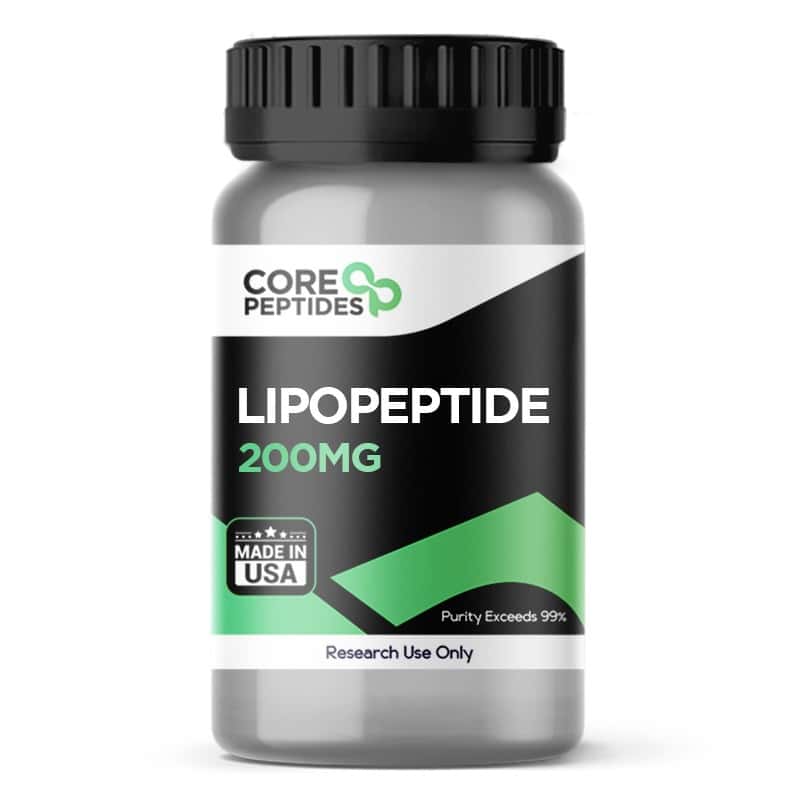
Lipopeptide (200mg) – Palmitoyl-GQPR Research Peptide
Lipopeptide (200mg) is a research-grade lipopeptide supplied in lyophilised powder form for laboratory, analytical and in-vitro research. The referenced Core Peptides listing identifies the material as a 200mg product with a reported purity of >99%. Its detailed chemical description identifies the peptide as Pal-Gly-Gln-Pro-Arg (Pal-GQPR), a palmitoylated tetrapeptide.
Lipopeptides combine a peptide sequence with a lipid component. In this case, the addition of a palmitoyl group increases the molecule’s lipophilic character, making Pal-GQPR particularly relevant to research involving peptide interaction with lipid-rich biological barriers and topical or cosmetic peptide formulations.
Research into Pal-GQPR has focused on extracellular dermal matrix biology, inflammatory signalling, skin structure and photoaged skin models. Studies have investigated potential changes involving fibrillin-1, laminins, collagen VII and inflammatory mediators such as IL-6.
However, much of the available evidence concerns peptide-containing formulations or experimental models rather than isolated Lipopeptide alone, so findings should be interpreted accordingly.
What Is Lipopeptide (Pal-GQPR)?
Lipopeptide, as described on the referenced product page, is characterised by the sequence Pal-Gly-Gln-Pro-Arg, commonly abbreviated as Pal-GQPR. It is described as a palmitoylated peptide fragment derived from immunoglobulin G (IgG). Palmitoylation involves attaching a palmitic acid-derived lipid group to the peptide, altering its physicochemical properties.
The lipid component is particularly relevant to topical peptide research because the outermost layer of skin contains a lipid-rich environment. The supplier’s research summary describes experimental observations suggesting that palmitoylation may improve penetration through skin and corneal tissue models compared with the corresponding non-lipidated peptide.
Lipopeptides are therefore of interest in research where peptide structure, lipid conjugation, membrane interaction and skin delivery are investigated together.
Lipopeptide (200mg) Product Highlights
| Specification | Details |
|---|---|
| Product | Lipopeptide |
| Quantity | 200mg |
| Detailed peptide identity | Pal-Gly-Gln-Pro-Arg (Pal-GQPR) |
| Form | Lyophilised powder |
| Reported purity | >99% |
| Alternative names listed | Pal-GQPR; Palmitoyl Tetrapeptide-7/3 |
| Molecular formula | C38H68N6O8 |
| Molecular weight | 736.9 g/mol |
| Research areas | Dermal matrix biology, skin structure, inflammatory signalling and photoageing research |
| Intended use | Research, laboratory and analytical applications |
The specifications above follow the referenced Core Peptides product listing. Researchers should consult the applicable batch documentation and certificate of analysis for current analytical specifications.
Important nomenclature note: the supplier’s product summary includes “GHK-Cu” in the product metadata under “Contents”, while the detailed description and chemical specifications identify the material as Pal-GQPR. These are chemically different peptide materials. Researchers should therefore verify the current product label, certificate of analysis and batch documentation before using the material in an experiment.
Understanding Pal-GQPR
Pal-GQPR consists of a short peptide sequence combined with a palmitoyl lipid group. The peptide portion contains four amino acids:
- Glycine (Gly/G): a small amino acid commonly found in flexible peptide sequences.
- Glutamine (Gln/Q): a polar amino acid that contributes to peptide structure and biological interactions.
- Proline (Pro/P): an amino acid known for its distinctive conformational properties.
- Arginine (Arg/R): a basic amino acid that can contribute to interactions with biological molecules.
The sequence is conjugated to a palmitoyl group. This lipid modification changes the molecule’s hydrophobicity and may affect its interaction with lipid-containing environments.
This combination of peptide and lipid chemistry is the defining feature of a lipopeptide and is central to research into topical peptide delivery and skin biology.
What Does Palmitoylation Do?
Palmitoylation refers to the attachment of a palmitoyl group, derived from palmitic acid, to a molecule. In synthetic peptide research, lipid conjugation can change characteristics such as lipophilicity, membrane affinity, stability and interaction with biological barriers.
For topical peptide research, this is particularly relevant because the stratum corneum contains organised lipid structures that can restrict the passage of many water-soluble molecules.
The Core Peptides description reports that the palmitoyl modification may improve penetration through corneal layers in experimental models by adding a lipid component capable of interacting with lipid-rich tissue environments.
These observations provide a rationale for studying Pal-GQPR in topical delivery and skin-barrier research, although experimental permeability results should not be interpreted as proof of clinical effectiveness.
Lipopeptide and Extracellular Dermal Matrix Research
The extracellular dermal matrix (ECM) is a complex network of proteins and other molecules surrounding skin cells. It contributes to the structural properties, elasticity and organisation of dermal tissue.
Research involving peptide-containing formulations that included Lipopeptide has investigated changes in dermal matrix structure. According to the referenced supplier’s summary, experimental studies examined parameters including the subepidermal low-echogenic band, dermal density and extracellular matrix organisation. Animal research also investigated possible changes in dermal matrix structure following peptide application.
These studies have contributed to scientific interest in Pal-GQPR as a compound for investigating peptide-mediated changes in skin structure and extracellular matrix biology.
Lipopeptide and Collagen VII Research
Collagen VII is an important structural protein associated with anchoring fibrils at the junction between the epidermis and dermis. These structures contribute to the mechanical connection between different layers of the skin.
The research summary associated with the referenced Lipopeptide product describes investigations into the potential stimulation of structural components including collagen VII. Such findings are relevant to studies of the dermal-epidermal junction and extracellular matrix organisation.
However, observations involving a formulation containing multiple active ingredients cannot necessarily be attributed to Pal-GQPR alone. Controlled experiments using isolated material are required to determine the contribution of an individual peptide.
Lipopeptide and Laminin Research
Laminins are structural glycoproteins found within basement membranes. They participate in cell adhesion, organisation, differentiation and migration.
Research summarised by the supplier has investigated whether peptide-containing formulations including Lipopeptide influence the production of laminin IV and V. These observations are relevant to research into basement-membrane organisation and epidermal-dermal interactions.
The potential relationship between Pal-GQPR and these structural proteins remains an area for experimental investigation rather than an established therapeutic mechanism.
Lipopeptide and IL-6 Research
Interleukin-6 (IL-6) is a cytokine involved in immune and inflammatory signalling. Changes in IL-6 production can occur in response to tissue injury, environmental stressors and inflammatory stimuli.
The Core Peptides research summary describes experimental observations in which Lipopeptide-containing formulations were associated with changes in IL-6 secretion, including research involving UVB-related skin inflammation.
These findings make IL-6 an interesting endpoint for laboratory research involving Pal-GQPR and related cosmetic peptide formulations.
It is important to distinguish changes in an experimental biomarker from evidence of a clinically meaningful anti-inflammatory effect in humans.
Lipopeptide and Photoaged Skin Research
Photoageing describes structural and functional changes in skin associated with long-term exposure to ultraviolet radiation. Experimental research into photoaged skin commonly evaluates collagen, elastin, fibrillin, matrix organisation and visible changes such as wrinkles.
A published randomised controlled study investigated a cosmetic formulation containing Lipopeptide alongside other active ingredients. The study examined markers associated with dermal structure and the appearance of photoaged skin. According to the study, fibrillin-1 deposition increased following treatment, while longer-term observations reported improvements in wrinkle appearance.
Because the formulation contained several ingredients, the study does not establish that Pal-GQPR alone caused the reported outcomes. Nevertheless, it provides useful context for ongoing research into lipopeptides and photoaged skin biology.
Lipopeptide and Fibrillin-1
Fibrillin-1 is an extracellular matrix protein that forms microfibrils and contributes to the organisation and mechanical properties of connective tissue.
Research into photoaged skin has used fibrillin-1 as a marker of dermal structural changes. The published study referenced by Core Peptides reported increased fibrillin-1 deposition following use of a cosmetic formulation containing Lipopeptide and other active ingredients. :contentReference[oaicite:12]{index=12}
This makes fibrillin-1 a potentially useful research endpoint when studying peptide-based cosmetic formulations and extracellular matrix remodelling.
Lipopeptide and Skin Structure Research
Skin structure depends on coordinated interactions between keratinocytes, fibroblasts, extracellular matrix proteins, basement-membrane components and signalling molecules.
Research involving Lipopeptide has explored several of these components, including:
- Extracellular dermal matrix organisation.
- Fibrillin-1 deposition.
- Collagen VII.
- Laminin IV and V.
- Inflammatory cytokine signalling.
- Skin response to UVB exposure.
- Photoaged skin morphology.
Together, these areas form part of the broader research landscape surrounding peptide-based approaches to skin biology and cosmetic science.
Lipopeptide in Cosmetic Peptide Research
Lipopeptides are widely investigated in cosmetic science because lipid conjugation can influence how small peptide molecules interact with the skin barrier.
The scientific interest in Pal-GQPR is therefore not limited to its peptide sequence. Researchers can also investigate how the attached palmitoyl group influences physicochemical properties, skin compatibility and interaction with lipid-rich environments.
Research into synthetic peptides for sensitive skin and cosmetic applications has identified peptide-based ingredients as an area of continuing scientific investigation. However, the biological effects of an isolated research peptide should not be assumed to match those of a finished cosmetic formulation.
Lipopeptide and Skin Penetration Research
The outermost skin layer, the stratum corneum, represents a significant barrier to the penetration of many molecules.
Its structure includes corneocytes surrounded by organised lipid domains. Adding a lipophilic palmitoyl group to a peptide can alter the way that molecule interacts with these lipid structures.
The supplier’s product description states that palmitoylation may improve penetration through skin tissue models by helping the molecule interact with the lipid-rich environment of the outer skin layers.
For researchers, this makes Pal-GQPR relevant to studies involving:
- Peptide permeability.
- Skin-barrier interaction.
- Lipid-peptide interactions.
- Topical delivery systems.
- Peptide stability.
- Dermal absorption models.
Lipopeptide and UVB Research
Ultraviolet B (UVB) radiation can produce inflammatory and structural changes in skin cells and tissues. Laboratory research often uses UVB exposure as an experimental model for investigating photoageing and skin inflammation.
The research summary for the referenced product describes studies examining Lipopeptide-containing formulations in relation to UVB-associated inflammatory responses, including investigations of IL-6.
Such studies may help researchers understand how peptide-based formulations interact with cellular responses to environmental stress.
Lipopeptide Research Applications
Lipopeptide (200mg) may be relevant to laboratory research across several fields:
- Cosmetic science: Investigation of peptide-based topical formulations.
- Dermatological research: Study of skin structure and extracellular matrix biology.
- Peptide chemistry: Investigation of lipid-conjugated peptide molecules.
- Skin-barrier research: Study of peptide interaction with the stratum corneum.
- Extracellular matrix research: Investigation of collagen, laminins and fibrillin.
- Inflammation research: Examination of cytokine-associated signalling.
- Photoageing research: Experimental investigation of UV-related skin changes.
- Cell biology: Study of peptide-cell and peptide-matrix interactions.
- Topical delivery research: Investigation of lipid-modified peptide permeability.
Lipopeptide Chemical Information
The detailed Core Peptides listing provides the following chemical information for its Lipopeptide material.
| Chemical Property | Specification |
|---|---|
| Peptide sequence | Pal-Gly-Gln-Pro-Arg |
| Abbreviation | Pal-GQPR |
| Molecular formula | C38H68N6O8 |
| Molecular weight | 736.9 g/mol |
| Quantity | 200mg |
| Physical form | Lyophilised powder |
| Reported purity | >99% |
Why Study Pal-GQPR Instead of a Non-Lipidated Peptide?
The principal research interest in Pal-GQPR comes from combining a short peptide sequence with a lipid modification.
A non-lipidated peptide and its palmitoylated counterpart can have different physicochemical behaviour. The palmitoyl group can increase lipophilicity and may influence interactions with biological membranes and lipid-rich barriers.
This provides researchers with an opportunity to compare:
- Non-lipidated versus lipidated peptide structures.
- Differences in membrane interaction.
- Changes in experimental skin penetration.
- Changes in peptide stability.
- Differences in cellular uptake.
- Potential effects on topical formulation performance.
Such comparative studies can help determine whether lipid conjugation provides measurable experimental advantages under defined laboratory conditions.
Lipopeptide Versus Other Palmitoylated Peptides
Lipopeptide should not be confused with every peptide containing a palmitoyl group. Several structurally different palmitoylated peptides are used in cosmetic and research applications.
| Peptide | General Research Focus |
|---|---|
| Pal-GQPR | Dermal matrix, skin structure and inflammatory research |
| Pal-GHK | GHK-related extracellular matrix and cosmetic peptide research |
| Pal-AHK | AHK-related collagen and elastin research |
| Palmitoyl Tetrapeptide-7 | Extracellular matrix and inflammatory signalling research |
| Palmitoyl Pentapeptide-4 | Collagen and photoaged skin research |
These compounds should not be treated as interchangeable. Differences in amino acid sequence, lipid attachment and molecular structure can significantly affect their experimental properties.
Lipopeptide and Extracellular Matrix Remodelling
Extracellular matrix remodelling is a dynamic process involving synthesis, degradation and reorganisation of structural proteins.
In skin, the ECM includes collagen, elastin, fibrillin, laminins and other proteins that collectively influence tissue organisation and mechanical properties.
The research surrounding Lipopeptide has examined several of these components, providing a basis for further investigation into how peptide-based compounds may interact with dermal matrix biology.
Researchers can investigate these mechanisms using endpoints such as protein expression, immunohistochemistry, microscopy, gene-expression analysis and extracellular matrix imaging.
Lipopeptide and Photoageing Biomarkers
Experimental photoageing studies frequently use structural biomarkers to evaluate changes in the dermal matrix.
Fibrillin-1, for example, is an important component of elastic microfibrils. Changes in its distribution can provide information about alterations in the dermal extracellular matrix.
The published clinical research cited by Core Peptides investigated fibrillin-1 deposition in human skin following application of a multi-ingredient cosmetic formulation containing Lipopeptide. The researchers reported increased fibrillin-1 in the papillary dermis compared with baseline or control conditions.
Because the study formulation contained multiple active ingredients, additional controlled research is necessary to determine the specific contribution of Pal-GQPR.
Frequently Asked Questions About Lipopeptide (200mg)
What is Lipopeptide?
Lipopeptide, as described in the referenced product listing, is a palmitoylated peptide identified as Pal-Gly-Gln-Pro-Arg (Pal-GQPR). It is investigated primarily in skin, extracellular matrix and peptide-delivery research.
What does Lipopeptide contain?
The detailed chemical description identifies the material as Pal-GQPR, consisting of a palmitoyl group attached to the Gly-Gln-Pro-Arg peptide sequence. The product metadata on the supplier’s page also lists GHK-Cu under “Contents”, so researchers should verify the batch-specific certificate of analysis and product label before use.
What is Pal-GQPR?
Pal-GQPR is an abbreviation for the palmitoylated peptide sequence Pal-Gly-Gln-Pro-Arg. The palmitoyl component is a lipid modification that changes the physicochemical properties of the underlying peptide.
Why is Lipopeptide palmitoylated?
Palmitoylation increases the lipophilic character of the peptide and may influence its interaction with lipid-rich biological barriers. This is particularly relevant to research into topical peptide delivery and skin penetration.
What is Lipopeptide researched for?
Research has examined Lipopeptide in relation to extracellular dermal matrix structure, fibrillin-1, laminins, collagen VII, inflammatory signalling, photoaged skin and topical peptide formulations.
Has Lipopeptide been studied in humans?
A published randomised controlled study investigated a cosmetic formulation containing Lipopeptide together with other active ingredients in human participants. The study reported observations involving fibrillin-1 and wrinkle appearance. However, because the formulation contained multiple ingredients, these results cannot establish the effects of isolated Pal-GQPR.
Is Lipopeptide the same as GHK-Cu?
No. Pal-GQPR and GHK-Cu are chemically distinct materials. The detailed product description identifies the Lipopeptide as Pal-GQPR, although the supplier’s metadata contains a GHK-Cu entry. Researchers should confirm the exact material supplied using the current product documentation and certificate of analysis.
What form is Lipopeptide supplied in?
The referenced product is supplied as lyophilised powder. The listed quantity is 200mg and the supplier reports purity above 99%.
What is the molecular weight of Lipopeptide?
The referenced product page lists a molecular weight of 736.9 g/mol and molecular formula C38H68N6O8.
Can Lipopeptide be considered a medicine?
No. The referenced supplier identifies its products as materials for research, laboratory or analytical purposes and states that they are not intended for human consumption.
Does research prove that Lipopeptide treats wrinkles or skin conditions?
No. Although research involving Lipopeptide-containing formulations has reported changes in skin biomarkers and wrinkle appearance, these findings do not establish that isolated Lipopeptide is a clinically proven treatment for wrinkles, photoageing or any medical condition.
What quantity does the referenced product contain?
The referenced product contains 200mg of material and is supplied as lyophilised powder. The listed purity is above 99%. :contentReference[oaicite:29]{index=29}
Research Summary
Lipopeptide (200mg) is a lyophilised research material described in detail by the referenced supplier as the palmitoylated peptide Pal-GQPR (Pal-Gly-Gln-Pro-Arg). Its reported purity is greater than 99%, with a listed molecular weight of 736.9 g/mol.
The defining feature of Pal-GQPR is its palmitoyl modification. This lipid component increases lipophilicity and makes the molecule particularly relevant to research into peptide interaction with lipid-rich barriers, topical delivery and skin biology.
Research has explored Lipopeptide-containing formulations in relation to extracellular dermal matrix structure, fibrillin-1, collagen VII, laminins, inflammatory signalling and photoaged skin. A human study involving a multi-ingredient cosmetic formulation also reported changes in fibrillin-1 and wrinkle appearance, although the contribution of Lipopeptide alone could not be established.
For laboratory researchers, Pal-GQPR provides an interesting model for investigating the relationship between peptide sequence, lipid conjugation, skin-barrier interaction and extracellular matrix biology.
Research-Use Disclaimer
Lipopeptide (200mg) is intended for laboratory, analytical and scientific research purposes only. It is not a food product, dietary supplement or approved medicinal product.
The information presented here is intended for educational and research purposes and should not be interpreted as medical advice or as evidence that Lipopeptide can diagnose, treat, cure or prevent any disease or medical condition.
Research involving cosmetic formulations or experimental models does not automatically establish the safety or efficacy of isolated Pal-GQPR. In particular, studies involving multi-ingredient formulations cannot be used to attribute all observed effects to a single peptide.
The referenced supplier states that its products are for research, laboratory or analytical purposes only and are not intended for human consumption. Researchers should follow applicable laboratory procedures, institutional requirements, supplier documentation and relevant laws and regulations when handling research materials.
Be the first to review “Lipopeptide (200mg)”
Related products
Peptides for Sale
Peptides for Sale
Peptide Blends for Sale
Peptides for Sale
Peptides for Sale
Peptides for Sale
Peptides for Sale
Peptides for Sale
Reviews
There are no reviews yet.