
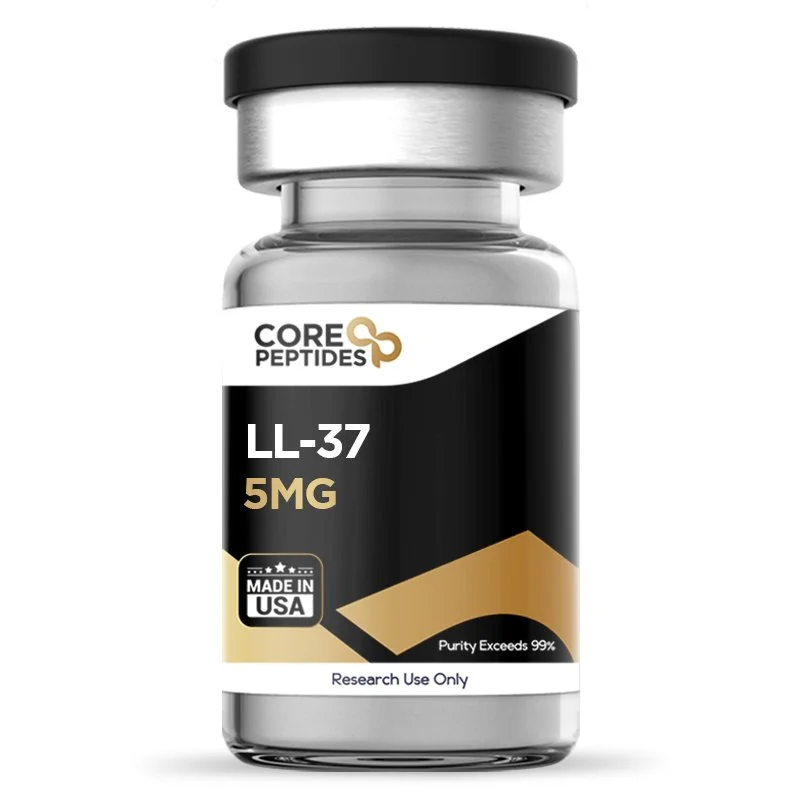

LL-37 (5mg) – Research Peptide | High-Purity Cathelicidin
LL-37 (5mg) is a synthetic research peptide belonging to the cathelicidin family of human host-defence peptides. Also referred to as CAP-18, LL-37 is a cationic, alpha-helical peptide consisting of 37 amino acids. It has been extensively investigated in laboratory research examining antimicrobial activity, membrane interactions, innate immunity and inflammatory signalling.
The referenced product is supplied as a lyophilised powder with a reported purity of >99% and a total quantity of 5mg. The supplier identifies the material as intended exclusively for research, laboratory and analytical applications rather than human or animal consumption.
What Is LL-37?
LL-37 is a naturally occurring human antimicrobial peptide derived from the precursor protein known as human cathelicidin antimicrobial protein 18 (hCAP18). Proteolytic processing of hCAP18 releases the mature LL-37 peptide.
Unlike many globular proteins, LL-37 is a relatively short peptide with a predominantly alpha-helical structure. Its positively charged character allows it to interact with negatively charged biological membranes and other molecular structures, making it an important model for studying peptide–membrane interactions.
Research has investigated LL-37 for its ability to interact with bacterial membranes, lipopolysaccharides and host-cell signalling pathways. Early laboratory studies demonstrated activity against a range of Gram-positive and Gram-negative microorganisms, while subsequent research has expanded into immunomodulation and inflammatory biology.
LL-37 (5mg) Product Specifications
| Specification | Details |
|---|---|
| Product Name | LL-37 |
| Quantity | 5mg |
| Alternative Name | CAP-18 |
| Peptide Family | Cathelicidin |
| Peptide Length | 37 amino acids |
| Form | Lyophilised powder |
| Reported Purity | >99% |
| Molecular Formula | C205H340N50O53 |
| Molecular Weight | 4493.34 g/mol |
| Primary Research Areas | Antimicrobial peptide research, membrane biology, innate immunity and inflammatory signalling |
| Intended Use | Research, laboratory and analytical applications |
The product specifications above are based on the referenced supplier listing. Researchers should consult the current batch-specific certificate of analysis for definitive analytical specifications.
LL-37 Chemical Characteristics
LL-37 is a 37-amino-acid cationic peptide. Its positive charge is an important characteristic in research investigating interactions between antimicrobial peptides and negatively charged microbial membranes.
The peptide is also described as amphipathic, meaning that its molecular structure contains regions with different affinities for aqueous and lipid environments. This property is particularly relevant to studies of membrane association and peptide-induced membrane disruption.
Structural research has shown that LL-37 can adopt an alpha-helical conformation when interacting with lipid environments. Such structural changes are an important part of research into how antimicrobial peptides associate with biological membranes.
LL-37 and Cathelicidin Research
LL-37 is the best-characterised human member of the cathelicidin family. Cathelicidins are host-defence peptides that form part of the innate immune system.
LL-37 is generated from the larger hCAP18 precursor following proteolytic processing. It has been detected in several epithelial and immune-related environments and has been investigated for both direct antimicrobial activity and broader immunomodulatory properties.
Research into human LL-37 has therefore expanded beyond simple antimicrobial activity to include cellular signalling, inflammation, chemotaxis, tissue responses and interactions with nucleic acids.
LL-37 and Antimicrobial Research
One of the principal research areas surrounding LL-37 is its interaction with microorganisms.
Laboratory studies have examined LL-37 against a range of bacterial species, including Escherichia coli, Pseudomonas aeruginosa, Staphylococcus aureus, Staphylococcus epidermidis and other organisms. Experimental results indicate that activity can vary according to the microorganism and the surrounding experimental conditions.
One early study found that LL-37 displayed measurable antimicrobial activity against several Gram-positive and Gram-negative organisms and demonstrated membrane permeabilisation in an E. coli model.
These findings make LL-37 a useful research model for studying the mechanisms of cationic antimicrobial peptides.
How LL-37 Interacts With Microbial Membranes
The interaction between LL-37 and microbial membranes is an important area of peptide research.
Because LL-37 carries a positive charge, it can be attracted electrostatically to negatively charged components on microbial surfaces. Following initial association, peptide molecules may reorganise on the membrane and interact with lipid structures.
Several proposed mechanisms have been investigated, including:
- Electrostatic association with microbial membranes.
- Peptide accumulation at membrane surfaces.
- Insertion into lipid bilayers.
- Membrane permeabilisation.
- Formation of transient or organised membrane structures.
- Disruption of membrane integrity.
Structural studies indicate that LL-37 can undergo conformational changes when interacting with membrane-associated lipids, supporting continued research into the relationship between peptide structure and membrane activity.
LL-37 and Lipopolysaccharide Research
Lipopolysaccharide (LPS) is an important component of the outer membrane of Gram-negative bacteria. Because LPS can participate in host inflammatory responses, interactions between antimicrobial peptides and LPS are an important area of investigation.
Experimental research has demonstrated that LL-37 can bind to bacterial LPS. This interaction has been studied as part of efforts to understand how host-defence peptides interact with microbial surface components and inflammatory signalling molecules.
Research involving LL-37 and LPS can therefore provide insights into both antimicrobial mechanisms and host–microbe interactions.
LL-37 and Innate Immunity
LL-37 is associated with the innate immune system, the body’s rapid first-line defence against potentially harmful microorganisms.
Unlike adaptive immune responses, innate immune mechanisms can respond quickly to broad molecular patterns. Host-defence peptides such as LL-37 are part of this complex network of physical, chemical and cellular defence mechanisms.
Research has shown that LL-37 may have effects extending beyond direct antimicrobial activity. Studies have investigated its interactions with epithelial cells, monocytes and dendritic cells, as well as its influence on chemokine and cytokine signalling.
LL-37 and Immunomodulatory Research
Immunomodulation describes the ability of a molecule to influence immune-cell activity or immune signalling. LL-37 has attracted significant research interest in this area because its biological effects are not limited to interactions with microorganisms.
Research has examined LL-37 interactions with several types of immune and epithelial cells. Reported experimental effects include changes in cellular signalling and chemokine production, although these responses can depend strongly on cell type, concentration and experimental environment.
Current scientific literature therefore considers LL-37 a multifunctional host-defence peptide rather than a molecule with a single biological mechanism.
LL-37 and Inflammatory Signalling
Inflammatory signalling is another major area of LL-37 research.
Studies have investigated how LL-37 interacts with endogenous nucleic acids, cellular receptors and signalling pathways. In certain experimental models, LL-37 can contribute to inflammatory signalling, while in other contexts it may influence host-defence responses in different ways.
This context-dependent behaviour is an important consideration when interpreting LL-37 research. A laboratory observation involving one cell type or experimental condition cannot automatically be generalised to other biological systems.
Research has specifically examined LL-37 in inflammatory and autoimmune disease models, including investigations involving psoriasis and other inflammatory conditions.
LL-37 and Skin Research
The skin is an important site for research into antimicrobial peptides because epithelial surfaces form a major interface between the body and the external environment.
LL-37 has been studied in relation to keratinocytes, epithelial defence and skin-associated immune responses. Its expression can change in response to injury, inflammation and infection, making it relevant to research into the interaction between epithelial tissues and innate immunity.
Research has also investigated how LL-37 interacts with nucleic acids and immune signalling pathways in skin-related models. These studies contribute to a broader understanding of antimicrobial peptide biology within epithelial tissues.
LL-37 and Wound Biology Research
LL-37 has been investigated in experimental models of tissue injury and wound biology because antimicrobial peptides can participate in both microbial defence and cellular signalling.
Researchers have examined LL-37 in relation to epithelial responses, immune-cell recruitment and inflammatory pathways associated with damaged tissue.
These studies are relevant to understanding the complex role of host-defence peptides during tissue injury. However, experimental observations should not be interpreted as proof that isolated LL-37 is a treatment for wounds or other medical conditions.
LL-37 and Gastrointestinal Research
Research has also examined LL-37 in the gastrointestinal tract, where epithelial tissues are continuously exposed to microorganisms and microbial products.
Experimental studies have investigated LL-37 expression in gastrointestinal tissues and its potential interactions with microbial components such as LPS. Other work has examined relationships between LL-37 and inflammatory signalling in intestinal cell models.
These investigations help researchers understand how host-defence peptides may contribute to the complex relationship between epithelial barriers, microorganisms and local immune responses.
LL-37 and Respiratory Research
LL-37 has also been detected in respiratory epithelial environments and investigated as part of pulmonary innate immunity.
Research has demonstrated the presence of LL-37/hCAP18 in human airway tissues and airway surface fluids. Experimental studies have investigated antimicrobial activity against respiratory-associated microorganisms, including Pseudomonas aeruginosa.
This research contributes to understanding how antimicrobial peptides participate in the first-line defence of epithelial surfaces.
LL-37 and Staphylococcus aureus Research
Staphylococcus aureus is a commonly studied bacterial species in antimicrobial peptide research. LL-37 has been evaluated against both extracellular and intracellular forms of S. aureus in laboratory and experimental models.
One study reported rapid antimicrobial activity against extracellular and intracellular S. aureus under the conditions examined. Such results demonstrate the research potential of LL-37 as a model antimicrobial peptide but do not establish it as a clinically approved antimicrobial treatment.
LL-37 and Membrane Biology
The membrane-active properties of LL-37 make it particularly useful for research in membrane biology.
Researchers can use LL-37 as a model for investigating how positively charged amphipathic peptides associate with phospholipid membranes and how peptide organisation can influence membrane structure.
Relevant experimental endpoints may include:
- Membrane permeability.
- Lipid binding.
- Peptide aggregation.
- Membrane insertion.
- Bilayer organisation.
- Peptide conformation.
- Membrane disruption.
Structural studies have demonstrated that LL-37 can adopt an alpha-helical structure in lipid environments, making it a valuable model for investigating peptide–membrane interactions.
LL-37 and Peptide Structure
The relationship between peptide structure and biological activity is a central theme in antimicrobial peptide research.
LL-37 provides an interesting example because its amphipathic alpha-helical structure can facilitate interactions with lipid membranes. Researchers can investigate how changes to peptide sequence, charge, hydrophobicity or secondary structure influence antimicrobial and cellular activity.
LL-37-derived peptide variants are also being explored as part of research into next-generation antimicrobial compounds. Recent research has investigated engineered peptides containing LL-37-derived sequences against multidrug-resistant bacterial models.
LL-37 and Multidrug-Resistance Research
The continuing development of antimicrobial resistance has increased interest in alternative antimicrobial strategies, including host-defence peptides.
LL-37 is frequently investigated as a model because its antimicrobial mechanism differs from many conventional small-molecule antibiotics. Research has examined whether peptide-based approaches could provide alternative mechanisms for interacting with microbial membranes.
More recent research has also investigated LL-37-derived peptides designed specifically to target multidrug-resistant microorganisms. These studies remain experimental and represent an area of ongoing antimicrobial discovery rather than established clinical treatment.
LL-37 Research Applications
LL-37 (5mg) can be relevant to laboratory research in several scientific disciplines, including:
- Antimicrobial peptide research: Studying interactions between LL-37 and microbial organisms.
- Membrane biology: Investigating peptide–lipid and peptide–membrane interactions.
- Innate immunity: Examining naturally occurring host-defence mechanisms.
- Immunology: Studying peptide-associated immune-cell signalling.
- Inflammation research: Investigating cytokine and chemokine responses.
- Microbiology: Evaluating peptide activity against bacterial models.
- Structural biology: Examining alpha-helical peptide conformations.
- Cell biology: Investigating interactions between LL-37 and mammalian cells.
- Drug-discovery research: Using LL-37 as a template for developing experimental antimicrobial peptide derivatives.
Why Is LL-37 Important in Peptide Research?
LL-37 is particularly valuable as a research model because it combines several scientifically interesting properties within a relatively small molecule.
Researchers can investigate its:
- Cationic charge.
- Amphipathic character.
- Alpha-helical structure.
- Membrane-binding behaviour.
- Antimicrobial activity.
- Interaction with microbial lipids.
- Interaction with LPS.
- Immunomodulatory properties.
- Relationship with inflammatory signalling.
This combination makes LL-37 useful for studying the intersection between microbiology, immunology, structural biology and peptide chemistry.
LL-37 Compared With Other Antimicrobial Peptides
| Peptide | Family | General Research Interest |
|---|---|---|
| LL-37 | Cathelicidin | Antimicrobial activity, membrane interactions and immunomodulation |
| HNP-1 | Alpha-defensin | Innate immunity and antimicrobial activity |
| Protegrin-1 | Protegrin | Membrane disruption and antimicrobial mechanisms |
| Dermcidin | Dermcidin family | Skin-associated antimicrobial defence |
These peptides differ in sequence, structure, charge distribution and membrane-interaction mechanisms. LL-37 is distinguished by its human cathelicidin origin and its broad research profile spanning antimicrobial and immunomodulatory biology.
LL-37 (5mg) Research Summary
LL-37 (5mg) is a research-grade synthetic cathelicidin peptide supplied as a lyophilised powder. The referenced product lists a quantity of 5mg and reported purity greater than 99%.
LL-37 is a 37-amino-acid cationic peptide derived from the hCAP18 precursor. Scientific research has extensively investigated its antimicrobial properties, particularly its ability to associate with microbial membranes and influence membrane integrity.
Research has also established LL-37 as a multifunctional host-defence peptide with potential immunomodulatory effects. Investigations have examined its role in epithelial biology, inflammatory signalling, immune-cell activity and interactions with endogenous nucleic acids.
More recent research continues to explore LL-37 and LL-37-derived sequences as experimental templates for antimicrobial discovery, including studies involving multidrug-resistant microorganisms.
Overall, LL-37 remains an important model molecule for research into antimicrobial peptides, membrane biology, innate immunity, inflammation and peptide-based antimicrobial discovery.
Frequently Asked Questions About LL-37 (5mg)
What is LL-37?
LL-37 is a 37-amino-acid human cathelicidin peptide investigated extensively for its antimicrobial, membrane-active and immunomodulatory properties.
What does LL-37 stand for?
The name LL-37 refers to the mature 37-amino-acid peptide derived from the human cathelicidin precursor hCAP18. It is also commonly associated with the designation CAP-18.
Is LL-37 an antimicrobial peptide?
Yes. LL-37 is classified as a host-defence antimicrobial peptide. Laboratory studies have demonstrated activity against various microorganisms under defined experimental conditions.
How does LL-37 interact with bacterial membranes?
Research suggests that positively charged LL-37 can associate with negatively charged microbial membrane components. Subsequent peptide organisation and membrane interaction may result in membrane permeabilisation or disruption.
What is LL-37 researched for?
LL-37 is researched in antimicrobial peptide science, membrane biology, innate immunity, immunology, inflammation, epithelial biology and antimicrobial drug discovery.
Is LL-37 only involved in antimicrobial activity?
No. Scientific research indicates that LL-37 also has immunomodulatory properties and can influence cellular signalling. Its biological activity is therefore broader than direct interaction with microorganisms.
What is the molecular weight of LL-37?
The referenced Core Peptides listing reports a molecular weight of approximately 4493.34 g/mol and the molecular formula C205H340N50O53.
What form is LL-37 (5mg) supplied in?
The referenced product is supplied as a lyophilised powder with a listed quantity of 5mg and reported purity above 99%. :contentReference[oaicite:25]{index=25}
Has LL-37 been studied against bacteria?
Yes. Numerous laboratory studies have investigated LL-37 against Gram-positive and Gram-negative bacterial species, including Staphylococcus aureus, Escherichia coli and Pseudomonas aeruginosa.
Is LL-37 approved as a medicine?
The referenced product is supplied for research, laboratory and analytical purposes and should not be presented as an approved medicinal product. Experimental antimicrobial or immunological findings do not by themselves establish clinical efficacy or safety.
Can LL-37 be used to treat infections?
This product description concerns LL-37 as a research material. Laboratory findings should not be interpreted as instructions or evidence supporting human treatment of infections or other medical conditions.
Research-Use Disclaimer
LL-37 (5mg) is intended for research, laboratory and analytical purposes only. It is not intended for human or animal consumption, self-administration, diagnosis, treatment, cure or prevention of any disease.
Research findings involving LL-37 can vary according to experimental conditions, cell type, microorganism, formulation and assay methodology. In-vitro or animal findings should not automatically be extrapolated to clinical outcomes in humans.
Researchers should consult the applicable certificate of analysis, safety documentation and institutional laboratory procedures before working with this material. All handling and experimentation should comply with applicable legislation and laboratory safety requirements.
Be the first to review “LL-37 (5mg)”
Related products
Peptides for Sale
Peptide Blends for Sale

Peptides for Sale
Peptides for Sale
Peptides for Sale
Peptides for Sale
Peptides for Sale
Peptides for Sale
Reviews
There are no reviews yet.