
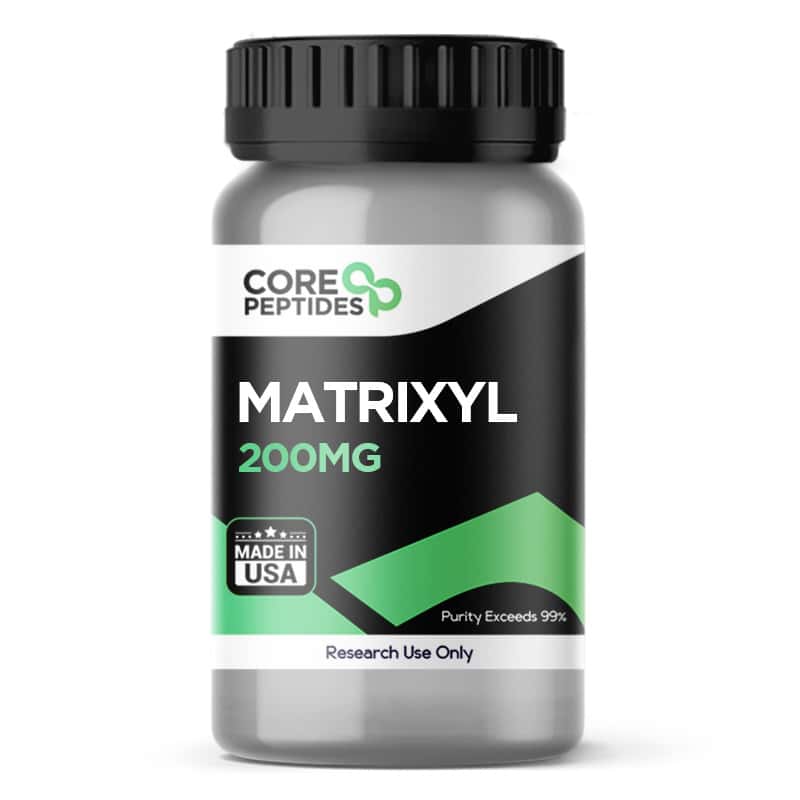

Matrixyl (200mg) – Palmitoyl Pentapeptide-4 Research Peptide
Matrixyl (200mg) is a synthetic peptide material associated with Palmitoyl Pentapeptide-4 (Pal-KTTKS), a well-known peptide used in cosmetic and skin-science research.
The molecule consists of the five-amino-acid sequence Lys-Thr-Thr-Lys-Ser (KTTKS) linked to a palmitoyl group. This lipid modification increases the peptide’s lipophilic character and is relevant to research into topical delivery and peptide interactions with the skin barrier.
Matrixyl has attracted scientific interest primarily because Pal-KTTKS is a matrikine-related signal peptide. Research has investigated its relationship with extracellular matrix components, collagen production, skin structure and the visible characteristics associated with photoaged skin.
Clinical and laboratory studies have reported promising observations, although these findings should be understood in the context of cosmetic research rather than pharmaceutical treatment.
The referenced product is supplied as a 200mg research material. Researchers should consult the current product label and batch-specific certificate of analysis for definitive information regarding purity, formulation and analytical specifications.
What Is Matrixyl?
Matrixyl is the commonly used trade name associated with Palmitoyl Pentapeptide-4, also known as Pal-KTTKS. The underlying peptide sequence is KTTKS, comprising lysine, threonine, threonine, lysine and serine.
A palmitoyl group is attached to the peptide, creating a lipid-modified pentapeptide. PubChem identifies Palmitoyl Pentapeptide-4 by the sequence KTTKS and reports a molecular weight of approximately 802.1 g/mol.
KTTKS is associated with a fragment of the C-terminal propeptide region of type I procollagen. This has led to interest in Pal-KTTKS as a matrikine-inspired peptide, where a peptide fragment derived from extracellular matrix biology is investigated for its ability to influence cellular matrix-related processes.
Matrixyl (200mg) Product Highlights
| Specification | Details |
|---|---|
| Product | Matrixyl |
| Quantity | 200mg |
| Peptide | Palmitoyl Pentapeptide-4 |
| Abbreviation | Pal-KTTKS |
| Peptide Sequence | Lys-Thr-Thr-Lys-Ser (KTTKS) |
| Form | Research peptide material |
| Molecular Formula | C39H75N7O10 |
| Molecular Weight | 802.1 g/mol |
| Research Areas | Cosmetic science, extracellular matrix biology, collagen research and skin biology |
| Intended Application | Laboratory, analytical and research applications |
The chemical identity and molecular specifications above are consistent with PubChem’s record for Palmitoyl Pentapeptide-4.
Understanding Pal-KTTKS
Pal-KTTKS contains two principal structural components:
- KTTKS peptide sequence: A five-amino-acid sequence consisting of lysine, threonine, threonine, lysine and serine.
- Palmitoyl group: A 16-carbon lipid chain attached to the peptide that increases its lipophilic character.
The combination produces a lipid-modified peptide with different physicochemical properties from the unmodified KTTKS sequence.
Researchers have investigated palmitoylation as a strategy for improving peptide interaction with the lipid-rich environment of the stratum corneum. In an in-vitro study comparing KTTKS and palmitoyl-KTTKS, researchers specifically examined dermal stability and skin permeation.
Matrixyl and Matrikine Research
A matrikine is a peptide fragment generated from extracellular matrix proteins that can participate in cellular signalling. The concept is important in skin research because extracellular matrix turnover can release smaller peptide fragments capable of interacting with cells.
KTTKS has been studied as a fragment associated with the C-terminal propeptide of type I procollagen. Its palmitoylated derivative, Pal-KTTKS, is consequently of interest in research investigating how extracellular matrix-derived peptide signals may influence fibroblast activity and matrix production.
This research concept forms the scientific basis for investigating Matrixyl in relation to collagen and other extracellular matrix components.
Matrixyl and Collagen Research
Collagen is one of the principal structural proteins in the skin and extracellular matrix. Changes in collagen organisation and production are closely associated with the structural characteristics of ageing skin.
Research into Pal-KTTKS has examined collagen-related cellular activity. Reviews of cosmetic peptide research describe Palmitoyl Pentapeptide-4 as a signal peptide investigated for its influence on collagen and extracellular matrix synthesis.
In laboratory research, the KTTKS sequence has also been examined for its ability to influence extracellular matrix production by dermal fibroblasts. This provides a mechanistic rationale for further investigation of Pal-KTTKS in cosmetic peptide science.
Matrixyl and Extracellular Matrix Research
The extracellular matrix (ECM) provides structural support around cells and contains proteins and molecules involved in tissue organisation and cellular communication.
Skin ECM research commonly focuses on molecules such as:
- Collagen.
- Elastin.
- Fibronectin.
- Glycosaminoglycans.
- Hyaluronic acid.
- Proteoglycans.
Pal-KTTKS has been investigated in relation to several of these extracellular matrix components. Reviews of the cosmetic peptide literature describe research suggesting that Pal-KTTKS can influence collagen and other matrix-related processes in experimental models.
Matrixyl and Skin Barrier Research
The outermost layer of the skin, known as the stratum corneum, provides a significant barrier to the movement of substances into and through the skin.
The palmitoyl modification of KTTKS increases the molecule’s lipophilic character. This is relevant to research into topical peptide delivery because the stratum corneum contains organised lipid structures.
A 2014 study specifically compared the dermal stability and in-vitro skin permeation of KTTKS and palmitoyl-KTTKS. The investigation provides useful experimental context for understanding why lipid conjugation is used in cosmetic peptide design.
Matrixyl and Photoaged Skin Research
Photoageing refers to structural and visible changes associated with cumulative exposure to ultraviolet radiation. Research into photoaged skin commonly examines wrinkles, fine lines, skin texture, collagen organisation and other extracellular matrix characteristics.
Pal-KTTKS has been investigated in controlled topical studies involving photoaged facial skin. A double-blind, placebo-controlled, split-face study involving 93 women aged 35–55 evaluated a moisturiser containing 3 ppm Pal-KTTKS over 12 weeks. The researchers reported statistically significant improvements in fine lines and wrinkles compared with the control formulation.
This is relevant evidence for the cosmetic research profile of Pal-KTTKS, although the study evaluated a specific topical formulation rather than isolated laboratory Matrixyl powder.
Matrixyl and Fine-Line Research
The appearance of fine lines and wrinkles is influenced by multiple factors, including chronological ageing, ultraviolet exposure, changes in dermal matrix organisation and alterations in skin hydration.
The clinical study of Pal-KTTKS cited above evaluated visible wrinkle and fine-line changes using quantitative technical analysis and expert image grading. The researchers reported greater improvement with the Pal-KTTKS-containing moisturiser than with the control product.
A later double-blind randomised study also investigated a cream containing Palmitoyl Pentapeptide-4 in relation to crow’s feet. Although the study was relatively small, the Pal-KTTKS group showed improvements in several measured parameters compared with placebo.
These studies provide useful context for cosmetic research but do not establish Matrixyl as a medicinal treatment for wrinkles.
Matrixyl and Fibroblast Research
Dermal fibroblasts are connective-tissue cells that produce and organise important components of the extracellular matrix.
Because fibroblasts are central to collagen and matrix biology, they are frequently used in laboratory studies investigating cosmetic peptides.
Research involving KTTKS and Pal-KTTKS has examined collagenesis and extracellular matrix-related activity in fibroblast models. More recent in-vitro work has also investigated Palmitoyl Pentapeptide-4 in combination with other bioactive materials, measuring fibroblast viability, proliferation and ECM-related gene expression.
These experimental models can help researchers explore the cellular pathways potentially associated with peptide-mediated changes in skin structure.
Matrixyl and Collagen I Research
Type I collagen is a major structural protein in the dermis. It provides tensile strength and contributes significantly to the organisation of connective tissue.
The KTTKS sequence was originally investigated because of its relationship to type I procollagen. Subsequent research into Pal-KTTKS has therefore focused heavily on collagen-related cellular responses.
For laboratory researchers, collagen I expression, synthesis and extracellular deposition can provide useful endpoints when evaluating Pal-KTTKS or related peptide structures.
Matrixyl and Collagen III Research
Type III collagen is another important component of connective tissue and frequently occurs alongside type I collagen.
Reviews of cosmetic peptide research describe Pal-KTTKS as a signal peptide associated with research into collagen I and III production, as well as broader extracellular matrix synthesis.
Investigating multiple collagen types can provide a more complete picture of how a peptide influences extracellular matrix biology than measuring a single protein in isolation.
Matrixyl and Fibronectin Research
Fibronectin is an extracellular matrix glycoprotein involved in cell adhesion, migration and tissue organisation.
Research reviews identify fibronectin among the extracellular matrix components investigated in connection with Pal-KTTKS and related cosmetic peptides.
Fibronectin expression and deposition can therefore serve as potential endpoints in experimental research examining the broader effects of signal peptides on extracellular matrix biology.
Matrixyl and Glycosaminoglycan Research
Glycosaminoglycans (GAGs) are long-chain carbohydrates found within the extracellular matrix. They contribute to hydration, matrix organisation and interactions between cells and structural proteins.
Scientific reviews of cosmetic peptides describe Pal-KTTKS research in relation to extracellular matrix components including glycosaminoglycans.
Such research is relevant to understanding whether peptide-mediated signalling can influence several interconnected components of dermal matrix biology.
Why Is Matrixyl Palmitoylated?
Palmitoylation changes the physical properties of the KTTKS peptide by attaching a hydrophobic lipid chain.
The principal research rationale is that increased lipophilicity can influence:
- Interaction with lipid-rich environments.
- Peptide stability.
- Membrane association.
- Skin-barrier interactions.
- Topical delivery characteristics.
Experimental work comparing KTTKS with palmitoyl-KTTKS has specifically investigated differences in dermal stability and skin permeation, demonstrating why lipid conjugation is an important variable in peptide formulation research.
Matrixyl Research Applications
Matrixyl (200mg) may be relevant to laboratory investigations involving:
- Cosmetic peptide research: Studying peptide ingredients used in topical cosmetic formulations.
- Extracellular matrix research: Investigating collagen, fibronectin and related matrix components.
- Fibroblast research: Examining peptide-associated cellular responses in dermal fibroblast models.
- Skin-barrier research: Investigating the effect of lipid conjugation on peptide permeation.
- Photoageing research: Studying experimental models of age-related skin changes.
- Peptide chemistry: Characterising lipid-modified peptide structures.
- Topical delivery research: Evaluating peptide stability and movement through skin models.
- Cell signalling research: Investigating matrikine-associated signalling mechanisms.
Matrixyl Compared With Other Cosmetic Peptides
| Peptide | General Classification | Research Focus |
|---|---|---|
| Matrixyl / Palmitoyl Pentapeptide-4 | Palmitoylated signal peptide | Extracellular matrix, collagen and skin appearance research |
| Palmitoyl Tripeptide-1 | Palmitoylated signal peptide | Collagen and extracellular matrix research |
| Palmitoyl Tetrapeptide-7 | Palmitoylated peptide | Skin and inflammatory-signalling research |
| GHK-Cu | Copper-associated peptide | Skin repair, extracellular matrix and cosmetic research |
These peptides have different sequences, structures and chemical properties. They should therefore not be considered interchangeable, even when they are investigated for related cosmetic or skin-science applications.
Matrixyl vs Matrixyl 3000
Matrixyl and Matrixyl 3000 are related but should not automatically be treated as the same material.
The original Matrixyl ingredient is associated with Palmitoyl Pentapeptide-4 (Pal-KTTKS). Matrixyl 3000 is a later cosmetic peptide blend based on different palmitoylated peptides. The distinction is important when evaluating chemical identity, research data and product specifications.
For laboratory work, researchers should always verify the exact peptide sequence and composition rather than relying solely on a commercial family name.
Matrixyl and Topical Cosmetic Research
Matrixyl has one of the more substantial research histories among cosmetic peptides. Published studies have investigated topical formulations containing Pal-KTTKS and measured changes in visible skin characteristics and instrumental parameters.
The 12-week split-face clinical study is particularly notable because it used a placebo-controlled design and quantitative image analysis. Participants receiving the Pal-KTTKS formulation showed greater improvement in fine lines and wrinkles than the control side.
A subsequent randomised study examined Palmitoyl Pentapeptide-4 cream in Asian participants and reported improvements in several skin measurements and crow’s-feet assessments. The authors nevertheless noted the need for larger studies with longer follow-up.
Matrixyl and Skin Permeation Research
Topical peptide research must consider the ability of a molecule to interact with and move through the skin barrier.
KTTKS is relatively hydrophilic, whereas attaching a palmitoyl group increases lipophilicity. Researchers have therefore investigated whether Pal-KTTKS demonstrates different dermal stability and permeation characteristics from the unmodified peptide.
A dedicated in-vitro study evaluated the dermal stability and skin permeation of both KTTKS and pal-KTTKS, providing experimental evidence for continued investigation of lipid-modified peptide delivery systems.
Matrixyl and Photoageing Biomarkers
Research into photoaged skin commonly evaluates several biological and physical endpoints rather than relying on a single measure.
Potential research endpoints for Pal-KTTKS include:
- Collagen production.
- Procollagen expression.
- Fibronectin expression.
- Extracellular matrix organisation.
- Skin roughness.
- Fine-line measurements.
- Wrinkle depth.
- Skin hydration.
- Dermal fibroblast activity.
Using multiple endpoints can help researchers distinguish direct cellular effects from changes in the visible characteristics of a finished cosmetic formulation.
Matrixyl (200mg) Chemical Information
| Chemical Property | Specification |
|---|---|
| Common Name | Matrixyl |
| INCI Name | Palmitoyl Pentapeptide-4 |
| Sequence | Pal-KTTKS |
| Unmodified Peptide Sequence | Lys-Thr-Thr-Lys-Ser |
| Molecular Formula | C39H75N7O10 |
| Molecular Weight | 802.1 g/mol |
| Quantity | 200mg |
PubChem identifies Palmitoyl Pentapeptide-4 as C39H75N7O10, with a molecular weight of 802.1 g/mol and the peptide sequence KTTKS.
Frequently Asked Questions About Matrixyl (200mg)
What is Matrixyl?
Matrixyl is the commercial name commonly associated with Palmitoyl Pentapeptide-4, a synthetic lipid-modified pentapeptide with the sequence Pal-KTTKS. It has been widely studied in cosmetic and skin-science research.
What is the sequence of Matrixyl?
The peptide portion of Matrixyl is Lys-Thr-Thr-Lys-Ser (KTTKS). The sequence is conjugated to a palmitoyl group to produce Pal-KTTKS.
What is Pal-KTTKS?
Pal-KTTKS is the abbreviation for palmitoyl-Lys-Thr-Thr-Lys-Ser, also known as Palmitoyl Pentapeptide-4.
Why is Matrixyl associated with collagen research?
KTTKS is associated with a fragment of the type I procollagen propeptide. Research has therefore investigated whether this peptide and its palmitoylated derivative can influence collagen and extracellular matrix-related activity.
Has Matrixyl been studied in humans?
Yes. A double-blind, placebo-controlled split-face study involving 93 women evaluated a topical moisturiser containing Pal-KTTKS for 12 weeks and reported significant improvements in fine lines and wrinkles compared with the control formulation.
Is Matrixyl the same as Matrixyl 3000?
No. The original Matrixyl is associated with Palmitoyl Pentapeptide-4, whereas Matrixyl 3000 refers to a different peptide-based cosmetic blend. Researchers should verify the exact composition of each material.
What is the molecular weight of Palmitoyl Pentapeptide-4?
PubChem reports a molecular weight of approximately 802.1 g/mol for Palmitoyl Pentapeptide-4.
What is Matrixyl researched for?
Matrixyl is researched primarily in cosmetic science, extracellular matrix biology, collagen-related research, fibroblast studies, skin-barrier research and photoageing models.
Does Matrixyl treat wrinkles?
Published topical studies have reported improvements in the appearance of fine lines and wrinkles with formulations containing Pal-KTTKS. However, these findings relate to specific cosmetic formulations and do not establish Matrixyl as a medicine or treatment for a medical condition.
Is Matrixyl a pharmaceutical drug?
Matrixyl is primarily associated with cosmetic ingredient and research applications. It should not be presented as an approved pharmaceutical treatment.
What is the purpose of the palmitoyl group?
The palmitoyl group increases the lipophilic character of KTTKS. Researchers have investigated this modification in relation to peptide stability, skin interaction and topical permeation.
Is Matrixyl suitable for laboratory research?
The referenced 200mg product is presented as a research material. Researchers should use the current product documentation and certificate of analysis to confirm its exact specifications before incorporating it into an experiment.
Matrixyl (200mg) Research Summary
Matrixyl (200mg) refers to a research material associated with Palmitoyl Pentapeptide-4 (Pal-KTTKS), a synthetic five-amino-acid peptide conjugated to a palmitoyl group.
Matrixyl is particularly notable in cosmetic peptide research because KTTKS is associated with a fragment of type I procollagen and has been investigated as a matrikine-related signal peptide. Studies have explored its relationship with collagen, fibronectin, glycosaminoglycans and other extracellular matrix components.
Clinical research has also evaluated topical Pal-KTTKS formulations. In a 12-week, double-blind, placebo-controlled split-face study involving 93 women, the Pal-KTTKS-containing formulation produced greater improvements in fine lines and wrinkles than the control formulation.
Further research has examined Pal-KTTKS in relation to skin permeation, dermal stability, fibroblast biology and other extracellular matrix endpoints.
Overall, Matrixyl provides a well-established model for investigating lipid-modified signal peptides, extracellular matrix biology, collagen-related processes and cosmetic skin research. Results from individual formulations or laboratory experiments should not automatically be extrapolated to isolated research material or clinical outcomes.
Research-Use Disclaimer
Matrixyl (200mg) is intended for laboratory, analytical and scientific research purposes only. It should not be represented as a medicine, dietary supplement or approved treatment for any disease or medical condition.
The scientific literature includes both laboratory research and cosmetic clinical studies involving specific topical formulations. Such evidence should not be interpreted as proof that isolated Matrixyl powder has the same effects as a finished cosmetic formulation.
Researchers should consult the current certificate of analysis, product documentation and applicable safety information before conducting experiments. All research should be performed by appropriately qualified personnel and in accordance with relevant institutional requirements and applicable legislation.
Be the first to review “Matrixyl (200mg)”
Related products
Peptides for Sale

Peptides for Sale
Peptides for Sale

Peptides for Sale

Peptides for Sale
Peptides for Sale

Peptides for Sale
Peptides for Sale
Reviews
There are no reviews yet.