
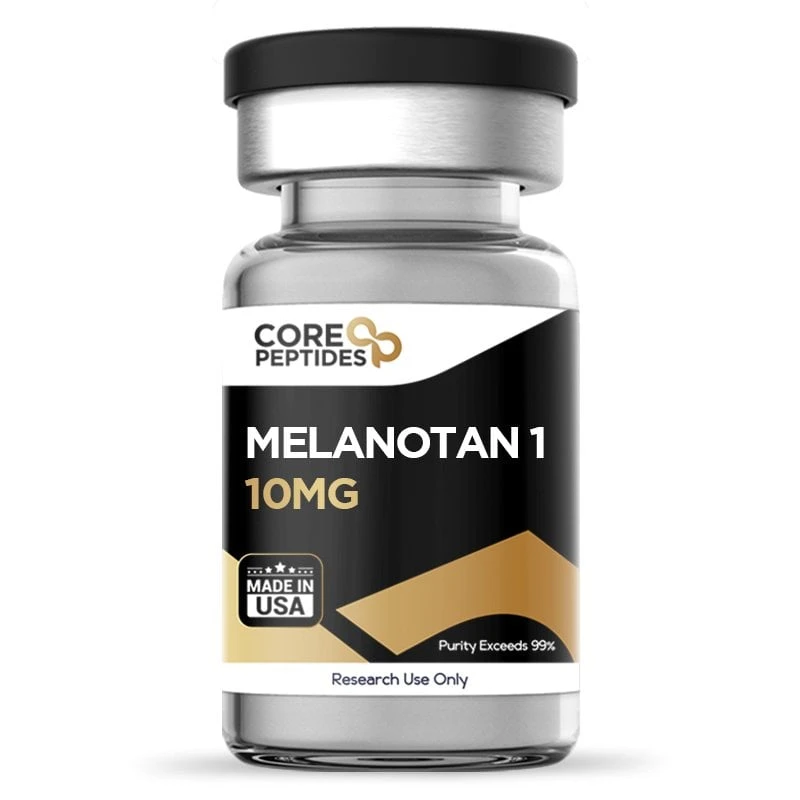
Melanotan 1 (10mg) – Afamelanotide Research Peptide
Melanotan 1 (10mg), also known as Melanotan I, MT-1 or afamelanotide, is a synthetic analogue of alpha-melanocyte-stimulating hormone (α-MSH). It is a 13-amino-acid melanocortin peptide that has been extensively studied for its interaction with melanocortin receptors, particularly the melanocortin-1 receptor (MC1R), which plays an important role in melanogenesis and pigmentation.
The referenced Core Peptides product is supplied as a 10mg lyophilised powder with a stated purity of >99% and is designated for research, laboratory and analytical purposes only.
Melanotan 1 has a distinctive research history because it has been investigated both as a synthetic melanocortin analogue and as the active pharmaceutical ingredient afamelanotide in an approved medicinal product for a specific rare disorder. These contexts should be kept separate: research-grade Melanotan 1 powder is not equivalent to an authorised medicinal formulation.
In the United States, afamelanotide is approved as the active ingredient in SCENESSE for increasing pain-free light exposure in adults with erythropoietic protoporphyria (EPP), and the approved product is a 16mg subcutaneous implant administered by a healthcare professional.
What Is Melanotan 1?
Melanotan 1 is a synthetic analogue of the naturally occurring hormone α-MSH. It contains 13 amino acids and incorporates two notable structural substitutions compared with endogenous α-MSH: norleucine replaces methionine at position 4, while D-phenylalanine replaces L-phenylalanine at position 7.
These modifications were designed to produce a more stable melanocortin analogue with enhanced activity compared with the natural peptide. The peptide has been studied extensively in relation to the melanocortin receptor system.
Of particular interest is MC1R, a G-protein-coupled receptor expressed prominently by melanocytes and closely associated with melanin production. Activation of MC1R signalling can increase intracellular cyclic AMP (cAMP), which contributes to downstream pathways involved in melanogenesis.
Melanotan 1 (10mg) Product Specifications
| Specification | Details |
|---|---|
| Product Name | Melanotan 1 |
| Alternative Names | Melanotan I, MT-1, Afamelanotide |
| Quantity | 10mg |
| Form | Lyophilised powder |
| Reported Purity | >99% |
| Molecular Formula | C78H111N21O19 |
| Molecular Weight | 1646.87 g/mol |
| Peptide Length | 13 amino acids |
| Primary Research Area | Melanocortin receptor and pigmentation research |
| Intended Application | Research, laboratory and analytical use |
The product quantity, form and reported purity are taken from the referenced Core Peptides listing. Researchers should use the current batch-specific certificate of analysis for definitive quality-control information.
Melanotan 1 Chemical Structure
Melanotan 1 is a modified α-MSH analogue. Its molecular structure retains the characteristic melanocortin sequence while incorporating two substitutions that distinguish it from the endogenous hormone.
The two principal modifications are:
- Norleucine at position 4: Methionine is replaced with norleucine.
- D-phenylalanine at position 7: The naturally occurring L-phenylalanine is replaced by its D-isomer.
These structural modifications are important to research because peptide sequence and stereochemistry can substantially influence receptor affinity, biological stability and pharmacological behaviour. Modern analytical work continues to investigate the stability and degradation pathways of afamelanotide under different chemical and physical conditions.
Melanotan 1 and the Melanocortin System
The melanocortin system is a family of peptide hormones, receptors and signalling pathways involved in several biological processes.
Five principal melanocortin receptors are recognised:
- MC1R: Closely associated with melanocyte function and pigmentation.
- MC2R: Primarily associated with adrenocorticotropic hormone signalling in the adrenal cortex.
- MC3R: Involved in research into energy homeostasis and other physiological processes.
- MC4R: Extensively studied in relation to central melanocortin signalling and energy balance.
- MC5R: Investigated in relation to several peripheral physiological processes.
Melanotan 1 has particular research relevance to MC1R. Structural research has shown how melanocortin ligands, including afamelanotide, interact with MC1R and activate receptor-associated G-protein signalling.
Melanotan 1 and MC1R
MC1R is a receptor found on melanocytes and is a major regulator of the balance between different types of melanin.
When MC1R is activated, signalling through adenylate cyclase and cAMP can promote downstream pathways associated with melanogenesis. Experimental studies of melanocortin signalling have demonstrated that activation of MC1R can stimulate both melanocyte activity and melanin production.
Melanotan 1 is therefore an important research tool for investigating how synthetic melanocortin analogues interact with MC1R and influence pigmentation-related cellular pathways.
Melanotan 1 and Melanin Research
Melanin is a group of pigments produced by specialised cells known as melanocytes. Two broad forms of melanin are particularly relevant to pigmentation research: eumelanin and pheomelanin.
Eumelanin is generally associated with darker brown-to-black pigmentation and has important photoprotective properties. Research into MC1R activation has therefore focused on how melanocortin signalling can influence eumelanin synthesis.
Human studies involving melanocortin analogues have demonstrated that activation of MC1R can increase skin pigmentation. A study involving individuals with different MC1R variants reported increased melanin density following administration of the melanocortin analogue examined.
Melanotan 1 and Eumelanin
Eumelanin is one of the principal pigments responsible for brown and black pigmentation in human skin, hair and other tissues.
MC1R signalling is an important regulatory pathway in eumelanin synthesis. Research indicates that activation of MC1R can increase cAMP signalling and stimulate transcriptional pathways involved in melanogenesis.
Melanotan 1 is consequently used in laboratory research examining the relationship between synthetic melanocortin ligands, MC1R activation and eumelanin production.
Melanotan 1 and Skin Pigmentation Research
One of the most extensively investigated properties of Melanotan 1 is its effect on skin pigmentation.
Early human research investigated the pharmacokinetics and pigmentation response associated with Melanotan-I. In a small controlled study, subcutaneous administration produced measurable plasma exposure and increased pigmentation, with pigmentation effects persisting after the treatment period.
These findings helped establish Melanotan-I as an important experimental melanocortin analogue and contributed to subsequent development of afamelanotide.
Melanotan 1 and UV-Related Research
Melanocortin signalling has an important relationship with the skin’s response to ultraviolet radiation. Melanin can absorb and dissipate ultraviolet energy, contributing to the skin’s natural photoprotective mechanisms.
Research has investigated Melanotan 1 in combination with ultraviolet exposure and examined changes in pigmentation. Studies in human volunteers have reported increased pigmentation following melanocortin analogue exposure, including research examining the relationship between the peptide and solar UV radiation.
However, increased pigmentation should not be interpreted as equivalent to complete UV protection. Melanotan 1 research does not remove the need for established sun-protection measures.
Melanotan 1 and DNA Repair Research
MC1R signalling has also attracted scientific interest because melanogenesis and cellular responses to ultraviolet radiation are interconnected.
Research into melanocortin signalling indicates that MC1R activation may influence pathways associated with antioxidant responses and DNA repair in melanocytes. These mechanisms are important subjects of laboratory investigation, particularly when studying how pigmentation biology interacts with ultraviolet-induced cellular stress.
Such mechanistic findings should be interpreted cautiously. Evidence from receptor, cellular and experimental models does not automatically establish a clinical protective effect for an individual research peptide product.
Melanotan 1 and Erythropoietic Protoporphyria Research
Erythropoietic protoporphyria (EPP) is a rare inherited disorder in which exposure to light can produce severe phototoxic reactions.
Afamelanotide has undergone clinical development for EPP and is now an approved medicinal product in the United States and European Union for the management of this specific condition. The FDA describes SCENESSE as an MC1R agonist indicated to increase pain-free light exposure in adults with a history of phototoxic reactions from EPP.
The authorised medicine is a specific controlled-release implant formulation. It should not be confused with research-grade Melanotan 1 supplied as lyophilised powder.
Afamelanotide and Approved Medical Use
Afamelanotide is an important distinction within the Melanotan 1 research landscape.
The FDA-approved product SCENESSE contains 16mg of afamelanotide in a biodegradable subcutaneous implant. It is administered by a trained healthcare professional and is specifically indicated for adults with erythropoietic protoporphyria.
The FDA also identifies skin monitoring as an important precaution because afamelanotide can darken existing naevi and freckles. Reported adverse reactions include implant-site reactions, nausea, fatigue, dizziness, skin hyperpigmentation and other effects.
Consequently, the existence of an approved afamelanotide medicine does not mean that an unapproved research-grade Melanotan 1 product has the same quality, formulation, safety profile or regulatory status.
Melanotan 1 and Receptor Research
Melanotan 1 provides a useful model for investigating receptor pharmacology because its structure is closely related to α-MSH while containing specific modifications that affect its pharmacological characteristics.
Researchers can investigate:
- MC1R ligand binding.
- Receptor selectivity.
- cAMP signalling.
- Melanocyte activation.
- Melanin synthesis.
- Receptor structure and ligand recognition.
- Differences between natural and synthetic melanocortin ligands.
Recent structural studies using cryo-electron microscopy have provided detailed information about the interaction between afamelanotide and MC1R, including ligand recognition and receptor activation.
Melanotan 1 and Inflammation Research
Melanocortin peptides are also being investigated in the context of inflammatory signalling.
Preclinical research has examined α-MSH analogues in experimental inflammatory models. For example, animal research has investigated melanocortin signalling in models of liver fibrosis and reported changes in several inflammatory and fibrogenic markers.
These observations are useful for understanding melanocortin biology but should not be interpreted as evidence that research-grade Melanotan 1 is a treatment for inflammation, fibrosis or any other disease.
Melanotan 1 and Skin Biology
Melanotan 1 research extends beyond pigmentation alone. Because MC1R is expressed by melanocytes and participates in cellular responses to environmental stressors, melanocortin signalling has become an important topic in skin biology.
Researchers can use Melanotan 1 to study interactions between:
- Melanocortin receptors.
- Melanocyte biology.
- Melanin production.
- Ultraviolet stress.
- Oxidative signalling.
- DNA repair pathways.
- Inflammatory signalling.
This makes the peptide relevant to multidisciplinary research spanning dermatology, molecular biology, pharmacology and peptide chemistry.
Melanotan 1 Research Applications
Melanotan 1 (10mg) may be relevant to laboratory investigations involving:
- Melanocortin receptor research: Studying MC1R and related receptor pathways.
- Pigmentation research: Investigating melanogenesis and melanin production.
- Melanocyte biology: Examining cellular responses to melanocortin signalling.
- Peptide pharmacology: Studying synthetic α-MSH analogues.
- Skin biology: Investigating pigmentation and UV-associated cellular pathways.
- Receptor signalling: Examining cAMP-mediated signalling downstream of MC1R.
- Structural biology: Studying ligand–receptor interactions.
- Photobiology: Investigating relationships between melanin and ultraviolet exposure.
- Analytical chemistry: Characterising synthetic peptide identity, purity and stability.
Melanotan 1 vs Alpha-MSH
| Characteristic | Melanotan 1 | α-MSH |
|---|---|---|
| Type | Synthetic analogue | Endogenous melanocortin peptide |
| Length | 13 amino acids | 13 amino acids |
| MC1R Activity | Agonist activity | Natural MC1R ligand |
| Research Focus | Pigmentation, MC1R pharmacology and melanocortin signalling | Physiological melanocortin signalling |
| Structural Difference | Norleucine and D-phenylalanine substitutions | Natural amino-acid sequence |
The two substitutions in Melanotan 1 are central to its development as a synthetic melanocortin analogue.
Melanotan 1 vs Melanotan 2
Melanotan 1 and Melanotan 2 are related synthetic melanocortin compounds, but they are structurally different molecules.
Melanotan 1 is a linear 13-amino-acid analogue of α-MSH, whereas Melanotan 2 is a cyclic melanocortin analogue with a different structure and receptor profile. Their pharmacological properties and research applications should therefore not be treated as interchangeable.
Melanotan 1 is also the peptide analogue associated with the development of afamelanotide for EPP.
Melanotan 1 and Peptide Stability
Peptide stability is an important consideration in laboratory research because environmental conditions can influence molecular integrity.
Recent analytical research has specifically investigated the stability profile and degradation pathways of afamelanotide under acidic, basic, neutral, oxidative, ultraviolet and elevated-temperature conditions. This work highlights the importance of controlled storage and analytical verification when studying synthetic peptides.
Researchers should always follow the storage requirements supplied with the specific batch and consult the applicable certificate of analysis and product documentation.
Melanotan 1 Pharmacokinetic Research
Early human pharmacokinetic research investigated Melanotan-I following different routes of administration. The study found measurable plasma exposure following subcutaneous administration and reported a relatively short plasma half-life, while oral administration did not produce detectable drug levels in that experimental setting.
These historical pharmacokinetic observations helped inform subsequent development of controlled-release afamelanotide formulations.
They should not, however, be interpreted as instructions for administering research-grade Melanotan 1.
Melanotan 1 and Clinical Research
Melanotan 1 has been evaluated in human research, particularly in relation to pigmentation and photoprotection.
Clinical development ultimately led to afamelanotide, which has been studied extensively in erythropoietic protoporphyria. A review of clinical evidence describes afamelanotide as a synthetic α-MSH analogue and MC1R agonist that was approved in the EU for preventing phototoxicity in adults with EPP.
The clinical evidence for an authorised pharmaceutical formulation should not be confused with evidence for an independently supplied research-grade 10mg powder.
Research Considerations for Melanotan 1
Researchers evaluating Melanotan 1 should consider several factors when designing experiments:
- Peptide identity: Verify the molecular identity and sequence.
- Purity: Confirm purity using batch-specific analytical documentation.
- Stability: Consider environmental conditions that may influence peptide integrity.
- Receptor system: Clearly define which melanocortin receptor is being investigated.
- Experimental model: Distinguish between receptor assays, cultured cells, animal models and human studies.
- Controls: Include appropriate positive, negative and vehicle controls.
- Analytical endpoints: Select validated methods for measuring receptor signalling or pigmentation-related outcomes.
Why Study Melanotan 1?
Melanotan 1 remains scientifically interesting because it connects peptide chemistry with receptor pharmacology and pigmentation biology.
Its research value stems from several characteristics:
- It is structurally related to endogenous α-MSH.
- It interacts with melanocortin receptors, particularly MC1R.
- MC1R signalling is strongly associated with melanogenesis.
- It provides a model for studying synthetic melanocortin analogues.
- It has a substantial history of laboratory and clinical investigation.
- Its active pharmaceutical derivative, afamelanotide, provides an established example of translational melanocortin research.
Frequently Asked Questions About Melanotan 1 (10mg)
What is Melanotan 1?
Melanotan 1 is a synthetic analogue of α-MSH consisting of 13 amino acids. It has been studied extensively for its interaction with melanocortin receptors and pigmentation-related signalling.
Is Melanotan 1 the same as afamelanotide?
Melanotan 1 and afamelanotide are commonly used names for the same synthetic melanocortin analogue, although the term afamelanotide is particularly associated with the pharmaceutical active ingredient used in SCENESSE.
What receptor does Melanotan 1 target?
Melanotan 1 is particularly associated with the melanocortin-1 receptor (MC1R), a receptor involved in melanocyte signalling and pigmentation.
What is Melanotan 1 researched for?
Research applications include melanocortin receptor pharmacology, melanogenesis, pigmentation biology, melanocyte signalling, UV-related research and peptide stability studies.
What is the molecular weight of Melanotan 1?
The referenced Core Peptides listing reports a molecular weight of 1646.87 g/mol and a molecular formula of C78H111N21O19.
How many amino acids does Melanotan 1 contain?
Melanotan 1 is a 13-amino-acid synthetic analogue of α-MSH.
What form is Melanotan 1 (10mg) supplied in?
The referenced product is supplied as a 10mg lyophilised powder with a stated purity of greater than 99%.
Has Melanotan 1 been studied in humans?
Yes. Historical clinical research investigated Melanotan-I in human volunteers, including pharmacokinetics and pigmentation responses.
Is afamelanotide an approved medicine?
Yes. Afamelanotide is the active ingredient in SCENESSE, an approved medicine indicated in the United States for increasing pain-free light exposure in adults with erythropoietic protoporphyria.
Is research-grade Melanotan 1 the same as SCENESSE?
No. SCENESSE is a regulated pharmaceutical implant containing 16mg of afamelanotide and is administered by a healthcare professional. A research-grade Melanotan 1 powder is a different product presentation and should not be assumed to have the same manufacturing controls, formulation, sterility or clinical status.
Does Melanotan 1 provide sun protection?
Melanocortin research has investigated pigmentation and photoprotective mechanisms associated with melanin. However, increased pigmentation should not be treated as a substitute for established UV-protection measures, and research-grade Melanotan 1 should not be marketed as a sunscreen or guaranteed form of sun protection.
Can Melanotan 1 be used to treat EPP?
The approved pharmaceutical afamelanotide product SCENESSE is indicated for adults with EPP under specific medical conditions. Research-grade Melanotan 1 powder is not an authorised treatment and should not be substituted for prescribed medical therapy.
Melanotan 1 (10mg) Research Summary
Melanotan 1 (10mg) is a synthetic 13-amino-acid analogue of α-MSH that has been extensively investigated within melanocortin and pigmentation research. The referenced product is supplied as lyophilised powder with a stated purity above 99%.
Its principal research interest centres on MC1R, a melanocortin receptor expressed by melanocytes and involved in signalling pathways that regulate melanin production. Structural and cellular studies have helped clarify how melanocortin ligands such as afamelanotide interact with MC1R and activate downstream signalling.
Melanotan 1 has also been investigated in human pharmacokinetic and pigmentation studies, while its pharmaceutical development as afamelanotide ultimately resulted in an approved treatment for erythropoietic protoporphyria.
For laboratory researchers, Melanotan 1 therefore provides a useful model for investigating melanocortin receptor pharmacology, melanogenesis, pigmentation biology, peptide chemistry, UV-related cellular responses and receptor signalling.
Research-Use Disclaimer
Melanotan 1 (10mg) is intended for research, laboratory and analytical purposes only. It is not intended for human or animal consumption, self-administration, diagnosis, treatment, cure or prevention of any disease.
Research-grade Melanotan 1 should not be confused with an authorised pharmaceutical formulation of afamelanotide. Clinical evidence concerning SCENESSE applies to the specific regulated medicinal product, not automatically to independently supplied research peptide material.
Researchers should consult the applicable certificate of analysis, safety documentation and institutional procedures before handling or analysing this material. All experiments should be conducted by appropriately qualified personnel and in accordance with applicable legislation and laboratory safety requirements.
Be the first to review “Melanotan 1 (10mg)”
Related products
Peptides for Sale
Peptides for Sale
Peptides for Sale
Peptide Blends for Sale
Peptide Blends for Sale
Peptides for Sale
Peptides for Sale
Peptides for Sale
Reviews
There are no reviews yet.