
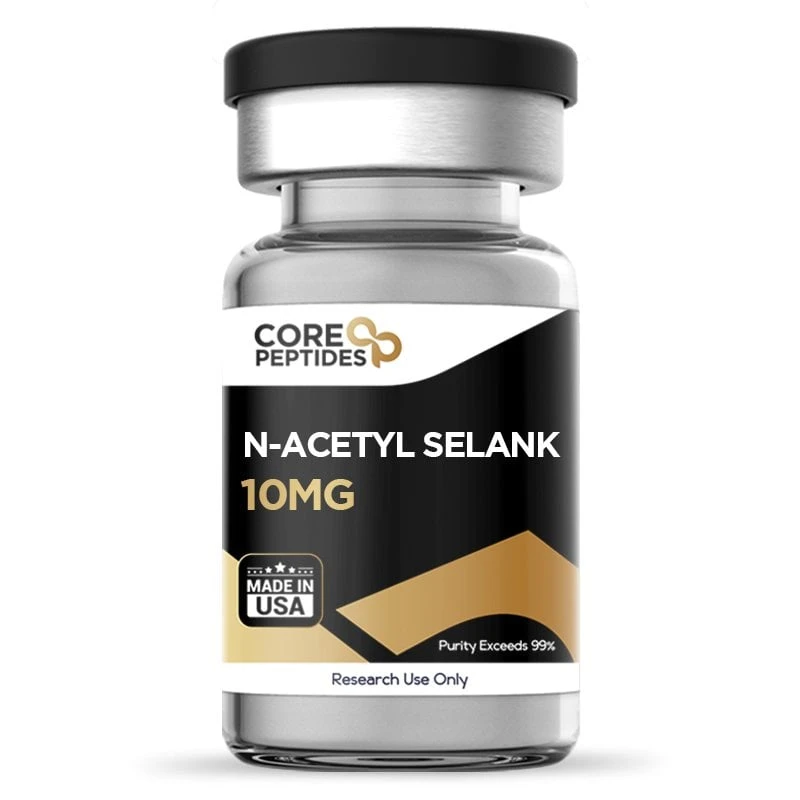


N-Acetyl Selank (10mg) – Synthetic Research Peptide
N-Acetyl Selank (10mg) is a synthetic peptide derivative related to Selank, a short peptide that has been investigated in preclinical and clinical research involving neurobiological signalling, cognitive processes, stress responses and immune-related pathways. The N-acetylated form is of particular interest because modification of the peptide’s N-terminus may influence its stability and physicochemical characteristics.
The referenced N-Acetyl Selank 10mg product is supplied as a lyophilised powder with a stated purity of >99%. It is presented for research, laboratory and analytical applications only.
Research specifically examining N-Acetyl Selank remains limited compared with the larger body of literature concerning unmodified Selank. Consequently, much of the available scientific context for this compound is based on research into Selank itself rather than direct studies of the acetylated derivative.
What Is N-Acetyl Selank?
N-Acetyl Selank is an acetylated derivative of Selank, a synthetic peptide associated with the tuftsin peptide family. Selank itself has been investigated for possible effects involving neurotransmitter systems, stress-related responses, cognition, immune signalling and gene expression.
The addition of an acetyl group to the N-terminus is a structural modification that may alter the peptide’s stability and interaction with biological environments. Acetylation can reduce the accessibility of the terminal amino group to certain enzymatic processes, which is one reason N-terminally modified peptides are frequently investigated in peptide chemistry.
However, the precise biological and pharmacokinetic characteristics of N-Acetyl Selank should not simply be assumed from studies of unmodified Selank. Direct research on the acetylated compound remains comparatively sparse.
N-Acetyl Selank (10mg) Product Specifications
| Specification | Details |
|---|---|
| Product Name | N-Acetyl Selank |
| Quantity | 10mg |
| Form | Lyophilised powder |
| Stated Purity | >99% |
| Peptide Classification | Acetylated synthetic peptide |
| Related Peptide | Selank |
| Research Areas | Neurobiology, peptide chemistry, cognition, stress and immune signalling |
| Intended Application | Research, laboratory and analytical use only |
Researchers should consult the current batch-specific certificate of analysis for definitive information regarding identity, purity and analytical characteristics.
N-Acetyl Selank and Selank
Selank is a synthetic peptide that has been investigated extensively in comparison with the relatively limited research available for N-Acetyl Selank. Selank is structurally related to tuftsin, an endogenous tetrapeptide associated with immune regulation.
Research involving Selank has explored several biological systems, including GABAergic neurotransmission, serotonin-related signalling, enkephalin metabolism, brain-derived neurotrophic factor (BDNF) expression and inflammatory or immune-related pathways.
N-Acetyl Selank retains the underlying peptide framework while incorporating an acetyl modification at the N-terminus. This makes it a useful subject for research investigating how structural modifications can influence peptide stability, activity and biological behaviour.
Why Is N-Acetyl Selank Studied?
The scientific interest surrounding N-Acetyl Selank is linked to both its structural characteristics and the broader research history of Selank.
Researchers may investigate the compound in areas including:
- Peptide structure-function relationships.
- N-terminal peptide modification.
- Peptide stability and degradation.
- Neurotransmitter-related signalling.
- GABAergic pathways.
- Serotonergic pathways.
- Enkephalin metabolism.
- BDNF and neuroplasticity research.
- Immune and inflammatory signalling.
- Stress-response mechanisms.
These areas represent research interests rather than established therapeutic applications.
N-Acetylation and Peptide Stability
One of the key reasons to investigate an N-acetylated peptide is the possibility that modification of the terminal amino group may influence its stability.
The N-terminus of a peptide can be recognised by certain enzymes involved in peptide degradation. Acetylation may reduce accessibility of this terminal region and potentially alter how the molecule interacts with enzymatic environments.
Structural modification may also influence properties such as conformation, hydrophobicity, solubility and interactions with other biological molecules. These effects are highly dependent on the specific peptide sequence and chemical environment.
For N-Acetyl Selank, these potential characteristics remain an area for laboratory investigation rather than a basis for assuming improved biological performance.
Selank and GABAergic Research
One of the major research areas surrounding Selank concerns the gamma-aminobutyric acid (GABA) system.
GABA is the principal inhibitory neurotransmitter in the central nervous system and is involved in regulating neuronal excitability. Research has investigated whether Selank can influence the expression of genes associated with GABA receptors, transporters and ion channels.
Experimental findings have suggested that Selank may influence GABAergic signalling through mechanisms more complex than direct receptor activation. Researchers have therefore examined changes in gene expression and other molecular responses following exposure to the peptide.
These findings provide scientific context for studying N-Acetyl Selank but should not be interpreted as proof that the acetylated derivative produces identical effects.
N-Acetyl Selank and Serotonin Research
Serotonin is an important neurotransmitter involved in numerous physiological processes, including mood regulation, stress responses and neuronal communication.
Research involving Selank has examined its potential influence on serotonin-related pathways. Experimental studies have investigated changes in serotonin metabolism and signalling under conditions where serotonergic activity has been altered.
This research has contributed to broader interest in Selank-related peptides as tools for studying interactions between peptide signalling and neurotransmitter systems.
Because N-Acetyl Selank is structurally modified, direct experimental investigation is required before conclusions about its serotonergic activity can be established.
Selank and Enkephalin Research
Enkephalins are endogenous opioid peptides involved in several physiological processes, including pain perception and stress-related signalling. Their activity is regulated partly by enzymes that break down these peptides.
Research has investigated whether Selank can influence enzymes involved in enkephalin degradation. Experimental work has suggested that Selank may inhibit certain enkephalin-degrading enzymes, potentially altering the availability of endogenous enkephalins.
This provides another area of interest for researchers investigating the molecular pharmacology of Selank-related compounds.
N-Acetyl Selank and BDNF Research
Brain-derived neurotrophic factor (BDNF) is a neurotrophin involved in neuronal development, synaptic plasticity and several processes associated with learning and memory.
Experimental research has investigated whether Selank influences BDNF expression in the hippocampus. Studies in animal models have reported changes in BDNF messenger RNA following exposure to Selank under specific experimental conditions.
These findings have contributed to scientific interest in the relationship between Selank-related peptides, stress responses and neuroplasticity.
However, evidence concerning unmodified Selank should not be presented as direct evidence for N-Acetyl Selank.
Selank and Cognitive Research
Research into Selank has included experimental models of learning and memory. In animal studies, researchers have examined behavioural performance using conditioned avoidance paradigms and other cognitive tasks.
Some studies reported improvements in learning performance under particular experimental conditions. Researchers have proposed several possible mechanisms, including modulation of neuropeptide systems, neurotransmitter signalling and pathways involved in synaptic plasticity.
Such findings are useful for understanding the research history surrounding Selank, but they do not establish N-Acetyl Selank as a cognitive-enhancement product or demonstrate equivalent effects in humans.
Selank and Immunomodulatory Research
Another area of interest is the potential relationship between Selank and immune signalling.
Experimental research has investigated cytokine profiles and immune responses following exposure to Selank. Studies have reported changes in cytokine-related parameters and alterations in the balance between certain immune signalling pathways.
These observations have led researchers to investigate whether Selank may interact with immune and inflammatory processes.
For N-Acetyl Selank, however, direct evidence remains limited, meaning these findings should be treated as background information rather than established characteristics of the acetylated compound.
Selank and Stress-Response Research
Stress and anxiety-related experimental models have formed an important part of the published research surrounding Selank.
Studies have investigated behavioural and biochemical responses following Selank exposure in experimental models associated with stress and anxiety. Researchers have examined potential relationships between peptide exposure, neurotransmitter signalling and endogenous opioid pathways.
This research has contributed to the scientific interest in Selank as a tool for studying neurobiological responses to stress.
It is important to distinguish this experimental research from clinical claims concerning N-Acetyl Selank.
Selank and Metabolic Research
Experimental research has also explored possible metabolic effects associated with Selank.
One animal study examined Selank in a model of diet-induced metabolic changes and investigated parameters including lipid profiles, cholesterol, triglycerides, glucose-related measures and haemostatic markers.
The reported findings included changes in several metabolic parameters. Such research provides potential avenues for studying peptide interactions with metabolic pathways, although animal findings cannot automatically be extrapolated to humans or to N-Acetyl Selank.
N-Acetyl Selank and Blood-Brain Barrier Research
The blood-brain barrier (BBB) is a highly selective interface separating circulating blood from the central nervous system. Its restrictive properties make the transport of many molecules into brain tissue a significant area of pharmaceutical and peptide research.
Selank-related peptide structures have attracted interest because of their proposed interactions with biological barriers. The referenced product information discusses the presence of a Pro-Gly-Pro sequence and its possible relationship with peptide transport and tissue penetration.
However, proposed mechanisms involving BBB permeability should be regarded as hypotheses unless directly demonstrated for the specific compound and experimental system being studied.
Chemical Characteristics
| Characteristic | N-Acetyl Selank |
|---|---|
| Common Name | N-Acetyl Selank |
| Related Peptide | Selank |
| Peptide Class | Synthetic peptide derivative |
| Product Quantity | 10mg |
| Physical Form | Lyophilised powder |
| Stated Purity | >99% |
| Research Focus | Peptide chemistry, neurobiology and cellular signalling |
Analytical specifications should always be confirmed using the current documentation supplied for the individual research batch.
Potential Research Applications
N-Acetyl Selank may be of interest to qualified laboratories investigating:
- Peptide chemistry: Investigation of N-terminal acetylation and its influence on peptide characteristics.
- Peptide stability: Examination of degradation and structural stability under controlled conditions.
- Neurobiology: Investigation of peptide interactions with neuronal signalling systems.
- GABAergic signalling: Study of pathways associated with GABA receptors and transporters.
- Serotonergic research: Investigation of serotonin-related cellular and molecular pathways.
- Enkephalin research: Study of enzymes involved in endogenous opioid peptide metabolism.
- Neuroplasticity: Investigation of BDNF-associated signalling and neuronal adaptation.
- Cognitive research: Examination of peptide-related effects in controlled experimental models.
- Immunology: Investigation of cytokine and immune signalling pathways.
- Stress biology: Study of molecular responses associated with experimental stress models.
Why Researchers May Choose N-Acetyl Selank
The principal research interest in N-Acetyl Selank comes from the combination of a recognised Selank peptide framework with an N-terminal acetyl modification.
This provides researchers with an opportunity to compare a modified peptide with its parent compound and investigate whether structural changes influence properties such as stability, degradation, receptor interaction or biological activity.
For laboratories studying peptide chemistry and neurobiological signalling, such comparisons can help clarify relationships between peptide structure and function.
N-Acetyl Selank vs Selank
| Feature | N-Acetyl Selank | Selank |
|---|---|---|
| Relationship | Acetylated derivative | Parent synthetic peptide |
| Structural Modification | N-terminal acetyl group | No N-terminal acetyl modification |
| Research History | Relatively limited direct research | Broader preclinical and clinical research literature |
| Research Areas | Peptide stability, neurobiology and structure-function research | Neurobiology, cognition, stress, immune and metabolic research |
The two compounds should not be treated as interchangeable. Evidence concerning Selank provides useful scientific context, but direct studies are necessary to characterise the properties of N-Acetyl Selank.
Frequently Asked Questions About N-Acetyl Selank (10mg)
What is N-Acetyl Selank?
N-Acetyl Selank is an acetylated derivative of Selank, a synthetic peptide related to the tuftsin peptide family. The N-acetyl modification is of interest because it may influence peptide stability and other physicochemical properties.
How much N-Acetyl Selank is in this product?
The referenced product contains 10mg of N-Acetyl Selank and is supplied as a lyophilised powder.
What is the stated purity?
The referenced product listing states a purity of >99%. Researchers should verify the specific batch using its certificate of analysis.
What is the difference between Selank and N-Acetyl Selank?
N-Acetyl Selank contains an additional acetyl modification at the peptide’s N-terminus. This chemical modification may influence peptide stability and biological characteristics, meaning the two compounds should be investigated separately.
Is N-Acetyl Selank well studied?
Direct research on N-Acetyl Selank is relatively limited. The larger body of scientific literature concerns unmodified Selank, so conclusions about N-Acetyl Selank should be made cautiously.
What is Selank studied for?
Selank has been investigated in research involving GABAergic and serotonergic signalling, enkephalin metabolism, BDNF expression, cognition, stress responses and immune-related pathways.
Is N-Acetyl Selank a nootropic?
Selank has been investigated for potential nootropic properties in experimental research. However, N-Acetyl Selank should not be described as an established cognitive-enhancement product because direct evidence for the acetylated form remains limited.
Has N-Acetyl Selank been clinically tested?
The clinical studies commonly discussed in connection with this compound largely concern unmodified Selank. The referenced supplier notes that research specifically concerning the acetylated form is sparse.
Why is the peptide acetylated?
N-terminal acetylation is a common peptide-chemistry modification that can alter enzymatic susceptibility, structural properties and other physicochemical characteristics. For N-Acetyl Selank, the effect of this modification remains an area for experimental investigation.
What is the research interest in the blood-brain barrier?
Peptide transport across the blood-brain barrier is an important area of research because the BBB restricts the movement of many molecules into the central nervous system. Selank-related structures have been discussed in connection with potential tissue and BBB interactions, but compound-specific permeability must be established experimentally.
Is N-Acetyl Selank approved as a medicine?
The referenced product is presented as a research material, not an approved medicinal product. It should not be marketed as a treatment for anxiety, cognitive disorders, immune conditions or any other disease.
Is N-Acetyl Selank intended for human or animal consumption?
No. The product is intended exclusively for research, laboratory and analytical purposes and is not intended for human or animal consumption or self-administration.
N-Acetyl Selank (10mg) Research Summary
N-Acetyl Selank (10mg) is a synthetic, acetylated peptide derivative supplied as lyophilised powder with a stated purity of greater than 99%. Its research interest stems from its relationship to Selank and from the potential influence of N-terminal acetylation on peptide stability and biological characteristics.
Selank itself has been investigated in a range of experimental areas, including GABAergic signalling, serotonin metabolism, enkephalin pathways, BDNF expression, cognition, stress responses and immune-related signalling.
Because direct research on N-Acetyl Selank remains limited, evidence concerning unmodified Selank should be used as scientific background rather than as proof that the acetylated derivative has identical properties or effects.
For qualified researchers, N-Acetyl Selank provides an opportunity to investigate peptide modification, stability, structure-function relationships and potential interactions with neurobiological and cellular signalling systems.
Research-Use Disclaimer
N-Acetyl Selank (10mg) is intended exclusively for research, laboratory, analytical and in-vitro experimental purposes. It is not intended for human or animal consumption, self-administration, diagnosis, treatment, cure or prevention of any disease.
Information concerning Selank research should not be interpreted as evidence that N-Acetyl Selank is clinically effective or therapeutically equivalent to unmodified Selank. Findings from animal models, cell studies or research involving other peptide formulations cannot automatically be extrapolated to this specific product or to human use.
Researchers should consult the current certificate of analysis and applicable product documentation for batch-specific information and conduct all laboratory work in accordance with relevant legislation, institutional requirements and appropriate laboratory safety procedures.
Be the first to review “N-Acetyl Selank (10mg)”
Related products

Peptides for Sale

Peptides for Sale

Peptides for Sale

Peptides for Sale

Peptides for Sale

Peptides for Sale

Peptides for Sale

Peptides for Sale
Reviews
There are no reviews yet.