
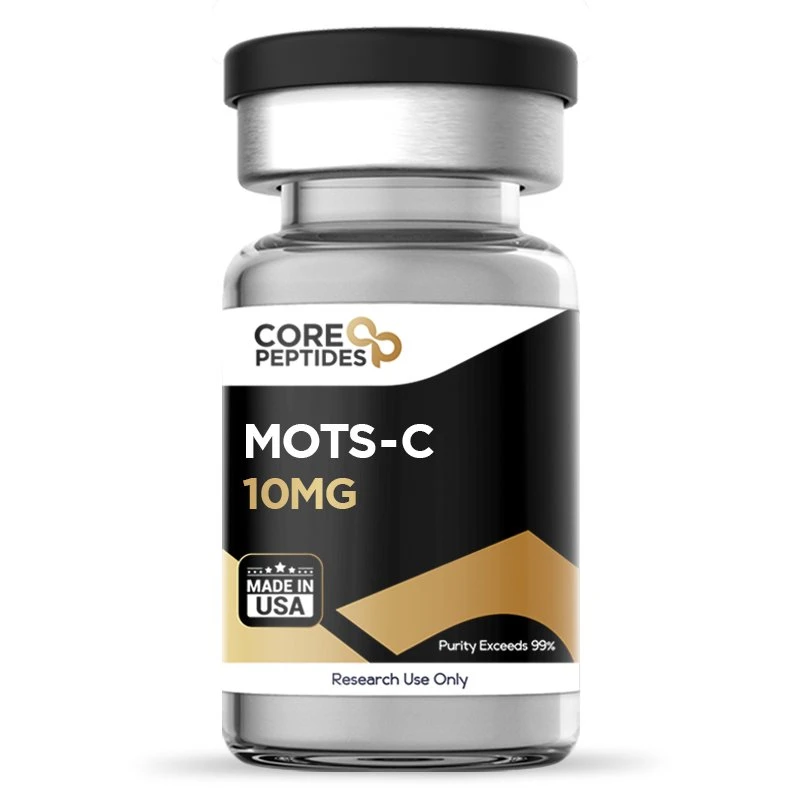


MOTS-C (10mg) – Mitochondrial-Derived Research Peptide
MOTS-C (10mg) is a research peptide based on MOTS-c, short for mitochondrial open reading frame of the 12S rRNA-c. MOTS-c is a naturally occurring, mitochondria-derived peptide consisting of 16 amino acids and has attracted scientific interest because of its proposed involvement in cellular metabolism, energy regulation, mitochondrial signalling and metabolic stress responses.
The referenced MOTS-C 10mg product is supplied as a lyophilised powder with a stated purity of >99%. It is intended exclusively for qualified research, laboratory and analytical applications and is not intended for human or animal consumption.
Research into MOTS-c has investigated pathways associated with AMP-activated protein kinase (AMPK), glucose and lipid metabolism, mitochondrial-to-nuclear communication, metabolic stress and age-related cellular changes. These areas remain subjects of ongoing scientific investigation, and experimental findings should not be interpreted as established therapeutic effects.
What Is MOTS-C?
MOTS-c is a short mitochondrial-derived peptide encoded within the mitochondrial genome. Unlike many better-known peptides encoded by nuclear DNA, MOTS-c originates from the 12S ribosomal RNA (12S rRNA) mitochondrial open reading frame.
The peptide contains 16 amino acids and has been described in scientific literature as a mitochondrial-derived peptide, mitochondrial hormone or mitokine. Research has examined its presence in tissues and circulating plasma and has explored its possible role in communication between mitochondria and other cellular compartments.
MOTS-c is particularly interesting to researchers because mitochondrial function is closely connected with energy production, nutrient sensing and cellular stress. Investigating MOTS-c therefore provides an experimental approach for studying how mitochondrial signals may influence broader cellular processes.
MOTS-C (10mg) Product Specifications
| Specification | Details |
|---|---|
| Product Name | MOTS-C |
| Quantity | 10mg |
| Peptide | MOTS-c |
| Alternative Name | Mitochondrial open reading frame of the 12S rRNA-c |
| Peptide Length | 16 amino acids |
| Form | Lyophilised powder |
| Stated Purity | >99% |
| Molecular Formula | C101H152N28O22S2 |
| Molecular Weight | 2174.64 g/mol |
| Research Classification | Mitochondrial-derived peptide |
| Intended Application | Research, laboratory and analytical use only |
Product specifications are based on the referenced supplier listing. Researchers should consult the current batch-specific certificate of analysis for definitive analytical information.
Why Is MOTS-C Studied?
Mitochondria are central to cellular energy production and play important roles in nutrient sensing, oxidative stress responses and cellular signalling. Researchers have identified several peptides originating from mitochondrial sequences, with Humanin and MOTS-c among the mitochondrial-derived peptides that have received particular scientific attention.
MOTS-c is of interest because experimental studies suggest that it may participate in communication between mitochondrial and nuclear signalling systems.
Researchers have investigated its possible relationship with metabolic pathways, particularly those associated with AMPK activation, glucose utilisation and cellular adaptation to metabolic stress.
These investigations have helped establish MOTS-c as a research target in mitochondrial biology and metabolic physiology.
MOTS-C and AMPK Research
One of the most frequently investigated aspects of MOTS-c biology is its relationship with the AMP-activated protein kinase (AMPK) pathway.
AMPK functions as an important cellular energy sensor. It responds to changes in cellular energy availability and helps regulate processes involving glucose uptake, lipid metabolism and energy balance.
Experimental research has proposed that MOTS-c can influence metabolic pathways connected with AMPK. This has made the peptide relevant to laboratory studies examining how mitochondrial-derived signals may influence cellular responses to metabolic stress.
Research into this mechanism is primarily concerned with understanding cellular signalling rather than establishing a therapeutic application for MOTS-c.
MOTS-C and Cellular Metabolism
Cellular metabolism involves a network of interconnected pathways responsible for processing nutrients and producing or storing energy. MOTS-c has attracted interest because experimental research has investigated its potential involvement in several metabolic processes.
Research has examined possible relationships between MOTS-c and:
- Glucose utilisation.
- Glucose transporter activity.
- Lipid metabolism.
- Energy sensing.
- AMPK-related signalling.
- Folate and methionine metabolism.
- Purine biosynthesis.
- Metabolic stress responses.
- Mitochondrial-to-nuclear communication.
These areas provide a broad framework for investigating how mitochondrial-derived peptides may participate in the regulation of cellular metabolism.
MOTS-C and Skeletal Muscle Research
Skeletal muscle is one of the body’s major tissues for glucose utilisation and energy metabolism. Consequently, researchers have investigated MOTS-c in relation to muscle physiology and metabolic adaptation.
Experimental studies have examined whether MOTS-c influences pathways involved in glucose uptake and AMPK activation within skeletal muscle. Other research has explored its potential association with physical activity and age-related changes in muscle function.
These findings have contributed to scientific interest in MOTS-c as a possible molecular link between mitochondrial activity, exercise and cellular metabolic regulation.
However, observations from experimental models should not be interpreted as evidence that MOTS-C is an established treatment for muscle-related or metabolic conditions.
MOTS-C and Exercise Research
Research has investigated MOTS-c as an exercise-associated mitochondrial-derived peptide. Studies have explored whether physical activity can influence endogenous MOTS-c expression and whether changes in the peptide may be connected with cellular adaptation.
This research is particularly relevant to the study of mitochondrial responses to physical stress. Researchers are interested in whether mitochondria can produce signalling molecules that help coordinate metabolic adaptations across different tissues.
The relationship between exercise, MOTS-c expression and long-term physiological adaptation remains an area of continuing research.
MOTS-C and Adipose Tissue Research
Adipose tissue plays an important role in energy storage, endocrine signalling and whole-body metabolism. MOTS-c has therefore also been studied in experimental models involving adipose tissue and metabolic regulation.
Research has examined whether MOTS-c can influence pathways associated with glucose utilisation, lipid handling and metabolic stress. Experimental work has also investigated possible interactions between MOTS-c and genes involved in cellular stress responses.
One area of interest is the potential connection between MOTS-c and antioxidant response elements (AREs), which form part of cellular defence mechanisms against oxidative and metabolic stress.
MOTS-C and Mitochondrial-to-Nuclear Communication
A particularly distinctive feature of MOTS-c research is the investigation of its movement between cellular compartments.
Under certain experimental conditions associated with metabolic stress, MOTS-c has been reported to move from mitochondria towards the cell nucleus. Researchers have investigated whether this process can influence nuclear gene expression.
This concept is important because mitochondria and the nucleus must continually exchange information to coordinate cellular function. MOTS-c provides a potential molecular model for studying this form of mitonuclear communication.
Research has investigated possible relationships between MOTS-c and stress-responsive transcriptional pathways, including pathways involving NRF2 and antioxidant response elements.
MOTS-C and Folate-Methionine Metabolism
Another area of MOTS-c research involves the folate-methionine cycle and its relationship with purine biosynthesis.
Experimental studies have proposed that MOTS-c may interact with metabolic pathways associated with folate and methionine metabolism. These pathways are important for cellular biosynthesis and energy regulation.
Researchers have investigated whether modulation of these pathways can influence AMPK activity and alter cellular metabolic priorities. This work provides a possible mechanistic explanation for some of the metabolic effects observed in experimental systems.
MOTS-C and Glucose Metabolism
Glucose metabolism is another important area of MOTS-c research. Experimental models have examined whether exposure to MOTS-c can influence glucose utilisation and cellular responses to insulin-related signalling.
Some preclinical studies have reported changes in glucose uptake and metabolic parameters in experimental animals exposed to MOTS-c. These findings have contributed to interest in MOTS-c as a research tool for studying the molecular mechanisms underlying glucose homeostasis.
It is important to distinguish these preclinical findings from clinically demonstrated benefits. Experimental observations in animals do not establish safety, efficacy or appropriate use in humans.
MOTS-C and Metabolic Stress
Metabolic stress occurs when cellular energy requirements and available resources become imbalanced. Mitochondria play a central role in sensing and responding to these changes.
MOTS-c has been investigated as a possible signalling molecule involved in the cellular response to metabolic stress. Research suggests that changes in the peptide’s location and activity may influence gene expression and metabolic pathways.
This makes MOTS-c particularly useful for experimental studies investigating how mitochondrial signals can coordinate cellular adaptation under changing metabolic conditions.
MOTS-C and Cellular Ageing Research
Ageing research is another major field in which MOTS-c has attracted scientific interest.
Some studies have reported age-associated changes in MOTS-c expression and have investigated whether the peptide may interact with biological pathways associated with cellular ageing, metabolic function and physical decline.
Researchers have also examined possible relationships between MOTS-c and longevity-associated regulators, including NAD+ and sirtuin-related pathways.
Although these findings provide interesting hypotheses for ageing research, they do not establish MOTS-c as an anti-ageing treatment or demonstrate that supplementation can extend human lifespan.
MOTS-C and Bone Research
Research has also investigated the potential relationship between MOTS-c and bone biology.
Experimental work has examined whether MOTS-c can influence osteogenic differentiation of bone marrow-derived cells and whether the TGF-β/SMAD signalling pathway may be involved.
Researchers have investigated markers associated with osteogenesis, including genes involved in osteoblast differentiation. These studies provide a molecular framework for examining how mitochondrial-derived peptides may interact with bone-forming pathways.
Such findings remain experimental and should not be interpreted as evidence that MOTS-c is an established treatment for osteoporosis or other bone disorders.
MOTS-C and Cardiovascular Research
MOTS-c has also been examined in research involving vascular and endothelial biology.
Endothelial cells line blood vessels and play important roles in vascular function. Studies have investigated relationships between circulating MOTS-c concentrations and measures of endothelial function.
Researchers have proposed that AMPK-related signalling may be one mechanism connecting MOTS-c with endothelial responses. However, the molecular basis of these observations remains an area of investigation.
Research involving MOTS-c and cardiovascular biology should therefore be viewed as exploratory rather than as evidence of an established cardiovascular therapy.
MOTS-C Chemical Characteristics
| Characteristic | MOTS-C |
|---|---|
| Full Name | Mitochondrial open-reading-frame of the 12S rRNA-c |
| Common Name | MOTS-c |
| Peptide Length | 16 amino acids |
| Molecular Formula | C101H152N28O22S2 |
| Molecular Weight | 2174.64 g/mol |
| Peptide Classification | Mitochondrial-derived peptide |
| Associated Research Pathway | AMPK and metabolic signalling |
| Product Quantity | 10mg |
| Physical Form | Lyophilised powder |
Potential Research Applications of MOTS-C
MOTS-C may be relevant to qualified laboratory research in several areas of molecular and cellular biology, including:
- Mitochondrial biology: Investigation of peptides encoded by mitochondrial DNA.
- Metabolic research: Study of glucose, lipid and cellular energy metabolism.
- AMPK research: Investigation of energy-sensing and metabolic signalling pathways.
- Muscle research: Examination of skeletal muscle metabolism and adaptation.
- Exercise biology: Investigation of exercise-associated mitochondrial signalling.
- Adipose research: Study of adipose metabolism and metabolic stress responses.
- Cell signalling: Investigation of mitochondrial-to-nuclear communication.
- Ageing research: Examination of age-associated changes in mitochondrial-derived peptides.
- Bone research: Study of osteogenic differentiation and TGF-β/SMAD signalling.
- Endothelial research: Investigation of relationships between MOTS-c and vascular cell function.
Why Researchers Are Interested in MOTS-C
MOTS-c is unusual among research peptides because of its mitochondrial origin. Most peptide signalling systems investigated in conventional molecular biology are encoded by nuclear genes, whereas MOTS-c originates from a mitochondrial open reading frame.
This distinctive origin has prompted researchers to investigate whether mitochondria can function not only as cellular energy-producing organelles but also as sources of signalling molecules that influence wider physiological processes.
MOTS-c therefore represents an interesting research model for examining the relationship between mitochondrial activity, cellular metabolism, gene expression and physiological adaptation.
MOTS-C Compared With Other Mitochondrial-Derived Peptides
| Feature | MOTS-C | Humanin |
|---|---|---|
| Origin | Mitochondrial genome | Mitochondrial genome |
| Classification | Mitochondrial-derived peptide | Mitochondrial-derived peptide |
| Primary Research Interest | Metabolic and mitochondrial signalling | Cellular stress and mitochondrial signalling |
| Research Areas | Metabolism, AMPK, ageing, muscle and cellular adaptation | Cellular protection, mitochondrial biology and ageing |
Both MOTS-c and Humanin are mitochondrial-derived peptides, but they are structurally distinct and have different research profiles. Studying them independently and comparatively can help researchers better understand the emerging field of mitochondrial peptide signalling.
Frequently Asked Questions About MOTS-C (10mg)
What is MOTS-C?
MOTS-c is a 16-amino-acid mitochondrial-derived peptide encoded within the mitochondrial 12S rRNA open reading frame. It is studied for its potential involvement in mitochondrial, metabolic and cellular signalling.
What does MOTS-C stand for?
MOTS-C refers to mitochondrial open reading frame of the 12S rRNA-c, which describes the mitochondrial genetic origin of the peptide.
How much MOTS-C is included in this product?
The referenced product contains 10mg of MOTS-C and is supplied as a lyophilised powder.
What is the stated purity of MOTS-C (10mg)?
The referenced product listing states a purity of >99%. Researchers should verify the precise purity and analytical characteristics of their batch using the applicable certificate of analysis.
What is the molecular weight of MOTS-C?
The molecular weight listed for MOTS-c is 2174.64 g/mol.
What is the main research interest in MOTS-C?
Research interest centres on the potential role of MOTS-c in mitochondrial signalling, AMPK-related pathways, glucose and lipid metabolism, metabolic stress responses, muscle biology and cellular ageing.
Is MOTS-C a hormone?
MOTS-c has been described in scientific literature as a mitochondrial-derived peptide and as a potential mitochondrial hormone or mitokine. Its possible endocrine and cell-specific signalling functions remain subjects of scientific investigation.
Does MOTS-C activate AMPK?
Experimental research has proposed that MOTS-c can influence pathways associated with AMPK activation. AMPK is an important cellular energy-sensing pathway involved in glucose and lipid metabolism.
Is MOTS-C involved in metabolism?
Yes. MOTS-c has been investigated in relation to glucose utilisation, lipid metabolism, energy sensing, folate-methionine metabolism and metabolic stress responses.
Is MOTS-C an anti-ageing treatment?
No established conclusion supports marketing MOTS-c as an anti-ageing treatment. Although research has investigated relationships between MOTS-c, ageing and longevity-associated pathways, these findings remain experimental and do not establish a clinically proven anti-ageing effect.
Has MOTS-C been studied in animals?
Yes. Preclinical studies have investigated MOTS-c in experimental animal models, including research examining metabolism, physical performance, adipose tissue and other biological processes. Results from animal studies cannot automatically be applied to humans.
Is MOTS-C approved as a medicine?
The referenced product is presented as a research material, not as an approved medicinal product. It should not be represented as a treatment for metabolic, cardiovascular, bone, ageing or other medical conditions.
Is MOTS-C intended for human consumption?
No. The referenced product is designated for research, laboratory and analytical purposes only and is not intended for human or animal consumption or self-administration.
MOTS-C (10mg) Research Summary
MOTS-C (10mg) is a research-grade mitochondrial-derived peptide supplied as a lyophilised powder with a stated purity above 99%. MOTS-c consists of 16 amino acids and originates from the mitochondrial 12S rRNA open reading frame.
The peptide has attracted scientific interest because experimental research has investigated its potential involvement in AMPK signalling, glucose and lipid metabolism, mitochondrial-to-nuclear communication, skeletal muscle adaptation, adipose metabolism, cellular stress and ageing-related pathways.
Its distinctive mitochondrial origin makes MOTS-c a useful research subject for laboratories investigating the emerging field of mitochondrial-derived signalling peptides and the relationship between mitochondrial function and cellular metabolism.
As with all experimental peptides, research findings should be interpreted according to the specific experimental model and conditions used. Preclinical or mechanistic findings should not be presented as evidence of established clinical efficacy.
Research-Use Disclaimer
MOTS-C (10mg) is intended exclusively for research, laboratory, analytical and in-vitro experimental purposes. It is not intended for human or animal consumption, self-administration, diagnosis, treatment, cure or prevention of any disease.
Information regarding MOTS-c mechanisms and experimental findings is provided for scientific and educational purposes only. Research involving cells or animals does not establish that MOTS-c is safe or effective for human use, nor does it establish this specific product as an approved medicinal treatment.
Researchers should consult the current certificate of analysis and relevant product documentation for batch-specific information and conduct all laboratory work in accordance with applicable legislation, institutional requirements and appropriate laboratory safety procedures.
Be the first to review “MOTS-C (10mg)”
Related products

Peptides for Sale

Peptides for Sale

Peptides for Sale

Peptides for Sale

Peptides for Sale

Peptides for Sale

Peptides for Sale

Peptides for Sale
Reviews
There are no reviews yet.