
Mod GRF 1-29 & Ipamorelin Blend (10mg) – Research Peptide
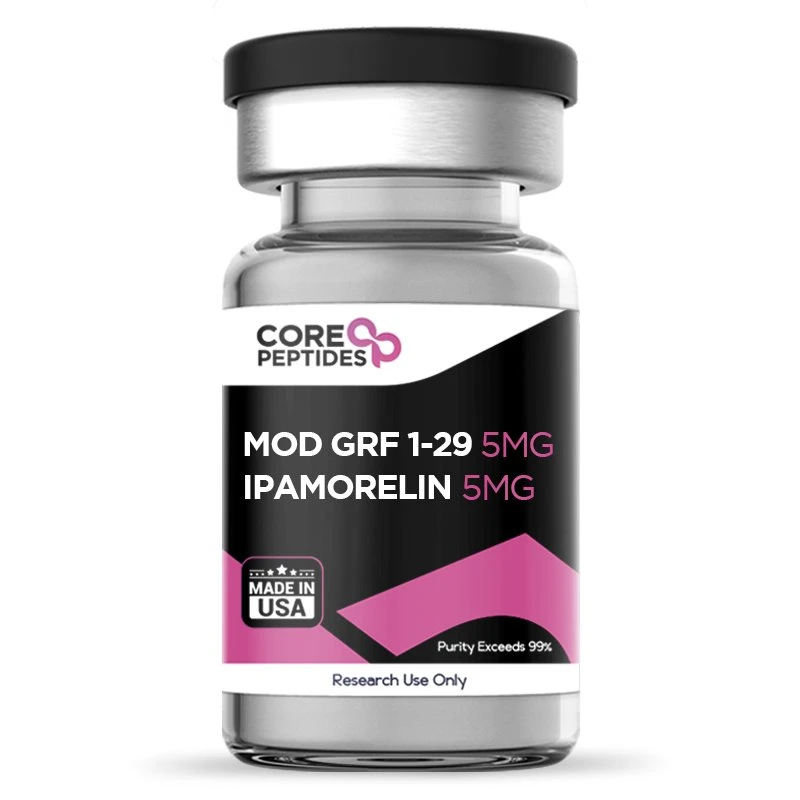
Mod GRF 1-29 & Ipamorelin Blend (10mg) is a two-peptide research formulation combining Modified GRF 1-29 and Ipamorelin. The referenced product contains 5mg of Mod GRF 1-29 and 5mg of Ipamorelin, supplied as a lyophilised powder with a stated purity of greater than 99%. The formulation is intended exclusively for laboratory, analytical and research applications.
Mod GRF 1-29 is a synthetic analogue of growth hormone-releasing hormone (GHRH), whereas Ipamorelin is a synthetic growth hormone secretagogue studied in connection with the growth hormone secretagogue receptor, GHS-R1a.
Their distinct receptor mechanisms make the combination relevant to experimental research into growth hormone signalling and pituitary physiology. This product is for research and laboratory use only. It is not intended for human or animal consumption, self-administration, diagnosis, treatment, cure or prevention of any disease.
What Is Mod GRF 1-29 & Ipamorelin Blend?
Mod GRF 1-29 & Ipamorelin Blend combines two synthetic peptides associated with different components of growth hormone regulation.
Modified GRF 1-29, commonly referred to as Mod GRF 1-29 or CJC-1295 without DAC, is a modified analogue based on the first 29 amino acids of native GHRH. It is studied for its interaction with GHRH receptors located on somatotroph cells in the anterior pituitary.
Ipamorelin is a synthetic pentapeptide and growth hormone secretagogue. Research has examined its interaction with GHS-R1a, a receptor associated with ghrelin signalling and growth hormone secretion.
By combining these two peptide classes, researchers can investigate how GHRH-related signalling and growth hormone secretagogue signalling interact within experimental models.
Mod GRF 1-29 & Ipamorelin Blend (10mg) Product Specifications
| Specification | Details |
|---|---|
| Product Name | Mod GRF 1-29 & Ipamorelin Blend |
| Total Quantity | 10mg |
| Mod GRF 1-29 | 5mg |
| Ipamorelin | 5mg |
| Blend Ratio | 1:1 by stated mass |
| Form | Lyophilised powder |
| Stated Purity | >99% |
| Mod GRF 1-29 Molecular Weight | 3367.95 g/mol |
| Ipamorelin Molecular Weight | 711.86 g/mol |
| Research Classification | Two-peptide research blend |
| Intended Application | Research, laboratory and analytical use only |
The supplier’s product page identifies the 10mg formulation as containing 5mg of each peptide and lists the material as lyophilised powder with a stated purity above 99%. Batch-specific analytical documentation should be consulted for current specifications.
Mod GRF 1-29: Research Overview
Modified GRF 1-29 is a synthetic analogue of growth hormone-releasing hormone. It is based on the initial 29-amino-acid region of native GHRH and incorporates modifications intended to alter its properties compared with unmodified GRF 1-29.
Mod GRF 1-29 is commonly described as CJC-1295 without DAC. This terminology distinguishes it from longer-acting CJC-1295 formulations that contain the drug-affinity-complex modification.
Mod GRF 1-29 and GHRH Receptors
Research into Mod GRF 1-29 focuses partly on its interaction with GHRH receptors on somatotroph cells in the anterior pituitary. These receptors form part of the signalling network responsible for regulating growth hormone secretion.
Following GHRH receptor activation, intracellular signalling can involve adenylyl cyclase, cyclic AMP (cAMP) and protein kinase A (PKA). Subsequent signalling events can influence calcium-channel activity and intracellular calcium levels, which are important components of hormone secretion from pituitary cells.
Ipamorelin: Research Overview
Ipamorelin is a synthetic pentapeptide belonging to the growth hormone secretagogue class. It has been investigated for its activity at the growth hormone secretagogue receptor 1a (GHS-R1a).
GHS-R1a is closely associated with the biological actions of ghrelin. Consequently, Ipamorelin provides a research model for examining growth hormone secretagogue signalling through a receptor system distinct from the GHRH receptor.
Ipamorelin and GHS-R1a Signalling
Experimental research has examined how Ipamorelin interacts with GHS-R1a and influences intracellular signalling. The receptor is associated with G-protein-mediated pathways, including signalling involving Gαq/11, phospholipase C (PLC), inositol trisphosphate (IP3) and intracellular calcium.
These pathways are relevant to research into pituitary secretory mechanisms and the regulation of growth hormone release.
How the Mod GRF 1-29 & Ipamorelin Combination Is Studied
The scientific interest in this blend comes primarily from the complementary nature of its two components.
| Component | Primary Research Target | Associated Signalling |
|---|---|---|
| Mod GRF 1-29 | GHRH receptor | Adenylyl cyclase, cAMP and PKA-related pathways |
| Ipamorelin | GHS-R1a | G-protein, PLC, IP3 and calcium-related pathways |
Because the peptides are associated with different receptor systems, the blend can be used in research investigating how multiple signals converge on growth-hormone-producing cells.
Mod GRF 1-29 & Ipamorelin and Growth Hormone Research
Growth hormone (GH) is a peptide hormone produced primarily by somatotroph cells in the anterior pituitary. Its secretion is naturally pulsatile and is regulated by several interconnected signals, including GHRH and inhibitory somatostatin pathways.
Mod GRF 1-29 provides a model for studying the GHRH component of this regulatory system, while Ipamorelin provides a model for studying growth hormone secretagogue signalling through GHS-R1a.
Research cited by the supplier has examined the activity of Ipamorelin and related growth hormone secretagogues in experimental pituitary tissue, rodents and swine. A separate pharmacokinetic-pharmacodynamic study investigated Ipamorelin in human volunteers.
These studies provide scientific context for understanding the peptides but should not be interpreted as evidence that this specific commercial blend is an approved medicine or established human treatment.
Potential Complementary Signalling
One reason Mod GRF 1-29 and Ipamorelin are studied together is that they represent two different pathways associated with growth hormone regulation.
Mod GRF 1-29 is associated with GHRH receptor signalling, whereas Ipamorelin is associated with GHS-R1a. Experimental research has investigated whether stimulating these pathways together can produce a different GH response compared with stimulating either pathway independently.
The term synergistic is sometimes used to describe this research concept. However, results from individual peptides, animal models or specific experimental conditions should not be assumed to predict the response to every fixed-ratio formulation.
Research Into Pituitary Signalling
The anterior pituitary is a central component of the endocrine system and contains specialised somatotroph cells responsible for producing growth hormone.
Mod GRF 1-29 research examines how activation of GHRH receptors can influence intracellular cAMP and PKA signalling. Ipamorelin research examines a separate receptor pathway involving GHS-R1a and downstream G-protein signalling.
Studying these pathways together can help researchers investigate:
- GHRH receptor activity.
- GHS-R1a receptor activity.
- Growth hormone secretion mechanisms.
- Intracellular cAMP signalling.
- PLC and calcium-related signalling.
- Interactions between different secretagogue pathways.
- Pituitary somatotroph responses.
- Endocrine feedback mechanisms.
Ipamorelin and Selectivity Research
Ipamorelin has attracted research interest because early experimental work characterised it as a relatively selective growth hormone secretagogue. The supplier cites research in which Ipamorelin was investigated for its effects on growth hormone in comparison with other hormonal responses.
However, selectivity observed in a particular experimental system should not be interpreted as proof of complete physiological selectivity in all circumstances. Biological responses depend on the research model, concentration, receptor expression and other experimental variables.
Mod GRF 1-29 & Ipamorelin and Gastrointestinal Research
Ipamorelin has also been studied outside the pituitary growth hormone system. Research in a rodent model investigated its potential relationship with gastric emptying and gastrointestinal smooth-muscle activity.
In that experimental model, researchers observed changes in gastric emptying and investigated the effects of Ipamorelin and ghrelin on gastrointestinal contractility. These findings are relevant to basic pharmacology because GHS-R1a signalling can extend beyond the endocrine system.
Such animal findings should be considered exploratory and cannot automatically be translated into human therapeutic effects.
Ipamorelin and Appetite Research
Because Ipamorelin is associated with the ghrelin receptor, researchers have also investigated its relationship with appetite and energy balance.
The supplier cites experimental research in which Ipamorelin exposure was associated with changes in body weight, fat-pad weight and serum leptin in animal models. The researchers discussed the possibility that increased feeding contributed to some of the observed changes.
These findings demonstrate why GHS-R1a research should consider metabolic and appetite-related endpoints in addition to growth hormone measurements.
Mod GRF 1-29 & Ipamorelin and Bone Research
Ipamorelin has also been investigated in animal studies examining bone mineral content. Research cited by the supplier used DEXA and peripheral quantitative computed tomography to examine bone-related measurements in adult female rats.
The reported findings included changes in bone mineral content in selected skeletal regions. These results represent experimental observations and should not be interpreted as evidence of a clinically established effect in humans.
Chemical Characteristics
| Characteristic | Mod GRF 1-29 | Ipamorelin |
|---|---|---|
| Common Name | Modified GRF 1-29 | Ipamorelin |
| Alternative Name | CJC-1295 without DAC | Ipamorelin Acetate |
| Peptide Length | 29 amino acids | 5 amino acids |
| Molecular Formula | C152H252N44O42 | C38H49N9O5 |
| Molecular Weight | 3367.95 g/mol | 711.86 g/mol |
| Primary Research Target | GHRH receptor | GHS-R1a |
| Research Classification | GHRH analogue | Growth hormone secretagogue |
The molecular formulae and molecular weights correspond to the information provided on the referenced product page.
Mod GRF 1-29 & Ipamorelin Research Applications
This peptide blend may be relevant to qualified laboratories conducting research into:
- Endocrinology: Investigation of growth hormone regulation and endocrine signalling.
- Pituitary biology: Study of somatotroph cell responses.
- GHRH signalling: Examination of GHRH receptor activity.
- GHS-R1a research: Investigation of growth hormone secretagogue receptor activity.
- Signal transduction: Study of cAMP, PKA, PLC and calcium-related pathways.
- Growth hormone research: Investigation of GH secretion and pulsatile endocrine responses.
- Metabolic research: Examination of ghrelin-related signalling and appetite pathways.
- Gastrointestinal research: Investigation of GHS-R1a-associated gastrointestinal effects.
- Bone biology: Experimental examination of bone mineral measurements.
- Peptide pharmacology: Comparison of GHRH analogues and growth hormone secretagogues.
Mod GRF 1-29 vs Ipamorelin
| Feature | Mod GRF 1-29 | Ipamorelin |
|---|---|---|
| Peptide Class | GHRH analogue | Growth hormone secretagogue |
| Primary Receptor | GHRH receptor | GHS-R1a |
| Related Endogenous Signal | GHRH | Ghrelin |
| Peptide Length | 29 amino acids | 5 amino acids |
| Principal Research Interest | GHRH-mediated GH signalling | Growth hormone secretagogue and GHS-R1a signalling |
Although both peptides are studied in connection with growth hormone regulation, their structures and primary receptor targets differ. This distinction is central to research involving the combined formulation.
Why Researchers Study the Combined Formulation
The Mod GRF 1-29 and Ipamorelin combination provides a model for studying two complementary components of growth hormone signalling within one research formulation.
Rather than investigating only GHRH receptor activation or only GHS-R1a activation, researchers can examine how these pathways interact and converge on pituitary somatotroph activity.
This can be useful for comparative experiments in which researchers evaluate responses to individual peptides alongside responses to a fixed-ratio combination.
Important Research Considerations
Researchers working with this formulation should consider several factors when interpreting experimental results:
- Growth hormone secretion is naturally pulsatile and can vary according to age, sex, sleep, nutrition and other biological variables.
- Mod GRF 1-29 and Ipamorelin act through different receptor systems.
- Ipamorelin’s association with GHS-R1a means research may involve pathways beyond pituitary GH secretion.
- Results obtained from individual peptides cannot automatically be applied to a fixed-ratio blend.
- Findings from cell cultures and animal studies cannot automatically be extrapolated to human clinical outcomes.
- Purity, identity and composition should be verified using appropriate batch-specific analytical documentation.
- Laboratory work should be performed in accordance with applicable institutional, safety and regulatory requirements.
Frequently Asked Questions
What is Mod GRF 1-29 & Ipamorelin Blend (10mg)?
It is a research formulation combining Modified GRF 1-29 and Ipamorelin. The referenced product contains 5mg of Mod GRF 1-29 and 5mg of Ipamorelin for a total stated quantity of 10mg.
What is Mod GRF 1-29?
Mod GRF 1-29 is a synthetic analogue of growth hormone-releasing hormone based on the first 29 amino acids of the native hormone. It is commonly referred to as CJC-1295 without DAC and is studied for its interaction with GHRH receptors.
What is Ipamorelin?
Ipamorelin is a synthetic pentapeptide classified as a growth hormone secretagogue. Research has examined its interaction with the GHS-R1a receptor, which is associated with ghrelin signalling.
How much Mod GRF 1-29 is in the 10mg blend?
The referenced formulation contains 5mg of Mod GRF 1-29 and 5mg of Ipamorelin, giving a total stated quantity of 10mg.
Why are Mod GRF 1-29 and Ipamorelin combined?
The peptides are associated with different signalling pathways. Mod GRF 1-29 is linked to GHRH receptor activity, while Ipamorelin is associated with GHS-R1a. Combining them allows researchers to investigate interactions between these growth hormone-related signalling systems.
Is Mod GRF 1-29 the same as CJC-1295?
Mod GRF 1-29 is commonly described as CJC-1295 without DAC. It should not be confused with CJC-1295 formulations containing DAC, which have different structural and pharmacological characteristics.
Does Ipamorelin interact with ghrelin receptors?
Ipamorelin has been studied for its interaction with GHS-R1a, the growth hormone secretagogue receptor associated with ghrelin signalling.
What is the research interest in this blend?
The principal research interest is the interaction between GHRH-related signalling through Mod GRF 1-29 and growth hormone secretagogue signalling through Ipamorelin. This makes the combination relevant to experimental studies of pituitary and endocrine pathways.
What form is the product supplied in?
The referenced product is supplied as a lyophilised powder and is listed with a stated purity greater than 99%.
Is this product intended for human use?
No. The referenced product is designated for research, laboratory or analytical purposes only. It is not intended for human or animal consumption or self-administration.
Can findings from Ipamorelin studies be applied directly to this blend?
No. Findings from studies involving isolated Ipamorelin, Mod GRF 1-29, animal models or other experimental formulations cannot automatically predict the properties or effects of this specific fixed-ratio blend.
Mod GRF 1-29 & Ipamorelin Blend (10mg) Summary
Mod GRF 1-29 & Ipamorelin Blend (10mg) is a research formulation containing 5mg of Modified GRF 1-29 and 5mg of Ipamorelin. It is supplied as a lyophilised powder and the referenced product listing states a purity of greater than 99%.
Mod GRF 1-29 is a GHRH analogue associated with GHRH receptor signalling, while Ipamorelin is a growth hormone secretagogue studied in connection with GHS-R1a and ghrelin-related signalling. Their distinct mechanisms provide a research model for examining pituitary signalling, growth hormone regulation, receptor interactions and downstream endocrine pathways.
The formulation may therefore be of interest to qualified researchers investigating the molecular and physiological mechanisms underlying growth hormone secretagogue activity. Experimental findings should always be interpreted according to the specific peptide preparation, research model and analytical conditions used.
Research-Use Disclaimer
Mod GRF 1-29 & Ipamorelin Blend (10mg) is intended exclusively for research, laboratory and analytical purposes. It is not intended for human or animal consumption, self-administration, diagnosis, treatment, cure or prevention of any disease.
Research findings concerning Mod GRF 1-29, Ipamorelin or related peptide compounds do not establish this specific formulation as an approved medicine or therapeutic treatment. Results from cell, animal or clinical research involving individual compounds should not be interpreted as evidence of safety or efficacy for this commercial blend.
Researchers should consult the current certificate of analysis and relevant safety documentation for the specific batch and ensure that all experimental work complies with applicable legislation, institutional requirements and laboratory safety procedures.
Be the first to review “Mod GRF 1-29 & Ipamorelin Blend (10mg)”
Related products
Peptides for Sale
Peptides for Sale
Peptides for Sale
Peptides for Sale
Peptides for Sale
Peptides for Sale
Peptides for Sale
Peptide Blends for Sale
Reviews
There are no reviews yet.