
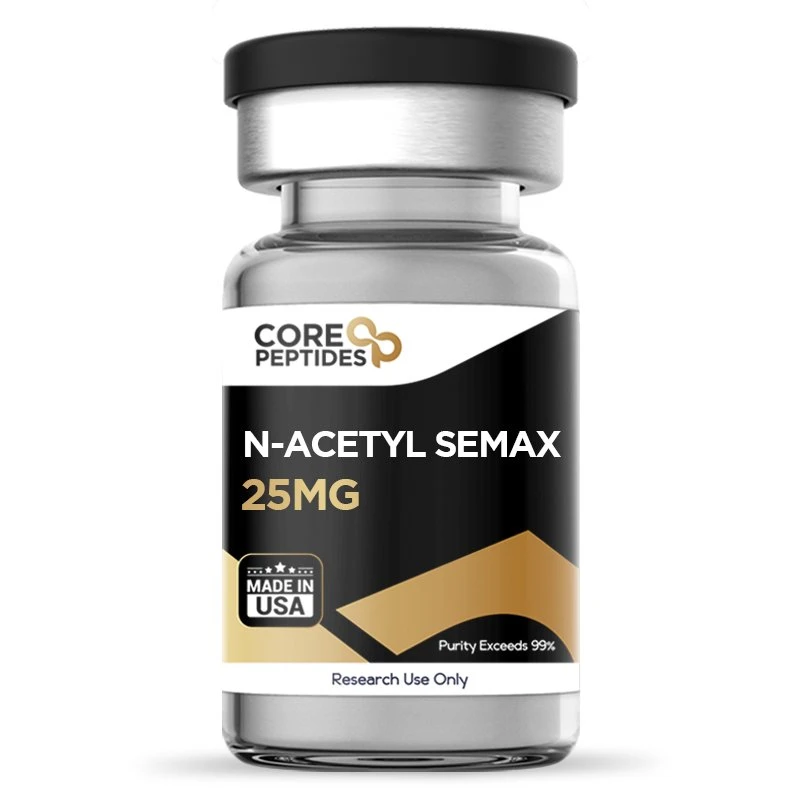

N-Acetyl Semax (25mg) – Synthetic Research Peptide
N-Acetyl Semax (25mg) is a chemically modified analogue of Semax, a synthetic peptide derived from a sequence associated with adrenocorticotropic hormone (ACTH). Semax is commonly described as a heptapeptide containing the sequence Met-Glu-His-Phe-Pro-Gly-Pro, combining the ACTH(4-7) fragment with a C-terminal Pro-Gly-Pro (PGP) extension.
N-Acetyl Semax incorporates an N-terminal acetyl modification. This makes it a distinct molecular entity from unmodified Semax and provides researchers with an opportunity to investigate how N-terminal modification influences peptide chemistry, stability and biological behaviour.
Published research has specifically shown that N-terminal acetylation can alter the chemical and biological properties of Semax, including its interactions with copper and zinc ions.
The referenced N-Acetyl Semax (25mg) product is supplied as a lyophilised powder with a stated purity of >99%. It is intended exclusively for research, laboratory and analytical applications.
What Is N-Acetyl Semax?
N-Acetyl Semax is an N-terminally acetylated derivative of Semax. The parent peptide is a short synthetic analogue associated with the ACTH(4-7) sequence and contains the additional C-terminal Pro-Gly-Pro motif.
The N-acetyl group represents a structural modification to the free amino terminus of Semax. From a peptide chemistry perspective, N-terminal acetylation can affect enzymatic recognition, metal-ion coordination, molecular interactions and other physicochemical properties.
This distinction is important when evaluating research findings. Although studies involving Semax provide useful scientific context, results obtained with unmodified Semax should not automatically be considered evidence for identical properties or effects of N-Acetyl Semax.
N-Acetyl Semax (25mg) Product Specifications
| Specification | Details |
|---|---|
| Product Name | N-Acetyl Semax |
| Quantity | 25mg |
| Form | Lyophilised powder |
| Stated Purity | >99% |
| Related Compound | Semax |
| Peptide Type | N-terminally acetylated synthetic peptide |
| Research Areas | Peptide chemistry, neurobiology and cellular signalling |
| Intended Use | Research, laboratory and analytical use only |
The supplier listing identifies the product as a 25mg lyophilised preparation with stated purity above 99%. Researchers should consult the current batch-specific certificate of analysis for definitive identity and purity information.
N-Acetyl Semax Chemical Structure
Semax is characterised as the sequence Met-Glu-His-Phe-Pro-Gly-Pro. The first four amino acids correspond to the ACTH(4-7) fragment, while the Pro-Gly-Pro sequence forms the C-terminal extension characteristic of Semax.
N-Acetyl Semax modifies the N-terminal amino group through acetylation. This seemingly small structural change can have measurable consequences for peptide chemistry. Research comparing Semax and N-acetylated Semax has demonstrated differences in their coordination with copper(II) and zinc(II), illustrating why modified peptide analogues should be investigated independently.
| Characteristic | N-Acetyl Semax |
|---|---|
| Parent Peptide | Semax |
| Core Sequence | Met-Glu-His-Phe-Pro-Gly-Pro |
| Modification | N-terminal acetylation |
| Peptide Classification | Modified synthetic peptide |
| Product Quantity | 25mg |
| Physical Form | Lyophilised powder |
N-Acetyl Semax and Semax Research
Semax has been investigated extensively compared with its N-acetylated derivative. Research into the parent peptide has explored neurotrophic signalling, neurotransmitter-related pathways, enkephalin metabolism and other aspects of central nervous system biology.
In particular, research has examined relationships between Semax and brain-derived neurotrophic factor (BDNF), as well as other neurotrophic pathways. Recent research summaries describe Semax as a synthetic ACTH(4-10) analogue used as a research tool in studies of neurotrophic signalling and related molecular pathways.
For N-Acetyl Semax, however, the scientific literature is considerably more limited. A 2016 study directly examined how N-terminal acetylation changes the chemical and biological properties of Semax, demonstrating that the modification affects metal-ion coordination and certain cellular responses.
N-Acetyl Semax and Peptide Stability
N-terminal acetylation is a commonly investigated modification in peptide chemistry. Blocking the free amino terminus can change how a peptide interacts with enzymes that recognise or degrade terminal residues.
For this reason, researchers may investigate N-Acetyl Semax when examining relationships between peptide structure, enzymatic stability and degradation kinetics.
It is important, however, not to assume that acetylation automatically produces a particular biological outcome. The effect of N-terminal modification is dependent on the peptide sequence, experimental conditions and biological environment.
Comparative laboratory analysis can therefore be used to determine whether the modification produces measurable differences in stability or other characteristics under defined experimental conditions.
N-Acetyl Semax and Neurobiological Research
Semax has attracted scientific interest because of research involving the central nervous system and neurotrophic signalling. Experimental studies have investigated potential relationships between Semax and neurotransmitter systems, neurotrophic factors and endogenous peptide pathways.
Among the most frequently discussed research areas are BDNF, NGF, serotonin, dopamine and enkephalin-related pathways. These findings provide a broader research context for N-Acetyl Semax, but they should not be interpreted as demonstrating equivalent activity for the modified peptide.
The distinction is particularly important because chemical modification can change a peptide’s interaction with proteins, enzymes, metal ions and cellular environments.
N-Acetyl Semax and BDNF Research
Brain-derived neurotrophic factor (BDNF) is a neurotrophin involved in neuronal development, synaptic plasticity and neuronal signalling.
Research into Semax has investigated changes in BDNF-related signalling and expression in experimental models. Researchers have used molecular methods such as quantitative PCR and protein analysis to examine neurotrophic pathways following peptide exposure.
These studies are relevant when understanding the research background of Semax, but direct evidence concerning N-Acetyl Semax remains comparatively limited. Consequently, BDNF-related findings from Semax research should be treated as scientific context rather than established characteristics of the acetylated analogue.
N-Acetyl Semax and NGF Research
Nerve growth factor (NGF) is another neurotrophin involved in neuronal survival, differentiation and maintenance.
Semax-related research has investigated changes in neurotrophic signalling involving both BDNF and NGF. These studies form part of the broader scientific interest in ACTH-derived peptide analogues and their potential interactions with neuronal signalling pathways.
For N-Acetyl Semax, further compound-specific research would be required to establish whether N-terminal acetylation changes these interactions in a meaningful way.
N-Acetyl Semax and Enkephalin Research
Enkephalins are endogenous opioid peptides involved in physiological processes including nociception and stress-related signalling.
Research involving Semax has investigated its possible influence on enzymes responsible for enkephalin degradation. One published study specifically examined the inhibitory activity of Semax and Selank on enkephalin-degrading enzymes in human serum.
This research provides useful background for understanding the parent peptide, but it should not be presented as evidence that N-Acetyl Semax produces the same enzyme interactions.
N-Acetyl Semax and Serotonergic Research
Serotonin is a major neurotransmitter involved in neuronal communication and numerous physiological processes.
Research into Semax has examined serotonin metabolism, including changes in the serotonin metabolite 5-hydroxyindoleacetic acid (5-HIAA). The supplier’s research description discusses experimental observations involving serotonin-related pathways and potential modulation of dopaminergic responsiveness.
Such findings are part of the research history of Semax rather than definitive evidence for N-Acetyl Semax. Direct experiments are needed to characterise the acetylated compound.
N-Acetyl Semax and Dopaminergic Research
Dopamine is an important neurotransmitter involved in movement, motivation, reward, attention and other aspects of central nervous system function.
Experimental research described for Semax has examined dopamine-related signalling and the response of dopaminergic systems to pharmacological stimulation. Some findings suggest that Semax may influence dopaminergic responsiveness without necessarily producing large changes in baseline dopamine concentrations.
Again, these observations concern Semax and should not automatically be attributed to its N-acetylated analogue.
N-Acetyl Semax and Metal-Ion Research
One of the clearest examples of direct research into the effect of N-terminal acetylation on Semax comes from studies of copper(II) and zinc(II) coordination.
A peer-reviewed study found that both Semax and N-acetylated Semax can coordinate copper and zinc ions, while the coordination characteristics differ between the two forms. The researchers reported that acetylation modifies the copper-binding behaviour and redox properties of the resulting complexes.
The study also found that acetylation changed the response of the peptide in a cellular model exposed to copper toxicity. These findings demonstrate that N-terminal acetylation is not merely a cosmetic modification but can measurably change peptide chemistry and biological behaviour under experimental conditions.
N-Acetyl Semax and Blood-Brain Barrier Research
The blood-brain barrier (BBB) is a specialised biological interface that restricts the movement of many substances from the circulation into the central nervous system.
The Pro-Gly-Pro component of Semax has been discussed in research and supplier literature in relation to peptide transport and possible interactions with biological barriers. Proposed mechanisms include passive diffusion and receptor- or transporter-associated processes.
However, claims concerning enhanced BBB penetration of N-Acetyl Semax should be treated cautiously unless demonstrated directly for the specific compound using appropriate experimental methods. Structural similarity to Semax does not by itself establish a particular pharmacokinetic profile.
Potential Research Applications
Qualified research laboratories may find N-Acetyl Semax relevant to investigations involving:
- Peptide chemistry: Studying the effects of N-terminal acetylation on a defined peptide sequence.
- Stability research: Comparing enzymatic degradation and structural stability between modified and unmodified peptides.
- Neurobiology: Investigating peptide interactions with central nervous system signalling pathways.
- Neurotrophic signalling: Studying pathways associated with BDNF and NGF.
- Neurotransmitter research: Examining relationships involving serotonergic and dopaminergic systems.
- Enkephalin research: Investigating peptide-degrading enzymes and endogenous opioid pathways.
- Metal-ion coordination: Studying peptide interactions with copper and zinc ions.
- Structure-function research: Comparing modified and unmodified Semax analogues.
- Analytical chemistry: Characterising peptide identity, purity and molecular properties.
Why Study N-Acetyl Semax?
N-Acetyl Semax provides researchers with a defined structural variant of Semax that can be compared directly with the parent peptide.
Such comparative studies are valuable because a single chemical modification can affect peptide stability, molecular interactions and biological behaviour. The published research on acetylated Semax and metal-ion coordination demonstrates that the N-terminal modification can produce measurable chemical differences.
For laboratories interested in peptide design, N-terminal modification and neuropeptide research, N-Acetyl Semax can therefore serve as a useful research material for controlled comparative experiments.
N-Acetyl Semax vs Semax
| Feature | N-Acetyl Semax | Semax |
|---|---|---|
| Relationship | Modified analogue | Parent peptide |
| N-Terminus | Acetylated | Free amino terminus |
| Core Sequence | Met-Glu-His-Phe-Pro-Gly-Pro with N-terminal modification | Met-Glu-His-Phe-Pro-Gly-Pro |
| Research Focus | Modification, stability, peptide chemistry and neurobiological research | Neurotrophic, neurochemical and CNS research |
| Direct Evidence | More limited | Broader research literature |
The compounds should be considered separate research entities. Evidence concerning Semax can provide useful background, but it does not establish the pharmacological profile of N-Acetyl Semax.
Frequently Asked Questions About N-Acetyl Semax (25mg)
What is N-Acetyl Semax?
N-Acetyl Semax is an N-terminally acetylated derivative of Semax, a synthetic peptide related to the ACTH(4-7) region and containing a C-terminal Pro-Gly-Pro extension.
How much N-Acetyl Semax is supplied?
The referenced product contains 25mg of N-Acetyl Semax in lyophilised powder form.
What is the stated purity?
The referenced Core Peptides listing states a purity of >99%. Researchers should verify batch-specific results using the applicable certificate of analysis.
What is the difference between Semax and N-Acetyl Semax?
The primary structural difference is the addition of an acetyl group to the N-terminus of Semax. Research indicates that this modification can alter the peptide’s chemical and biological properties.
What is Semax derived from?
Semax is a synthetic analogue associated with the ACTH sequence. Its structure contains the ACTH(4-7) sequence Met-Glu-His-Phe followed by Pro-Gly-Pro.
What is N-Acetyl Semax studied for?
Research interest includes peptide stability, N-terminal modification, neurobiological signalling, neurotrophic pathways, metal-ion coordination and comparative structure-function studies.
Has N-Acetyl Semax been extensively studied?
No. The research base for N-Acetyl Semax is substantially smaller than the literature surrounding unmodified Semax. A peer-reviewed study has directly investigated how acetylation changes Semax’s chemical and biological properties, but many broader claims are based on research into the parent peptide.
Does N-Acetyl Semax have the same properties as Semax?
Not necessarily. Chemical modification can alter peptide behaviour. Published research has demonstrated differences in copper and zinc coordination between Semax and N-acetylated Semax, illustrating why the two compounds should be studied independently.
Is N-Acetyl Semax a nootropic?
Semax has been investigated in research involving cognition and neurotrophic signalling. However, N-Acetyl Semax should not be marketed as an established nootropic because direct evidence for the modified compound remains limited.
Is N-Acetyl Semax a medicine?
The referenced product is supplied as a research material and is not presented as an approved medicinal product. It should not be represented as a treatment for neurological, cognitive or other medical conditions.
Is N-Acetyl Semax intended for human consumption?
No. The product is intended exclusively for research, laboratory and analytical purposes and is not intended for human or animal consumption or self-administration.
N-Acetyl Semax (25mg) Research Summary
N-Acetyl Semax (25mg) is a synthetic, N-terminally acetylated derivative of Semax supplied as lyophilised powder with a stated purity above 99%. Semax is structurally associated with the ACTH(4-7) fragment and includes a C-terminal Pro-Gly-Pro extension.
The principal scientific interest in N-Acetyl Semax lies in understanding how N-terminal acetylation changes the properties of the parent peptide. Research has demonstrated measurable differences in copper and zinc coordination and other chemical and biological characteristics between acetylated and non-acetylated Semax.
The broader Semax literature has explored neurotrophic signalling, including BDNF-related pathways, as well as neurotransmitter and enkephalin-related mechanisms. However, these findings should be distinguished from direct evidence concerning N-Acetyl Semax.
For qualified laboratories, N-Acetyl Semax can therefore be considered a research material for controlled studies of peptide modification, stability, analytical characteristics, molecular interactions and neurobiological signalling.
Research-Use Disclaimer
N-Acetyl Semax (25mg) is intended exclusively for research, laboratory, analytical and in-vitro experimental purposes. It is not intended for human or animal consumption, self-administration, diagnosis, treatment, cure or prevention of any disease.
Information concerning Semax research is provided as scientific background and should not be interpreted as proof that N-Acetyl Semax has identical biological effects. Experimental findings from cells, animals or the unmodified parent peptide cannot automatically be extrapolated to this specific compound or to human use.
Researchers should consult the current certificate of analysis and relevant product documentation for batch-specific information and conduct all laboratory work in accordance with applicable legislation, institutional requirements and appropriate laboratory safety procedures.
Be the first to review “N-Acetyl Semax (25mg)”
Related products
Peptides for Sale
Peptides for Sale
Peptides for Sale
Peptides for Sale
Peptides for Sale
Peptides for Sale
Peptides for Sale
Peptides for Sale
Reviews
There are no reviews yet.