
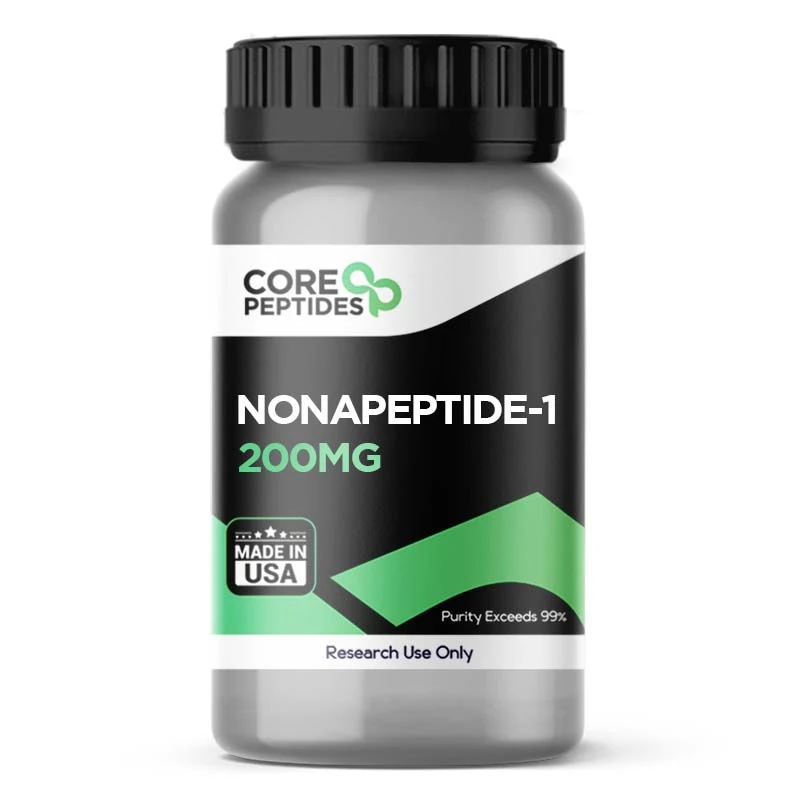
Nonapeptide-1 (200mg) – Research-Grade Peptide for Melanogenesis Studies
Nonapeptide-1 (200mg) is a synthetic nine-amino-acid peptide that has attracted scientific interest for its interaction with the melanocortin-1 receptor (MC1R) and its potential influence on pathways involved in melanin production.
Research into Nonapeptide-1 has primarily focused on melanogenesis, pigmentation biology, MC1R signalling and the molecular mechanisms that regulate melanin synthesis.
The referenced product is supplied as a lyophilised powder with a stated purity of >99% and contains 200mg of Nonapeptide-1. The supplier identifies it as a research, laboratory and analytical material rather than a medicinal product.
Nonapeptide-1 is also known in cosmetic research under the name Melanostatine-5. Its scientific interest stems from its proposed ability to act as an antagonist of MC1R, a receptor involved in signalling between melanocyte-stimulating hormones and pigment-producing melanocytes.
What Is Nonapeptide-1?
Nonapeptide-1 is a synthetic peptide consisting of nine amino-acid residues. It was identified during research programmes investigating antagonists of the melanocortin-1 receptor and subsequently became an important subject of research into pigmentation and melanogenesis.
The compound identified in the original structure-function research is Met-Pro-D-Phe-Arg-D-Trp-Phe-Lys-Pro-Val-NH2. Research investigating a large library of melanocortin receptor antagonists identified this peptide as a potent MC1R antagonist, with the study reporting an IC50 of approximately 11 nM under its experimental conditions.
Because MC1R is an important regulator of melanocyte signalling, Nonapeptide-1 has subsequently been investigated in laboratory models examining melanin synthesis and pigmentation-related pathways.
Nonapeptide-1 (200mg) Product Specifications
| Specification | Details |
|---|---|
| Product Name | Nonapeptide-1 |
| Alternative Name | Melanostatine-5 |
| Quantity | 200mg |
| Peptide Type | Synthetic nonapeptide |
| Form | Lyophilised powder |
| Stated Purity | >99% |
| Molecular Formula | C61H87N15O9S |
| Molecular Weight | 1,206.5 g/mol |
| Primary Research Area | Melanogenesis and pigmentation biology |
| Research Focus | MC1R signalling, melanin production and peptide structure-function relationships |
| Intended Use | Research, laboratory and analytical applications only |
The product listing identifies Nonapeptide-1 as a 200mg lyophilised preparation with a stated purity exceeding 99%. Batch-specific analytical information should be confirmed using the applicable certificate of analysis.
How Does Nonapeptide-1 Work?
The principal research interest in Nonapeptide-1 centres on its interaction with the melanocortin-1 receptor (MC1R).
MC1R is expressed on melanocytes, specialised cells responsible for producing melanin. One of its important endogenous activators is alpha-melanocyte-stimulating hormone (α-MSH). When α-MSH binds to MC1R, it can initiate intracellular signalling that promotes melanogenesis and increases the activity of pigment-producing pathways.
Nonapeptide-1 has been investigated as an MC1R antagonist. By interfering with the receptor-signalling pathway, researchers have investigated whether it can reduce downstream activation associated with melanogenesis.
This mechanism makes Nonapeptide-1 particularly relevant to laboratory research examining how receptor signalling regulates pigmentation.
Nonapeptide-1 and Melanogenesis Research
Melanogenesis is the biological process through which melanocytes synthesise melanin pigments. It is influenced by multiple signalling pathways, with MC1R, MITF and tyrosinase representing important components of the regulatory network.
Activation of MC1R by α-MSH can increase intracellular signalling that promotes expression of melanogenic proteins. These include microphthalmia-associated transcription factor (MITF), tyrosinase and tyrosinase-related proteins.
Research involving Nonapeptide-1 has investigated whether interfering with MC1R signalling can subsequently influence these downstream components. Laboratory findings reported reductions in the expression of melanogenic markers including tyrosinase, TRP1, TRP2 and MITF under specific experimental conditions.
These findings help explain why Nonapeptide-1 has become a subject of research into pigmentation control and peptide-based approaches to melanogenesis modulation.
Nonapeptide-1 and MC1R
The melanocortin-1 receptor is a G-protein-coupled receptor located on melanocytes and is a central component of the signalling network controlling pigmentation.
MC1R responds to melanocortin peptides including α-MSH. Its activation can promote signalling pathways associated with increased eumelanin production and other cellular responses.
Research into Nonapeptide-1 began partly from the search for molecules capable of antagonising this receptor. In an early structure-function study, researchers screened a library containing more than 31,000 structurally different melanocortin receptor antagonists. Nonapeptide-1 was identified as one of the most potent antagonists evaluated in that study.
This receptor-focused mechanism differentiates Nonapeptide-1 from compounds that act directly on downstream enzymes such as tyrosinase.
Nonapeptide-1 and α-MSH
Alpha-melanocyte-stimulating hormone (α-MSH) is an endogenous peptide hormone involved in several biological processes, including pigmentation signalling.
In melanocytes, α-MSH can bind to MC1R and initiate a signalling cascade that promotes melanogenesis. This makes the α-MSH–MC1R pathway an important experimental model for investigating pigment regulation.
Nonapeptide-1 has been investigated for its ability to interfere with this receptor-mediated signalling process. Importantly, this does not mean that Nonapeptide-1 eliminates α-MSH or acts as a direct inhibitor of every pathway influenced by α-MSH; its research interest is primarily associated with MC1R antagonism.
Nonapeptide-1 and Tyrosinase Research
Tyrosinase is a key enzyme in melanogenesis and is commonly studied as a marker of pigment-producing activity.
Because MC1R signalling can regulate downstream melanogenic pathways, researchers have investigated whether Nonapeptide-1 can indirectly influence tyrosinase expression and activity.
Experimental research has reported reductions in tyrosinase expression alongside changes in other melanogenesis-associated proteins following exposure to Nonapeptide-1 under defined laboratory conditions.
This is mechanistically different from compounds that directly inhibit the catalytic activity of tyrosinase. Nonapeptide-1 is primarily investigated as an upstream signalling modulator through its relationship with MC1R.
Nonapeptide-1, MITF and Melanogenic Proteins
Microphthalmia-associated transcription factor (MITF) is an important transcriptional regulator of melanocyte differentiation and pigment production.
MITF regulates the expression of several proteins involved in melanogenesis, including tyrosinase and tyrosinase-related proteins.
Research examining Nonapeptide-1 has reported changes in MITF, tyrosinase, TRP1 and TRP2 expression in experimental melanocyte models. These findings support further investigation into the relationship between MC1R antagonism and downstream melanogenic signalling.
Recent reviews of pigmentation research continue to highlight MITF and tyrosinase-related signalling as important molecular targets when studying regulation of melanin production.
Nonapeptide-1 and UVA Research
Ultraviolet radiation can influence melanogenesis and pigmentation-related cellular responses. Consequently, researchers have investigated Nonapeptide-1 in experimental systems that include UVA exposure.
One reported laboratory study examined human keratinocytes and epidermal melanocytes exposed to UVA alongside different concentrations of Nonapeptide-1 acetate. Researchers evaluated parameters including cell viability, melanin content and tyrosinase activity.
The study reported changes in MC1R expression and several melanogenic markers, providing a basis for further research into how peptide-based MC1R modulation may interact with UV-associated pigmentation pathways.
These observations are experimental and should not be interpreted as evidence that research-grade Nonapeptide-1 provides protection from ultraviolet radiation or replaces established sun-protection measures.
Nonapeptide-1 and Pigmentation Research
Research into Nonapeptide-1 has primarily focused on its potential to influence melanin production and pigmentation.
Experimental studies have investigated the peptide in models of melanocyte activity, melanin synthesis and pigmentation-related signalling. Some research has also explored topical formulations containing Nonapeptide-1 in the context of cosmetic pigmentation research.
However, the available evidence should be interpreted according to the type of study performed. Findings from cultured cells, animal models and cosmetic formulations do not necessarily demonstrate the same effects in humans, and further compound-specific research is required to establish efficacy and safety.
Nonapeptide-1 in Cosmetic Science
Nonapeptide-1 has also attracted interest as a cosmetic research ingredient because of its relationship with melanogenesis and pigmentation pathways.
Ingredient documentation describes Nonapeptide-1 as an active researched for applications associated with skin radiance, pigmentation control and dark-spot formulations. Such applications are distinct from medicinal treatment claims and depend on the formulation, concentration, delivery system and regulatory status of the finished cosmetic product.
For research purposes, the peptide can therefore be investigated in formulation-development studies examining stability, compatibility, delivery and interactions with other cosmetic ingredients.
Potential Research Applications
Qualified laboratories may investigate Nonapeptide-1 in a range of experimental areas, including:
- Melanogenesis research: Examining cellular mechanisms that regulate melanin production.
- MC1R research: Investigating receptor antagonism and melanocortin signalling.
- α-MSH signalling: Studying the relationship between melanocyte-stimulating hormone signalling and pigment production.
- Tyrosinase research: Evaluating downstream changes in melanogenic enzyme expression.
- MITF research: Investigating transcriptional regulation of melanogenic proteins.
- Cell culture studies: Examining responses in melanocytes and relevant skin-cell models.
- UVA-related research: Studying interactions between ultraviolet exposure and pigmentation signalling.
- Cosmetic formulation research: Evaluating peptide stability and compatibility in topical formulations.
- Structure-function research: Investigating how peptide sequence and stereochemistry influence MC1R activity.
- Analytical research: Characterising peptide identity, purity and physicochemical properties.
Nonapeptide-1 Chemical Information
| Property | Information |
|---|---|
| Peptide Name | Nonapeptide-1 |
| Common Research Name | Melanostatine-5 |
| Sequence | Met-Pro-D-Phe-Arg-D-Trp-Phe-Lys-Pro-Val-NH2 |
| Molecular Formula | C61H87N15O9S |
| Molecular Weight | 1,206.5 g/mol |
| Classification | Synthetic nonapeptide |
| Primary Molecular Target | Melanocortin-1 receptor (MC1R) |
The molecular formula and molecular weight correspond to the information provided in the referenced product listing.
Why Study Nonapeptide-1?
Nonapeptide-1 is particularly interesting for researchers because it provides a tool for studying an upstream receptor involved in pigmentation regulation.
Many pigmentation studies focus on downstream targets such as tyrosinase. Nonapeptide-1 provides an alternative research approach by investigating MC1R signalling and the relationship between receptor activation and downstream melanogenic pathways.
This makes it useful for comparative experiments involving MC1R agonists, antagonists, α-MSH signalling, tyrosinase activity and MITF expression.
Nonapeptide-1 vs Direct Tyrosinase Inhibitors
| Research Characteristic | Nonapeptide-1 | Direct Tyrosinase Inhibitors |
|---|---|---|
| Primary Research Target | MC1R signalling | Tyrosinase enzyme |
| Position in Pathway | Upstream signalling | Downstream melanogenesis |
| Research Focus | Receptor antagonism and pigment signalling | Enzyme activity |
| Example Marker | MC1R | Tyrosinase |
| Related Pathways | α-MSH–MC1R–MITF signalling | Melanin synthesis reactions |
This distinction is useful when designing comparative laboratory experiments because compounds affecting different stages of melanogenesis may produce different cellular responses.
Research Evidence and Limitations
Nonapeptide-1 has been investigated in biochemical, cellular and cosmetic research, but the evidence base should be interpreted carefully.
Early research established the peptide as an MC1R antagonist through structure-function analysis. Subsequent laboratory work examined its effects on melanogenesis-related pathways and pigmentation markers.
Some studies have also investigated cosmetic applications and pigmentation outcomes. However, evidence from topical cosmetic formulations, cell cultures or animal models should not automatically be interpreted as proof of a therapeutic effect in humans.
Further research is required to establish compound-specific pharmacology, pharmacokinetics, long-term safety and clinical effectiveness.
Frequently Asked Questions About Nonapeptide-1 (200mg)
What is Nonapeptide-1?
Nonapeptide-1 is a synthetic nine-amino-acid peptide researched primarily for its interaction with MC1R and its potential influence on melanogenesis and pigmentation signalling.
What is another name for Nonapeptide-1?
Nonapeptide-1 is also known in cosmetic research as Melanostatine-5.
How much Nonapeptide-1 is supplied?
The referenced product contains 200mg of Nonapeptide-1 in lyophilised powder form.
What is the stated purity?
The supplier lists a stated purity of >99%. Researchers should consult the relevant batch-specific certificate of analysis for definitive analytical information.
What does Nonapeptide-1 research focus on?
Research primarily focuses on MC1R antagonism, α-MSH signalling, melanogenesis, melanin production and downstream markers such as MITF and tyrosinase.
Does Nonapeptide-1 affect melanin?
Laboratory research has investigated Nonapeptide-1 for its ability to reduce melanogenesis-related signalling and melanin production under defined experimental conditions. However, research findings should not be interpreted as a guaranteed effect in humans.
Is Nonapeptide-1 a tyrosinase inhibitor?
Its principal proposed mechanism is MC1R antagonism rather than direct inhibition of tyrosinase. Research has nevertheless reported changes in tyrosinase expression downstream of MC1R-related signalling.
What is MC1R?
MC1R, or melanocortin-1 receptor, is a receptor expressed by melanocytes that participates in signalling pathways regulating pigmentation.
What is the relationship between Nonapeptide-1 and α-MSH?
α-MSH can activate MC1R and promote melanogenic signalling. Nonapeptide-1 has been investigated as an antagonist that interferes with MC1R signalling.
Is Nonapeptide-1 used in cosmetic research?
Yes. Nonapeptide-1 has been researched as a cosmetic peptide associated with pigmentation and skin-radiance formulations. Ingredient documentation describes research applications involving pigmentation control and dark-spot formulations.
Is Nonapeptide-1 a medicine?
No. The referenced product is supplied as a research material and should not be represented as an approved medicinal product or treatment for pigmentation disorders.
Is Nonapeptide-1 intended for human consumption?
No. The referenced product is designated for research, laboratory and analytical purposes only and is not intended for human or animal consumption.
Can Nonapeptide-1 be described as a skin-whitening treatment?
It is more appropriate to describe Nonapeptide-1 as a research peptide investigated in pigmentation and melanogenesis studies. Research findings should not be presented as proof that a research-grade preparation is a clinically established skin-whitening treatment.
Nonapeptide-1 (200mg) Research Summary
Nonapeptide-1 (200mg) is a synthetic nonapeptide supplied as lyophilised powder and listed with a stated purity above 99%. Its principal research interest is its interaction with the melanocortin-1 receptor (MC1R), an important signalling component in melanocyte biology and pigmentation.
Early structure-function research identified Nonapeptide-1 as a potent MC1R antagonist. Subsequent experimental research has investigated its relationship with α-MSH signalling, melanin synthesis and downstream melanogenic markers including MITF, tyrosinase, TRP1 and TRP2.
The peptide is also relevant to cosmetic science and formulation research because of its association with pigmentation-control pathways. Current research into peptides that influence melanogenesis continues to examine receptor signalling, transcriptional regulation and melanogenic enzymes as potential approaches to understanding pigment biology.
For qualified laboratories, Nonapeptide-1 provides a defined research material for investigating MC1R biology, melanogenesis, peptide structure-function relationships, pigmentation pathways and topical formulation science.
Research-Use Disclaimer
Nonapeptide-1 (200mg) is intended exclusively for research, laboratory, analytical and in-vitro experimental purposes. It is not intended for human or animal consumption, self-administration, diagnosis, treatment, cure or prevention of any disease.
Research findings concerning Nonapeptide-1 should be interpreted according to the experimental model and conditions in which they were obtained. Results from cell cultures, animal models or cosmetic formulations cannot automatically be extrapolated to clinical outcomes in humans.
Researchers should review the current certificate of analysis and product documentation for batch-specific information and conduct all experimental work in accordance with applicable legislation, institutional requirements and appropriate laboratory safety procedures.
For research use only. Human and animal consumption prohibited.
Be the first to review “Nonapeptide-1 (200mg)”
Related products
Peptides for Sale
Peptides for Sale

Peptides for Sale
Peptides for Sale
Peptides for Sale
Peptides for Sale
Peptides for Sale
Peptide Blends for Sale
Reviews
There are no reviews yet.