
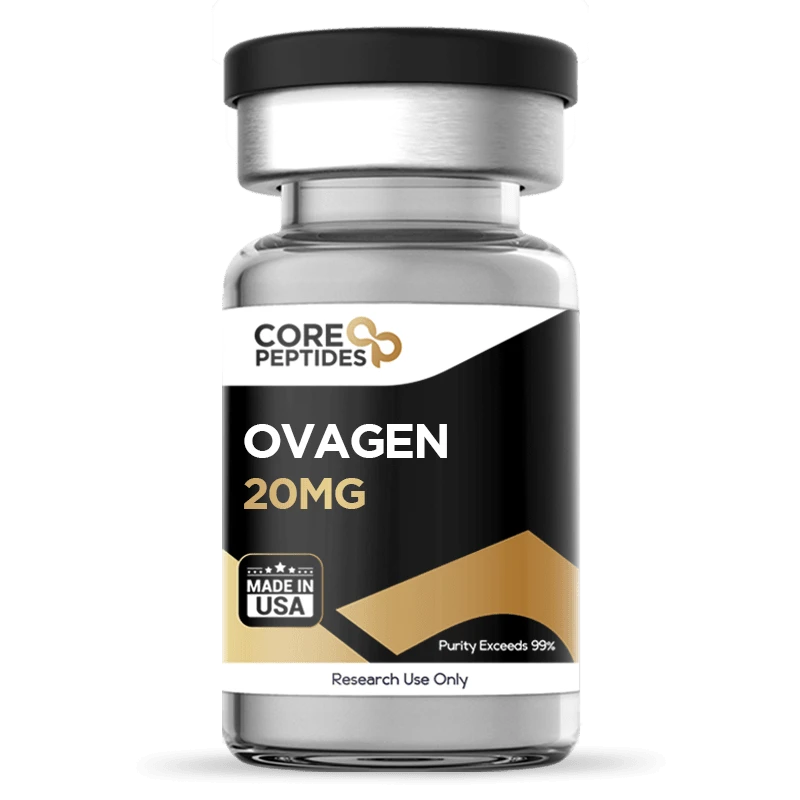
Ovagen (20mg) – Research Peptide for Cellular and Molecular Biology
Ovagen (20mg) is a short synthetic peptide research material commonly identified as the tripeptide Glu–Asp–Leu (EDL). It belongs to a broader group of short regulatory peptides that have been investigated for their potential interactions with cellular signalling and gene-expression pathways.
The referenced Core Peptides product is supplied as a lyophilised powder containing 20mg of Ovagen, with a stated purity of >99%. The product is designated for research, laboratory and analytical applications only.
Research interest in Ovagen has centred particularly on cellular ageing, renal-cell models, liver-related cellular processes and proposed peptide-mediated regulation of gene expression. However, evidence for the specific EDL sequence remains limited, and available findings should be regarded as preliminary rather than established clinical evidence.
What Is Ovagen?
Ovagen is commonly described by suppliers as a synthetic tripeptide with the sequence Glu–Asp–Leu (EDL). It has also been referred to as H-Glu-Asp-Leu-OH. According to the referenced product information, the peptide has a molecular weight of approximately 375.37 g/mol and the molecular formula C15H25N3O8.
Ovagen is associated with the research concept of short peptide bioregulators, sometimes described as peptide messengers that may influence cellular functions through interactions with molecular and genomic targets. These proposed mechanisms are part of an active research area and should not be interpreted as established therapeutic mechanisms.
Importantly, the name Ovagen can refer to different substances in unrelated contexts. For scientific work, researchers should verify the exact molecular identity, sequence and batch documentation of the material being studied before drawing conclusions from published information.
Ovagen (20mg) Product Specifications
| Specification | Details |
|---|---|
| Product Name | Ovagen |
| Commonly Reported Sequence | Glu–Asp–Leu (EDL) |
| Alternative Name | H-Glu-Asp-Leu-OH |
| Quantity | 20mg |
| Form | Lyophilised powder |
| Stated Purity | >99% |
| Molecular Weight | 375.37 g/mol |
| Molecular Formula | C15H25N3O8 |
| Research Areas | Cellular biology, gene-expression research, ageing biology and tissue-response studies |
| Intended Use | Research, laboratory and analytical purposes only |
The specifications above are based on the referenced Core Peptides product listing. Batch-specific identity, purity and analytical characteristics should always be verified against the applicable certificate of analysis.
Ovagen and Peptide Bioregulator Research
Short peptides have been investigated as potential biological signalling molecules because their small size may allow them to interact with specific cellular targets. Research associated with the Khavinson peptide-bioregulator concept has proposed that certain short peptides could influence cellular programmes by interacting with DNA or other components involved in gene regulation.
Within this broader research framework, Ovagen has been described as potentially interacting with AT-rich DNA sequences located within the minor groove of DNA. Such interactions have been proposed as one possible explanation for changes in gene-expression patterns observed in experimental models.
However, it is important to distinguish the broader peptide-bioregulator hypothesis from evidence specifically demonstrating these effects for the EDL sequence. Independent scientific reviews note that the evidence base for Ovagen itself is limited and that human efficacy data have not been established.
Ovagen and Cellular Ageing Research
One area of interest surrounding Ovagen is the study of cellular ageing and senescence.
The referenced supplier discusses experimental work in renal-cell cultures in which Ovagen was investigated in young and aged cells. The reported observations included changes in cell proliferation and expression of cellular ageing-associated markers, including p16, p21 and p53, alongside changes in SIRT6 expression.
These observations have been interpreted as potential evidence that short peptides could influence cellular processes associated with senescence. Nevertheless, cell-culture findings do not establish that the same effects occur in humans, and additional independent research is needed to determine the reproducibility and biological significance of these observations.
Ovagen and SIRT6 Research
SIRT6 is a member of the sirtuin family of proteins and has attracted substantial interest in research involving DNA maintenance, chromatin regulation, metabolism and cellular ageing.
According to the research described on the referenced product page, Ovagen exposure in renal-cell models was associated with increased SIRT6 expression alongside changes in other ageing-related markers.
This makes the relationship between Ovagen and SIRT6 an interesting subject for laboratory investigation. Researchers can examine whether observed changes are reproducible and whether they result from direct molecular interactions or broader cellular responses.
Ovagen and Renal Cell Research
Kidney-related research is another area associated with Ovagen investigations.
The referenced product literature describes experimental work examining Ovagen in renal systems, including research involving renal cell cultures and animal models. Reported observations included changes in water and sodium handling and markers associated with oxidative stress.
These findings may provide hypotheses for future investigation into renal cellular regulation. However, they should not be interpreted as evidence that Ovagen is an established treatment for kidney disease or impaired renal function.
Animal and laboratory findings require independent replication and clinical investigation before any conclusions about human efficacy or safety can be made.
Ovagen and Liver Research
Ovagen has also been investigated in relation to liver-cell biology and hepatic regeneration.
The referenced product information describes experimental work involving liver-cell systems and animal models in which researchers investigated cell survival, proliferation and markers associated with liver regeneration. Some reported observations included changes in the proportion of dividing cells and hepatic glycogen content.
Such findings make liver-related cellular biology a potential research area for Ovagen. However, the evidence should be considered preclinical and exploratory rather than proof of a therapeutic effect.
Ovagen and Gene-Expression Research
One of the most distinctive proposed mechanisms associated with short peptide bioregulators is their potential interaction with gene-expression pathways.
In the proposed model, short peptides may interact with DNA sequences or chromatin-associated structures and influence transcription of selected genes. The referenced Ovagen research describes potential interactions with AT-rich DNA sequences and subsequent changes in genes associated with cellular stress, proliferation and ageing.
From a research perspective, this provides an opportunity to investigate relationships between peptide structure, DNA interaction and transcriptional regulation.
Nevertheless, the molecular mechanism remains a research hypothesis and should not be presented as a clinically established mode of action for Ovagen.
Ovagen and Oxidative Stress Research
Oxidative stress describes an imbalance between reactive chemical species and the biological systems that regulate them. It is studied extensively in cellular ageing, renal biology, liver research and metabolic science.
Some experimental descriptions of Ovagen research have associated the peptide with changes in cellular processes related to oxidative balance. Renal studies cited by the supplier have investigated potential changes in sodium handling and parameters interpreted in relation to oxidative stress.
Further controlled studies would be necessary to determine whether these observations represent direct antioxidant mechanisms, secondary cellular responses or other biological effects.
Potential Research Applications of Ovagen
Qualified researchers may investigate Ovagen in several laboratory contexts, including:
- Cellular ageing research: Studying molecular markers associated with cellular senescence.
- Gene-expression research: Investigating potential relationships between short peptides and transcriptional regulation.
- Renal biology: Examining peptide-related responses in kidney-cell and renal-function models.
- Liver-cell research: Investigating cellular proliferation and regeneration-related pathways.
- SIRT6 studies: Examining changes in expression of ageing-associated regulatory proteins.
- Oxidative-stress research: Investigating cellular responses associated with redox balance.
- Peptide-DNA interaction studies: Exploring potential interactions between short peptide sequences and nucleic acids.
- Comparative peptide research: Comparing Ovagen with other short regulatory peptides.
- Analytical chemistry: Characterising peptide identity, purity and molecular properties.
- In-vitro research: Studying peptide effects under controlled laboratory conditions.
Ovagen Chemical Information
| Property | Information |
|---|---|
| Compound | Ovagen |
| Reported Sequence | Glu–Asp–Leu (EDL) |
| Peptide Length | 3 amino acids |
| Molecular Formula | C15H25N3O8 |
| Molecular Weight | 375.37 g/mol |
| Product Quantity | 20mg |
| Physical Form | Lyophilised powder |
The molecular information corresponds to the identity presented in the referenced supplier listing.
Why Researchers Study Short Regulatory Peptides
Short regulatory peptides provide researchers with compact molecular systems for studying interactions between peptide structure and cellular function.
The small size of these molecules makes them useful for investigating questions involving receptor interactions, intracellular signalling, nucleic-acid binding, transcriptional regulation and cellular responses.
Ovagen is therefore of interest within the broader field of peptide bioregulator research, although the evidence supporting specific biological effects remains limited compared with extensively studied endogenous signalling molecules.
Ovagen Compared With Conventional Peptides
| Characteristic | Ovagen | Longer Peptides |
|---|---|---|
| Reported Length | 3 amino acids | Usually substantially longer |
| Structure | Short tripeptide | Extended peptide chain |
| Research Interest | Cellular regulation and molecular interactions | Varies according to sequence and target |
| Research Areas | Ageing, gene expression and tissue biology | Receptor, enzyme, signalling and structural research |
This distinction is useful when selecting research materials because the biological behaviour of a peptide cannot be predicted solely from its size; sequence, stereochemistry, chemical modifications and target interactions are all important.
Research Evidence and Limitations
Ovagen should be approached as an experimental research material rather than an established therapeutic compound.
The Core Peptides listing cites research involving renal and hepatic models and describes potential changes in cellular proliferation, ageing markers and tissue responses.
However, independent reviews report that there are no well-established human clinical data demonstrating efficacy for Ovagen/EDL, and the specific identity and evidence base surrounding the EDL peptide require careful verification.
For this reason, statements concerning anti-ageing, regenerative, hepatic, renal or other health effects should be treated as research hypotheses rather than established medical claims.
Frequently Asked Questions About Ovagen (20mg)
What is Ovagen?
Ovagen is commonly marketed as a short synthetic peptide identified as Glu–Asp–Leu (EDL). It is studied within the broader field of short peptide bioregulators.
How much Ovagen is supplied?
The referenced product contains 20mg of Ovagen in lyophilised powder form.
What is the sequence of Ovagen?
The referenced product identifies Ovagen as Glu–Asp–Leu (EDL). Researchers should verify the exact molecular identity against the batch-specific analytical documentation before experiments.
What is the molecular weight of Ovagen?
The referenced product listing gives a molecular weight of approximately 375.37 g/mol.
What is the molecular formula?
The molecular formula listed for the EDL form of Ovagen is C15H25N3O8.
What is Ovagen studied for?
Research and supplier literature have discussed Ovagen in relation to cellular ageing, renal-cell biology, liver-cell research, gene-expression pathways and cellular stress responses.
Is Ovagen an anti-ageing treatment?
No. Although cellular-ageing research has investigated Ovagen, there is insufficient clinical evidence to describe it as an established anti-ageing treatment. Available evidence is primarily experimental and preclinical.
Does Ovagen have human clinical evidence?
Reliable human efficacy data for the EDL peptide have not been established. Independent research summaries report no well-established controlled human clinical trials for Ovagen/EDL.
Is Ovagen a medicine?
No. The referenced product is supplied as a research material and should not be represented as an approved medicinal product.
Is Ovagen intended for human consumption?
No. The referenced Core Peptides listing specifies that its products are intended for research, laboratory or analytical purposes only and are not for human consumption.
Why is Ovagen supplied as a lyophilised powder?
Lyophilisation, or freeze-drying, is commonly used for laboratory peptide materials because it provides a dry format that can be handled and stored according to the supplier’s specifications before experimental preparation.
Should researchers verify the identity of Ovagen?
Yes. Because the name Ovagen can be used in unrelated contexts and supplier descriptions may differ, researchers should confirm the exact sequence, molecular weight, purity and batch identity using appropriate analytical documentation such as a certificate of analysis.
Ovagen (20mg) Research Summary
Ovagen (20mg) is a lyophilised research material commonly identified as the short tripeptide Glu–Asp–Leu (EDL). The referenced product is listed with a stated purity above 99% and is supplied for research, laboratory and analytical purposes.
Research interest in Ovagen has focused on potential relationships between short peptide bioregulators and cellular processes including gene expression, cellular ageing, renal biology, liver-cell responses and oxidative-stress pathways. Experimental work cited by the supplier includes renal-cell and liver-related models.
At the same time, the evidence base for the specific EDL peptide remains limited. Independent research summaries indicate that human efficacy data are not established, meaning that proposed anti-ageing, regenerative or tissue-specific effects should not be treated as clinically proven.
For qualified laboratories, Ovagen can serve as a research material for investigating short-peptide biology, molecular interactions, cellular signalling, gene-expression hypotheses and tissue-related experimental models.
Research-Use Disclaimer
Ovagen (20mg) is intended exclusively for research, laboratory, analytical and in-vitro experimental purposes. It is not intended for human or animal consumption, self-administration, diagnosis, treatment, cure or prevention of any disease.
Information concerning potential biological effects is provided for scientific and research context only. Findings from cell cultures or animal models should not automatically be interpreted as evidence of efficacy or safety in humans.
Researchers should review the current certificate of analysis and product documentation for batch-specific information and conduct all experimental work in accordance with applicable legislation, institutional requirements and appropriate laboratory safety procedures.
For research use only. Human and animal consumption prohibited.
Be the first to review “Ovagen (20mg)”
Related products
Peptides for Sale
Peptides for Sale
Peptides for Sale
Peptides for Sale
Peptides for Sale
Peptides for Sale
Peptides for Sale
Peptides for Sale
Reviews
There are no reviews yet.