
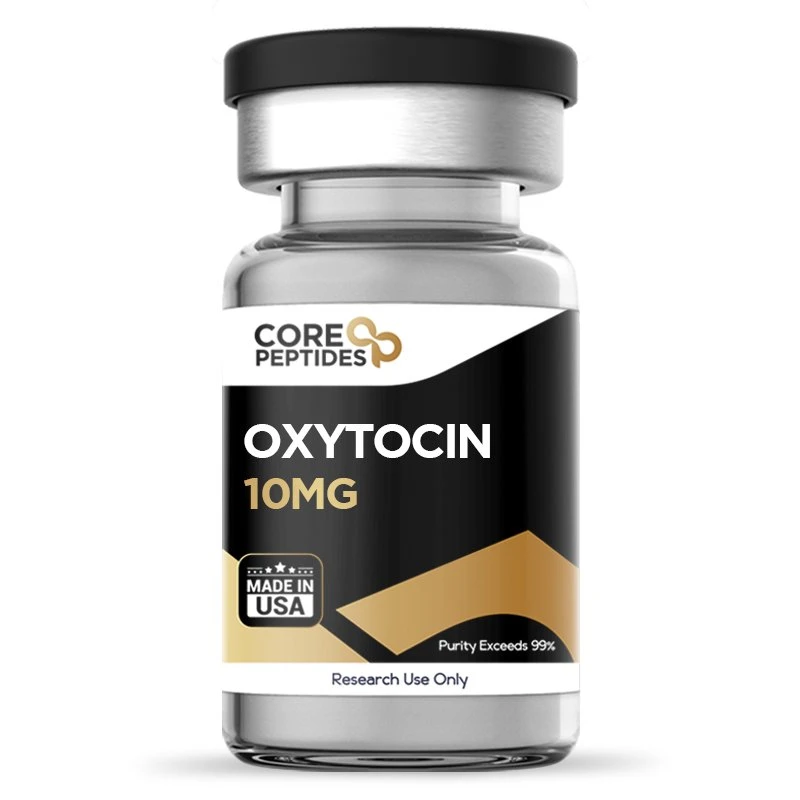


Oxytocin (10mg) – Research-Grade Cyclic Nonapeptide
Oxytocin (10mg) is a synthetic form of a naturally occurring cyclic nonapeptide hormone that has been extensively studied for its role in reproductive physiology, lactation, smooth-muscle signalling, neurobiology and oxytocin-receptor activity. Oxytocin is produced naturally in the hypothalamus and released from the posterior pituitary, where it functions both as a hormone and as a signalling molecule within the nervous system.
The referenced product is supplied as 10mg of lyophilised Oxytocin powder with a stated purity of >99%. Core Peptides identifies the material for research, laboratory and analytical purposes only and explicitly prohibits human and animal consumption.
Oxytocin is particularly valuable as a research compound because its receptor, OXTR, belongs to the G-protein-coupled receptor family and activates intracellular signalling pathways involved in calcium mobilisation, smooth-muscle contraction and diverse neuronal processes.
What Is Oxytocin?
Oxytocin is a naturally occurring nine-amino-acid peptide hormone. It is classified as a cyclic nonapeptide because a disulphide bond between two cysteine residues creates the characteristic ring structure of the molecule.
PubChem identifies the sequence as CYIQNCPLG, with a molecular formula of C43H66N12O12S2 and a molecular weight of approximately 1007.2 g/mol. Endogenous oxytocin is synthesised primarily in neurons of the hypothalamus and transported to the posterior pituitary for storage and release.
Oxytocin-producing neurons also project into the central nervous system, where oxytocin signalling has been investigated in relation to social behaviour, stress responses, neuronal activity and other physiological processes.
Because of its well-characterised receptor system and extensive scientific literature, Oxytocin remains an important research tool for studying peptide hormones and G-protein-coupled receptor signalling.
Oxytocin (10mg) Product Specifications
| Specification | Details |
|---|---|
| Product Name | Oxytocin |
| Quantity | 10mg |
| Form | Lyophilised powder |
| Stated Purity | >99% |
| Peptide Type | Cyclic nonapeptide |
| Sequence | CYIQNCPLG |
| Molecular Formula | C43H66N12O12S2 |
| Molecular Weight | 1007.2 g/mol |
| Primary Receptor | Oxytocin receptor (OXTR) |
| Research Areas | Reproductive biology, lactation, neurobiology, GPCR signalling and smooth-muscle physiology |
| Intended Use | Research, laboratory and analytical purposes only |
The product specifications above combine the supplier’s current listing with established chemical information from PubChem. Batch-specific identity, purity and analytical characteristics should be confirmed through the applicable certificate of analysis.
How Does Oxytocin Work?
Oxytocin exerts its biological effects primarily through the oxytocin receptor (OXTR), a class 1 G-protein-coupled receptor. Activation of OXTR can stimulate intracellular signalling pathways involving phospholipase C, inositol trisphosphate and calcium mobilisation.
In smooth-muscle cells, increased intracellular calcium can promote contraction. This mechanism is particularly well characterised in the uterine myometrium, where oxytocin signalling contributes to the regulation of contractions during labour.
OXTR signalling is not limited to reproductive tissues. Receptors are also expressed in various regions of the nervous system and other peripheral tissues, which has led to extensive research into oxytocin’s broader physiological functions.
Oxytocin and OXTR Signalling
The oxytocin receptor is central to understanding the pharmacology and biology of Oxytocin.
OXTR is a seven-transmembrane GPCR that can couple to intracellular signalling proteins and activate several downstream pathways. Research has identified signalling involving PLC, PKC, MAPK and CaMK, among other pathways. The precise cellular response can vary according to tissue type, receptor expression and the surrounding physiological environment.
This signalling complexity makes Oxytocin useful for investigating how peptide hormones regulate cellular responses through GPCRs.
Oxytocin and Reproductive Biology
One of the most established areas of Oxytocin research concerns reproductive physiology.
Oxytocin signalling contributes to uterine smooth-muscle contraction and is therefore extensively studied in relation to parturition. During labour, activation of OXTR in the myometrium promotes intracellular calcium signalling and contraction.
Research into the oxytocin receptor system also examines receptor expression, desensitisation, hormonal regulation and interactions with other signalling systems involved in pregnancy and labour.
These mechanisms make Oxytocin an established research model for investigating GPCR-mediated smooth-muscle activity and reproductive signalling.
Oxytocin and Lactation Research
Oxytocin is also closely associated with the milk-ejection reflex.
During lactation, oxytocin signalling promotes contraction of myoepithelial cells surrounding mammary alveoli. These contractions help move milk from the alveolar structures towards the ducts, forming an important component of the physiological milk-ejection response.
Laboratory and clinical research continues to investigate how oxytocin release, receptor sensitivity and other hormonal factors contribute to lactation physiology.
Oxytocin and Neurobiology
Beyond its peripheral endocrine functions, Oxytocin is an important subject of neuroscience research.
Oxytocin-producing neurons project into multiple regions of the brain, and OXTR signalling has been investigated in connection with neuronal excitability, synaptic plasticity, social recognition and behavioural responses.
Research involving the hippocampus has examined OXTR signalling in relation to neuronal network activity, synaptic plasticity and social memory. These studies highlight the complexity of oxytocin signalling within the central nervous system.
Importantly, findings concerning behavioural or psychiatric effects remain an active research area and should not be interpreted as evidence that research-grade Oxytocin is an established treatment for neurological or psychiatric conditions.
Oxytocin and Dopamine Research
Researchers have investigated interactions between oxytocin and dopaminergic signalling, particularly within neural circuits involved in reward and reproductive behaviour.
Experimental literature has examined potential oxytocin-mediated effects on dopamine neurons in regions including the ventral tegmental area and nucleus accumbens. These investigations are relevant to understanding how neuropeptide signalling may interact with reward-related neural pathways.
Such findings remain mechanistic and experimental. They should not be used to make clinical claims regarding mood, sexual function, relationships or psychiatric disorders.
Oxytocin and Neuroplasticity Research
Neuroplasticity refers broadly to the ability of the nervous system to modify neuronal connections and functional responses.
Research has investigated OXTR signalling in relation to neuronal excitability, neurotransmitter release, synaptic plasticity and neurodevelopment. Oxytocin-related signalling can influence intracellular calcium and several kinase-dependent pathways that participate in neuronal communication.
These mechanisms make Oxytocin useful for laboratory studies examining relationships between neuropeptides, GPCR signalling and synaptic function.
Oxytocin and Vascular Research
Oxytocin and OXTR signalling have also been studied in the context of vascular physiology.
Experimental research has investigated oxytocin-associated signalling in vascular tissues and its possible effects on vascular tone. OXTR is expressed in several peripheral tissues, and receptor activation can produce tissue-specific cellular responses.
Because vascular effects can depend on experimental conditions, receptor distribution and physiological state, individual findings should be interpreted within the specific model in which they were obtained.
Oxytocin and Social Behaviour Research
Oxytocin has received substantial scientific attention for its possible involvement in social cognition and behaviour.
Research has investigated OXTR signalling in areas of the brain associated with social recognition, stress regulation, maternal behaviour and other forms of social interaction. Reviews emphasise that the underlying mechanisms are complex and that behavioural outcomes can vary considerably between experimental settings.
Consequently, Oxytocin is best viewed as a valuable research molecule for studying neuroendocrine signalling rather than as a simple or universal “social” or “bonding” compound.
Potential Research Applications of Oxytocin
Qualified laboratories may investigate Oxytocin across a range of scientific disciplines, including:
- Oxytocin receptor research: Investigating OXTR activation, receptor expression and receptor regulation.
- GPCR signalling: Studying G-protein-dependent and downstream intracellular signalling pathways.
- Reproductive biology: Examining uterine signalling and mechanisms involved in parturition.
- Lactation research: Investigating myoepithelial-cell contraction and milk-ejection mechanisms.
- Neuroscience: Studying neuronal signalling and neuropeptide activity.
- Synaptic plasticity research: Examining OXTR-mediated effects on neuronal networks.
- Social-behaviour research: Investigating the relationship between oxytocin signalling and social recognition.
- Dopamine research: Studying interactions between oxytocin and reward-related dopaminergic pathways.
- Vascular research: Investigating OXTR signalling in vascular tissues.
- Pharmacology: Using Oxytocin as a reference compound in studies of receptor agonists and antagonists.
- Analytical chemistry: Characterising peptide identity, purity and molecular properties.
Oxytocin Chemical Information
| Property | Information |
|---|---|
| Compound | Oxytocin |
| Peptide Class | Cyclic nonapeptide |
| Sequence | CYIQNCPLG |
| Molecular Formula | C43H66N12O12S2 |
| Molecular Weight | 1007.2 g/mol |
| Primary Receptor | Oxytocin receptor (OXTR) |
| Structure | Disulphide-linked cyclic peptide |
| Product Quantity | 10mg |
The molecular formula, sequence and molecular weight are consistent with the current PubChem record for Oxytocin.
Oxytocin Compared With Vasopressin
Oxytocin and vasopressin are closely related neurohypophysial peptide hormones. Both are cyclic nonapeptides and share structural similarities, but they have distinct receptor preferences and physiological roles.
| Characteristic | Oxytocin | Vasopressin |
|---|---|---|
| Peptide Length | 9 amino acids | 9 amino acids |
| Primary Research Receptor | Oxytocin receptor | Vasopressin receptor family |
| Major Research Areas | Reproduction, lactation, neurobiology and social signalling | Fluid balance, vascular signalling and neuroendocrine regulation |
| Structural Relationship | Closely related neurohypophysial peptide | Closely related neurohypophysial peptide |
Research into both peptides is useful for understanding receptor selectivity and the evolution of closely related peptide-hormone signalling systems.
Why Study Oxytocin?
Oxytocin provides researchers with a well-characterised model for investigating the relationship between peptide structure, receptor activation and cellular signalling.
Its established role in reproductive physiology makes it particularly useful for studying smooth-muscle contraction and endocrine signalling, while its central nervous system activity has generated extensive research into neuronal communication and social behaviour.
Because OXTR signalling involves multiple intracellular pathways, Oxytocin can also be used as a reference molecule in pharmacological research examining receptor agonism, antagonism, desensitisation and downstream signalling.
Research Evidence and Limitations
Oxytocin is one of the most extensively studied peptide hormones, but its effects are highly dependent on tissue, receptor distribution, concentration, physiological state and experimental conditions.
The strongest established biological roles involve uterine contraction and milk ejection, while research into neurological, behavioural, vascular and metabolic effects continues to develop.
Evidence from cell cultures, animal models and controlled clinical studies should be considered separately. Results from one experimental setting cannot automatically be extrapolated to other tissues or to clinical outcomes.
In particular, research findings concerning social behaviour, neuropsychiatric conditions or other non-classical applications should be regarded as investigational unless supported by appropriate clinical evidence.
Frequently Asked Questions About Oxytocin (10mg)
What is Oxytocin?
Oxytocin is a naturally occurring cyclic nonapeptide hormone involved in reproductive physiology, lactation and a wide range of neuroendocrine signalling processes.
How much Oxytocin is supplied?
The referenced product contains 10mg of Oxytocin in lyophilised powder form.
What is the purity of Oxytocin (10mg)?
The referenced supplier lists the product with a stated purity of >99%. Researchers should consult the applicable batch-specific certificate of analysis for definitive analytical information.
What is the sequence of Oxytocin?
Oxytocin is a nine-amino-acid peptide with the sequence CYIQNCPLG. Its cyclic structure is formed through a disulphide bond involving the two cysteine residues.
What is the molecular weight of Oxytocin?
PubChem lists the molecular weight of Oxytocin as approximately 1007.2 g/mol.
What receptor does Oxytocin activate?
Oxytocin primarily acts through the oxytocin receptor (OXTR), a G-protein-coupled receptor that activates several intracellular signalling pathways.
What is Oxytocin studied for?
Oxytocin is studied extensively in reproductive biology, lactation, smooth-muscle physiology, neurobiology, receptor pharmacology, synaptic signalling and social-behaviour research.
Does Oxytocin affect uterine contractions?
Yes. Oxytocin receptor activation in the myometrium can increase intracellular calcium and promote smooth-muscle contraction. This is one of the best-established physiological actions of the oxytocin system.
What is the role of Oxytocin in lactation?
Oxytocin signalling promotes contraction of myoepithelial cells surrounding mammary alveoli, contributing to the physiological milk-ejection reflex.
Is Oxytocin involved in brain signalling?
Yes. Oxytocin-producing neurons project throughout the central nervous system, and OXTR signalling has been investigated in relation to neuronal excitability, synaptic plasticity, social recognition and other behavioural processes.
Is Oxytocin a medicine?
Oxytocin is an established pharmaceutical hormone in regulated medical settings, but the 10mg research material referenced here is not presented as a medicinal product. The supplier identifies its material as being for research, laboratory and analytical purposes only.
Is Oxytocin (10mg) intended for human or animal consumption?
No. The referenced product is explicitly designated for research, laboratory or analytical purposes only, with human and animal consumption prohibited.
Why is Oxytocin supplied as a lyophilised powder?
Lyophilisation, or freeze-drying, is commonly used for laboratory peptide materials to provide a dry preparation that can be stored and handled according to the supplier’s documented requirements before use in an approved research protocol.
Oxytocin (10mg) Research Summary
Oxytocin (10mg) is a research-grade cyclic nonapeptide supplied as lyophilised powder with a stated purity above 99%. Oxytocin is one of the best-characterised peptide hormones and is extensively studied for its interactions with the oxytocin receptor and its roles in reproductive, endocrine and neurological signalling.
Its primary receptor, OXTR, is a G-protein-coupled receptor capable of activating intracellular pathways involving calcium mobilisation, PLC, PKC, MAPK and other signalling mechanisms. These pathways make Oxytocin an important model for research into GPCR biology and peptide-hormone signalling.
Oxytocin research encompasses uterine physiology, lactation, neurobiology, synaptic plasticity, vascular signalling and social-behaviour research. While some of these areas have well-established physiological foundations, others remain active areas of investigation and should not be interpreted as proven therapeutic applications of research-grade material.
For qualified laboratories, Oxytocin (10mg) provides a defined peptide research material for investigating OXTR biology, receptor signalling, reproductive physiology, neuroendocrine mechanisms and related cellular pathways.
Research-Use Disclaimer
Oxytocin (10mg) is intended exclusively for research, laboratory, analytical and in-vitro experimental purposes. It is not intended for human or animal consumption, self-administration, diagnosis, treatment, cure or prevention of any disease.
Oxytocin has recognised medical uses in appropriately regulated pharmaceutical formulations, but those clinical applications should not be confused with the research material described on this page. Any medical use of oxytocin should be undertaken only with an appropriately authorised medicinal product and under qualified healthcare supervision.
Researchers should review the current certificate of analysis and product documentation for batch-specific information and conduct all experimental work in accordance with applicable legislation, institutional requirements and appropriate laboratory safety procedures.
For research use only. Human and animal consumption prohibited.
Be the first to review “Oxytocin (10mg)”
Related products
Peptides for Sale
Peptides for Sale
Peptides for Sale
Peptides for Sale
Peptides for Sale
Peptides for Sale
Peptides for Sale
Peptides for Sale
Reviews
There are no reviews yet.