
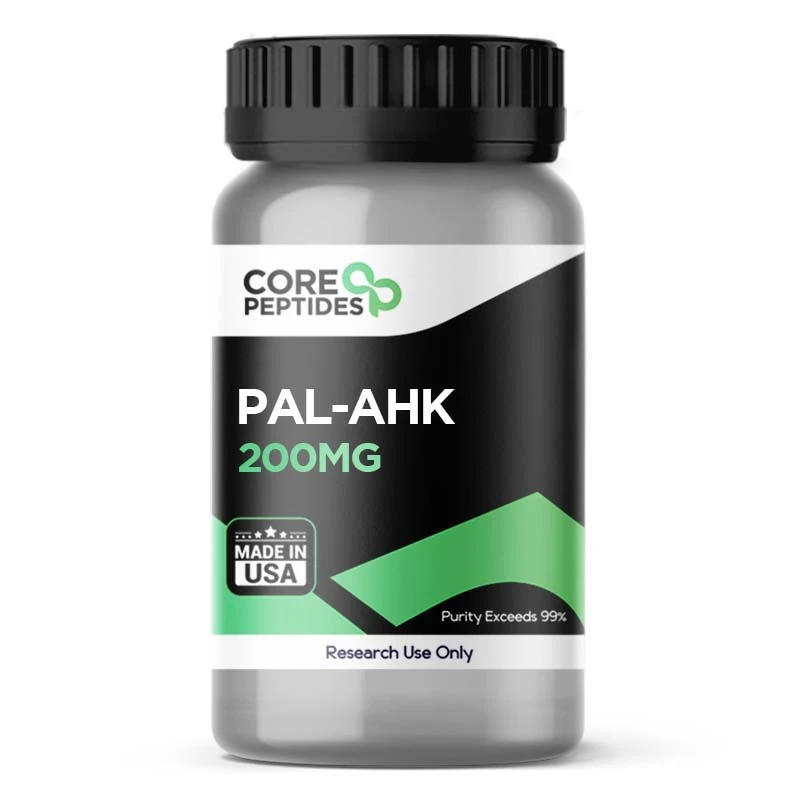
Pal-AHK (200mg) – Palmitoyl AHK Research Peptide
Pal-AHK (200mg), also known as Palmitoyl AHK, is a synthetic, palmitoylated peptide based on the tripeptide AHK, consisting of alanine, histidine and lysine. The addition of a palmitoyl group changes the physicochemical properties of the peptide and has been proposed to improve lipophilicity and cellular permeability.
Pal-AHK is primarily of interest in laboratory research involving dermal cells, extracellular matrix biology, oxidative stress and hair-follicle-related pathways. The referenced product contains 200mg of lyophilised Pal-AHK powder and is listed with a stated purity of >99%.
Core Peptides specifies that the material is intended exclusively for research, laboratory and analytical purposes and is not intended for human or animal consumption.
Research surrounding Pal-AHK itself remains limited. Much of the available evidence concerns the non-palmitoylated AHK tripeptide or related AHK-copper complexes, meaning proposed biological effects of Pal-AHK should be treated as experimental rather than established outcomes.
What Is Pal-AHK?
Pal-AHK is a palmitoylated derivative of the short peptide AHK. AHK is composed of the amino acids alanine (A), histidine (H) and lysine (K). Palmitoylation involves attaching a palmitoyl group to the peptide, creating a more lipophilic molecule than the unmodified tripeptide.
The rationale behind this modification is primarily related to peptide chemistry and membrane interaction. Increasing lipophilicity may influence how a peptide interacts with biological membranes and may potentially improve cellular penetration. However, the extent to which this modification translates into biological activity for Pal-AHK specifically remains an area requiring further research.
AHK was originally investigated as a peptide derived from albumin hydrolysate, while subsequent research explored its antioxidant and cellular effects. Studies of related AHK compounds have contributed to interest in Pal-AHK for skin and hair research.
Pal-AHK (200mg) Product Specifications
| Specification | Details |
|---|---|
| Product Name | Pal-AHK |
| Alternative Name | Palmitoyl AHK |
| Quantity | 200mg |
| Form | Lyophilised powder |
| Stated Purity | >99% |
| Peptide Components | Alanine, histidine and lysine with a palmitoyl group |
| Molecular Formula | C31H56N6O5 |
| Molecular Weight | 592.8 g/mol |
| Research Areas | Dermal cell biology, extracellular matrix research, oxidative stress and hair-follicle research |
| Intended Use | Research, laboratory and analytical purposes only |
The quantity, physical form, stated purity, molecular formula and molecular weight correspond to the referenced Core Peptides listing. Researchers should consult the relevant batch-specific certificate of analysis for definitive analytical information.
How Is Pal-AHK Different From AHK?
The fundamental difference between AHK and Pal-AHK is the addition of the palmitoyl group.
| Characteristic | AHK | Pal-AHK |
|---|---|---|
| Core peptide | Alanine-Histidine-Lysine | Alanine-Histidine-Lysine |
| Modification | Unmodified tripeptide | Palmitoylated derivative |
| Lipophilicity | Lower than palmitoylated derivatives | Increased by the palmitoyl group |
| Research interest | Cellular, antioxidant and collagen-related research | Peptide permeability, dermal-cell and hair-related research |
| Evidence base | More research available | Limited direct research |
The palmitoylation strategy is particularly relevant to peptide research because adding a lipid chain can alter solubility, membrane interactions, stability and cellular uptake. These properties must nevertheless be experimentally established for each specific compound rather than assumed from the modification alone.
Pal-AHK and Skin Cell Research
One of the principal areas of interest surrounding Pal-AHK is dermal cell biology. Research involving the underlying AHK peptide has examined fibroblast viability, proliferation and collagen production.
Dermal fibroblasts are important cells within the skin because they produce extracellular-matrix components, including collagen. In cell-culture research, AHK has been investigated for potential effects on fibroblast growth and viability, as well as the production of type I collagen. Core Peptides reports research in which AHK was associated with increased collagen type I production in cultured fibroblasts.
However, the supplier explicitly notes that the specific effects of Pal-AHK on skin have yet to be adequately investigated. Therefore, findings involving unmodified AHK should not automatically be attributed to Pal-AHK.
Pal-AHK and Collagen Research
Collagen is one of the principal structural proteins of the extracellular matrix and contributes to the structural integrity of connective tissues.
Laboratory research into AHK has examined its possible influence on collagen type I production by dermal fibroblasts. Core Peptides cites research reporting increased collagen production in cultured fibroblasts following exposure to AHK, with one cited study reporting an increase of up to approximately 300% relative to controls.
These findings are useful for understanding the potential relationship between short peptides and extracellular-matrix biology. They do not, however, establish that topical Pal-AHK produces comparable collagen changes in human skin.
Recent reviews of peptide use in cosmetics also emphasise that promising in-vitro peptide mechanisms need to be distinguished from demonstrated clinical effects, particularly because topical delivery and skin penetration can present significant challenges.
Pal-AHK and Oxidative Stress Research
Oxidative stress describes an imbalance between reactive molecular species and the body’s antioxidant defence systems. Oxidative processes can affect lipids, proteins, DNA and cellular signalling.
AHK has been investigated for potential antioxidant activity, and Core Peptides suggests that the peptide’s amino acid composition may contribute to interactions with oxidative processes.
Because direct research on Pal-AHK is limited, proposed antioxidant effects should be treated as a research hypothesis rather than a confirmed biological property of the palmitoylated compound.
Pal-AHK and TGF-β1 Research
Transforming growth factor beta 1 (TGF-β1) is a multifunctional signalling molecule involved in cellular proliferation, extracellular-matrix regulation, immune signalling and tissue-repair processes.
Research involving AHK has investigated potential effects on TGF-β1 expression. Core Peptides cites research suggesting that AHK may reduce TGF-β1 expression under certain experimental conditions.
Because TGF-β1 participates in numerous biological pathways, changes in its expression can have context-dependent consequences. Further investigation is therefore required to establish the relevance of these observations to Pal-AHK specifically.
Pal-AHK and Hair Follicle Research
Pal-AHK is also marketed in the context of hair-follicle research, although the direct evidence base is limited.
Importantly, the Core Peptides product page states that no direct research exists on Pal-AHK’s impact on hair or fur growth. Instead, proposed hair-related mechanisms are based partly on studies of AHK derivatives and AHK-copper complexes.
Research involving related AHK compounds has examined dermal papilla cells, which are specialised cells located within hair follicles and involved in follicular growth signalling. Experimental studies have investigated pathways involving apoptosis-related proteins such as Bcl-2, Bax, caspase-3 and PARP, as well as growth-related signalling such as VEGF.
These findings provide potential mechanisms for further laboratory investigation but should not be presented as proof that Pal-AHK promotes hair growth in humans.
Pal-AHK and Dermal Papilla Cells
Dermal papilla cells (DPCs) are specialised mesenchymal cells within hair follicles that play an important role in follicular signalling and hair-cycle biology.
Studies of related AHK-copper compounds have investigated whether these peptides influence DPC proliferation and apoptosis. Research has reported changes in markers including the Bcl-2/Bax ratio, cleaved caspase-3 and PARP in experimental models.
Such molecular markers are useful for investigating cellular survival pathways. However, evidence involving an AHK-copper complex or another AHK derivative cannot automatically be considered direct evidence for Pal-AHK.
Pal-AHK and VEGF Research
Vascular endothelial growth factor (VEGF) is an important signalling protein associated with angiogenesis and vascular biology.
Research cited by Core Peptides has proposed that related AHK compounds may influence VEGF expression in experimental hair-follicle models. Since blood-vessel signalling can contribute to the local follicular environment, VEGF is of interest in studies of hair biology.
Nevertheless, the relationship between VEGF modulation and actual hair growth is complex, and no conclusion should be drawn that Pal-AHK is an established hair-growth treatment.
Pal-AHK and Apoptosis Research
Apoptosis is a regulated form of programmed cell death that is essential for normal tissue development and cellular homeostasis.
Research into related AHK compounds has investigated several apoptosis-associated markers, including Bcl-2, Bax, caspase-3 and PARP. Changes in these markers can provide information about cellular survival and apoptotic signalling in experimental systems.
The potential relevance of these pathways to Pal-AHK remains investigational. Direct studies using the palmitoylated compound are needed before such mechanisms can be confirmed.
Potential Research Applications of Pal-AHK
Qualified laboratories may investigate Pal-AHK in a range of experimental contexts, including:
- Dermal cell research: Investigating peptide interactions with fibroblasts and other skin-associated cells.
- Extracellular matrix research: Examining collagen and other structural proteins.
- Collagen research: Studying mechanisms associated with type I collagen production.
- Oxidative-stress research: Investigating potential interactions between AHK-derived peptides and oxidative pathways.
- TGF-β1 research: Examining peptide-associated changes in growth-factor signalling.
- Hair-follicle biology: Studying AHK-related signalling in experimental follicular models.
- Dermal papilla research: Investigating cellular proliferation and survival pathways.
- Apoptosis research: Examining markers including Bcl-2, Bax, caspase-3 and PARP.
- VEGF research: Investigating vascular signalling associated with hair-follicle models.
- Peptide chemistry: Studying the effect of palmitoylation on peptide properties and cellular interactions.
- Analytical research: Characterising peptide identity, purity and molecular properties.
Why Study Pal-AHK?
Pal-AHK is of interest because it combines a short biologically studied tripeptide with a lipid-based palmitoyl modification. This provides researchers with an opportunity to investigate how peptide structure influences physicochemical properties and potential cellular interactions.
The underlying AHK sequence has generated research interest in dermal fibroblasts, collagen production, oxidative stress and hair-follicle biology. The palmitoylated version provides an additional research model for examining whether increased lipophilicity changes the behaviour of the parent peptide.
At present, however, the evidence for Pal-AHK itself remains considerably more limited than the evidence for AHK and certain AHK-copper derivatives. This distinction is important when interpreting published research.
Pal-AHK Chemical Information
| Property | Information |
|---|---|
| Compound | Pal-AHK |
| Also Known As | Palmitoyl AHK |
| Core Peptide | AHK – Alanine, Histidine, Lysine |
| Modification | Palmitoyl group |
| Molecular Formula | C31H56N6O5 |
| Molecular Weight | 592.8 g/mol |
| Product Quantity | 200mg |
| Physical Form | Lyophilised powder |
| Stated Purity | >99% |
The chemical information above follows the referenced supplier’s product listing. Batch-specific analytical documentation should always take precedence where available.
Pal-AHK Compared With GHK-Cu
Pal-AHK and GHK-Cu are both peptide-based compounds that have attracted interest in dermal and cosmetic research, but they are chemically distinct.
| Characteristic | Pal-AHK | GHK-Cu |
|---|---|---|
| Core Peptide | AHK | GHK |
| Amino Acids | Alanine, histidine, lysine | Glycine, histidine, lysine |
| Modification | Palmitoyl group | Copper complex |
| Primary Research Interest | Dermal cells, extracellular matrix and hair-related pathways | Skin biology, copper-dependent signalling and extracellular-matrix research |
| Evidence Base | Limited direct research | More extensively studied peptide-copper system |
Although both compounds are investigated in skin-related research, they should not be treated as interchangeable. Their structures, modifications and biological properties are different.
Research Evidence and Limitations
The most important consideration when evaluating Pal-AHK is the distinction between direct evidence for Pal-AHK and evidence involving related compounds.
Core Peptides explicitly notes that studies have investigated non-palmitoylated AHK rather than Pal-AHK itself, while its newer research overview similarly states that direct research on Pal-AHK remains limited.
Consequently, proposed effects involving collagen, skin-cell proliferation, antioxidant activity or hair follicles should be regarded as experimental hypotheses. Results obtained in cultured cells or with related AHK derivatives cannot automatically be translated into outcomes in humans.
Modern research into topical peptides also highlights the importance of skin permeability, peptide stability, concentration and formulation. Demonstrating an effect in vitro does not necessarily demonstrate that the same effect occurs following topical application in humans.
Frequently Asked Questions About Pal-AHK (200mg)
What is Pal-AHK?
Pal-AHK is a synthetic palmitoylated derivative of the AHK tripeptide, consisting of alanine, histidine and lysine. The palmitoyl group increases the molecule’s lipophilic character and makes it an interesting subject for peptide-permeability and dermal research.
How much Pal-AHK is supplied?
The referenced product contains 200mg of Pal-AHK in lyophilised powder form.
What is the stated purity of Pal-AHK (200mg)?
The referenced Core Peptides listing states a purity of >99%. Researchers should consult the relevant batch-specific certificate of analysis for definitive quality information.
What does AHK stand for?
AHK refers to the three-amino-acid sequence alanine-histidine-lysine.
What does the “Pal” in Pal-AHK mean?
“Pal” refers to the palmitoyl group attached to the AHK peptide. This lipid modification increases lipophilicity and may influence membrane interactions and peptide permeability.
Is Pal-AHK the same as AHK?
No. AHK is the unmodified tripeptide, whereas Pal-AHK is a palmitoylated derivative. The modification can alter the physicochemical characteristics of the molecule.
Is Pal-AHK the same as GHK-Cu?
No. Pal-AHK and GHK-Cu are chemically different peptide systems. Pal-AHK is based on AHK and contains a palmitoyl modification, while GHK-Cu is a copper-associated form of the GHK tripeptide.
Is Pal-AHK studied for collagen?
Research involving the underlying AHK peptide has investigated collagen type I production in dermal fibroblasts. However, direct research confirming equivalent collagen effects from Pal-AHK remains limited.
Is Pal-AHK studied for hair?
Pal-AHK has attracted interest in hair-follicle research, but direct evidence is limited. The supplier notes that there is no direct research establishing Pal-AHK’s effect on hair or fur growth; proposed mechanisms are based partly on related AHK derivatives.
Does Pal-AHK increase hair growth?
There is currently insufficient direct evidence to establish that Pal-AHK increases hair growth in humans. Research involving related AHK compounds provides hypotheses for further laboratory investigation but does not establish a clinical hair-growth effect.
Is Pal-AHK intended for human consumption?
No. The referenced product is designated for research, laboratory and analytical purposes only, and human and animal consumption is prohibited.
Is Pal-AHK a medicine?
No. The research material described here should not be represented as an authorised medicinal product or as a treatment for skin, hair or other medical conditions.
Why is Pal-AHK supplied as a lyophilised powder?
Lyophilisation, or freeze-drying, is commonly used for laboratory peptide materials to provide a dry preparation suitable for storage and subsequent handling according to the supplier’s documented requirements.
Pal-AHK (200mg) Research Summary
Pal-AHK (200mg) is a synthetic, palmitoylated derivative of the AHK tripeptide. The addition of a palmitoyl group increases the molecule’s lipophilic character and provides a useful research model for studying how lipid modifications influence peptide behaviour and cellular interactions.
Research surrounding the underlying AHK peptide has examined dermal fibroblast viability, collagen type I production, oxidative processes and signalling pathways relevant to hair follicles. Studies of related AHK-copper compounds have additionally investigated dermal papilla cells, apoptosis-associated markers and VEGF signalling.
However, the direct evidence base for Pal-AHK remains limited. Proposed effects involving skin, collagen or hair should therefore be understood as areas of laboratory research rather than established human benefits.
For qualified researchers, Pal-AHK (200mg) provides a defined peptide material for investigating peptide chemistry, dermal-cell biology, extracellular-matrix pathways, oxidative stress and related experimental mechanisms.
Research-Use Disclaimer
Pal-AHK (200mg) is intended exclusively for research, laboratory, analytical and in-vitro experimental purposes. It is not intended for human or animal consumption, self-administration, diagnosis, treatment, cure or prevention of any disease.
Statements concerning collagen, skin, oxidative stress, hair follicles, cellular proliferation or other biological effects refer to experimental research and should not be interpreted as established medical or cosmetic claims.
Researchers should verify the exact identity, purity and batch-specific analytical information using the applicable certificate of analysis and conduct all experimental work in accordance with relevant legislation, institutional requirements and appropriate laboratory safety procedures.
For research use only. Human and animal consumption prohibited.
Be the first to review “Pal-AHK (200mg)”
Related products
Peptides for Sale
Peptides for Sale
Peptides for Sale
Peptides for Sale
Peptides for Sale
Peptides for Sale
Peptides for Sale
Peptide Blends for Sale
Reviews
There are no reviews yet.