
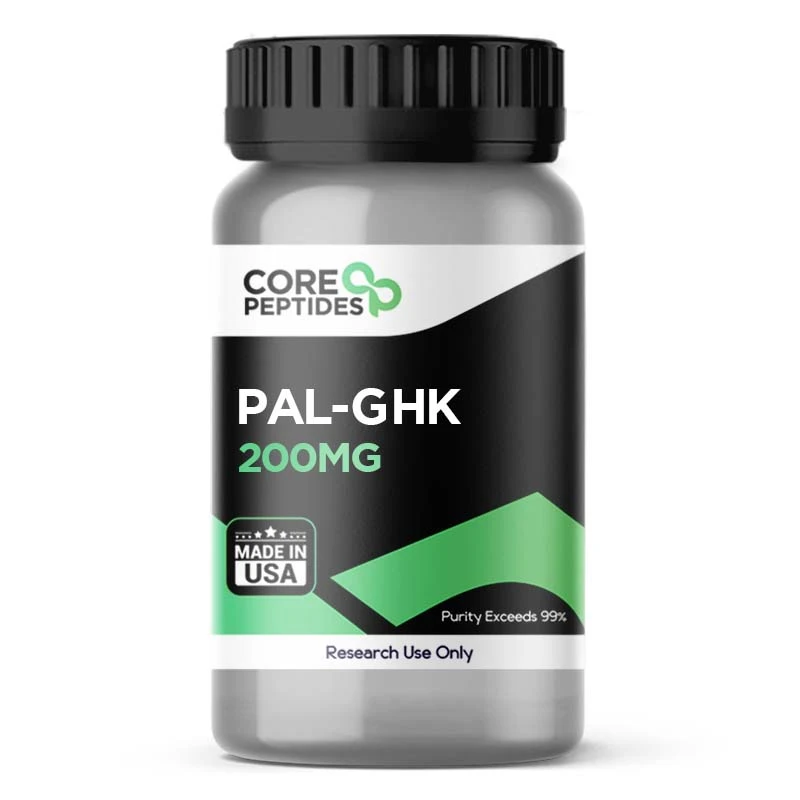
Pal-GHK (200mg) – Palmitoyl GHK Research Peptide
Pal-GHK (200mg), also known as Palmitoyl GHK or Palmitoyl Tripeptide-1, is a synthetic lipopeptide consisting of the naturally occurring tripeptide glycine-histidine-lysine (GHK) modified with a palmitoyl fatty-acid chain. This structural modification increases the lipophilic character of GHK and has been investigated for its potential to improve interaction with the skin’s lipid-rich outer barrier.
The referenced Core Peptides product is supplied as 200mg of Pal-GHK for research and laboratory purposes. Pal-GHK has attracted considerable interest in skin biology and cosmetic-peptide research, particularly in studies involving collagen synthesis, extracellular-matrix signalling, skin permeability and the appearance of wrinkles.
Although Pal-GHK has been used as a topical cosmetic peptide, the strength of evidence varies between laboratory, ex-vivo and human studies. Research reviews note that questions remain regarding optimal delivery, formulation, permeability and the clinical significance of reported effects.
What Is Pal-GHK?
Pal-GHK is a palmitoylated derivative of the tripeptide GHK, whose amino-acid sequence is glycine-histidine-lysine. The palmitoyl group is a 16-carbon fatty-acid chain chemically attached to the peptide, creating a more hydrophobic molecule than unmodified GHK.
GHK has been studied as a signalling peptide associated with extracellular-matrix biology. Researchers became interested in Pal-GHK because attaching a hydrophobic moiety such as palmitic acid can alter the peptide’s physicochemical properties and potentially facilitate interaction with the lipid structures of the stratum corneum.
This distinction is important when comparing Pal-GHK with GHK-Cu. GHK-Cu is a copper complex of GHK, whereas Pal-GHK is produced through covalent attachment of a palmitoyl group. The two compounds therefore have different structures and should not be considered interchangeable.
Pal-GHK (200mg) Product Specifications
| Specification | Details |
|---|---|
| Product Name | Pal-GHK |
| Alternative Names | Palmitoyl GHK, Palmitoyl Tripeptide-1, Palmitoyl-Gly-His-Lys |
| Quantity | 200mg |
| Peptide Sequence | Glycine-Histidine-Lysine (GHK) with a palmitoyl modification |
| Peptide Type | Synthetic palmitoylated tripeptide |
| Research Areas | Skin biology, extracellular matrix, collagen research and peptide permeability |
| Physical Form | Research-grade peptide material |
| Intended Use | Research and laboratory purposes only |
The product quantity and research-use designation are based on the referenced Core Peptides listing. Researchers should consult the applicable batch-specific certificate of analysis for definitive information concerning purity, identity and analytical specifications.
Pal-GHK vs GHK
Pal-GHK and unmodified GHK share the same three-amino-acid backbone, but their physicochemical characteristics are different because Pal-GHK contains an additional palmitoyl group.
| Characteristic | GHK | Pal-GHK |
|---|---|---|
| Core Sequence | Glycine-Histidine-Lysine | Glycine-Histidine-Lysine |
| Modification | None | Palmitoyl fatty-acid chain |
| Lipophilicity | Relatively hydrophilic | Higher due to palmitoylation |
| Research Interest | Cell signalling and extracellular-matrix biology | Topical delivery, skin permeability and extracellular-matrix research |
| Common Research Context | Biological and peptide research | Cosmetic and topical peptide research |
Scientific literature describes palmitoylation as a strategy for modifying hydrophilic peptides to improve their interaction with the lipid environment of the skin. Pal-GHK has consequently become a widely studied peptide in topical cosmetic research.
Pal-GHK and Skin Permeability
One of the primary reasons Pal-GHK differs from GHK is its palmitoyl modification. The outermost layer of human skin, the stratum corneum, contains a highly organised lipid matrix that can restrict the movement of many hydrophilic molecules.
Researchers have investigated whether increasing the hydrophobic character of GHK can improve its interaction with this barrier. A study using advanced molecular profiling techniques detected Pal-GHK within the stratum corneum following topical application of a commercial analogue formulation, providing experimental evidence that the peptide can enter the outer skin layer.
A recent review similarly describes the palmitoyl group as a chemical modification intended to improve skin permeability by increasing the peptide’s affinity for the lipid environment of the stratum corneum.
Skin penetration remains dependent on factors including formulation, concentration, vehicle composition, peptide stability and the condition of the skin. Therefore, the presence of Pal-GHK within the stratum corneum should not automatically be interpreted as proof of a particular clinical effect.
Pal-GHK and Collagen Research
Collagen is one of the major structural proteins of the extracellular matrix. Because collagen content and organisation are closely associated with skin structure, collagen synthesis is a major subject of cosmetic and dermatological peptide research.
Research into GHK identified the tripeptide as a potential signalling fragment associated with collagen breakdown and tissue remodelling. The GHK sequence can occur within collagen, and researchers have proposed that fragments released during collagen degradation may act as signalling molecules for fibroblasts.
Pal-GHK has subsequently been studied for its potential to stimulate extracellular-matrix processes. Core Peptides cites research suggesting that Pal-GHK may influence collagen, elastin and glycosaminoglycan production.
Laboratory and ex-vivo research has reported increased collagen production following exposure to palmitoyl-GHK. A framework for cosmetic-peptide safety evaluation also cites a small human study in which a formulation containing 4 ppm palmitoyl-GHK was associated with an approximately 4% increase in measured skin thickness after four weeks.
These findings are relevant to research into extracellular-matrix biology, but study design, formulation and sample size should be considered when interpreting the results.
Pal-GHK and Extracellular-Matrix Research
The extracellular matrix (ECM) is the complex network of proteins and other molecules surrounding cells. In skin, important ECM components include collagen, elastin and glycosaminoglycans.
Pal-GHK has been investigated as a potential signalling peptide for fibroblast-related extracellular-matrix processes. Its GHK sequence is particularly relevant because GHK has been studied as a matrikine, meaning a small extracellular-matrix-derived peptide that may influence cellular behaviour.
For researchers, Pal-GHK therefore provides a useful model for investigating how lipid-modified matrikines interact with skin-associated cells and extracellular-matrix pathways.
Pal-GHK and Fibroblast Research
Fibroblasts are connective-tissue cells responsible for producing many extracellular-matrix components, including collagen. Their activity is consequently central to laboratory studies of skin structure and tissue remodelling.
Research cited in the scientific literature has investigated Pal-GHK in fibroblast systems and reported effects associated with collagen production. The proposed mechanism is linked to the GHK sequence functioning as a signalling fragment, while the palmitoyl chain may influence topical delivery and interaction with biological membranes.
These observations provide a basis for further research into peptide-mediated signalling between extracellular-matrix fragments and fibroblasts.
Pal-GHK and Wrinkle Research
Pal-GHK has been widely investigated in the context of skin appearance and wrinkle research. The peptide is commonly included in topical formulations designed to investigate changes in skin texture, roughness and wrinkle appearance.
Core Peptides cites a clinical study involving a cream formulation containing Pal-GHK in which researchers reported reductions in wrinkle length, depth and surface roughness following the study period.
A separate placebo-controlled study involving 23 participants was reported to find an approximately 4% increase in skin thickness after four weeks of topical application at a low concentration.
It is important to distinguish these limited studies from broad claims of proven anti-ageing efficacy. Independent reviews have noted that clinical evidence specifically for Pal-GHK remains limited, despite extensive use of the ingredient in cosmetic formulations.
Pal-GHK and Skin Texture Research
Skin texture is influenced by several factors, including hydration, collagen organisation, epidermal structure and extracellular-matrix composition.
Research involving Pal-GHK-containing formulations has examined parameters such as skin roughness and wrinkle depth. The supplier-referenced studies report improvements in several surface measurements following topical use in small human studies.
Because these studies may involve complete formulations rather than isolated research-grade Pal-GHK, researchers should avoid attributing every observed outcome exclusively to the peptide.
Pal-GHK and Antioxidant Research
Oxidative stress is another area in which GHK-derived peptides have attracted research interest. Reactive oxygen species can affect cellular components and contribute to inflammatory and tissue-stress pathways.
Core Peptides discusses experimental research in which Pal-GHK has been investigated in relation to oxidative stress and Nrf2, a transcription factor involved in regulating antioxidant defence mechanisms.
Research described by the supplier proposes that Pal-GHK may influence oxidative-stress pathways in experimental cell systems. Such findings should remain within a laboratory context and should not be interpreted as evidence that Pal-GHK prevents oxidative damage or treats disease in humans.
Pal-GHK and Nrf2 Research
Nuclear factor erythroid 2-related factor 2 (Nrf2) is an important regulator of cellular antioxidant responses. Under appropriate conditions, Nrf2 signalling contributes to the expression of proteins involved in protecting cells from oxidative stress.
Research referenced by Core Peptides has proposed an association between Pal-GHK and increased Nrf2 expression in experimental models of oxidative stress.
These observations may be useful when designing studies examining peptide-mediated responses to oxidative or inflammatory stress. However, additional research is required to determine whether the proposed pathway is reproducible across models and relevant to topical human use.
Pal-GHK and Inflammation Research
Inflammatory signalling is closely connected with tissue injury, oxidative stress and extracellular-matrix remodelling. Pal-GHK has therefore also been discussed in experimental research investigating inflammatory pathways.
Core Peptides describes research in which Pal-GHK has been examined in relation to pathways involving p38 MAPK, TNF-related signalling and IL-6. These mechanisms are proposed areas of investigation rather than established therapeutic effects.
Understanding how Pal-GHK interacts with these signalling pathways may help researchers investigate the relationship between peptide structure, cellular stress and extracellular-matrix biology.
Pal-GHK and Topical Formulation Research
Because Pal-GHK is primarily investigated as a topical peptide, formulation science is an important part of its research profile.
A 2025 study investigated vesicular lipid systems and semi-solid formulations designed to deliver Pal-GHK to the skin. The research demonstrates continuing interest in developing formulation strategies that can improve the delivery and stability of this cosmetic peptide.
Formulation research can examine parameters such as peptide stability, release characteristics, skin interaction and the influence of different delivery systems. These factors are important because peptide activity depends not only on molecular structure but also on whether sufficient material reaches the relevant biological environment.
Potential Research Applications of Pal-GHK
Qualified laboratories may investigate Pal-GHK in several experimental areas, including:
- Collagen research: Investigating peptide-associated changes in collagen synthesis and deposition.
- Fibroblast research: Studying interactions between Pal-GHK and dermal fibroblasts.
- Extracellular-matrix research: Examining collagen, elastin and glycosaminoglycan pathways.
- Skin permeability research: Investigating the effect of palmitoylation on peptide penetration through the stratum corneum.
- Skin ageing research: Studying molecular and structural changes associated with chronological or photoageing.
- Wrinkle research: Investigating changes in wrinkle depth, length and skin roughness.
- Oxidative-stress research: Examining interactions with reactive oxygen species and antioxidant pathways.
- Nrf2 research: Investigating potential effects on cellular antioxidant signalling.
- Inflammatory signalling: Studying pathways such as p38 MAPK and related inflammatory mediators.
- Topical formulation research: Evaluating creams, gels, emulsions and advanced delivery systems.
- Peptide chemistry: Examining how palmitoylation changes peptide physicochemical properties.
- Analytical research: Characterising peptide identity, purity, stability and formulation behaviour.
Why Is Pal-GHK Used in Peptide Research?
Pal-GHK is particularly interesting because it combines a biologically researched tripeptide with a lipid modification that can influence delivery properties.
The parent GHK sequence has been studied extensively in relation to fibroblasts and extracellular-matrix signalling. Adding a palmitoyl chain produces a more hydrophobic molecule that has been investigated for improved interaction with the stratum corneum.
This combination makes Pal-GHK a useful research material for studying the relationship between peptide signalling and topical delivery. Researchers can examine not only biological activity but also how molecular modifications influence penetration, stability and formulation performance.
Pal-GHK Compared With GHK-Cu
Although Pal-GHK and GHK-Cu share the GHK tripeptide sequence, they are chemically distinct derivatives.
| Characteristic | Pal-GHK | GHK-Cu |
|---|---|---|
| Core Peptide | Glycine-Histidine-Lysine | Glycine-Histidine-Lysine |
| Modification | Palmitoyl fatty-acid chain | Copper(II) complex |
| Primary Research Interest | Topical delivery and extracellular-matrix signalling | Copper-dependent peptide biology and skin research |
| Lipophilicity | Increased through palmitoylation | Different physicochemical profile due to copper complexation |
| Topical Research | Extensively used in cosmetic peptide formulations | Also widely investigated in topical formulations |
A scientific review specifically identifies GHK-Cu as a copper complex and Pal-GHK as the palmitoylated derivative of GHK. Their differing modifications can substantially alter physicochemical behaviour and potential delivery characteristics.
Pal-GHK and Matrixyl
Pal-GHK is also associated with the cosmetic peptide ingredient family commonly marketed under Matrixyl formulations. However, individual Matrixyl products can contain different peptide combinations, so Pal-GHK should not automatically be considered synonymous with every Matrixyl product.
Scientific literature identifies Pal-GHK as palmitoyl tripeptide-1 and distinguishes it from palmitoyl hexapeptide-12 and other palmitoylated cosmetic peptides.
For research documentation, using the precise chemical designation Palmitoyl Tripeptide-1 or Pal-GHK can help prevent confusion between different peptide ingredients and multi-peptide commercial formulations.
Research Evidence and Limitations
Pal-GHK has a comparatively substantial history of cosmetic and laboratory research, but its evidence base still requires careful interpretation.
Research has reported effects on collagen-related processes in cell and ex-vivo models, while small human studies have investigated parameters such as skin thickness and wrinkle appearance.
At the same time, a recent review notes that published information concerning the permeability, effectiveness, physicochemical characteristics and safety of GHK derivatives remains incomplete. The authors specifically highlight the need for further research into delivery and formulation.
This distinction is particularly important for research-grade material. Findings obtained using a finished cosmetic formulation cannot necessarily be reproduced with isolated Pal-GHK powder, because the vehicle, concentration and delivery system can substantially affect peptide performance.
Frequently Asked Questions About Pal-GHK (200mg)
What is Pal-GHK?
Pal-GHK is a synthetic palmitoylated derivative of the GHK tripeptide, also known as Palmitoyl Tripeptide-1. It consists of glycine, histidine and lysine with a palmitoyl modification.
What does Pal-GHK stand for?
“Pal” refers to the palmitoyl group attached to GHK. GHK stands for the amino-acid sequence glycine-histidine-lysine.
How much Pal-GHK is supplied?
The referenced Core Peptides product is supplied in a 200mg quantity for research and laboratory purposes.
What is Palmitoyl Tripeptide-1?
Palmitoyl Tripeptide-1 is the formal cosmetic-ingredient name commonly used for Pal-GHK. Scientific literature identifies it as a palmitoylated derivative of the GHK tripeptide.
Is Pal-GHK the same as GHK?
No. Pal-GHK contains the same GHK peptide sequence but has an additional palmitoyl fatty-acid chain. This modification changes the molecule’s physicochemical properties and increases its hydrophobic character.
Is Pal-GHK the same as GHK-Cu?
No. GHK-Cu is a copper complex of GHK, whereas Pal-GHK is a palmitoylated form of GHK. They are distinct compounds with different chemical modifications.
Why is GHK palmitoylated?
Palmitoylation adds a hydrophobic fatty-acid chain to GHK. Researchers use this type of modification to alter peptide lipophilicity and investigate whether it improves interaction with or penetration into the lipid-rich stratum corneum.
Is Pal-GHK studied for collagen?
Yes. Pal-GHK has been investigated in laboratory and human studies involving collagen-related processes. Research has reported increased collagen production in experimental systems, while a small human study reported a modest increase in measured skin thickness following topical application.
Is Pal-GHK studied for wrinkles?
Yes. Small clinical studies have investigated Pal-GHK-containing formulations for wrinkle length, depth and skin roughness. However, the studies are limited in size and formulation-specific, so they should not be interpreted as universal evidence of clinical efficacy.
Can Pal-GHK penetrate the skin?
Experimental research has detected Pal-GHK within the stratum corneum following topical application, supporting the concept that the palmitoyl modification can facilitate interaction with the skin barrier. The degree of penetration depends on formulation and experimental conditions.
Is Pal-GHK a medicine?
No. Pal-GHK is primarily known as a cosmetic and research peptide rather than an authorised medicinal product. Research findings should not be presented as evidence that Pal-GHK diagnoses, treats, cures or prevents disease.
Is Pal-GHK intended for human consumption?
No. The referenced research product is intended for research and laboratory purposes only. It should not be presented as a product for human or animal consumption or self-administration.
Why is formulation important for Pal-GHK?
Peptides can have challenging stability and skin-delivery characteristics. Formulation can influence solubility, stability, release and the amount of peptide available at the skin surface. Recent research has therefore investigated semi-solid and vesicular delivery systems specifically for Pal-GHK.
Pal-GHK (200mg) Research Summary
Pal-GHK (200mg) is a synthetic palmitoylated derivative of the GHK tripeptide and is also known as Palmitoyl Tripeptide-1. Its defining structural feature is the attachment of a palmitoyl fatty-acid chain, which increases the peptide’s lipophilic character and has made it a prominent subject of topical skin-delivery research.
Research has explored Pal-GHK in relation to collagen synthesis, fibroblast activity, extracellular-matrix signalling, skin permeability, wrinkle appearance and oxidative-stress pathways. Experimental evidence includes cell and ex-vivo studies as well as small human investigations of topical formulations.
The research landscape nevertheless has important limitations. Results can depend heavily on the formulation, concentration, delivery vehicle and study design, and independent clinical evidence remains more limited than the peptide’s widespread use in cosmetic formulations might suggest.
For qualified laboratories, Pal-GHK (200mg) provides a defined research material for investigating the relationship between lipid-modified peptides, skin permeability, fibroblast signalling and extracellular-matrix biology.
Research-Use Disclaimer
Pal-GHK (200mg) is intended exclusively for research, laboratory, analytical and in-vitro experimental purposes. It is not intended for human or animal consumption, self-administration, diagnosis, treatment, cure or prevention of any disease.
Statements concerning collagen, wrinkles, skin texture, antioxidant activity, inflammation or other biological effects describe areas of experimental research and should not be interpreted as established medical claims.
Researchers should verify the exact identity, purity and batch-specific analytical information using the applicable certificate of analysis and conduct all experimental work in accordance with relevant legislation, institutional requirements and appropriate laboratory safety procedures.
For research use only. Human and animal consumption prohibited.
Be the first to review “Pal-GHK (200mg)”
Related products
Peptides for Sale
Peptides for Sale
Peptides for Sale
Peptides for Sale
Peptides for Sale
Peptides for Sale
Peptides for Sale
Peptides for Sale
Reviews
There are no reviews yet.