
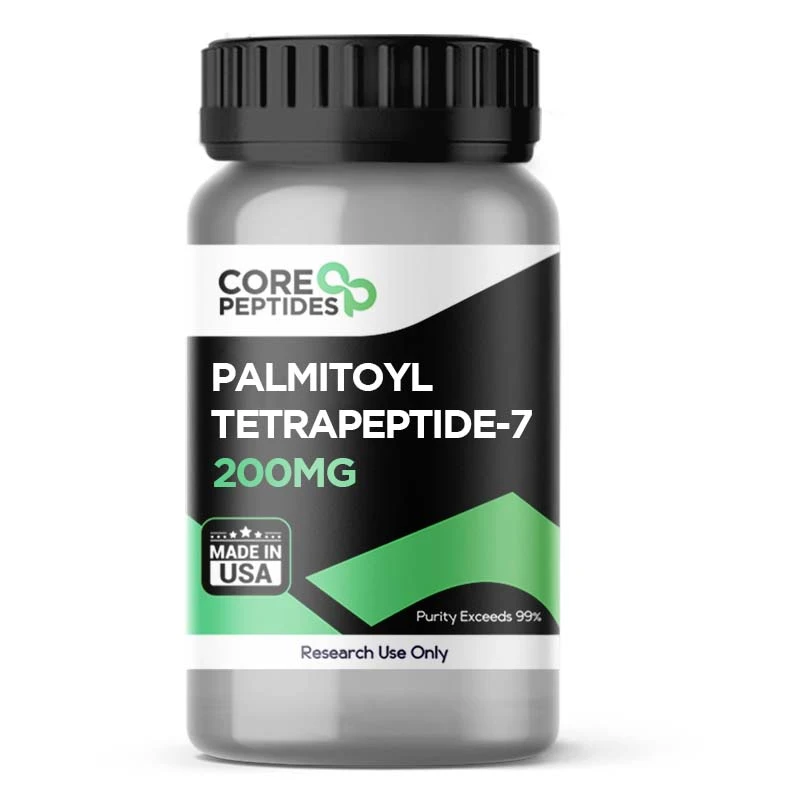
Palmitoyl Tetrapeptide-7 (200mg) – Pal-GQPR Research Peptide
Palmitoyl Tetrapeptide-7 (200mg), also known as Pal-GQPR, is a synthetic, lipid-modified tetrapeptide consisting of the sequence glycine-glutamine-proline-arginine (GQPR) with a palmitoyl group attached to the N-terminus. This structural modification increases the lipophilic character of the peptide and has made Palmitoyl Tetrapeptide-7 an important subject of topical peptide and skin-biology research.
The 200mg research material is intended for qualified laboratory and research applications. Palmitoyl Tetrapeptide-7 has been investigated in areas including dermal extracellular-matrix biology, fibroblast activity, skin elasticity, wrinkle appearance and inflammatory signalling.
However, much of the available evidence comes from formulations containing the peptide alongside other ingredients or peptide combinations, so findings should be interpreted within the limitations of each experimental model.
For researchers investigating cosmetic peptides, Palmitoyl Tetrapeptide-7 provides an opportunity to examine how a palmitoylated peptide interacts with dermal systems and how structural modification can influence peptide behaviour in topical formulations.
What Is Palmitoyl Tetrapeptide-7?
Palmitoyl Tetrapeptide-7 is a synthetic tetrapeptide commonly identified by the abbreviated name Pal-GQPR. Its peptide sequence is glycine-glutamine-proline-arginine (GQPR), with a palmitoyl fatty-acid chain attached to the peptide. Scientific literature describes the GQPR sequence as a fragment associated with immunoglobulin G, while the palmitoyl modification alters the molecule’s physicochemical properties.
The addition of the palmitoyl chain makes the molecule more lipophilic than the unmodified peptide. This type of modification is of particular interest in topical research because the skin’s outer barrier is highly lipid-rich.
Palmitoyl Tetrapeptide-7 is therefore studied not only for its biological interactions but also for questions surrounding peptide delivery, formulation and dermal exposure.
Palmitoyl Tetrapeptide-7 (200mg) Specifications
| Specification | Details |
|---|---|
| Product Name | Palmitoyl Tetrapeptide-7 |
| Alternative Name | Pal-GQPR |
| Peptide Sequence | Gly-Gln-Pro-Arg (GQPR) |
| Modification | N-terminal palmitoylation |
| Quantity | 200mg |
| Peptide Type | Synthetic palmitoylated tetrapeptide |
| CAS Number | 221227-05-0 |
| Research Areas | Dermal biology, extracellular matrix, cosmetic peptide research and topical formulation |
| Intended Use | Research and laboratory purposes only |
PubChem identifies Palmitoyl Tetrapeptide-7 as a defined chemical compound with the molecular formula C34H62N8O7. The Core Peptides product is supplied in a 200mg quantity for research and laboratory use.
Understanding the GQPR Sequence
The four-amino-acid sequence within Palmitoyl Tetrapeptide-7 is:
- G – Glycine
- Q – Glutamine
- P – Proline
- R – Arginine
Together, these amino acids form the GQPR peptide sequence. The peptide is then modified through attachment of a palmitoyl group, producing Pal-GQPR.
The resulting molecule combines a short peptide sequence with a hydrophobic fatty-acid chain. This is particularly relevant to research examining the relationship between peptide structure, lipid interaction and topical delivery.
Why Is Palmitoyl Tetrapeptide-7 Palmitoylated?
Palmitoylation is a chemical modification in which a palmitoyl fatty-acid chain is attached to a molecule. In peptide research, this modification can increase lipophilicity and change how the peptide interacts with lipid-containing environments.
The outer layer of the skin, known as the stratum corneum, contains organised lipid structures that form a significant barrier to many compounds. Researchers therefore investigate lipid-modified peptides such as Palmitoyl Tetrapeptide-7 to understand whether their altered physicochemical properties can affect topical delivery.
Palmitoylation does not automatically guarantee deeper skin penetration or a particular biological outcome. Delivery remains dependent on factors including formulation, concentration, peptide stability and the characteristics of the skin barrier.
Palmitoyl Tetrapeptide-7 and Dermal Research
Palmitoyl Tetrapeptide-7 has attracted interest in dermal cell and extracellular-matrix research. The extracellular matrix is a network of structural proteins and other molecules surrounding cells and plays an important role in maintaining tissue structure.
Research involving Palmitoyl Tetrapeptide-7 has investigated markers associated with dermal structure, including collagen, fibronectin and hyaluronic acid. A study cited by Core Peptides examined Palmitoyl Tetrapeptide-7 as part of a two-peptide combination and reported increases in several extracellular-matrix markers in cultured dermal fibroblast systems.
These results are useful for understanding potential peptide–cell interactions, but they should not be interpreted as proof that isolated Palmitoyl Tetrapeptide-7 will reproduce the same effects in humans.
Palmitoyl Tetrapeptide-7 and Collagen Research
Collagen is one of the principal structural proteins in the extracellular matrix. Because collagen production and degradation influence skin structure, collagen-related pathways are frequently investigated in cosmetic peptide research.
Experimental research has examined Palmitoyl Tetrapeptide-7 in relation to collagen-associated processes. Core Peptides cites laboratory findings involving dermal fibroblast systems in which a formulation containing Palmitoyl Tetrapeptide-7 and another palmitoylated peptide was associated with increased collagen I levels compared with solvent controls.
Such findings provide a basis for further laboratory investigation of peptide signalling and extracellular-matrix biology. They should, however, be distinguished from evidence of clinical efficacy.
Palmitoyl Tetrapeptide-7 and Extracellular-Matrix Research
The extracellular matrix (ECM) provides structural support to cells and contains components such as collagen, fibronectin and hyaluronic acid.
Palmitoyl Tetrapeptide-7 has been investigated as part of research into changes in the dermal ECM and epidermal–dermal junction. In a study referenced by Core Peptides, a combination of palmitoylated peptides was associated with changes in several ECM markers, including collagen I, fibronectin and hyaluronic acid.
These areas remain relevant to researchers studying skin ageing, extracellular-matrix remodelling and cosmetic peptide mechanisms.
Palmitoyl Tetrapeptide-7 and Fibroblast Research
Dermal fibroblasts are connective-tissue cells that contribute to the production and organisation of extracellular-matrix components.
Because fibroblasts are central to collagen and ECM biology, they are frequently used in laboratory investigations of cosmetic peptides. Research involving Palmitoyl Tetrapeptide-7 has examined fibroblast responses and the expression or secretion of ECM-related markers.
For researchers, these experimental models can help explore whether peptide structure and lipid modification influence fibroblast signalling and extracellular-matrix production.
Palmitoyl Tetrapeptide-7 and Skin Elasticity Research
Skin elasticity is influenced by the organisation and condition of collagen, elastin and other extracellular-matrix components. Palmitoyl Tetrapeptide-7 has therefore been included in studies examining changes in skin elasticity and dermal structure.
Core Peptides cites a randomised, double-blind, placebo-controlled study in which a cream containing Palmitoyl Tetrapeptide-7 was applied twice daily for 12 weeks. The study reported reductions in wrinkle depth and length alongside an apparent increase in skin elasticity compared with placebo.
Because the study evaluated a cream formulation rather than isolated research-grade peptide, the results should be interpreted as formulation-specific evidence rather than proof of an independent effect from Palmitoyl Tetrapeptide-7 alone.
Palmitoyl Tetrapeptide-7 and Wrinkle Research
One of the most prominent areas of interest surrounding Palmitoyl Tetrapeptide-7 is wrinkle research.
The Core Peptides reference page reports a randomised, double-blind, placebo-controlled study involving a topical cream containing Palmitoyl Tetrapeptide-7. After 12 weeks, researchers reported apparent reductions in wrinkle depth and length and an increase in skin elasticity relative to placebo.
Another study cited by the supplier reported reductions in measured fine wrinkles of 5.97% after two weeks and 14.07% after four weeks. The same study reported increases in skin elasticity and dermal density over the study period.
These results are of interest to cosmetic science, but the relatively small study populations and the use of formulated products mean that additional independent research is needed before drawing broad conclusions.
Palmitoyl Tetrapeptide-7 and Inflammatory Research
Inflammatory signalling is another area investigated in relation to Palmitoyl Tetrapeptide-7.
Experimental research cited by Core Peptides suggests that Palmitoyl Tetrapeptide-7 may influence the secretion of inflammatory mediators such as interleukin-6 (IL-6). Studies have also investigated responses following UVB exposure.
These observations are relevant to laboratory research into the interaction between cosmetic peptides, cellular stress and inflammatory signalling. They should not be interpreted as evidence that Palmitoyl Tetrapeptide-7 treats inflammation or inflammatory disease in humans.
Palmitoyl Tetrapeptide-7 and UVB Research
Ultraviolet B (UVB) radiation can cause cellular stress and changes in skin-associated signalling pathways. Researchers have therefore investigated compounds that may influence cellular responses following UV exposure.
Research discussed by Core Peptides describes experimental work in which Palmitoyl Tetrapeptide-7 was investigated in relation to inflammatory responses following UVB exposure.
Such studies may help researchers understand how peptide signalling interacts with environmental stress pathways, although laboratory findings cannot automatically be translated into protective effects in humans.
Palmitoyl Tetrapeptide-7 and Hyaluronic Acid Research
Hyaluronic acid is an important component of the extracellular matrix and contributes to hydration and tissue structure.
In fibroblast research cited by Core Peptides, a two-peptide formulation containing Palmitoyl Tetrapeptide-7 was associated with an increase in measured hyaluronic-acid levels compared with controls.
This makes Palmitoyl Tetrapeptide-7 relevant to research examining how peptide-based ingredients may interact with extracellular-matrix components.
Palmitoyl Tetrapeptide-7 and Fibronectin Research
Fibronectin is an extracellular-matrix glycoprotein involved in cell adhesion and tissue organisation.
Experimental research referenced by Core Peptides reported increased fibronectin levels in dermal fibroblast cultures exposed to a combination containing Palmitoyl Tetrapeptide-7.
Researchers can use such findings as a basis for further investigation into the relationship between peptide signalling and ECM remodelling.
Palmitoyl Tetrapeptide-7 vs Palmitoyl Tripeptide-1
Palmitoyl Tetrapeptide-7 and Palmitoyl Tripeptide-1 are both palmitoylated cosmetic peptides, but they have different peptide sequences.
| Characteristic | Palmitoyl Tetrapeptide-7 | Palmitoyl Tripeptide-1 |
|---|---|---|
| Common Name | Pal-GQPR | Pal-GHK |
| Peptide Sequence | Gly-Gln-Pro-Arg | Gly-His-Lys |
| Peptide Length | 4 amino acids | 3 amino acids |
| Modification | Palmitoyl group | Palmitoyl group |
| Research Focus | Dermal ECM, elasticity, wrinkle and inflammatory research | Collagen, extracellular matrix and topical peptide research |
The distinction is important because cosmetic peptide names can be similar while representing different sequences. The Cosmetic Ingredient Review identifies Palmitoyl Tetrapeptide-7 as the GQPR sequence and Palmitoyl Tripeptide-1 as the GHK sequence.
Palmitoyl Tetrapeptide-7 vs GHK-Cu
Palmitoyl Tetrapeptide-7 should not be confused with GHK-Cu.
GHK-Cu is a copper-associated form of the GHK tripeptide, while Palmitoyl Tetrapeptide-7 is the palmitoylated GQPR tetrapeptide. Their amino-acid sequences and chemical modifications are different.
For accurate laboratory documentation, product records should therefore identify the exact peptide sequence and modification rather than relying solely on broad terms such as “copper peptide” or “palmitoyl peptide”.
Palmitoyl Tetrapeptide-7 in Cosmetic Research
Palmitoyl Tetrapeptide-7 is primarily recognised within cosmetic science as a skin-conditioning peptide. The Cosmetic Ingredient Review evaluated Palmitoyl Tetrapeptide-7 alongside several other peptide ingredients and concluded that the ingredients were safe for cosmetic use under the practices and concentrations assessed.
The safety assessment noted that these peptide ingredients were typically used at very low concentrations in cosmetic products. The conclusion applies to cosmetic use under the specific conditions reviewed and does not establish the safety of concentrated research materials or other routes of administration.
Research Applications of Palmitoyl Tetrapeptide-7
Qualified researchers may investigate Palmitoyl Tetrapeptide-7 in areas such as:
- Dermal biology: Investigating peptide interactions with skin-associated cells.
- Fibroblast research: Studying cellular responses to Pal-GQPR.
- Collagen research: Examining collagen-associated pathways and ECM markers.
- Extracellular-matrix research: Studying collagen, fibronectin and hyaluronic-acid pathways.
- Skin elasticity research: Investigating changes in dermal structure and mechanical properties.
- Wrinkle research: Evaluating changes in wrinkle depth, length and surface appearance.
- Inflammatory signalling: Studying IL-6 and related cellular pathways.
- UVB research: Investigating cellular responses to ultraviolet stress.
- Topical formulation research: Evaluating peptide incorporation into creams, gels and other delivery systems.
- Peptide chemistry: Examining how N-terminal palmitoylation changes peptide properties.
- Analytical research: Characterising peptide identity, purity and stability.
Why Choose Palmitoyl Tetrapeptide-7 for Research?
Palmitoyl Tetrapeptide-7 offers researchers a defined lipid-modified peptide for investigating the intersection of peptide chemistry, dermal biology and topical formulation science.
Its GQPR sequence and palmitoyl modification provide a distinct molecular structure that can be compared with other cosmetic peptides. This makes it useful for research into how peptide sequence and lipid modification influence cellular interactions, extracellular-matrix markers and topical delivery.
The availability of a 200mg research quantity can also support analytical and formulation-development projects where repeated experimental measurements are required.
Research Evidence and Limitations
Palmitoyl Tetrapeptide-7 has been investigated in laboratory studies and small topical human studies, particularly in relation to dermal structure and cosmetic appearance. However, the evidence should be interpreted carefully.
A notable limitation is that some studies evaluate Palmitoyl Tetrapeptide-7 in combination with other peptides rather than as an isolated active ingredient. Core Peptides specifically notes that much of the available research has involved peptide blends.
Similarly, clinical studies involving creams assess the complete formulation, including the vehicle and other ingredients. Therefore, measured changes cannot necessarily be attributed entirely to Palmitoyl Tetrapeptide-7.
Current evidence supports continued investigation, but it does not establish Palmitoyl Tetrapeptide-7 as a medicine or as a proven treatment for skin conditions.
Frequently Asked Questions About Palmitoyl Tetrapeptide-7 (200mg)
What is Palmitoyl Tetrapeptide-7?
Palmitoyl Tetrapeptide-7 is a synthetic, palmitoylated tetrapeptide also known as Pal-GQPR. Its peptide sequence is glycine-glutamine-proline-arginine (GQPR).
What does Pal-GQPR mean?
Pal-GQPR refers to the GQPR tetrapeptide with an N-terminal palmitoyl modification. “Pal” indicates the palmitoyl group, while GQPR identifies the four-amino-acid sequence.
How much Palmitoyl Tetrapeptide-7 is supplied?
The referenced product is supplied as 200mg of Palmitoyl Tetrapeptide-7 for research and laboratory purposes.
What is the sequence of Palmitoyl Tetrapeptide-7?
The peptide sequence is Gly-Gln-Pro-Arg (GQPR). The N-terminal portion is modified with a palmitoyl group.
What is Palmitoyl Tetrapeptide-7 used for in research?
Research applications include dermal cell studies, extracellular-matrix research, collagen-related investigations, wrinkle and elasticity research, inflammatory signalling and topical formulation development.
Is Palmitoyl Tetrapeptide-7 the same as Palmitoyl Tripeptide-1?
No. Palmitoyl Tetrapeptide-7 contains the GQPR sequence, whereas Palmitoyl Tripeptide-1 contains the GHK sequence. They are different peptides.
Is Palmitoyl Tetrapeptide-7 a copper peptide?
No. Palmitoyl Tetrapeptide-7 is a palmitoylated GQPR peptide. It does not represent the copper-associated GHK peptide commonly referred to as GHK-Cu.
Is Palmitoyl Tetrapeptide-7 studied for collagen?
Yes. Experimental research has examined Palmitoyl Tetrapeptide-7 in relation to collagen and extracellular-matrix markers, although some studies evaluate it in combination with other peptides.
Is Palmitoyl Tetrapeptide-7 studied for wrinkles?
Yes. Small topical studies cited by Core Peptides have investigated wrinkle depth, wrinkle length and skin elasticity following application of formulations containing Palmitoyl Tetrapeptide-7.
Is Palmitoyl Tetrapeptide-7 safe?
The Cosmetic Ingredient Review Expert Panel concluded that Palmitoyl Tetrapeptide-7 is safe in cosmetics under the practices and concentrations assessed in its safety review. This conclusion should not be extrapolated to concentrated research material, ingestion or unapproved routes of administration.
Is Palmitoyl Tetrapeptide-7 intended for human consumption?
No. The referenced 200mg product is designated for research and laboratory purposes only. It should not be presented as a product for human or animal consumption or self-administration.
Why is the palmitoyl group important?
The palmitoyl group increases the lipophilic character of the peptide and can alter its interaction with lipid environments. This is particularly relevant to research into topical peptide delivery and skin-barrier interactions.
Palmitoyl Tetrapeptide-7 (200mg) Research Summary
Palmitoyl Tetrapeptide-7 (200mg) is a synthetic palmitoylated tetrapeptide, also known as Pal-GQPR, containing the GQPR sequence. Its N-terminal palmitoyl modification gives the molecule a more lipophilic character and makes it particularly relevant to topical cosmetic peptide research.
Research has examined Palmitoyl Tetrapeptide-7 in relation to dermal fibroblasts, collagen and extracellular-matrix markers, skin elasticity, wrinkle appearance, inflammatory signalling and UVB-related cellular responses. Small topical studies have reported changes in wrinkle measurements and elasticity, while laboratory research has investigated possible effects on ECM-associated markers.
Nevertheless, the available evidence has limitations, particularly where Palmitoyl Tetrapeptide-7 is studied as part of a multi-peptide formulation. Further independent research can help clarify the contribution of the peptide itself and the influence of formulation and delivery conditions.
For qualified laboratories, Palmitoyl Tetrapeptide-7 (200mg) provides a defined research material for investigating lipid-modified peptide chemistry, dermal biology and extracellular-matrix pathways.
Research-Use Disclaimer
Palmitoyl Tetrapeptide-7 (200mg) is intended exclusively for research, laboratory, analytical and in-vitro experimental purposes. It is not intended for human or animal consumption, self-administration, diagnosis, treatment, cure or prevention of any disease.
Statements concerning collagen, wrinkles, skin elasticity, inflammation, UVB responses or other biological effects describe areas of experimental research and should not be interpreted as established medical claims.
Researchers should review the applicable certificate of analysis and product documentation for batch-specific identity, purity and analytical information. All experimental work should be performed by appropriately qualified personnel and in accordance with applicable legislation, institutional requirements and laboratory safety procedures.
For research use only. Human and animal consumption prohibited.
Be the first to review “Palmitoyl Tetrapeptide-7 (200mg)”
Related products
Peptides for Sale
Peptides for Sale
Peptides for Sale
Peptides for Sale
Peptides for Sale
Peptides for Sale
Peptides for Sale
Peptides for Sale
Reviews
There are no reviews yet.