
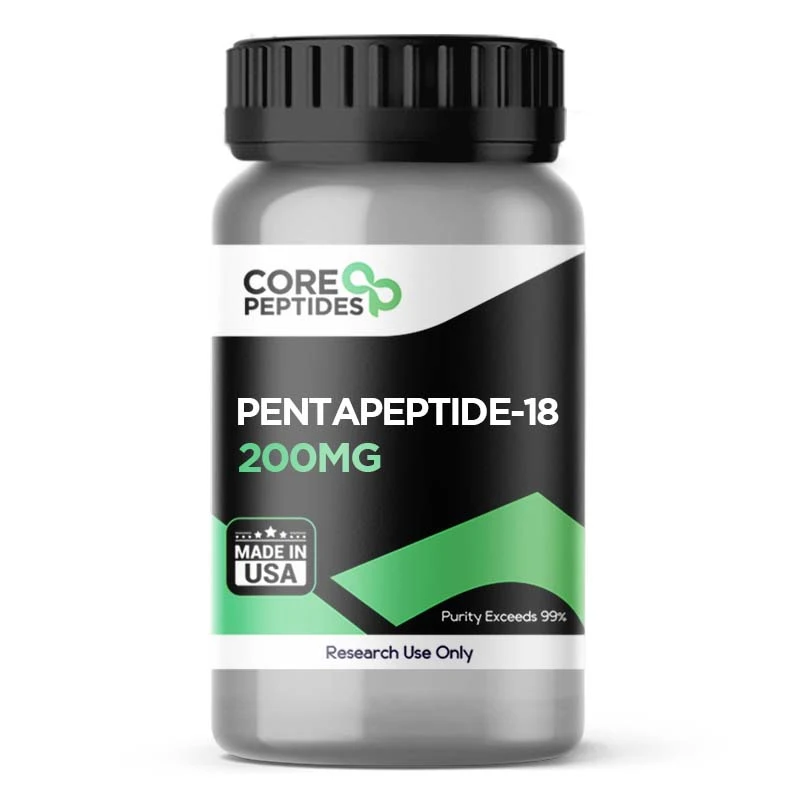

Pentapeptide-18 (Leuphasyl) (200mg) – Topical Research Peptide
Pentapeptide-18 (Leuphasyl) (200mg) is a synthetic five-amino-acid peptide widely studied as a cosmetic and topical research ingredient. Also known as Leuphasyl, Pentapeptide-18 has the sequence Tyr-D-Ala-Gly-Phe-Leu and is structurally related to the endogenous peptide leucine-enkephalin.
PubChem identifies Pentapeptide-18 as [D-Ala2]leucine-enkephalin, with the molecular formula C29H39N5O7 and a molecular weight of approximately 569.6 Da.
The referenced Core Peptides product contains 200mg of Pentapeptide-18 in lyophilised powder form and is listed with a reported purity of greater than 99%. It is supplied as a research material rather than as a finished cosmetic formulation.
Research into Pentapeptide-18 has primarily focused on cosmetic applications involving expression lines and the biological pathways associated with facial muscle contraction.
Proposed mechanisms centre on enkephalin-related neuronal signalling and modulation of neurotransmitter release. These mechanisms remain an area of scientific and cosmetic research and should not be interpreted as evidence of a medical treatment.
What Is Pentapeptide-18 (Leuphasyl)?
Pentapeptide-18 is a synthetic pentapeptide consisting of five amino-acid residues. Its recognised sequence is Tyr-D-Ala-Gly-Phe-Leu, and its commercial name Leuphasyl is widely associated with this cosmetic peptide.
The molecule is structurally related to leucine-enkephalin, an endogenous pentapeptide involved in neuronal signalling. Pentapeptide-18 differs from leucine-enkephalin through the incorporation of D-alanine at the second position.
This structural design is relevant to its research as an enkephalin-mimetic cosmetic ingredient. Unlike larger growth-factor peptides, Pentapeptide-18 is a relatively small molecule and is primarily investigated in the field of topical cosmetic peptide research.
Recent reviews of bioactive cosmetic peptides identify neurotransmitter modulation and related signalling pathways as important areas of investigation for this class of ingredients.
Pentapeptide-18 (200mg) Product Specifications
| Specification | Details |
|---|---|
| Product Name | Pentapeptide-18 (Leuphasyl) |
| Quantity | 200mg |
| Peptide Type | Synthetic pentapeptide |
| Sequence | Tyr-D-Ala-Gly-Phe-Leu |
| Alternative Name | Leuphasyl |
| CAS Number | 64963-01-5 |
| Molecular Formula | C29H39N5O7 |
| Molecular Weight | Approximately 569.6 g/mol |
| Form | Lyophilised powder |
| Reported Purity | >99% |
| Research Area | Topical peptide, cosmetic and skin-biology research |
| Intended Application | Laboratory and research use |
The product specifications above reflect the current Core Peptides listing, while the molecular identity and sequence are independently documented by PubChem and the FDA’s substance database.
Pentapeptide-18 Chemical Structure
Pentapeptide-18 has the sequence:
H-Tyr-D-Ala-Gly-Phe-Leu-OH
The sequence contains five amino-acid residues: tyrosine, D-alanine, glycine, phenylalanine and leucine. PubChem records Pentapeptide-18 under the synonym [D-Ala2]leucine-enkephalin and assigns it PubChem CID 10099522.
The presence of D-alanine distinguishes Pentapeptide-18 from naturally occurring leucine-enkephalin and is an important feature of its molecular design.
How Does Pentapeptide-18 Work?
Pentapeptide-18 is commonly described as an enkephalin-mimetic peptide. Research into its proposed activity focuses on neuronal signalling associated with facial muscle contraction and the formation of expression lines.
The proposed pathway involves interaction with enkephalin-sensitive receptors associated with presynaptic neuronal signalling. According to the proposed model, receptor activity can influence calcium-channel behaviour and consequently affect the release of neurotransmitters involved in neuromuscular communication.
In cosmetic research, this pathway is of interest because repeated facial muscle contractions contribute to the appearance of dynamic expression lines. Modulating the intensity of this signalling is therefore investigated as a potential approach to topical anti-wrinkle formulation development.
Importantly, these proposed mechanisms should be considered within the context of laboratory and cosmetic research. They do not establish Pentapeptide-18 as equivalent to injectable botulinum toxin or as a medicinal treatment.
Pentapeptide-18 and Enkephalin Research
Leuphasyl is structurally inspired by naturally occurring enkephalin peptides. Leucine-enkephalin contains the sequence Tyr-Gly-Gly-Phe-Leu, whereas Pentapeptide-18 incorporates D-alanine at the second position. PubChem specifically identifies the compound as [D-Ala2]leucine-enkephalin.
Enkephalins are endogenous signalling peptides involved in opioid-receptor pathways. The structural relationship between Pentapeptide-18 and these naturally occurring peptides provides the basis for research into its interaction with neuronal signalling pathways.
This enkephalin-mimetic design differentiates Pentapeptide-18 from other cosmetic peptides that operate through extracellular-matrix signalling, collagen-related pathways or different neuromuscular mechanisms.
Pentapeptide-18 and Expression Lines
One of the principal cosmetic research applications for Pentapeptide-18 is the study of expression lines and dynamic wrinkles.
Facial expressions involve repeated contraction of facial muscles. Over time, repetitive movement can contribute to visible lines and wrinkles. Cosmetic peptides that influence neuronal communication have consequently attracted interest as topical approaches to improving the appearance of expression-related skin ageing.
A review of topical peptide treatments describes Pentapeptide-18 as a cosmetic peptide investigated for its potential effects on fine lines and wrinkles. The review also discusses research involving Pentapeptide-18 alone and in combination with Acetyl Hexapeptide-3.
The distinction between cosmetic appearance and medical treatment is important: research concerning wrinkle appearance does not establish Pentapeptide-18 as a therapeutic intervention for skin disease.
Pentapeptide-18 and Skin Research
Cosmetic peptide research extends beyond wrinkle appearance and includes studies of skin structure, elasticity, hydration and cellular signalling.
A recent review of commercially available bioactive cosmetic peptides identified a wide range of proposed biological activities, including modulation of neurotransmitter pathways, enzyme activity, extracellular-matrix production, pigmentation and cellular defence. The review also emphasises that the strength of evidence varies substantially between individual peptides and experimental models.
For Pentapeptide-18 specifically, current research is particularly relevant to neuronal and neuromuscular signalling rather than treating the peptide as a general-purpose skin-repair agent.
Pentapeptide-18 and Acetylcholine Research
Acetylcholine is a neurotransmitter involved in communication between motor neurons and skeletal muscle. Its release at the neuromuscular junction plays an important role in muscle contraction.
The proposed cosmetic mechanism of Pentapeptide-18 involves modulation of presynaptic neuronal signalling that may influence neurotransmitter release. Research sources describe potential effects on calcium influx and subsequent neurotransmitter secretion.
This mechanism is scientifically interesting because it provides a pathway through which a topical peptide could theoretically influence the appearance of dynamic facial lines without directly altering the structure of the skin.
However, the precise degree of topical penetration, receptor engagement and biological activity depends on the final formulation, concentration, delivery system and experimental conditions.
Pentapeptide-18 and Calcium Signalling
Calcium ions play an essential role in neurotransmitter release. When a presynaptic nerve terminal is activated, calcium entry helps trigger vesicle fusion and neurotransmitter release.
The proposed mechanism for Leuphasyl involves modulation of presynaptic calcium-channel activity through enkephalin-related signalling. Reduced calcium influx could theoretically decrease neurotransmitter release at the neuromuscular junction.
For cosmetic research, this mechanism is relevant because reduced neurotransmitter signalling may decrease the intensity of repetitive muscle contraction associated with expression lines.
Pentapeptide-18 vs Other Cosmetic Peptides
| Peptide | General Research Focus | Primary Research Concept |
|---|---|---|
| Pentapeptide-18 (Leuphasyl) | Expression-line and neuromuscular research | Enkephalin-related neuronal signalling |
| Acetyl Hexapeptide-8 | Expression-line research | SNARE-related neurotransmitter release |
| Palmitoyl Pentapeptide-4 | Skin ageing and extracellular matrix research | Collagen-related signalling |
| Palmitoyl Tripeptide-5 | Skin structure and matrix research | Collagen-related pathways |
These peptides should not be treated as interchangeable. Cosmetic peptides can have substantially different sequences, targets and proposed mechanisms. Reviews of topical peptide research highlight the diversity of mechanisms investigated across this category.
Pentapeptide-18 and Acetyl Hexapeptide-8
Pentapeptide-18 and Acetyl Hexapeptide-8 are both commonly discussed in the context of expression-line cosmetics, but their proposed molecular pathways differ.
Pentapeptide-18 is an enkephalin-related pentapeptide associated with presynaptic neuronal signalling, while Acetyl Hexapeptide-8 is generally investigated in relation to SNAP-25 and the SNARE complex.
Research has also explored the use of these peptides together. A review of topical peptide treatments reported experimental findings in which formulations containing Pentapeptide-18 and Acetyl Hexapeptide-3 were evaluated separately and in combination, with the combination producing a greater reported reduction in wrinkle measurements in that particular study.
Such findings should be interpreted as formulation-specific evidence rather than a guarantee that combining the two ingredients will produce the same outcome in every product.
Pentapeptide-18 in Cosmetic Formulation Research
Pentapeptide-18 is relevant to laboratories investigating the development and optimisation of topical peptide formulations.
Research may examine:
- Peptide stability within different formulation environments.
- Solubility and compatibility with cosmetic bases.
- Release characteristics from topical delivery systems.
- Skin compatibility in appropriate laboratory models.
- Neuronal signalling associated with expression-line mechanisms.
- Formulation concentration and peptide performance.
- Interactions with other cosmetic actives.
- Physical stability during storage and formulation development.
Topical peptide research is highly formulation-dependent. The behaviour of a purified peptide powder cannot be assumed to represent the behaviour of the same peptide once incorporated into a cream, serum, gel or other cosmetic vehicle.
Pentapeptide-18 and Topical Delivery
Topical delivery is an important consideration for cosmetic peptide research. A purified peptide must interact with a complex skin barrier before reaching its intended biological environment.
The effectiveness of a topical peptide can depend on factors including molecular size, charge, solubility, formulation pH, vehicle composition, concentration and skin-barrier properties. Research into topical peptides therefore commonly evaluates both the peptide itself and the formulation in which it is delivered.
Published research on cosmetic peptides highlights that evidence for biological activity can vary depending on whether a study uses isolated cells, reconstructed skin, ex vivo tissue or human participants.
Consequently, laboratory findings involving Pentapeptide-18 should not automatically be interpreted as evidence of equivalent activity following topical application to human skin.
Pentapeptide-18 and Cosmetic Research Evidence
The scientific literature concerning Pentapeptide-18 includes reviews, laboratory investigations and cosmetic formulation studies. A 2026 study evaluated Leuphasyl alongside Vialox using molecular docking, molecular-dynamics simulations and in-vitro cytotoxicity testing. The authors investigated interactions with matrix metalloproteinases and SIRT-1 and reported no cytotoxicity in HaCaT cells at concentrations up to 1mg/mL under the tested conditions.
This study provides additional experimental information about Leuphasyl but does not establish clinical efficacy or prove that topical Pentapeptide-18 produces a particular cosmetic outcome in humans.
More broadly, recent reviews of bioactive cosmetic peptides emphasise the need to distinguish between in-vitro, ex-vivo and clinical evidence when evaluating cosmetic peptide claims.
Pentapeptide-18 and Skin-Ageing Research
Skin ageing involves multiple biological processes, including changes in extracellular-matrix organisation, collagen and elastin turnover, oxidative stress, pigmentation and altered cellular signalling.
Pentapeptide-18 occupies a particular niche within anti-ageing research because its proposed activity relates primarily to neuromuscular signalling and expression lines rather than directly replacing structural components of the extracellular matrix.
This makes it scientifically distinct from matrix-oriented peptides such as palmitoylated collagen-supporting peptides. Research into cosmetic peptides increasingly examines these different mechanisms separately.
Pentapeptide-18 Research Applications
Qualified laboratories may investigate Pentapeptide-18 in areas including:
- Cosmetic peptide research and topical formulation development.
- Expression-line research involving facial muscle activity.
- Neuronal signalling and neurotransmitter-release models.
- Enkephalin-mimetic peptide research.
- Calcium-channel signalling in appropriate experimental models.
- Skin-cell research involving cosmetic peptide formulations.
- Peptide stability studies under different formulation conditions.
- Topical delivery research using laboratory skin models.
- Combination-peptide studies examining interactions with other cosmetic actives.
- Structure–activity research investigating how sequence modifications affect peptide behaviour.
Analytical Characterisation of Pentapeptide-18
Reliable analytical characterisation is important when working with purified research peptides.
Researchers may evaluate:
- Identity: Confirmation that the material corresponds to Pentapeptide-18.
- Sequence: Verification of the Tyr-D-Ala-Gly-Phe-Leu structure.
- Purity: Assessment using suitable chromatographic methods.
- Molecular mass: Confirmation using an appropriate mass-spectrometric method.
- Batch consistency: Comparison of analytical results between production lots.
- Physical characteristics: Assessment of the lyophilised material.
- Stability: Monitoring under defined storage and formulation conditions.
Core Peptides reports a purity of greater than 99% for the referenced 200mg product. Researchers should nevertheless review the applicable batch-specific certificate of analysis and technical documentation when conducting experimental work.
Pentapeptide-18 (Leuphasyl) Storage Considerations
Lyophilised peptides should be handled according to the manufacturer’s current storage instructions and the documentation supplied with the specific batch.
For laboratory research, good practice generally includes:
- Keeping the material in its original, properly labelled container.
- Protecting the material from unnecessary exposure to moisture.
- Limiting exposure to unsuitable temperatures.
- Protecting sensitive materials from excessive light where appropriate.
- Following the supplier’s certificate of analysis and safety documentation.
- Using appropriate laboratory handling procedures.
Because storage requirements can vary according to formulation, packaging and peptide characteristics, the manufacturer’s batch documentation should take precedence over generic storage recommendations.
Frequently Asked Questions About Pentapeptide-18 (Leuphasyl)
What is Pentapeptide-18?
Pentapeptide-18 is a synthetic five-amino-acid peptide used primarily in cosmetic and topical peptide research. It is also known by the commercial name Leuphasyl. Its sequence is Tyr-D-Ala-Gly-Phe-Leu.
What is Leuphasyl?
Leuphasyl is a commercial name associated with Pentapeptide-18. The FDA substance database and PubChem identify Pentapeptide-18 as Tyr-D-Ala-Gly-Phe-Leu and as [D-Ala2]leucine-enkephalin.
What is the sequence of Pentapeptide-18?
The recognised sequence is Tyr-D-Ala-Gly-Phe-Leu. PubChem lists the molecular structure as H-Tyr-D-Ala-Gly-Phe-Leu-OH.
What is the molecular weight of Pentapeptide-18?
PubChem reports a molecular weight of approximately 569.6 g/mol for Pentapeptide-18.
What is the CAS number for Pentapeptide-18?
The CAS number associated with Pentapeptide-18 is 64963-01-5.
Why is Pentapeptide-18 used in cosmetic research?
Pentapeptide-18 is investigated particularly for its proposed effects on neuronal signalling associated with facial muscle contraction and the appearance of expression lines. Reviews of topical cosmetic peptides have discussed its potential anti-wrinkle applications.
Is Pentapeptide-18 the same as botulinum toxin?
No. Pentapeptide-18 is a small synthetic cosmetic peptide, whereas botulinum toxin is a biological neurotoxin with a fundamentally different structure, mechanism and clinical status. Similarities in discussions of expression lines should not be interpreted as equivalence.
Can Pentapeptide-18 be used with other cosmetic peptides?
Research has investigated Pentapeptide-18 in combination with other cosmetic peptides, including Acetyl Hexapeptide-3. However, the outcome of combining ingredients depends on the specific formulation and experimental conditions.
Is Pentapeptide-18 a collagen peptide?
No. Pentapeptide-18 is primarily researched as an enkephalin-mimetic, neuromuscular-signalling cosmetic peptide. It should not be confused with collagen-associated peptides such as palmitoylated matrix peptides.
Is the 200mg product a finished skincare product?
No. The referenced Core Peptides product is supplied as 200mg of lyophilised Pentapeptide-18 powder, rather than as a finished cream or serum. The listing reports greater than 99% purity.
Is Pentapeptide-18 intended for human consumption?
No. The referenced supplier states that its products are sold for research, laboratory or analytical purposes only and are not intended for human consumption.
Does Pentapeptide-18 have established medical uses?
Pentapeptide-18 is primarily discussed as a cosmetic research ingredient. Research into its potential effects on expression lines should not be presented as evidence of an approved medical indication.
What research supports Pentapeptide-18?
Research includes reviews of topical cosmetic peptides, laboratory investigations and more recent computational and in-vitro studies examining Leuphasyl’s molecular interactions and biological properties. Evidence varies by study design, and laboratory findings should not be equated with established clinical efficacy.
Why Choose Pentapeptide-18 (Leuphasyl) (200mg) for Research?
Pentapeptide-18 (Leuphasyl) (200mg) offers a defined synthetic peptide material for laboratories investigating topical cosmetic peptide chemistry, neuronal signalling and expression-line biology.
- Defined peptide identity: Pentapeptide-18 / Leuphasyl.
- Recognised sequence: Tyr-D-Ala-Gly-Phe-Leu.
- Research quantity: 200mg.
- Lyophilised form: Suitable for controlled laboratory handling and formulation research.
- Reported purity: Greater than 99% according to the referenced supplier listing.
- Broad research relevance: Applicable to cosmetic peptide, neuronal signalling and topical formulation studies.
The molecular identity of Pentapeptide-18 is independently documented by public chemical databases, while the supplier provides product-specific information concerning quantity, physical form and reported purity.
Pentapeptide-18 (Leuphasyl) Research Summary
Pentapeptide-18 (Leuphasyl) (200mg) is a synthetic enkephalin-related pentapeptide with the sequence Tyr-D-Ala-Gly-Phe-Leu. It is primarily investigated within cosmetic and topical research, particularly in connection with neuronal signalling, facial muscle contraction and expression-line appearance.
The proposed mechanism involves enkephalin-related receptor signalling and modulation of presynaptic neurotransmitter release. This distinguishes Pentapeptide-18 from matrix-focused cosmetic peptides and from other expression-line ingredients that act through different molecular pathways.
Recent scientific work continues to examine Leuphasyl using computational modelling, cell-based assays and broader reviews of bioactive cosmetic peptides. Such research is useful for understanding molecular activity and formulation potential, but the evidence should be interpreted according to the experimental model and should not be overstated as proof of clinical efficacy.
For qualified laboratories and formulation researchers, the 200mg Pentapeptide-18 format provides a defined research material for studying peptide chemistry, topical delivery, cosmetic formulation and enkephalin-related signalling.
Research-Use Disclaimer
Pentapeptide-18 (Leuphasyl) (200mg) is intended for qualified research, laboratory, analytical and formulation-development purposes only. It is not intended for human or veterinary consumption, self-administration, diagnosis, treatment, cure or prevention of any disease.
References to wrinkle reduction, muscle contraction, neurotransmitter modulation, skin appearance or anti-ageing activity describe areas of scientific and cosmetic research. They should not be interpreted as guaranteed results or established medical benefits.
Researchers should review the applicable certificate of analysis, safety documentation and supplier instructions for the specific batch before conducting experimental work. All handling, storage, formulation and disposal should be performed by appropriately trained personnel in accordance with institutional procedures and applicable legislation.
For research use only. Human and animal consumption prohibited.
Be the first to review “Pentapeptide-18 (Leuphasyl) (200mg)”
Related products
Peptides for Sale
Peptides for Sale
Peptides for Sale
Peptides for Sale
Peptides for Sale
Peptides for Sale
Peptides for Sale
Peptides for Sale
Reviews
There are no reviews yet.