
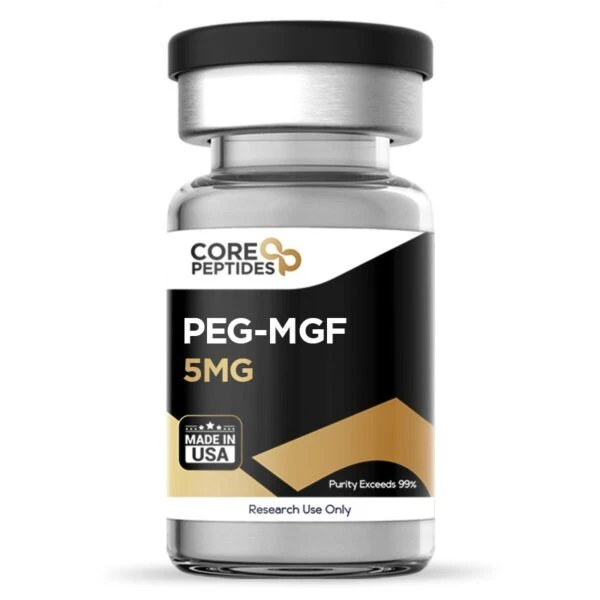


PEG-MGF (5mg) – PEGylated Mechano Growth Factor Research Peptide
PEG-MGF (5mg) is a synthetic, polyethylene glycol-modified form of Mechano Growth Factor (MGF), a peptide associated with the insulin-like growth factor 1 (IGF-1) family. MGF is commonly discussed in the scientific literature in connection with IGF-1 splice variants and skeletal-muscle responses to mechanical stress.
PEG-MGF is designed by attaching polyethylene glycol (PEG) to MGF, creating a modified research molecule with different physicochemical and pharmacokinetic characteristics from unmodified MGF.
The referenced product contains 5mg of lyophilised PEG-MGF and is listed with a reported purity of greater than 99%. It is intended for laboratory, analytical and research applications rather than human or veterinary use.
Research surrounding MGF and its E-domain peptides has explored muscle-cell proliferation, myogenic precursor-cell activity, cellular migration and tissue-repair pathways.
However, it is important to distinguish this literature from evidence specifically establishing PEG-MGF as a defined therapeutic compound. The scientific literature on native MGF and synthetic MGF-derived peptides is substantially broader than the evidence specifically characterising PEG-MGF.
What Is PEG-MGF?
PEG-MGF stands for polyethylene glycol-modified Mechano Growth Factor. MGF is associated with an alternatively spliced form of the IGF-1 gene and has also been referred to in the literature as IGF-1Ec in humans.
Research into MGF has focused particularly on its relationship with skeletal-muscle adaptation, mechanical stress and muscle-cell biology. PEGylation refers to the covalent attachment of a polyethylene glycol chain to another molecule.
In peptide research, PEGylation can alter molecular size, solubility, stability and clearance characteristics. The Core Peptides reference describes PEG-MGF as a PEGylated form of MGF developed with the aim of extending the peptide’s experimental duration.
Because PEGylation changes a peptide’s structure and pharmacokinetic behaviour, findings obtained with native MGF or non-PEGylated MGF-derived peptides should not automatically be assumed to apply to every PEG-MGF construct.
PEG-MGF (5mg) Specifications
| Specification | Details |
|---|---|
| Product Name | PEG-MGF |
| Full Name | PEGylated Mechano Growth Factor |
| Related Peptide | Mechano Growth Factor (MGF) |
| Related IGF-1 Isoform | IGF-1Ec / IGF-1Eb nomenclature varies by species and literature context |
| Quantity | 5mg |
| Physical Form | Lyophilised powder |
| Reported Purity | >99% |
| Research Area | Peptide biology, IGF-related signalling and muscle-cell research |
| Intended Use | Laboratory, analytical and research purposes only |
The Core Peptides listing identifies the product as PEG-MGF (5mg), supplied as lyophilised powder with a stated purity of greater than 99%. Batch-specific analytical information should always be verified using the applicable certificate of analysis.
Understanding Mechano Growth Factor (MGF)
Mechano Growth Factor is a term used in research concerning an IGF-1 splice variant associated with skeletal-muscle responses to mechanical stress. Scientific literature has described alternative splicing of IGF-1 pre-mRNA and the production of distinct IGF-1-related isoforms with different C-terminal sequences.
Early research suggested that the MGF-associated splice variant is upregulated following exercise or muscle injury. Subsequent studies investigated synthetic peptides corresponding to the C-terminal E-domain region of MGF to understand their effects on myogenic cells.
This research has contributed to interest in MGF as an experimental model for studying muscle-cell proliferation, differentiation and repair.
What Does PEGylation Mean?
PEGylation is the process of attaching a polyethylene glycol chain to a biological molecule such as a peptide or protein.
The modification can influence several molecular properties, including:
- Molecular size: PEG increases the effective hydrodynamic size of the molecule.
- Solubility: PEG can alter interactions between the modified molecule and its surrounding environment.
- Proteolytic stability: PEGylation may reduce access of certain proteolytic enzymes to the modified molecule.
- Clearance: The larger modified molecule may exhibit different clearance characteristics from the unmodified peptide.
- Tissue exposure: Changes in molecular properties can alter distribution and exposure.
These effects depend strongly on the precise PEG chain, attachment site and molecular architecture. Consequently, PEG-MGF should be regarded as a distinct modified molecule rather than simply a longer-lasting version of unmodified MGF.
PEG-MGF and IGF-1 Research
MGF belongs to the broader research area of IGF-1 biology. IGF-1 is a growth factor involved in numerous physiological processes, while alternative IGF-1 splicing generates related molecular forms with distinct C-terminal regions.
Research has proposed that mechanical stress can alter IGF-1 splice patterns in skeletal muscle. MGF-associated transcripts have therefore been studied in connection with exercise, muscle injury and myogenic-cell activity.
PEG-MGF extends this research area by introducing a PEG modification to MGF. However, the scientific evidence for native MGF or MGF-derived peptides should not be presented as direct evidence for the clinical effectiveness of PEG-MGF. Recent scientific reviews specifically highlight the limited characterisation of PEG-MGF as a defined therapeutic entity.
PEG-MGF and Muscle-Cell Research
One of the main reasons MGF-related peptides have attracted scientific interest is their potential interaction with myogenic cells, including myoblasts and muscle progenitor cells.
Experimental work has investigated synthetic MGF E-domain peptides in cultured muscle cells. Some studies reported increased proliferation or changes in differentiation-related processes, while other research has produced conflicting results.
For example, a study published in the American Journal of Physiology-Endocrinology and Metabolism attempted to reproduce previously reported MGF effects in mouse C2C12 cells and primary human skeletal-muscle myoblasts. The researchers reported that concentrations up to 500ng/ml did not increase proliferation in their experimental systems.
This illustrates why MGF-related research should be interpreted according to the specific peptide construct, experimental model and assay conditions rather than assuming a universal biological effect.
PEG-MGF and Muscle Progenitor Cells
Muscle progenitor cells are involved in skeletal-muscle maintenance and regeneration. MGF-derived peptides have been investigated for their potential effects on the behaviour of these cells.
Research published in Mechanisms of Ageing and Development reported that an MGF E peptide derived from an IGF-1 isoform activated human muscle progenitor cells and increased their fusion potential across different age groups in experimental systems.
These observations are relevant to research into muscle regeneration and age-associated changes in myogenic-cell function, but they concern MGF-E rather than establishing an equivalent effect for PEG-MGF.
PEG-MGF and Myoblast Research
Myoblasts are precursor cells that proliferate and subsequently differentiate and fuse to form multinucleated muscle fibres.
Early MGF research suggested that MGF-derived peptides could influence myoblast proliferation and delay aspects of terminal differentiation. A recombinant MGF study reported increased cellular proliferation and inhibition of terminal differentiation in experimental human myoblast systems.
However, subsequent research has challenged some of these findings. A study involving both C2C12 cells and primary human skeletal-muscle myoblasts found no apparent increase in proliferation after exposure to MGF peptide concentrations of up to 500ng/ml.
For this reason, MGF-related mechanisms remain an area of scientific investigation rather than a settled therapeutic pathway.
PEG-MGF and Muscle Repair Research
MGF has historically been investigated in connection with muscle repair and remodelling because MGF-associated IGF-1 splice variants appear to respond to mechanical stress and muscle injury.
Research has examined whether MGF-derived peptides can influence satellite-cell activity, myoblast behaviour, cell migration and myotube formation. Studies have reported potentially relevant effects in experimental muscle-cell systems.
However, these findings primarily concern MGF or specific MGF-E peptides. They do not establish PEG-MGF as an approved treatment for muscle injuries or degenerative muscle conditions.
PEG-MGF and Cell Migration Research
Cell migration is another area investigated with MGF-derived peptides.
A study published in the Journal of Molecular and Cellular Cardiology examined a peptide corresponding to the E-domain region of the MGF prohormone in human mesenchymal stem cells. The researchers reported increased chemotactic migration in response to the MGF-derived peptide compared with controls.
The study also found that IGF-1 and the MGF-derived peptide produced different effects on cell proliferation and migration, illustrating that distinct regions and isoforms of the IGF-1 system can have different biological properties.
PEG-MGF and Muscle Hypertrophy Research
MGF-related research has also investigated muscle-cell size and hypertrophy in experimental models.
Studies of MGF-derived peptides have examined myotube formation, cell fusion and expression of muscle-specific contractile proteins. Some experimental findings have suggested enhanced myotube formation and changes in muscle-cell size following exposure to MGF-derived peptides.
Such results should be interpreted as laboratory observations rather than evidence that PEG-MGF produces muscle hypertrophy in humans. No established clinical dosing or efficacy framework exists for PEG-MGF.
PEG-MGF and Tissue-Repair Research
MGF-associated peptides have been studied in several experimental models of tissue repair and regeneration.
Research has examined MGF-related signalling in skeletal muscle and other tissues, including experimental work involving cardiac cells and stem-cell migration. These studies have explored pathways related to cellular survival, migration and repair.
The broader scientific rationale for studying MGF is based on the observation that IGF-1 splice variants may respond differently to tissue stress and injury. However, PEG-MGF-specific evidence remains comparatively limited.
PEG-MGF vs MGF
| Characteristic | MGF | PEG-MGF |
|---|---|---|
| Relationship | MGF / IGF-1-related research peptide | PEG-modified form of MGF |
| PEG Modification | No | Yes |
| Primary Research Area | IGF-1 isoforms and muscle biology | Modified peptide pharmacology and MGF research |
| Physicochemical Properties | Native peptide properties | Altered by PEG attachment |
| Research Evidence | Substantial preclinical literature | More limited as a defined PEGylated entity |
| Human Therapeutic Approval | Not established as a therapeutic MGF product | Not authorised as a medicinal product |
PEGylation fundamentally changes a peptide’s properties, so experimental findings for MGF cannot automatically be transferred to PEG-MGF. Current reviews emphasise this distinction when discussing the evidence surrounding PEG-MGF.
PEG-MGF vs IGF-1
PEG-MGF and IGF-1 are related through the broader IGF-1 biological system but should not be considered interchangeable.
IGF-1 is a growth factor with established physiological roles and a well-characterised receptor system. MGF refers to an IGF-1-related splice variant or MGF-derived peptide depending on the context in which the term is used.
PEG-MGF is further modified by attachment of polyethylene glycol. This additional modification can affect molecular distribution, stability and clearance. Therefore, experimental results for recombinant IGF-1 or native IGF-1 isoforms cannot be assumed to predict the behaviour of PEG-MGF.
PEG-MGF and Experimental Stability
One of the principal research rationales for PEGylation is the possibility of modifying a peptide’s susceptibility to degradation and clearance.
Native peptide molecules can be rapidly degraded by proteolytic enzymes or cleared from biological systems. PEG attachment can alter these processes by increasing effective molecular size and creating steric shielding around portions of the peptide.
The Core Peptides reference describes PEG-MGF as being investigated with the intention of extending the duration of MGF activity.
However, the exact pharmacokinetic behaviour of a PEG-MGF preparation depends on its molecular structure, PEG chain characteristics, conjugation site and analytical identity. Claims of a specific human half-life should therefore not be made without appropriate pharmacokinetic evidence.
PEG-MGF and Skeletal-Muscle Research
Skeletal muscle is one of the principal tissues associated with MGF research.
Studies have investigated how mechanical loading and muscle injury influence IGF-1 alternative splicing and MGF-associated expression. Research has also examined the potential relationship between MGF-derived peptides and muscle progenitor-cell behaviour.
These experiments provide useful models for investigating muscle adaptation at a cellular and molecular level. PEG-MGF can be used as a separate research subject when investigators wish to examine the consequences of PEG modification.
PEG-MGF and Exercise Research
Exercise and mechanical loading are important contexts in MGF research because early studies reported changes in IGF-1 splice variants following resistance exercise and muscle damage.
Research cited in the scientific literature has examined MGF-associated mRNA expression after exercise-induced muscle damage and characterised the activity of MGF E-domain peptides in vitro.
These findings are useful for understanding physiological IGF-1 splicing but should not be interpreted as evidence that externally supplied PEG-MGF replicates the body’s natural response to exercise.
PEG-MGF and Scientific Controversy
The biological literature surrounding MGF is not entirely consistent.
Some studies have reported that MGF-derived peptides promote muscle-cell proliferation, migration or fusion, while other well-controlled experiments have failed to reproduce proposed effects on myoblast proliferation.
This inconsistency is scientifically important. It demonstrates that conclusions should be based on the exact peptide sequence, preparation, experimental conditions and biological model rather than broad claims about “MGF”.
It is also important to distinguish MGF-E peptides from PEG-MGF. PEG-MGF involves a chemical PEG modification that can substantially change the molecule’s behaviour.
Research Applications of PEG-MGF
Qualified laboratories may investigate PEG-MGF in areas including:
- Peptide chemistry: Studying the effect of PEG conjugation on peptide properties.
- IGF-related biology: Investigating relationships between MGF and the broader IGF-1 system.
- Muscle-cell biology: Examining responses in myoblast and myogenic precursor models.
- Satellite-cell research: Investigating pathways associated with muscle regeneration.
- Cell proliferation: Evaluating proliferation markers under controlled experimental conditions.
- Cell migration: Studying movement of muscle or stem/progenitor cells.
- Myotube formation: Examining cell fusion and muscle-cell differentiation.
- Protein stability: Investigating the effect of PEGylation on peptide stability.
- Pharmacology: Characterising altered exposure and clearance following PEG modification.
- Structure–activity research: Comparing modified and unmodified MGF constructs.
Analytical Considerations for PEG-MGF
Analytical characterisation is particularly important for PEGylated research peptides because PEG attachment can create substantial molecular heterogeneity depending on the conjugation chemistry and PEG architecture.
Researchers evaluating PEG-MGF should consider documentation addressing:
- Peptide identity and confirmation of the intended MGF sequence.
- PEG identity and modification, including the attachment site where applicable.
- Purity using appropriate chromatographic and analytical methods.
- Molecular-mass confirmation where technically appropriate.
- Batch identification for experimental traceability.
- Certificate of analysis for batch-specific quality information.
- Storage conditions provided by the manufacturer.
The referenced product listing reports a purity of greater than 99%, but researchers should rely on the current batch-specific certificate of analysis rather than assuming that a generic product specification applies to every lot.
PEG-MGF and Research Evidence
The strongest body of evidence relevant to PEG-MGF comes indirectly from research into MGF, MGF-E peptides and IGF-1 splice variants. These studies have investigated muscle-cell proliferation, migration, differentiation and tissue-repair pathways.
However, a recent review of performance-enhancing peptides notes that the mechanistic literature frequently cited for PEG-MGF is largely based on IGF-1Ec/MGF biology and synthetic E-domain peptide constructs rather than a clinically characterised PEG-MGF drug entity. PEGylation can also substantially alter pharmacokinetics and tissue exposure.
This distinction should be maintained in responsible product content: PEG-MGF is best described as an experimental research peptide, not as an established treatment for muscle injury, muscle wasting or other medical conditions.
Frequently Asked Questions About PEG-MGF (5mg)
What is PEG-MGF?
PEG-MGF is a polyethylene glycol-modified form of Mechano Growth Factor, a peptide associated with the IGF-1 family and studied in relation to muscle biology and mechanical stress.
What does PEG-MGF stand for?
PEG-MGF stands for PEGylated Mechano Growth Factor. “PEG” refers to polyethylene glycol, while “MGF” refers to Mechano Growth Factor.
How much PEG-MGF is supplied?
The referenced product contains 5mg of PEG-MGF and is supplied as lyophilised powder. The product listing reports a purity of greater than 99%.
What is MGF?
Mechano Growth Factor is a term used in research concerning an IGF-1-related splice variant associated with skeletal-muscle responses to mechanical stress. The nomenclature surrounding IGF-1 splice variants differs between species and publications.
Why is MGF PEGylated?
PEGylation is used to alter the physicochemical and pharmacokinetic characteristics of a peptide. The modification may influence stability, molecular size and clearance, although the precise effect depends on the specific PEGylated construct.
Is PEG-MGF the same as MGF?
No. PEG-MGF is a chemically modified form of MGF. The attachment of polyethylene glycol changes the molecule’s physical and pharmacological characteristics.
Is PEG-MGF the same as IGF-1?
No. MGF is associated with an IGF-1 splice variant, while PEG-MGF is a PEG-modified research construct. These compounds should not be treated as interchangeable.
Has MGF been studied for muscle-cell proliferation?
Yes. Several studies have investigated MGF or MGF-derived E-domain peptides in muscle-cell models. Some reported increased proliferation, while another study failed to reproduce an increase in proliferation in C2C12 and primary human myoblasts.
Has PEG-MGF been clinically approved?
No. PEG-MGF is not an authorised medicinal product and should be regarded as an experimental research compound.
Is there extensive human clinical research on PEG-MGF?
No established clinical evidence demonstrates the safety or efficacy of PEG-MGF as a therapeutic product. Much of the relevant literature concerns MGF or MGF-derived peptides rather than a clinically characterised PEG-MGF entity.
Is PEG-MGF intended for human use?
No. The referenced product is designated for research, laboratory and analytical purposes only and is not intended for human or veterinary consumption or administration.
Why is PEG-MGF relevant to peptide research?
PEG-MGF allows researchers to investigate how PEG conjugation changes the properties and biological behaviour of an MGF-related peptide. It can therefore be relevant to studies of peptide stability, pharmacology and IGF-related biology.
PEG-MGF (5mg) Research Summary
PEG-MGF (5mg) is a synthetic PEGylated form of Mechano Growth Factor, an IGF-1-related peptide studied extensively in the context of skeletal-muscle biology and mechanical stress. PEGylation modifies the parent peptide’s physicochemical properties and provides a distinct research molecule for studying the effects of PEG conjugation.
Research into MGF and MGF-derived peptides has explored myoblast proliferation, muscle progenitor-cell activity, cell migration, myotube formation, differentiation and tissue-repair pathways. However, findings are not completely consistent, and some studies have failed to reproduce previously reported effects.
Importantly, the scientific literature surrounding MGF-derived peptides should not be conflated with evidence specifically establishing PEG-MGF as a therapeutic compound. PEGylation can alter pharmacokinetics and tissue exposure, and current evidence does not establish a clinical indication for PEG-MGF.
For qualified laboratories, PEG-MGF (5mg) provides a defined research material for investigating PEG-modified peptide chemistry, IGF-related signalling, muscle-cell biology and the effects of molecular modification on peptide behaviour.
Research-Use Disclaimer
PEG-MGF (5mg) is intended exclusively for qualified research, laboratory, analytical and in-vitro experimental purposes. It is not intended for human or veterinary consumption, self-administration, diagnosis, treatment, cure or prevention of any disease.
References to muscle growth, regeneration, repair, proliferation, tissue recovery or other biological effects describe areas of experimental research and should not be interpreted as established therapeutic benefits or medical claims.
Researchers should review the applicable certificate of analysis, technical documentation and safety information for the specific batch before beginning experimental work. Handling, storage, preparation and disposal should be conducted by appropriately trained personnel in accordance with institutional procedures and applicable legislation.
For research use only. Human and animal consumption prohibited.
Be the first to review “PEG-MGF (5mg)”
Related products
Peptides for Sale
Peptides for Sale

Peptides for Sale

Peptides for Sale

Peptides for Sale
Peptides for Sale
Peptides for Sale
Peptides for Sale
Reviews
There are no reviews yet.