
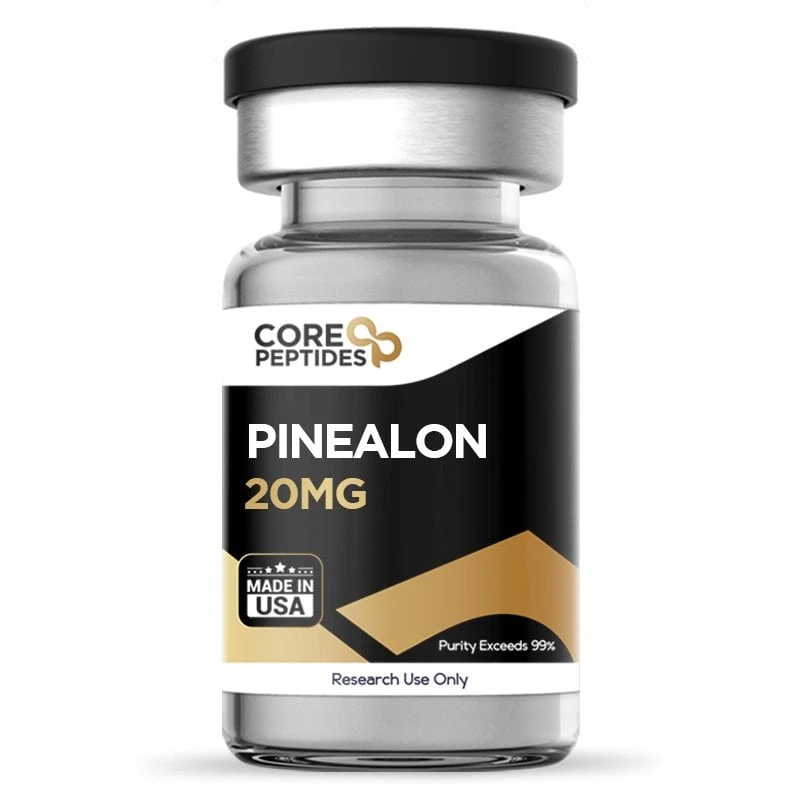
Pinealon (20mg) – Research Peptide
Pinealon (20mg), also known as the EDR peptide, is a synthetic tripeptide composed of the amino acids Glu-Asp-Arg (glutamic acid, aspartic acid and arginine). It belongs to the short-peptide research group associated with the Khavinson bioregulator research programme and has been investigated in cellular, neurological and ageing-related research.
The Core Peptides product is supplied as 20mg of lyophilised Pinealon powder with a reported purity of >99%. The supplier specifies that the material is intended for research, laboratory and analytical purposes only and is not intended for human or animal consumption.
Scientific research into Pinealon has examined its potential effects on oxidative stress, cell viability, neuronal processes, gene-expression pathways and cellular ageing. In vitro work has reported concentration-dependent effects on reactive oxygen species and cell viability, while other studies have investigated Pinealon in animal models and limited human research.
Although these findings provide areas for further investigation, the current evidence base remains limited. Pinealon should therefore be regarded as a research compound rather than an established medical treatment or approved therapeutic.
What Is Pinealon?
Pinealon is a short synthetic tripeptide with the sequence Glu-Asp-Arg (EDR). Its three amino acids are glutamic acid, aspartic acid and arginine. The compound is also referred to as the EDR peptide in scientific literature.
Research into Pinealon forms part of a broader programme investigating short synthetic peptides and their possible interactions with cellular signalling and gene-expression processes. The proposed biological effects have attracted interest particularly in the areas of neuroscience, oxidative stress and cellular ageing.
According to the Core Peptides product information, Pinealon is investigated for its possible interaction with cellular and nuclear membranes, as well as potential effects on neuronal and cellular processes. These mechanisms remain research hypotheses and should not be presented as established clinical effects.
Pinealon (20mg) Product Specifications
| Specification | Details |
|---|---|
| Product Name | Pinealon |
| Quantity | 20mg |
| Alternative Name | EDR peptide |
| Peptide Sequence | Glu-Asp-Arg |
| Peptide Type | Synthetic tripeptide |
| Molecular Formula | C15H26N6O8 |
| Molecular Weight | Approximately 418.4 g/mol |
| Physical Form | Lyophilised powder |
| Reported Purity | >99% |
| Research Areas | Cellular biology, neuroscience, oxidative stress and ageing research |
| Intended Use | Laboratory, analytical and in-vitro research |
The quantity, lyophilised form and reported purity correspond to the referenced Core Peptides product listing.
Pinealon Chemical Structure
Pinealon is structurally simple compared with larger peptide molecules because it consists of only three amino-acid residues:
Glu – Asp – Arg
These residues correspond to:
- Glu: Glutamic acid
- Asp: Aspartic acid
- Arg: Arginine
The molecular formula reported for Pinealon is C15H26N6O8, with a molecular weight of approximately 418.4 g/mol.
The relatively small size of the molecule is one reason researchers have investigated whether short peptides such as Pinealon can interact with cellular compartments and biological signalling pathways.
How Is Pinealon Studied?
Research into Pinealon has investigated several potential biological pathways. These include oxidative-stress regulation, cell viability, signalling through the MAPK/ERK pathway, apoptosis-related processes and possible interactions with gene-expression mechanisms.
In a peer-reviewed 2011 study, researchers reported that Pinealon produced dose-dependent reductions in reactive oxygen species accumulation in several cell models subjected to oxidative stress. The study also reported reduced necrotic cell death and changes involving ERK1/2 activation and cell-cycle behaviour.
These findings provide a basis for further laboratory investigation, but cell-culture results cannot automatically be translated into effects in humans.
Pinealon and Oxidative Stress Research
Oxidative stress occurs when the generation of reactive oxygen species exceeds the capacity of biological systems to neutralise or manage them. Excessive oxidative stress can affect cellular membranes, proteins, nucleic acids and signalling pathways.
Pinealon has attracted research interest because experimental studies have examined its relationship with reactive oxygen species. In the 2011 cell-based study, Pinealon demonstrated concentration-dependent restriction of ROS accumulation in several experimental cell types and was associated with reduced necrotic cell death.
The same study observed that the effects on ROS accumulation and cell mortality became saturated at lower concentrations, while changes in cell-cycle regulation continued at higher concentrations. This concentration-dependent behaviour provides an important area for further mechanistic research.
It is important to distinguish these laboratory observations from claims that Pinealon is an antioxidant treatment in humans. The available evidence does not establish such a medical use.
Pinealon and Cellular Viability
Cell viability is an important endpoint in experimental research because it provides information about how cells respond to environmental stress, chemical exposure or biological interventions.
Research published in Rejuvenation Research investigated Pinealon in cerebellar granule cells, neutrophils and PC12 cells exposed to oxidative stress. The investigators reported reduced ROS accumulation and reduced necrotic cell death in the tested experimental systems.
These findings have contributed to interest in Pinealon as a subject for cellular-protection and oxidative-stress research. Further work is required to establish how these observations relate to other biological models.
Pinealon and MAPK/ERK Signalling
The MAPK/ERK signalling pathway is involved in numerous cellular processes, including proliferation, differentiation, survival and responses to environmental stimuli.
Research cited by the supplier proposes that Pinealon’s potential neuroprotective and anti-apoptotic effects may involve MAPK/ERK signalling. The 2011 experimental study also observed delayed ERK1/2 activation following Pinealon exposure.
Understanding how a short peptide might influence this signalling cascade is an area of mechanistic research. However, pathway-level observations do not establish a therapeutic effect and should be interpreted according to the experimental system used.
Pinealon and Neurobiology Research
One of the principal research interests surrounding Pinealon is its possible relationship with central nervous system biology.
Research programmes have investigated Pinealon in models involving neuronal stress, hypoxia, ageing and neurochemical processes. Studies have also explored possible effects on serotonin expression in cultured brain cells and neurochemical responses in animal models.
A 2020 review specifically discussed the EDR peptide and possible mechanisms involving gene-expression and protein-synthesis regulation in the context of Alzheimer’s disease research. Such work represents a research hypothesis rather than evidence that Pinealon prevents, treats or reverses Alzheimer’s disease.
Pinealon and Serotonin Research
Serotonin is an important neurotransmitter involved in numerous physiological processes. Experimental research has investigated whether short peptides can influence serotonin-related pathways.
According to the research cited by Core Peptides, experiments using isolated brain-cortex cell cultures reported increased serotonin expression following exposure to Pinealon. The proposed mechanism involved possible interaction with a DNA promoter sequence associated with 5-tryptophan hydroxylase, an enzyme involved in serotonin synthesis.
These observations are based on experimental models and proposed molecular mechanisms. They should not be interpreted as evidence that Pinealon increases serotonin levels in people or as a treatment for mood-related conditions.
Pinealon and Cellular Ageing Research
Ageing research is another area in which Pinealon has been investigated. Researchers have examined short synthetic peptides in relation to cellular ageing, oxidative stress and age-associated changes in biological systems.
A 2015 study involving synthetic peptides including Pinealon and Vesugen examined cellular and metabolic aspects of ageing in people with chronic polymorbidity and organic brain syndrome in remission. The authors reported various biological effects, although the study design and limited evidence base mean that the findings require cautious interpretation.
Current evidence does not establish Pinealon as an anti-ageing treatment. Rather, ageing and longevity are areas in which its biological activity has been investigated.
Pinealon and Apoptosis Research
Apoptosis is a regulated form of cellular death that plays an important role in normal tissue development and cellular homeostasis.
Research has examined Pinealon in experimental models of cellular stress and hypoxia, including investigations of caspase-3, a protein involved in apoptotic signalling. Some animal studies have reported changes in caspase-3 activity following Pinealon exposure.
Researchers have also investigated inflammatory markers such as interleukin-6 and tumour necrosis factor in experimental hypoxic conditions. These findings may provide useful directions for laboratory research into cellular stress responses.
However, experimental modulation of apoptosis-related markers does not demonstrate that Pinealon prevents cell death or treats neurological or inflammatory disease in humans.
Pinealon and Hypoxia Research
Hypoxia refers to a condition in which tissues or cells experience reduced oxygen availability. Experimental hypoxia is frequently used to investigate mechanisms of cellular stress and neuronal injury.
Pinealon has been examined in animal models involving hypoxic and hypothermic stress. Research has focused on behaviour, neurochemical processes, cytokine regulation and apoptosis-related pathways.
These studies may help researchers understand how short peptides interact with biological systems under stress, but animal-model findings require independent confirmation before any conclusions about human applications can be made.
Pinealon and Brain Research
Brain-related research into Pinealon has included studies of neuronal viability, neurotransmitter expression, hypoxic stress and age-associated changes in neurochemical processes.
The proposed mechanisms include possible interactions with cellular membranes and nuclear processes, alongside possible effects on gene-expression pathways. The supplier’s scientific overview describes these mechanisms as areas of research rather than established effects.
A key consideration when evaluating Pinealon is the distinction between mechanistic plausibility and clinical evidence. While experimental studies can identify interesting biological signals, they do not by themselves establish efficacy, safety or appropriate use in humans.
Pinealon and Gene-Expression Research
One of the more distinctive hypotheses surrounding Pinealon concerns potential interactions with genetic regulatory processes.
The EDR peptide has been investigated in relation to possible interactions with DNA and promoter regions. Research cited by the supplier proposes that Pinealon may interact with specific DNA sequences and potentially influence transcription-related processes.
The 2011 research also noted cell-cycle modulation at higher concentrations and suggested that the peptide might interact directly with the cell genome.
These observations are important areas for molecular-biology research, but claims about direct DNA regulation should be treated as hypotheses requiring further independent investigation.
Pinealon Research Applications
Qualified laboratories may investigate Pinealon in several research areas, including:
- Oxidative-stress research involving reactive oxygen species and cellular viability.
- Neuroscience research involving neuronal and central nervous system models.
- Cellular ageing research examining age-associated biological changes.
- Apoptosis research involving caspase-related pathways.
- MAPK/ERK signalling studies investigating cellular stress responses.
- Gene-expression research exploring potential peptide–DNA interactions.
- Neurochemical research involving serotonin and related signalling.
- Hypoxia research using controlled cellular and animal models.
- Peptide chemistry involving short synthetic tripeptides.
- Formulation and analytical research involving purified lyophilised peptide material.
Pinealon vs Other Short Peptides
| Peptide | General Research Focus | Structure |
|---|---|---|
| Pinealon | Neurobiology, oxidative stress and cellular ageing | Glu-Asp-Arg |
| Epitalon | Pineal and ageing-related research | Tetrapeptide |
| Vesugen | Vascular and ageing-related research | Short synthetic peptide |
| Selank | Neurobiological and peptide-signalling research | Heptapeptide |
| Semax | Neurobiological research | Modified peptide |
These compounds have different molecular structures and research histories. They should not be considered interchangeable simply because they appear in the broader peptide-research field.
Pinealon and Research Evidence
The published literature on Pinealon is relatively small compared with extensively studied pharmaceutical compounds. Available research includes cell-based studies, animal experiments, reviews and a limited number of human reports.
One 2011 peer-reviewed study reported effects on reactive oxygen species, cell viability, ERK1/2 activation and cell-cycle behaviour in experimental models.
A 2015 human study investigated synthetic peptides including Pinealon in people with chronic polymorbidity and organic brain syndrome in remission. The authors reported biological effects, but the study was not a modern large-scale randomised clinical trial and was published in Russian.
Current reviews of the literature indicate that much of the Pinealon evidence originates from the same Russian research programme, with comparatively little independent replication. This is an important limitation when evaluating claims about efficacy or long-term safety.
Pinealon Analytical Characterisation
Analytical verification is an important part of responsible peptide research. Researchers working with Pinealon may assess the material for identity, purity, molecular mass and batch consistency.
Common analytical considerations include:
- Identity testing: Confirmation that the material corresponds to Glu-Asp-Arg.
- Purity analysis: Assessment of the peptide relative to related impurities.
- Molecular-mass confirmation: Verification using suitable analytical instrumentation.
- Chromatographic analysis: Evaluation of the peptide profile and purity.
- Batch consistency: Comparison between individual production lots.
- Stability testing: Monitoring under defined laboratory storage conditions.
The Core Peptides listing reports a purity of >99% for the 20mg product. Researchers should consult the applicable batch-specific Certificate of Analysis before beginning experimental work.
Pinealon (20mg) Storage Considerations
Pinealon is supplied as a lyophilised powder. Appropriate storage and handling are important when preserving the integrity of any research peptide.
Laboratories should:
- Keep the material in its original, clearly labelled container.
- Follow the supplier’s current storage recommendations.
- Minimise unnecessary exposure to moisture.
- Protect the material from inappropriate temperature conditions.
- Limit unnecessary exposure to environmental contaminants.
- Review the batch-specific Certificate of Analysis and technical documentation.
- Handle the material using appropriate laboratory procedures.
Storage requirements can vary according to the peptide, packaging and intended experimental application. The manufacturer’s current documentation should therefore take precedence over generic storage guidance.
Frequently Asked Questions About Pinealon (20mg)
What is Pinealon?
Pinealon is a synthetic tripeptide composed of glutamic acid, aspartic acid and arginine. Its sequence is Glu-Asp-Arg (EDR). It has been investigated in cellular, neurological, oxidative-stress and ageing-related research.
What is the Pinealon peptide sequence?
The Pinealon sequence is Glu-Asp-Arg, commonly abbreviated as EDR.
What is Pinealon also called?
Pinealon is also referred to as the EDR peptide or Glu-Asp-Arg peptide.
What is the molecular weight of Pinealon?
The molecular weight listed for Pinealon is approximately 418.4 g/mol, with the molecular formula C15H26N6O8.
What is Pinealon studied for?
Research has investigated Pinealon in relation to oxidative stress, cellular viability, neuronal processes, apoptosis, hypoxia, serotonin expression, gene-expression mechanisms and cellular ageing.
Does Pinealon have antioxidant activity?
In a 2011 cell-based study, Pinealon reduced reactive oxygen species accumulation under experimentally induced oxidative stress. This represents an experimental observation and should not be interpreted as proof that Pinealon functions as an antioxidant treatment in humans.
Does Pinealon cross the blood-brain barrier?
Potential interaction with the blood-brain barrier and central nervous system is an area of research surrounding Pinealon. However, evidence for reliable blood-brain barrier penetration and its significance in humans remains insufficient to establish a clinical conclusion.
Is Pinealon a treatment for neurological conditions?
No established medical indication should be inferred from the experimental literature. Pinealon remains a research compound, and laboratory or animal findings do not establish that it treats neurological disease.
Is Pinealon approved as a medicine?
Pinealon is not an approved medicine under the regulatory frameworks relevant to mainstream Western pharmaceutical use. Research-only material should not be represented as an approved therapeutic product.
Is Pinealon suitable for human consumption?
No. The referenced Core Peptides product is explicitly supplied for research, laboratory and analytical purposes and states that human and animal consumption is prohibited.
What does the 20mg Pinealon product contain?
The referenced product contains 20mg of Pinealon in lyophilised powder form and is listed with a reported purity of greater than 99%.
What is the difference between Pinealon and Epitalon?
Both are short synthetic peptides associated with the Khavinson bioregulator research programme, but they have different sequences and research areas. Pinealon is the EDR tripeptide, whereas Epitalon is a tetrapeptide with a different molecular structure.
Can Pinealon be used in laboratory research?
Yes. The referenced product is supplied specifically for laboratory, analytical and in-vitro experimental research. Researchers should follow applicable institutional procedures, safety requirements and supplier documentation.
Why Choose Pinealon (20mg) for Research?
Pinealon (20mg) provides researchers with a defined short synthetic peptide for investigating cellular and molecular processes associated with EDR peptide research.
- Defined composition: Glu-Asp-Arg tripeptide.
- 20mg quantity: Suitable for controlled laboratory research.
- Lyophilised format: Supplied as a dry research material.
- Reported purity: Greater than 99% according to the product listing.
- Established research interest: Investigated in cellular, animal and limited human studies.
- Multiple research pathways: Relevant to oxidative stress, neuronal signalling, apoptosis and cellular ageing research.
Researchers should evaluate the specific batch documentation and Certificate of Analysis before use.
Pinealon (20mg) Research Summary
Pinealon (20mg) is a synthetic EDR tripeptide consisting of Glu-Asp-Arg. It has attracted scientific interest because of experimental observations involving oxidative stress, cell viability, neuronal processes and cellular signalling.
Laboratory research has reported concentration-dependent effects on reactive oxygen species and cell death, while other studies have examined MAPK/ERK signalling, apoptosis-related pathways, serotonin expression and possible gene-regulatory mechanisms.
At the same time, the overall evidence base remains limited, with much of the published research originating from a relatively small group of investigators. Consequently, Pinealon is best approached as an experimental research peptide rather than a proven therapeutic intervention.
For qualified researchers, the 20mg lyophilised Pinealon format provides a defined material for controlled studies involving peptide chemistry, cellular biology, oxidative stress, neurobiology and ageing-related mechanisms.
Research-Use Disclaimer
Pinealon (20mg) is intended solely for qualified research, laboratory, analytical and in-vitro experimental purposes. It is not intended for human or veterinary consumption, self-administration, diagnosis, treatment, cure or prevention of any disease.
Descriptions of neuroprotective, antioxidant, anti-apoptotic, cognitive, anti-ageing or other biological effects refer to areas of scientific investigation and should not be interpreted as established medical benefits or guaranteed outcomes.
Researchers should review the applicable Certificate of Analysis, safety information and supplier documentation for the specific batch before conducting experiments. All handling, storage and disposal should be performed by appropriately trained personnel in accordance with institutional procedures and applicable legislation.
For research use only. Human and animal consumption prohibited.
Be the first to review “Pinealon (20mg)”
Related products
Peptides for Sale
Peptides for Sale
Peptides for Sale
Peptides for Sale
Peptides for Sale
Peptides for Sale
Peptides for Sale
Peptides for Sale
Reviews
There are no reviews yet.