
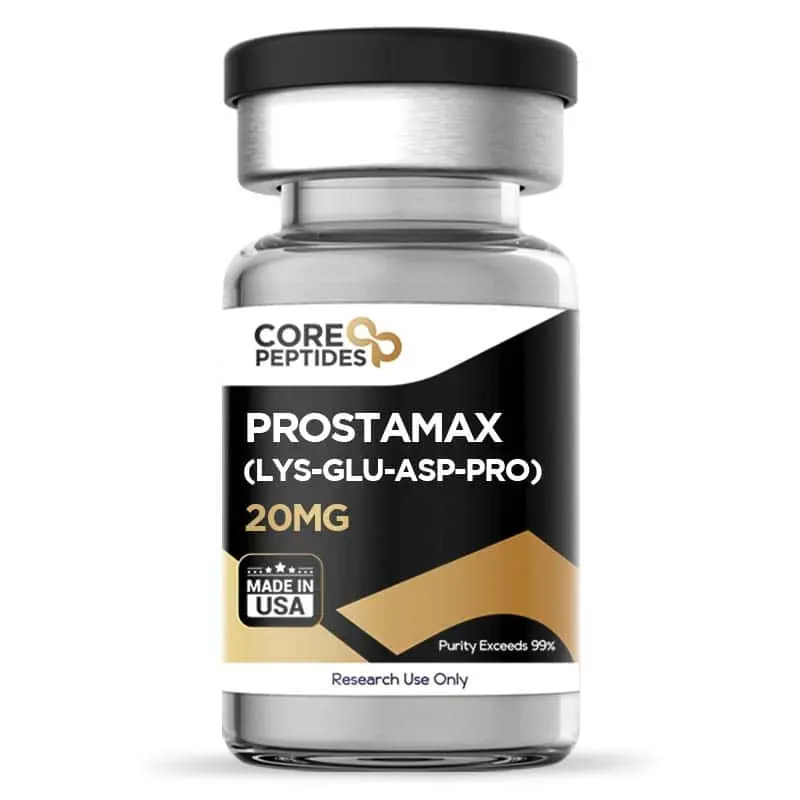

Prostamax (20mg) – Synthetic KEDP Research Peptide
Prostamax (20mg), also known as KEDP, is a synthetic tetrapeptide composed of the amino-acid sequence Lys-Glu-Asp-Pro. It belongs to the Khavinson peptide bioregulator group and has been investigated in experimental research involving chromatin structure, cellular ageing and prostate-related tissue models.
The Core Peptides product is supplied as 20mg of lyophilised Prostamax powder with a reported purity of >99%. The material is designated for research, laboratory and analytical applications only and is not intended for human or animal consumption.
Research surrounding Prostamax has examined potential effects on chromatin organisation and gene activity in aged-cell models, as well as tissue-specific responses in experimental prostate models. These findings are preliminary and should be interpreted as research observations rather than evidence of established clinical benefits.
What Is Prostamax?
Prostamax is a short synthetic peptide with the sequence Lys-Glu-Asp-Pro (KEDP). It is classified among the peptide bioregulators associated with the Khavinson research programme.
Unlike conventional proteins containing hundreds of amino acids, Prostamax consists of only four amino-acid residues. Its small molecular structure makes it useful for researchers investigating how short peptides may interact with cellular structures and influence biological processes in experimental systems.
Published research has investigated Prostamax in relation to chromatin organisation, heterochromatin structure, ribosomal RNA-related activity and tissue responses associated with ageing. Other experimental work has examined the peptide in prostate tissue models and models of chronic aseptic inflammation.
Prostamax (20mg) Product Specifications
| Specification | Details |
|---|---|
| Product Name | Prostamax |
| Alternative Name | KEDP |
| Sequence | Lys-Glu-Asp-Pro |
| Peptide Type | Synthetic tetrapeptide |
| Quantity | 20mg |
| Physical Form | Lyophilised powder |
| Reported Purity | >99% |
| Molecular Formula | C20H33N5O9 |
| Molecular Weight | 487.5 g/mol |
| Research Classification | Research and laboratory material |
| Intended Application | Laboratory, analytical and experimental research |
Prostamax Chemical Composition
Prostamax is chemically identified by the peptide sequence Lys-Glu-Asp-Pro. The four amino acids are linked into a defined short peptide chain that can be investigated using standard peptide-characterisation techniques.
The reported molecular formula is C20H33N5O9, with a molecular weight of approximately 487.5 g/mol. The compound is also known as KEDP in the scientific literature.
For laboratories working with synthetic peptides, confirming identity and purity through suitable analytical methods is important because the biological behaviour of a peptide can be affected by sequence, degradation products, impurities and storage conditions.
Prostamax and Chromatin Research
One of the principal areas of Prostamax research concerns chromatin structure. Chromatin is the complex of DNA and associated proteins that packages genetic material within the nucleus. Changes in chromatin organisation can influence how accessible particular genomic regions are to cellular machinery.
Experimental research has investigated whether short peptide bioregulators such as Prostamax can influence chromatin organisation in lymphocytes obtained from older subjects. Reported observations include changes in chromatin structure and alterations associated with the organisation of heterochromatin.
Researchers have proposed that such changes may be relevant to the study of age-associated alterations in gene activity. However, observations in cell-based research should not be interpreted as proof that Prostamax reverses ageing or produces an anti-ageing effect in humans.
Prostamax and Heterochromatin Research
Heterochromatin refers to relatively condensed regions of chromatin. Its organisation is closely associated with the regulation and accessibility of genetic material.
Studies involving Prostamax have investigated possible changes in heterochromatin organisation in aged-cell models. Research has reported observations described as deheterochromatinisation, referring to a reduction in chromatin condensation in particular genomic regions.
These findings have led researchers to explore whether short peptides can influence chromatin architecture and potentially modify the accessibility of previously less-active genomic regions. The precise molecular mechanisms behind these observations remain an area for further investigation.
Prostamax and Gene-Expression Research
Gene expression describes the process through which information encoded in DNA is used by cells to produce functional RNA and proteins. Because chromatin organisation can influence DNA accessibility, changes in chromatin structure are of interest in research into gene regulation.
Experimental Prostamax studies have explored whether changes in chromatin organisation may be associated with the activation of genes that were previously less active in aged cells.
Researchers should distinguish these experimental observations from claims of clinically meaningful gene activation. The available research does not establish Prostamax as a clinically validated agent for modifying gene expression or treating age-related conditions.
Prostamax and Ribosomal RNA Research
Another area investigated in connection with Prostamax involves ribosomal RNA (rRNA) gene activity. Ribosomal RNA is a fundamental component of ribosomes, the cellular structures responsible for protein synthesis.
Experimental studies have examined changes in Ag-positive nucleolus organiser regions and other chromosomal characteristics following exposure to short peptide bioregulators. These observations have been interpreted as potentially reflecting changes in ribosomal gene activity.
Such research provides a model for studying the relationship between peptide exposure, chromatin structure and cellular genetic activity, but further research is required to establish the biological significance of these observations.
Prostamax and Cellular Ageing Research
Prostamax has been investigated as part of broader research into the molecular changes associated with cellular ageing.
Ageing can be accompanied by changes in chromatin organisation, gene regulation and cellular function. Researchers studying Khavinson-class peptides have explored whether short peptide sequences can influence some of these molecular characteristics in experimental systems.
Studies involving Prostamax have reported changes in chromatin-related parameters in lymphocytes from older subjects. These observations have contributed to interest in short peptides as experimental tools for studying age-associated cellular changes.
It is important, however, to distinguish cellular ageing research from proven anti-ageing treatment. Experimental changes in cultured cells do not establish a clinical effect in humans.
Prostamax and Prostate Tissue Research
The name Prostamax reflects its association with research involving the prostate gland. Experimental studies have examined the peptide in organotypic prostate tissue cultures derived from young and aged animal models.
In these models, researchers investigated whether Prostamax could influence tissue responses and reparative processes. The reported findings suggested that the peptide may have tissue-specific activity in experimental prostate cultures.
These observations are of interest for researchers studying tissue-specific peptide biology and age-related changes in prostate tissue. They should not be interpreted as evidence that Prostamax is an established treatment for prostate disease.
Prostamax and Experimental Prostatitis Research
Research has also examined Prostamax in experimental models of chronic aseptic prostatitis. In an animal model, investigators evaluated changes in inflammatory and structural characteristics of prostate tissue following experimental treatment.
The reported observations included differences in tissue swelling, vascular changes and lymphoid infiltration. The study also investigated whether the peptide could influence the development of sclerotic and atrophic changes in the experimental prostate model.
Because these findings originate from experimental animal research, they cannot be directly translated into human therapeutic outcomes. Controlled human clinical research would be necessary to establish whether similar effects occur in people.
Prostamax and Tissue-Specific Peptide Research
One of the broader concepts behind Khavinson-class peptide research is the investigation of whether short peptides can demonstrate tissue-specific biological activity.
Prostamax provides a research model for examining this concept in prostate-associated tissue and cellular systems. Researchers can investigate whether peptide exposure produces different responses depending on cell type, tissue age or experimental conditions.
Comparing young and aged tissue models may also provide information about how cellular ageing changes the response to short peptide sequences.
Prostamax Research Applications
Prostamax (20mg) may be of interest to appropriately equipped research laboratories investigating areas such as:
- Peptide bioregulator research involving short synthetic peptide sequences.
- Chromatin biology and structural organisation of DNA-associated proteins.
- Heterochromatin research involving chromatin condensation and decondensation.
- Gene-regulation research examining relationships between chromatin structure and cellular activity.
- Ribosomal RNA research involving nucleolus organiser regions.
- Cellular ageing studies using appropriate experimental models.
- Prostate tissue research involving experimental organotypic cultures.
- Inflammation research using validated laboratory models.
- Tissue-repair research examining cellular and tissue responses in experimental systems.
- Peptide structure and analytical research involving synthetic tetrapeptides.
Prostamax Research and Chromosomal Dynamics
Research into Prostamax has also examined several chromosomal characteristics associated with cellular ageing. Investigators have reported changes in measures such as sister chromatid exchange and Ag-positive nucleolus organiser regions.
Sister chromatid exchange is a laboratory marker used to investigate reciprocal exchanges of genetic material between duplicated chromosomes. Changes in its frequency can provide information about chromosomal dynamics under specific experimental conditions.
Prostamax-related observations in this area form part of the wider investigation into whether short peptides can influence chromatin and chromosome organisation in aged cells.
Prostamax and Chromatin Structure
Chromatin can exist in different structural states, ranging from relatively open configurations to highly condensed regions. The organisation of chromatin plays an important role in controlling access to DNA.
Experimental work involving Prostamax has investigated changes in the thermal and structural characteristics of chromatin in lymphocytes. Researchers have proposed that some observed changes may reflect alterations in the organisation of chromatin fibres.
These studies are useful for understanding peptide–chromatin interactions at an experimental level, although the precise molecular mechanism remains incompletely established.
Prostamax (20mg) Purity and Analytical Considerations
The referenced Core Peptides product is listed with a reported purity of >99%. For research applications where peptide identity and purity are important, laboratories should review the relevant batch documentation and analytical data before beginning experimental work.
Common analytical approaches for synthetic peptides can include:
- High-performance liquid chromatography (HPLC) for assessing chromatographic purity.
- Mass spectrometry for confirming molecular mass and peptide identity.
- Analytical comparison between batches where reproducibility is important.
- Stability assessment under defined laboratory storage conditions.
Analytical results should be interpreted alongside the specific batch documentation rather than relying solely on a general product specification.
Prostamax (20mg) Physical Form
Prostamax (20mg) is supplied as a lyophilised powder. Lyophilisation, commonly known as freeze-drying, is widely used for laboratory peptide materials because it allows a peptide to be supplied in a dry, stable format before experimental preparation.
Researchers should follow the supplier’s current storage and handling information for the specific product and batch. Appropriate laboratory practices should be used to minimise exposure to moisture, contamination and unsuitable environmental conditions.
Research Evidence for Prostamax
The published literature surrounding Prostamax includes experimental studies examining chromatin characteristics in human lymphocytes and tissue-specific responses in animal models. Core Peptides references studies from Biofizika, Bulletin of Experimental Biology and Medicine, Advances in Gerontology and other scientific publications.
The evidence base is relatively limited, and many of the cited studies originate from the same broader research programme. Contemporary evidence reviews also note the absence of established human clinical efficacy trials for synthetic KEDP.
For this reason, Prostamax is best described as a research peptide rather than a clinically validated therapeutic product. Researchers should evaluate individual studies according to their design, model, endpoints and reproducibility.
Prostamax Compared With Other Short Peptides
| Feature | Prostamax | General Short Research Peptides |
|---|---|---|
| Structure | Tetrapeptide | Varies according to compound |
| Sequence | Lys-Glu-Asp-Pro | Compound-specific |
| Primary research focus | Chromatin, cellular ageing and prostate-related models | Varies according to peptide |
| Research format | Lyophilised powder | Varies according to supplier and compound |
| Clinical status | Research compound; not an approved medicine | Depends on individual compound |
Frequently Asked Questions About Prostamax (20mg)
What is Prostamax?
Prostamax is a synthetic tetrapeptide with the sequence Lys-Glu-Asp-Pro, also known as KEDP. It belongs to the Khavinson peptide bioregulator group and has been investigated in experimental cellular and tissue research.
What does Prostamax contain?
Prostamax contains the four-amino-acid sequence Lys-Glu-Asp-Pro. The Core Peptides product is supplied as 20mg of lyophilised material with a reported purity greater than 99%.
What is Prostamax studied for?
Research has examined Prostamax in relation to chromatin organisation, heterochromatin, cellular ageing, chromosomal characteristics and prostate-related tissue models.
Is Prostamax a prostate medicine?
No. Prostamax should not be presented as an approved medicine or established treatment for prostate conditions. Research involving prostate tissue and experimental prostatitis models remains preclinical and does not establish clinical efficacy in humans.
Has Prostamax been studied in human material?
Some published research has examined Prostamax and related short peptide bioregulators using human lymphocyte material, including lymphocytes obtained from older subjects. These are laboratory or ex-vivo studies and should not be confused with controlled human clinical trials.
Has Prostamax been studied in animals?
Yes. Research has investigated Prostamax in animal tissue models, including prostate-related experimental models. Animal findings provide useful research information but cannot by themselves establish safety or efficacy in humans.
Is Prostamax approved by the FDA or EMA?
Prostamax is not an FDA- or EMA-approved medicine. It is supplied as a research material rather than an authorised pharmaceutical treatment.
What is the molecular weight of Prostamax?
The molecular weight listed for Prostamax is approximately 487.5 g/mol, with the molecular formula C20H33N5O9.
What is KEDP?
KEDP is the abbreviation commonly used for the Prostamax sequence Lys-Glu-Asp-Pro. The terms Prostamax and KEDP are therefore used to identify the same synthetic tetrapeptide in the research literature.
What form is Prostamax (20mg) supplied in?
The product is supplied as a lyophilised powder. The listed quantity is 20mg and the reported purity is greater than 99%.
What is chromatin decondensation?
Chromatin decondensation describes a change from a more compact chromatin configuration towards a less condensed structure. Prostamax research has investigated this phenomenon in experimental cellular models, particularly in relation to ageing-associated chromatin changes.
Can Prostamax be used to treat ageing or prostate disease?
There is insufficient clinical evidence to support such use. Research findings concerning cellular ageing or prostate-related experimental models should not be interpreted as established medical treatment outcomes.
Why Researchers May Choose Prostamax (20mg)
Prostamax (20mg) provides a defined synthetic tetrapeptide for laboratories studying short peptide bioregulators and their potential interactions with cellular structures.
- Defined peptide sequence: Lys-Glu-Asp-Pro (KEDP).
- 20mg research format: Suitable for controlled laboratory research programmes.
- Lyophilised presentation: Supplied in a dry research format.
- Reported purity above 99%: Provides a defined starting material for analytical research.
- Broad research relevance: Supports investigation into chromatin, cellular ageing and prostate-related experimental models.
- Established research history: Prostamax and related KEDP research has been discussed in multiple scientific publications.
Prostamax (20mg) Research Summary
Prostamax (20mg) is a synthetic tetrapeptide with the sequence Lys-Glu-Asp-Pro (KEDP). Research has explored its relationship with chromatin organisation, heterochromatin structure, chromosomal dynamics and cellular ageing, alongside experimental studies involving prostate tissue.
The peptide is particularly relevant to researchers interested in the biological effects of short peptide sequences and the proposed relationship between peptide bioregulators and tissue-specific cellular processes.
Current evidence remains limited and predominantly experimental. Findings from cell cultures and animal models should therefore be treated as research observations rather than evidence of proven human therapeutic effects.
Research-Use Disclaimer
Prostamax (20mg) is intended solely for qualified research, laboratory, analytical and in-vitro experimental purposes. It is not intended for human or veterinary consumption, self-administration, diagnosis, treatment, cure or prevention of any disease.
References to prostate tissue, inflammation, cellular ageing, chromatin, gene activity or tissue repair describe areas of scientific investigation and should not be interpreted as medical claims or evidence of clinical efficacy.
Researchers should review the relevant Certificate of Analysis, product documentation, safety information and applicable legislation before working with this material. Handling, storage and disposal should be performed by appropriately trained personnel using suitable laboratory procedures.
For research use only. Human and animal consumption prohibited.
:::
Be the first to review “Prostamax – 20MG”
Related products
Peptides for Sale
Peptides for Sale
Peptides for Sale

Peptides for Sale

Peptides for Sale
Peptides for Sale
Peptides for Sale
Peptides for Sale
Reviews
There are no reviews yet.