
BPC-157 (5mg / 10mg) Peptide – Research-Grade Pentadecapeptide
BPC-157 (5mg / 10mg) is a synthetic 15-amino-acid peptide commonly known as Body Protection Compound-157 or pentadecapeptide BPC-157. It has attracted substantial scientific interest because of its activity in experimental models investigating tissue repair, angiogenesis, gastrointestinal biology, musculoskeletal injury and cellular protection.
BPC-157 is particularly well represented in preclinical research. Laboratory and animal studies have examined its relationship with processes such as blood-vessel formation, collagen production, fibroblast migration, extracellular signalling and gastrointestinal tissue responses. However, the majority of the evidence remains preclinical, and human clinical evidence is still limited.
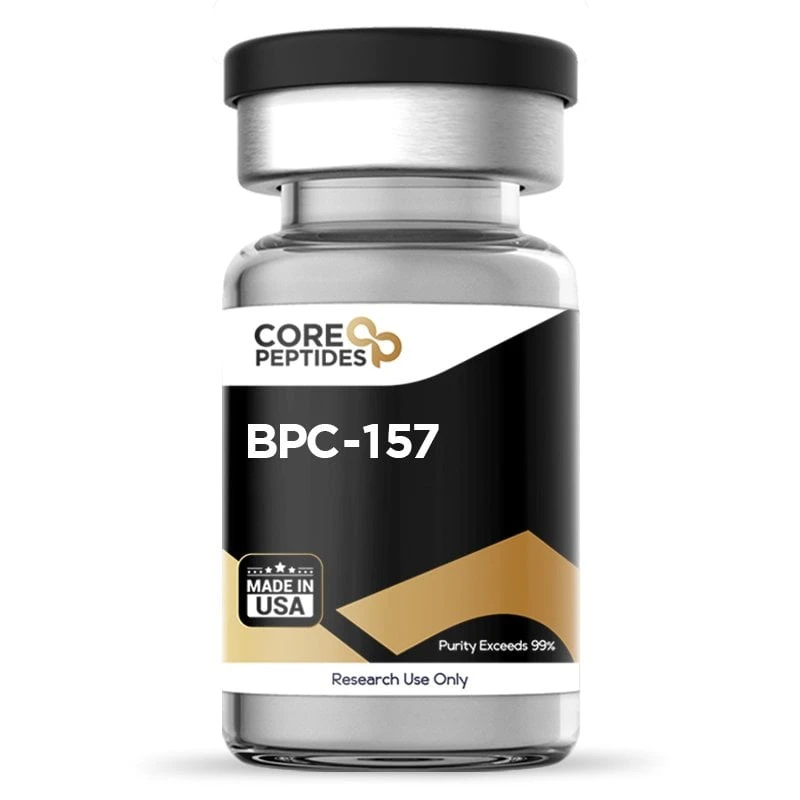
The referenced Core Peptides product is available in 5mg and 10mg formats as a lyophilised powder with a stated purity of greater than 99%. The supplier identifies the material as intended for research and laboratory purposes.
BPC-157 should be regarded as an experimental research peptide. It should not be presented as an approved treatment for wounds, tendon injuries, gastrointestinal disorders, inflammation or any other medical condition.
What Is BPC-157?
BPC-157 is a synthetic pentadecapeptide consisting of 15 amino acids. The peptide is commonly associated with a sequence identified in human gastric juice and has been investigated for its broad biological activity in experimental models. Its molecular formula is C62H98N16O22, with a reported molecular weight of approximately 1419.55 g/mol.
The name pentadecapeptide refers to the 15 amino acids that make up the peptide. BPC-157 has become an important research subject because studies have examined its potential involvement in tissue responses extending across the gastrointestinal tract, skin, connective tissue, muscle and nervous system.
Importantly, much of the existing literature consists of cellular and animal research. A recent review of BPC-157’s development highlighted significant translational barriers, including limited pharmacokinetic information, formulation challenges and the need for properly controlled clinical studies.
BPC-157 (5mg / 10mg) Product Highlights
- Product name: BPC-157
- Alternative names: Body Protection Compound-157, Pentadecapeptide BPC-157
- Available quantities: 5mg and 10mg
- Peptide length: 15 amino acids
- Molecular weight: approximately 1419.55 g/mol
- Molecular formula: C62H98N16O22
- Physical form: Lyophilised powder
- Stated purity: >99%
- Primary research areas: Tissue repair, gastrointestinal biology and angiogenesis
- Additional research areas: Tendon, ligament, muscle, bone and nerve research
- Intended application: Laboratory and scientific research
The product-specific quantity, form and stated purity are based on the referenced Core Peptides listing.
BPC-157 and Tissue Repair Research
One of the most extensively investigated areas surrounding BPC-157 is tissue repair. Researchers have examined the peptide in experimental models involving skin wounds, gastrointestinal injuries, tendon damage, muscle injury and other forms of tissue disruption.
Early experimental research evaluated BPC-157 in several animal models of wound healing, including skin incisions, colon anastomoses and experimental angiogenesis. The researchers reported differences in collagen, reticulin and blood-vessel development between BPC-157-treated animals and controls.
These findings have contributed to continued research into whether BPC-157 can influence cellular processes involved in tissue repair, including granulation tissue formation, collagen deposition, angiogenesis and tissue remodelling.
Such findings should nevertheless be interpreted within their experimental context. Evidence from animal models cannot by itself establish that the same effects occur in humans.
BPC-157 and Angiogenesis Research
Angiogenesis is the formation of new blood vessels from existing vascular structures. It is an important component of tissue repair because developing tissues require an adequate blood supply.
Experimental studies have investigated BPC-157 in relation to angiogenic signalling. Research has reported changes involving vascular endothelial growth factor (VEGF), endothelial-cell migration and blood-vessel formation in laboratory models.
More recent scientific reviews identify VEGFR2 among the signalling targets being investigated in connection with BPC-157. Other proposed molecular pathways include early growth response gene 1 (Egr-1), NAB2 and nitric-oxide-related signalling.
This makes BPC-157 relevant to laboratory studies examining the relationship between peptide signalling, vascular responses and tissue regeneration.
BPC-157 and Wound Healing Research
Wound healing involves several overlapping biological stages, including inflammation, granulation tissue formation, re-epithelialisation, collagen deposition, vascular development and tissue remodelling.
Researchers have investigated BPC-157 across multiple stages of this process. Experimental work has reported changes in collagen formation, granulation tissue and angiogenesis in animal models of skin and other tissue injuries.
Research examining cellular wound-healing models has also investigated BPC-157’s relationship with VEGF expression, endothelial-cell migration and ERK1/2-related signalling. These pathways are relevant to cell proliferation, migration and vascular development.
Although these findings provide a useful basis for laboratory investigation, BPC-157 has not been established as a clinically proven wound-healing therapy.
BPC-157 and Tendon Research
Tendon tissue has received considerable attention in BPC-157 research because tendons have relatively limited vascularity and can be challenging to repair following injury.
Laboratory research using tendon fibroblasts has examined BPC-157 in relation to cell survival, cell migration and tendon outgrowth. Experimental findings have suggested increased fibroblast migration and activation of signalling involving FAK and paxillin, proteins associated with cell adhesion and movement.
A review of BPC-157 research has also described findings from experimental tendon, ligament and muscle models while emphasising that most studies have been conducted in small animal models and that human efficacy remains unconfirmed.
Consequently, BPC-157 remains an important subject for experimental musculoskeletal research rather than an established clinical treatment for tendon injuries.
BPC-157 and Ligament Research
Ligaments contain connective tissue that provides stability to joints and can require substantial time to recover following injury. Researchers have therefore investigated BPC-157 in experimental models of ligament damage and repair.
Published reviews describe experimental evidence suggesting effects on connective-tissue healing, angiogenesis and cellular responses in ligament and tendon models.
These findings have contributed to interest in BPC-157 as a research compound for understanding the cellular mechanisms involved in connective-tissue repair.
BPC-157 and Muscle Research
Research has also examined BPC-157 in experimental models of skeletal muscle injury. Studies have investigated muscle recovery following direct injury as well as damage associated with other experimental stressors.
One research programme examined BPC-157 in animal models involving gastrocnemius muscle injury and corticosteroid-associated muscle damage. The researchers reported signs of improved tissue restoration and functional recovery in the experimental BPC-157 groups.
Reviews of the literature similarly describe experimental findings involving skeletal muscle while noting that these results have not yet been adequately confirmed through large-scale human trials.
BPC-157 and Gastrointestinal Research
The gastrointestinal tract is one of the most extensively investigated areas in the BPC-157 literature. Experimental studies have examined the peptide in models involving the oesophagus, stomach, duodenum and lower gastrointestinal tract.
A published review comparing BPC-157 with angiogenic growth factors such as EGF, FGF and VEGF described consistent activity across multiple experimental gastrointestinal injury models. The review also examined connections between gastrointestinal healing and repair processes involving tendon, ligament, muscle and bone.
Other experimental literature has investigated BPC-157 in relation to gastric mucosal protection and gastrointestinal tissue responses.
These findings have made BPC-157 a significant research subject in experimental gastrointestinal biology.
BPC-157 and Gastrointestinal Tissue Protection
Gastrointestinal tissue protection refers to biological mechanisms that help preserve the integrity of the digestive tract when tissues are exposed to injury or other forms of physiological stress.
Research into BPC-157 has investigated gastric and intestinal lesions, tissue repair and vascular responses. Experimental findings have suggested that BPC-157 may influence several systems involved in gastrointestinal homeostasis, although the precise mechanisms remain an active area of investigation.
Its stability in gastric conditions has also contributed to interest in the peptide as a research model for gastrointestinal peptide biology.
BPC-157 and Collagen Research
Collagen is a major structural protein found in connective tissue, skin, tendons, ligaments and other biological structures. Collagen production and remodelling are fundamental components of tissue repair.
Animal research investigating BPC-157 has reported changes in collagen deposition and organisation during experimental wound healing. In early wound models, researchers observed differences in collagen and reticulin formation between treated and control groups.
These observations provide a foundation for further research into how peptide signalling may influence extracellular-matrix formation during tissue repair.
BPC-157 and Fibroblast Research
Fibroblasts are connective-tissue cells involved in producing extracellular-matrix components, including collagen. Their migration and activity are important during wound healing and tissue remodelling.
Experimental studies involving tendon fibroblasts have investigated BPC-157 in relation to cell migration, survival and outgrowth. Research has suggested involvement of the FAK-paxillin pathway, which participates in cell adhesion and migration.
These findings are relevant to researchers studying how cellular signalling affects the repair of connective tissue.
BPC-157 and VEGF Signalling
Vascular endothelial growth factor (VEGF) is an important regulator of angiogenesis. Because new blood-vessel formation is closely associated with tissue repair, VEGF signalling is frequently investigated in regenerative biology.
Experimental BPC-157 research has examined VEGF expression and endothelial-cell behaviour. Studies have reported increased VEGF-related activity in experimental wound models alongside observations of endothelial-cell migration and tube formation in laboratory systems.
More recent reviews continue to identify VEGFR2 as one of the molecular signalling targets associated with BPC-157 research.
BPC-157 and ERK Signalling
ERK1/2 proteins form part of a major intracellular signalling pathway involved in cell proliferation, migration and differentiation.
BPC-157 research has investigated phosphorylation of ERK1/2 and downstream signalling proteins including c-Fos, c-Jun and Egr-1. These signalling components are relevant to cellular growth, migration and angiogenesis.
Understanding these pathways may help researchers establish how BPC-157 interacts with cellular signalling systems during experimental tissue repair.
BPC-157 and Nitric Oxide Research
Nitric oxide (NO) is a signalling molecule involved in vascular function, cellular communication and tissue responses. BPC-157 research has investigated interactions between the peptide and nitric-oxide-related pathways.
Current scientific reviews identify the NO/eNOS/HO-1 system among the molecular pathways proposed to contribute to BPC-157 activity.
These observations are relevant to research examining vascular regulation and cellular responses to tissue stress.
BPC-157 and Bone Research
Bone repair is a complex process involving inflammation, vascularisation, extracellular-matrix formation and mineralisation. Researchers have therefore investigated BPC-157 in experimental models of bone and fracture healing.
Published reviews have described experimental research involving bone healing alongside tendon, ligament and muscle models.
These studies remain primarily preclinical and should be interpreted as evidence for further investigation rather than proof of clinical effectiveness in humans.
BPC-157 and Nerve Research
BPC-157 has also been studied in experimental models involving nervous-system injury and function. Research has investigated the peptide in models of nerve injury and traumatic brain injury, with experimental findings suggesting potential effects on tissue responses and neurological outcomes.
These observations have broadened interest in BPC-157 beyond gastrointestinal and musculoskeletal research. However, evidence for neurological applications remains predominantly preclinical and requires substantially more human research.
BPC-157 and Experimental Traumatic Brain Injury Research
Some experimental studies have examined BPC-157 in animal models of traumatic brain injury. Research has investigated outcomes including brain oedema, haemorrhagic lesions and neurological responses following experimental injury.
Reported findings have generated interest in BPC-157 as a potential research tool for investigating neuroprotective and tissue-response mechanisms. However, animal findings involving traumatic brain injury cannot be extrapolated directly to human treatment.
BPC-157 and Cellular Protection
Cytoprotection refers to mechanisms that help cells withstand or recover from damaging conditions. BPC-157 has been studied extensively in experimental contexts involving cellular stress and tissue injury.
Research has investigated possible relationships between BPC-157 and several signalling systems, including nitric oxide, prostaglandins, dopamine-related pathways and growth-factor signalling.
The broad range of experimental observations is one reason BPC-157 continues to attract interest in pharmacological and regenerative-biology research.
BPC-157 and Growth-Factor Signalling
Growth factors are proteins and signalling molecules that regulate cellular growth, differentiation, migration and tissue development. BPC-157 research has examined interactions with several pathways associated with growth-factor activity.
Core Peptides’ referenced product information discusses experimental findings involving VEGF and growth-related signalling, while recent scientific reviews identify VEGFR2 and other pathways among proposed molecular targets.
The relationship between BPC-157 and growth-factor signalling remains an important area for mechanistic research.
BPC-157 Chemical Profile
| Property | Details |
|---|---|
| Compound | BPC-157 |
| Alternative name | Body Protection Compound-157 |
| Other designation | Pentadecapeptide BPC-157 |
| Peptide length | 15 amino acids |
| Molecular formula | C62H98N16O22 |
| Molecular weight | Approximately 1419.55 g/mol |
| Available formats | 5mg / 10mg |
| Physical form | Lyophilised powder |
| Stated purity | >99% |
| Research status | Experimental |
Product-specific specifications are based on the referenced Core Peptides listing.
BPC-157 (5mg) vs BPC-157 (10mg)
| Feature | BPC-157 5mg | BPC-157 10mg |
|---|---|---|
| Compound | BPC-157 | BPC-157 |
| Quantity | 5mg | 10mg |
| Peptide length | 15 amino acids | 15 amino acids |
| Physical form | Lyophilised powder | Lyophilised powder |
| Stated purity | >99% | >99% |
| Research applications | Same BPC-157 research applications | Same BPC-157 research applications |
The principal difference between the two options is the total quantity of research material supplied. The referenced product page lists both sizes under the same BPC-157 formulation.
BPC-157 Research Applications
BPC-157 may be relevant to controlled laboratory research involving:
- Wound-healing research: Investigation of collagen deposition, granulation tissue and tissue remodelling.
- Angiogenesis research: Study of blood-vessel formation and vascular signalling.
- Tendon research: Investigation of tendon fibroblast migration, survival and cellular signalling.
- Ligament research: Study of connective-tissue repair mechanisms.
- Muscle research: Investigation of experimental muscle injury and tissue restoration.
- Gastrointestinal research: Study of gastric and intestinal tissue responses.
- Bone research: Investigation of experimental fracture and bone-healing pathways.
- Neurological research: Examination of tissue responses in experimental nerve and CNS models.
- Cell-signalling research: Investigation of ERK1/2, FAK, paxillin and related pathways.
- VEGF research: Study of VEGF and VEGFR2-associated angiogenic signalling.
- Nitric-oxide research: Investigation of NO/eNOS-related signalling.
- Cytoprotection research: Study of cellular responses to experimental injury and stress.
- Pharmacological research: Investigation of peptide-mediated tissue responses and molecular mechanisms.
Why Researchers Study BPC-157
BPC-157 is unusual among experimental peptides because research has investigated it across a wide range of biological systems. The literature includes studies involving gastrointestinal tissue, connective tissue, skeletal muscle, vascular biology, bone and nervous-system models.
One potential explanation for this broad research interest is that several biological processes involved in tissue repair overlap across different organs. Angiogenesis, extracellular-matrix remodelling, cellular migration, inflammatory signalling and vascular responses are relevant to many forms of tissue injury.
Reviews of BPC-157 nevertheless emphasise that the field remains at an investigational stage. Although preclinical findings are extensive, rigorous human studies remain limited.
BPC-157 Research Evidence
The BPC-157 evidence base contains a large number of preclinical studies. Early research investigated wound healing and reported changes in collagen, reticulin and vascular development in experimental animal models.
Further research examined tendon fibroblasts and reported effects on cell migration, cell survival and tendon outgrowth, with proposed involvement of FAK and paxillin signalling.
Reviews have subsequently examined BPC-157 across gastrointestinal, tendon, ligament, muscle and bone models, describing generally positive experimental findings while highlighting the need for stronger clinical evidence.
Human research is considerably more limited. A 2025 pilot study investigated intravenous BPC-157 in two adults and reported no adverse effects during the small study period, but the extremely limited sample size means that the findings cannot establish general safety or efficacy.
A recent review similarly concluded that human evidence remains minimal and that well-designed clinical trials are needed before BPC-157 can be considered an established therapeutic option.
BPC-157 Regulatory and Research Status
BPC-157 is an investigational peptide rather than an established approved medicine. A recent scientific review notes that the compound has not received standard medical approval because sufficient comprehensive clinical evidence has not been established.
Its regulatory status should also be distinguished from recent discussions concerning pharmaceutical compounding. In July 2026, an FDA advisory committee recommended adding BPC-157 to the U.S. 503A bulk-substance list, but the recommendation was non-binding and did not constitute FDA approval of BPC-157 as a drug.
For research purposes, this distinction is important: regulatory discussions about compounding do not establish clinical efficacy, and they do not replace the evidence required for formal medicinal approval.
BPC-157 and Human Research
Human research into BPC-157 is considerably less developed than the preclinical literature. A recent review identified only a small number of pilot human studies, including investigations involving knee pain, interstitial cystitis and intravenous safety/pharmacokinetics.
A 2025 pilot study involving two healthy adults examined intravenous administration and reported that the participants tolerated the experimental infusions without reported adverse effects. However, a study involving only two participants cannot establish the safety profile of a compound across a wider population.
For this reason, claims regarding human therapeutic benefits should be treated cautiously until larger, controlled clinical trials are available.
Frequently Asked Questions About BPC-157 (5mg / 10mg)
What is BPC-157?
BPC-157 is a synthetic 15-amino-acid peptide commonly known as Body Protection Compound-157 or pentadecapeptide BPC-157. It is primarily studied in laboratory and preclinical research involving tissue repair, angiogenesis and gastrointestinal biology.
What does BPC-157 stand for?
BPC-157 is commonly expanded as Body Protection Compound-157. It is also known as pentadecapeptide BPC-157 because it contains 15 amino acids.
What is BPC-157 studied for?
Research has investigated BPC-157 in wound healing, gastrointestinal biology, angiogenesis, tendon and ligament research, muscle injury, bone healing, nerve research and cellular signalling.
What is the difference between BPC-157 5mg and 10mg?
The difference is the quantity of peptide supplied. The referenced product is available in both 5mg and 10mg formats, while the underlying compound, physical form and stated purity remain the same.
What form is BPC-157 supplied in?
The referenced Core Peptides product is supplied as a lyophilised powder with a stated purity of greater than 99%.
How many amino acids are in BPC-157?
BPC-157 is a 15-amino-acid peptide, which is why it is commonly described as a pentadecapeptide.
Has BPC-157 been studied for tendon repair?
Yes. Experimental studies have investigated BPC-157 in tendon fibroblasts and animal models, including research into fibroblast migration, cell survival and tendon outgrowth.
Has BPC-157 been studied for gastrointestinal healing?
Yes. Gastrointestinal research is one of the major areas of BPC-157 investigation, with experimental studies examining the oesophagus, stomach, duodenum and lower gastrointestinal tract.
Has BPC-157 been studied in humans?
Yes, but human research remains limited. Recent reviews describe only a small number of pilot studies, and larger, well-controlled clinical trials are still needed.
Is BPC-157 FDA approved?
No. BPC-157 is not an FDA-approved drug. Recent U.S. advisory discussions regarding compounding should not be confused with formal drug approval.
Does preclinical research prove that BPC-157 works in humans?
No. Animal and cellular studies can identify potential mechanisms and generate hypotheses, but they cannot establish equivalent efficacy or safety in humans. Current reviews specifically highlight the limited human evidence surrounding BPC-157.
What does the 5mg / 10mg designation mean?
The 5mg / 10mg designation refers to the available quantity of BPC-157 research material. It is a product specification and should not be interpreted as a recommended human dose.
Research-Use Disclaimer
BPC-157 (5mg / 10mg) is intended for laboratory and research applications only. It should not be represented as an approved medicine, dietary supplement or established treatment for tendon injuries, wounds, gastrointestinal disorders, muscle injuries, neurological conditions or any other medical condition.
The available BPC-157 literature contains substantial preclinical research but comparatively limited human evidence. Experimental results from rodents, cell cultures or other laboratory systems cannot automatically be translated into clinical outcomes.
This product description does not provide dosing, administration or treatment instructions. Qualified researchers should consult the relevant scientific literature, product documentation, analytical information, institutional laboratory procedures and applicable regulations before conducting experiments involving BPC-157.
BPC-157 (5mg / 10mg) – Research Summary
BPC-157 (5mg / 10mg) is a synthetic 15-amino-acid pentadecapeptide that has become a widely studied experimental compound in tissue-repair and regenerative-biology research.
Its research profile includes experimental work involving wound healing, angiogenesis, gastrointestinal tissue, tendon fibroblasts, ligament and muscle injury, bone repair and neurological models. Proposed mechanisms include interactions with VEGFR2-related signalling, ERK1/2, Egr-1, the nitric oxide system and cellular pathways involved in migration and tissue remodelling.
The referenced product is available in 5mg and 10mg quantities as a lyophilised powder, with a stated purity of greater than 99%.
Although the preclinical literature is extensive, BPC-157 remains investigational, and current scientific reviews emphasise the need for larger and better-controlled human studies before definitive conclusions can be made about clinical efficacy or long-term safety.
For appropriately equipped laboratories, BPC-157 (5mg / 10mg) provides a defined research peptide for investigating tissue responses, cellular signalling, angiogenesis, gastrointestinal biology and musculoskeletal repair mechanisms.
| Please select a size | 5mg, 10mg |
|---|
Be the first to review “BPC-157 (5mg / 10mg)”
Related products
Peptides for Sale
Peptides for Sale
Peptides for Sale
Peptides for Sale
Peptides for Sale
Peptides for Sale
Peptide Blends for Sale
Peptides for Sale
Reviews
There are no reviews yet.