
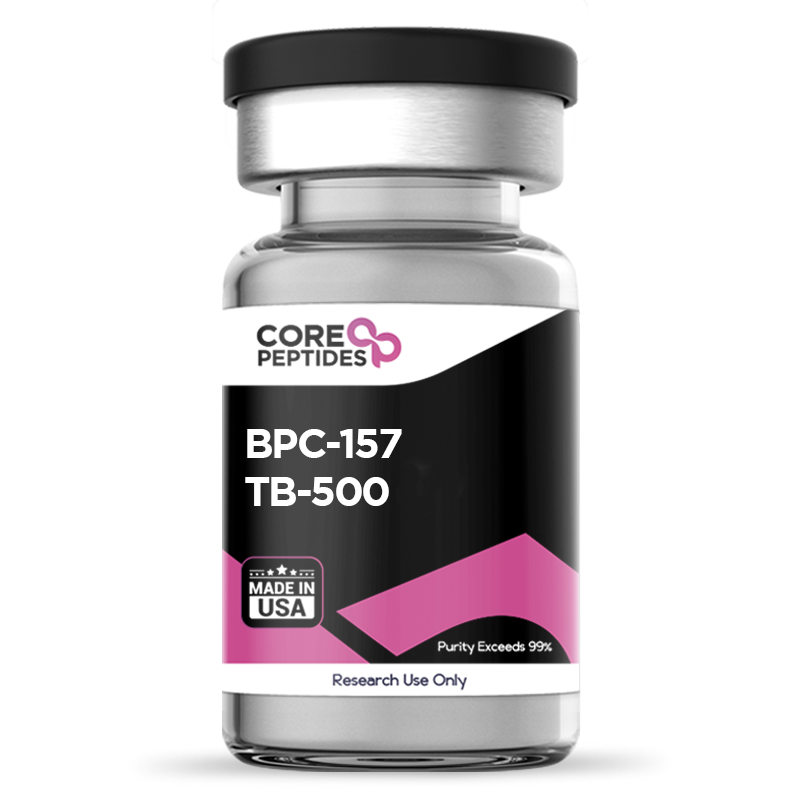
BPC-157 & TB-500 Blend (10mg/20mg) – Research Peptide Blend
BPC-157 & TB-500 Blend (10mg/20mg) is a research-focused peptide formulation combining two synthetic peptides that have attracted scientific interest in areas such as tissue biology, cellular migration, angiogenesis, wound-healing mechanisms and connective-tissue research.
According to the referenced product listing, the blend is available in 10mg and 20mg total quantities. The 10mg formulation contains 5mg BPC-157 and 5mg TB-500, while the 20mg formulation contains 10mg BPC-157 and 10mg TB-500. The material is supplied as a lyophilised powder with a stated purity of >99%.
BPC-157 and TB-500 have different molecular structures and research profiles, but both have been investigated in experimental models involving tissue responses, cellular movement and repair-related pathways.
Importantly, there are no established clinical studies directly demonstrating the safety or efficacy of this specific BPC-157 and TB-500 combination. The available scientific evidence primarily concerns the individual compounds.
This product is therefore best understood as an experimental research material rather than an approved medicinal product. It is intended for laboratory, analytical and in-vitro research applications.
What Is BPC-157 & TB-500 Blend?
The BPC-157 & TB-500 Blend combines two research peptides in a balanced formulation:
- BPC-157: A synthetic 15-amino-acid pentadecapeptide investigated in preclinical studies involving tissue responses, angiogenesis, gastrointestinal biology, connective tissue and cellular signalling.
- TB-500: A synthetic peptide associated with thymosin beta-4 research and investigated in relation to cellular migration, actin organisation, angiogenesis and wound-healing mechanisms.
The two peptides are supplied in an equal ratio. The 10mg version contains 5mg of each peptide, while the 20mg version contains 10mg of each peptide.
BPC-157 & TB-500 Blend Product Highlights
- Product name: BPC-157 & TB-500 Blend
- Available quantities: 10mg and 20mg
- 10mg formulation: 5mg BPC-157 + 5mg TB-500
- 20mg formulation: 10mg BPC-157 + 10mg TB-500
- BPC-157 peptide length: 15 amino acids
- TB-500: Thymosin beta-4-related research peptide
- Physical form: Lyophilised powder
- Stated purity: >99%
- Blend ratio: 1:1 by listed mass
- Primary research areas: Tissue biology, cellular migration and repair-related mechanisms
- Additional research areas: Angiogenesis, connective tissue and wound-healing research
- Intended use: Laboratory and scientific research
The product specifications above are based on the referenced Core Peptides listing.
What Is BPC-157?
BPC-157, also known as Body Protection Compound-157 or pentadecapeptide BPC-157, is a synthetic peptide consisting of 15 amino acids. It has become a prominent subject of preclinical research because studies have investigated its activity across several biological systems.
Research has examined BPC-157 in experimental models involving wound healing, gastrointestinal tissue, angiogenesis, tendon and ligament biology, skeletal muscle and cellular signalling. A number of studies have investigated possible relationships with endothelial-cell behaviour, fibroblast migration, collagen formation and vascular signalling.
Experimental research has also explored pathways involving nitric oxide, VEGF-related signalling, ERK1/2 and focal-adhesion-associated proteins. However, the mechanisms proposed in preclinical studies remain an area of ongoing scientific investigation.
What Is TB-500?
TB-500 is a synthetic peptide commonly associated with research into thymosin beta-4 (Tβ4). Thymosin beta-4 is a naturally occurring peptide involved in biological processes including actin regulation and cellular migration.
Research surrounding thymosin beta-4 has examined processes including cell movement, cytoskeletal organisation, angiogenesis, wound repair and tissue remodelling. These mechanisms have made thymosin beta-4-related peptides relevant to experimental studies of cellular responses following tissue injury.
Researchers should distinguish between literature involving naturally occurring thymosin beta-4 and research involving commercially designated TB-500 products.
The terms are often used interchangeably in commercial contexts, but the precise molecular identity of a research material should always be confirmed through analytical documentation.
BPC-157 & TB-500 Blend Composition
| Component | 10mg Blend | 20mg Blend |
|---|---|---|
| BPC-157 | 5mg | 10mg |
| TB-500 | 5mg | 10mg |
| Total peptide material | 10mg | 20mg |
| Ratio | 1:1 | 1:1 |
| Physical form | Lyophilised powder | Lyophilised powder |
| Stated purity | >99% | >99% |
The principal difference between the two product options is the total quantity of peptide material supplied. Both formulations maintain the same 1:1 BPC-157-to-TB-500 ratio.
BPC-157 Chemical Profile
| Property | BPC-157 |
|---|---|
| Common name | BPC-157 |
| Alternative name | Body Protection Compound-157 |
| Classification | Synthetic pentadecapeptide |
| Peptide length | 15 amino acids |
| Molecular formula | C62H98N16O22 |
| Molecular weight | Approximately 1419.5 g/mol |
The molecular specifications listed above correspond with the product information supplied by Core Peptides.
TB-500 Chemical Profile
| Property | TB-500 |
|---|---|
| Common designation | TB-500 |
| Related peptide | Thymosin beta-4 |
| Molecular formula listed by supplier | C212H350N56O78S |
| Molecular weight listed by supplier | Approximately 4963 g/mol |
Because TB-500 terminology can refer to different molecular preparations in commercial and research settings, researchers should verify the exact identity and analytical specifications of the material being investigated.
BPC-157 and Tissue Repair Research
One of the major areas of BPC-157 research concerns tissue repair. Experimental studies have investigated the peptide in models involving skin wounds, gastrointestinal injuries, tendons, ligaments and skeletal muscle.
Early research in animal wound models reported differences in collagen and blood-vessel formation between experimental groups. Such findings have contributed to continuing interest in the relationship between BPC-157 and processes involved in tissue remodelling.
More recent reviews continue to describe BPC-157 as a preclinical research compound while highlighting significant translational limitations, including insufficient human pharmacokinetic data, limited clinical evidence and the absence of a validated pharmaceutical formulation.
TB-500 and Wound-Healing Research
Research into thymosin beta-4 has investigated several biological processes associated with wound healing. These include cell migration, re-epithelialisation, angiogenesis and extracellular-matrix remodelling.
Experimental work has reported increased wound re-epithelialisation in animal models following thymosin beta-4 treatment. Other research has investigated thymosin beta-4 in connective-tissue models and has examined changes in collagen organisation and tissue properties.
These findings provide a foundation for laboratory research into thymosin beta-4-related signalling, but they should not be interpreted as evidence that TB-500 is an established treatment for wounds or injuries.
BPC-157 and Angiogenesis Research
Angiogenesis is the biological process through which new blood vessels develop from existing vascular structures. It is important in tissue development, repair and remodelling.
BPC-157 has been studied in relation to vascular responses and signalling involving growth factors such as VEGF. Experimental research has investigated endothelial-cell behaviour and blood-vessel formation as possible components of the peptide’s biological activity.
These findings are particularly relevant to laboratory studies examining the relationship between peptide signalling and vascular biology. However, the evidence remains predominantly preclinical.
TB-500 and Cellular Migration
Cellular migration is an important component of wound repair and tissue remodelling. Thymosin beta-4 research has focused extensively on mechanisms associated with cell movement and actin organisation.
Thymosin beta-4 is known to interact with actin-related cellular processes. Experimental research has proposed that these interactions may influence cell motility and migration, providing a potential mechanism for observed effects in wound-healing models.
This makes TB-500-related research particularly relevant to laboratory studies examining cytoskeletal regulation and cellular movement.
BPC-157 and Fibroblast Research
Fibroblasts are connective-tissue cells involved in extracellular-matrix production and tissue remodelling. Their movement and activity are important components of experimental wound-repair models.
Research has investigated BPC-157 in tendon fibroblasts, reporting effects on cellular migration and tendon outgrowth in laboratory models. The same research examined possible involvement of the FAK-paxillin signalling pathway.
These observations have contributed to ongoing interest in BPC-157 as a research tool for studying fibroblast behaviour and connective-tissue biology.
BPC-157 & TB-500 and Connective-Tissue Research
Connective tissues such as tendons and ligaments rely heavily on organised extracellular-matrix structures. Researchers have therefore investigated both BPC-157 and thymosin beta-4-related peptides in experimental connective-tissue models.
Research involving thymosin beta-4 has examined ligament healing and collagen organisation in animal models. Separate BPC-157 research has investigated tendon fibroblast migration and tissue outgrowth.
The overlapping research areas provide a basis for studying the two peptides within broader connective-tissue biology, although they do not demonstrate that the combination produces superior results.
BPC-157 & TB-500 and Muscle Research
Both peptides have been investigated in experimental models involving muscle tissue.
BPC-157 research has included animal models of experimentally induced muscle injury, while thymosin beta-4 research has examined cellular responses involving cardiac tissue and angiogenesis.
These studies may be useful to researchers investigating cellular survival, vascularisation and tissue remodelling. Nevertheless, findings from animal models should not be interpreted as proof of equivalent effects in humans.
BPC-157 & TB-500 and Cellular Signalling
One reason these peptides have attracted scientific interest is their interaction with multiple cellular signalling systems.
BPC-157 research has examined signalling involving nitric oxide, VEGF-related pathways, ERK1/2, FAK and paxillin. Thymosin beta-4 research has investigated actin-associated processes, cellular migration and signalling involving inflammatory pathways.
Studying the peptides together can therefore provide a research model for examining how different signalling pathways associated with cellular movement and tissue responses may interact.
BPC-157 & TB-500 Blend and Extracellular-Matrix Research
The extracellular matrix provides structural support to tissues and also participates in cellular signalling. Collagen is one of its principal structural components.
BPC-157 research has investigated collagen formation in experimental wound models, while thymosin beta-4 research has examined collagen organisation in connective-tissue models.
Research into both peptides may therefore be relevant to laboratory studies involving extracellular-matrix formation, collagen organisation and tissue remodelling.
Is There Research on the Combined BPC-157 & TB-500 Blend?
This is an important distinction when evaluating the scientific evidence.
The referenced Core Peptides product page explicitly states that there are no research or clinical studies in which BPC-157 and TB-500 were used together in the same experimental model. Most of the supporting literature concerns the individual peptides.
Consequently, claims that the two peptides necessarily work synergistically should be treated as hypotheses rather than established scientific conclusions.
A properly controlled study of the combined formulation would be required to determine whether the two compounds interact in an additive, synergistic, neutral or antagonistic manner.
Research Applications
The BPC-157 & TB-500 Blend may be relevant to controlled laboratory research involving:
- Wound-healing biology: Investigation of cellular migration, re-epithelialisation and tissue remodelling.
- Angiogenesis research: Study of experimental blood-vessel formation and vascular signalling.
- Fibroblast research: Investigation of connective-tissue cell migration and behaviour.
- Tendon research: Examination of fibroblast migration and tendon outgrowth.
- Ligament research: Study of experimental connective-tissue repair.
- Muscle research: Investigation of experimental muscle and cardiac tissue responses.
- Cell-migration research: Study of cytoskeletal organisation and cellular movement.
- Extracellular-matrix research: Investigation of collagen and tissue-remodelling pathways.
- Cell-signalling research: Examination of pathways associated with vascular and tissue responses.
- Comparative peptide research: Evaluation of individual versus combined peptide activity.
10mg vs 20mg BPC-157 & TB-500 Blend
| Feature | 10mg Blend | 20mg Blend |
|---|---|---|
| Total quantity | 10mg | 20mg |
| BPC-157 | 5mg | 10mg |
| TB-500 | 5mg | 10mg |
| Ratio | 1:1 | 1:1 |
| Physical form | Lyophilised powder | Lyophilised powder |
| Stated purity | >99% | >99% |
Both versions contain the same two peptides in the same 1:1 ratio. The 20mg option simply provides twice the total quantity of research material as the 10mg option.
Understanding Lyophilised Peptide Powder
Lyophilisation, commonly referred to as freeze-drying, is a technique used to remove water from sensitive biological materials under controlled conditions.
Lyophilised peptide preparations are commonly used in laboratory research because the dry form can provide a convenient material for analytical and experimental workflows. Researchers should follow the supplier’s storage information and relevant laboratory protocols when handling peptide materials.
The referenced BPC-157 & TB-500 Blend is supplied as lyophilised powder and has a stated purity of greater than 99%.
Research Quality and Analytical Documentation
For experimental peptide work, analytical documentation is an important part of evaluating material quality.
Researchers should consider documentation such as:
- Certificate of Analysis (CoA)
- Purity testing
- Identity confirmation
- Batch or lot information
- Molecular-weight confirmation
- Chromatographic analysis where applicable
- Storage and stability information
The referenced product page provides separate Certificate of Analysis documentation for the 10mg and 20mg versions.
Current Scientific Evidence for BPC-157
BPC-157 has accumulated a substantial preclinical literature. Studies have investigated its potential biological activity in animal models involving tissue injury, gastrointestinal conditions, connective tissue and the central nervous system.
However, a 2026 review emphasises that BPC-157 remains an investigational compound with significant translational limitations. The review reports that there is no approved pharmaceutical formulation, no validated dosing regimen and no completed Phase II clinical trial, while human pharmacokinetic information remains limited.
Another review similarly notes that BPC-157 has not been approved for standard medical use because comprehensive clinical evidence confirming health benefits in humans remains insufficient.
Current Scientific Evidence for TB-500 and Thymosin Beta-4
Thymosin beta-4 research provides much of the scientific background associated with TB-500. Experimental studies have examined thymosin beta-4 in wound healing, cellular migration, angiogenesis and tissue repair.
Research has investigated the peptide’s relationship with actin, a structural protein involved in cellular shape and movement. Other studies have explored potential effects on vascular development and cellular signalling.
As with BPC-157, however, research involving a naturally occurring peptide or a particular experimental preparation should not automatically be interpreted as evidence for every commercially labelled TB-500 formulation.
BPC-157 & TB-500 Blend: Research Limitations
Several limitations should be considered when evaluating this product:
- Limited combination research: Direct studies of BPC-157 and TB-500 together are lacking.
- Predominantly preclinical evidence: Much of the research involves cell cultures or animal models.
- Limited human data: Human clinical evidence for BPC-157 remains small, and evidence for the specific blend is lacking.
- Different molecular identities: TB-500 should not automatically be considered chemically identical to full-length thymosin beta-4.
- Unconfirmed synergy: Similar research areas do not establish synergistic effects.
- Regulatory uncertainty: The blend is not an approved medicinal treatment.
Frequently Asked Questions About BPC-157 & TB-500 Blend
What is the BPC-157 & TB-500 Blend?
It is a research peptide formulation combining BPC-157 and TB-500 in a 1:1 ratio. The referenced product is available in 10mg and 20mg total quantities.
How much BPC-157 is in the 10mg blend?
The 10mg version contains 5mg of BPC-157 and 5mg of TB-500.
How much BPC-157 is in the 20mg blend?
The 20mg version contains 10mg of BPC-157 and 10mg of TB-500.
How much TB-500 is in the blend?
The 10mg version contains 5mg TB-500, while the 20mg version contains 10mg TB-500.
What is BPC-157 studied for?
BPC-157 has been studied in preclinical models involving tissue responses, angiogenesis, gastrointestinal biology, tendon and ligament research, muscle tissue and cellular signalling.
What is TB-500 studied for?
TB-500 is associated with thymosin beta-4 research involving cellular migration, actin regulation, angiogenesis, wound-healing mechanisms and tissue remodelling.
Are BPC-157 and TB-500 clinically proven together?
No. The referenced supplier notes that there are no studies in which both peptides have been investigated together in the same experimental model.
Does the blend have synergistic effects?
There is currently insufficient direct evidence to establish synergy between BPC-157 and TB-500. Any proposed synergistic activity should be considered a research hypothesis rather than a demonstrated clinical effect.
What does 10mg/20mg mean?
It refers to the total quantity of peptide material supplied. The 10mg option contains 5mg of each peptide, while the 20mg option contains 10mg of each.
What form is the product supplied in?
The product is supplied as a lyophilised powder.
What is the stated purity?
The supplier states a purity of >99% for the blend.
Is BPC-157 an approved medicine?
No. BPC-157 remains an investigational compound and does not have an approved pharmaceutical formulation for standard medical use.
Is this product intended for human consumption?
No. The referenced supplier identifies the BPC-157 & TB-500 Blend as a research, laboratory and analytical product and states that it is not intended for human consumption.
Research-Use Disclaimer
BPC-157 & TB-500 Blend (10mg/20mg) is intended for laboratory, analytical and research purposes only. It is not an approved medicine, dietary supplement or treatment for any medical condition.
The information provided in this description summarises areas of scientific investigation and should not be interpreted as evidence of clinical efficacy or safety. Research involving BPC-157 and thymosin beta-4-related compounds is largely preclinical, and evidence directly concerning the complete BPC-157 and TB-500 blend is currently lacking.
This product description does not provide instructions for human administration, dosing, injection or self-experimentation. Researchers should consult relevant scientific literature, product documentation, institutional laboratory procedures and applicable regulations before working with experimental peptide materials.
BPC-157 & TB-500 Blend (10mg/20mg) – Research Summary
BPC-157 & TB-500 Blend (10mg/20mg) combines two experimentally investigated peptides in an equal 1:1 ratio. The 10mg formulation contains 5mg BPC-157 and 5mg TB-500, while the 20mg formulation contains 10mg BPC-157 and 10mg TB-500. Both are supplied as lyophilised powder with a stated purity above 99%.
BPC-157 contributes a research profile centred on tissue biology, angiogenesis, gastrointestinal research, fibroblast migration and connective-tissue models. TB-500, meanwhile, is associated with thymosin beta-4 research involving cellular migration, actin organisation, angiogenesis and wound-healing mechanisms.
The overlapping research areas make the combination scientifically interesting for laboratory investigation, particularly when studying cell migration, vascular responses, extracellular-matrix biology and tissue-remodelling pathways. However, the available literature does not establish that the two peptides work synergistically when combined, and direct research on the complete formulation remains limited.
For researchers investigating experimental peptide biology, the BPC-157 & TB-500 Blend provides a defined two-peptide formulation suitable for controlled laboratory and analytical research.
| Please select a size | 10mg, 20mg |
|---|
Be the first to review “BPC-157 & TB-500 Blend (10mg/20mg)”
Related products
Peptide Blends for Sale
Peptides for Sale
Peptides for Sale
Peptides for Sale
Peptides for Sale
Peptides for Sale
Peptides for Sale
Peptides for Sale
Reviews
There are no reviews yet.