
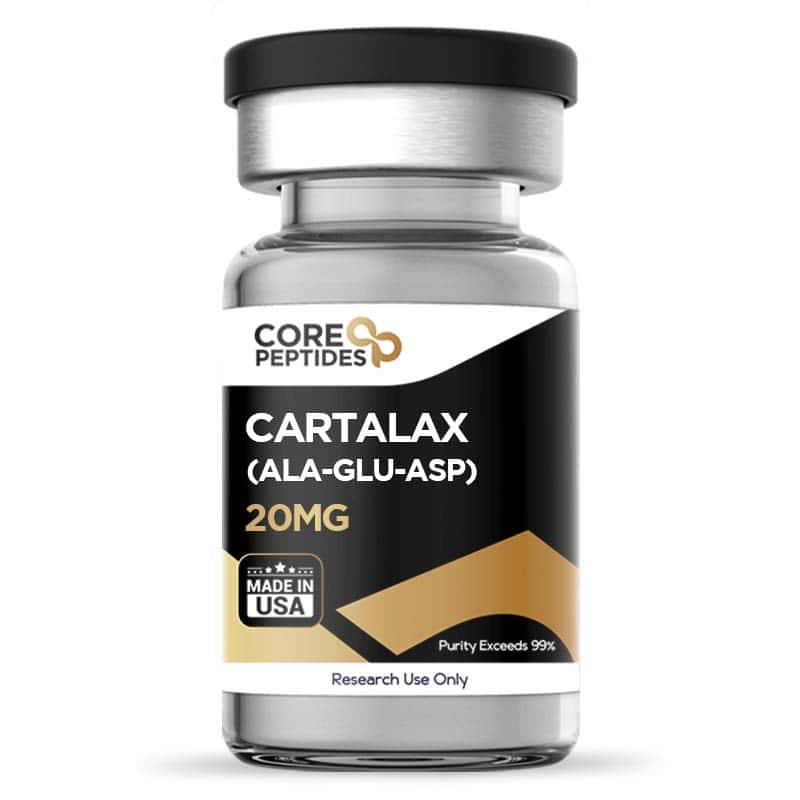

Cartalax (20mg) – Research Peptide
Cartalax (20mg) is a synthetic short-chain peptide investigated in laboratory research relating to cartilage biology, connective tissue, cellular ageing and chondrogenic differentiation. Also known as AED or the T-31 peptide, Cartalax consists of the three-amino-acid sequence Ala-Glu-Asp.
The 20mg formulation is supplied as a lyophilised peptide powder with a stated purity of >99%. The compound has attracted scientific interest as part of the broader group of short peptide bioregulators associated with research into tissue-specific cellular processes.
Current research involving Cartalax is predominantly experimental and includes cell-culture and preclinical studies. Research has explored its relationship with fibroblast function, cellular ageing, chondrogenic stem-cell differentiation and gene-expression processes. These findings provide areas for further investigation but do not establish Cartalax as an approved treatment for cartilage disorders, osteoarthritis or other medical conditions.
What Is Cartalax?
Cartalax is a synthetic tripeptide consisting of the amino-acid sequence Ala-Glu-Asp (AED). It is associated with the short peptide bioregulator research programme developed by researchers working in the Khavinson school of peptide research.
The name Cartalax is commonly associated with experimental research into cartilage and connective tissue biology. Unlike larger peptides and proteins, Cartalax contains only three amino acids, making it an example of an ultra-short peptide used in molecular and cellular research.
Researchers have investigated whether short peptides such as Cartalax may influence cellular regulatory processes, including gene expression and tissue-specific cell behaviour. These proposed biological effects remain an area of scientific investigation rather than established clinical mechanisms.
Cartalax (20mg) Product Highlights
- Product: Cartalax
- Quantity: 20mg
- Alternative names: AED, T-31 peptide
- Peptide classification: Synthetic tripeptide
- Amino-acid sequence: Ala-Glu-Asp
- Peptide length: 3 amino acids
- Form: Lyophilised powder
- Stated purity: >99%
- Molecular formula: C12H19N3O8
- Molecular weight: Approximately 333.29 g/mol
- Primary research area: Cartilage and connective tissue biology
- Additional research areas: Fibroblast function, cellular ageing and chondrogenic differentiation
- Research status: Experimental / preclinical
- Intended application: Laboratory and analytical research
Cartalax Chemical Profile
| Property | Specification |
|---|---|
| Common name | Cartalax |
| Alternative designation | AED / T-31 peptide |
| Amino-acid sequence | Ala-Glu-Asp |
| Peptide length | 3 amino acids |
| Classification | Synthetic tripeptide |
| Molecular formula | C12H19N3O8 |
| Molecular weight | Approximately 333.29 g/mol |
| Product quantity | 20mg |
| Physical form | Lyophilised powder |
| Stated purity | >99% |
Cartalax and Cartilage Research
Cartalax has attracted interest because of its proposed relationship with cartilage tissue and connective-tissue biology. Cartilage contains specialised cells known as chondrocytes, which are responsible for maintaining the extracellular matrix that gives cartilage its structural and mechanical properties.
Research involving Cartalax has explored whether short peptide bioregulators can influence processes associated with cartilage-related cellular activity and differentiation.
This area of research is relevant to scientists investigating cartilage ageing, chondrogenesis, extracellular-matrix biology and mechanisms associated with tissue maintenance.
It is important, however, to distinguish experimental cartilage research from evidence for clinical cartilage regeneration. Existing research does not establish Cartalax as a clinically proven treatment for cartilage damage or joint disease.
Cartalax and Chondrogenic Stem-Cell Research
One area of particular scientific interest is the potential relationship between Cartalax and chondrogenic stem-cell differentiation.
Chondrogenesis is the biological process through which precursor or stem cells develop towards a cartilage-producing cell phenotype. Understanding the molecular factors that influence this process is an important area of regenerative medicine and tissue-engineering research.
A 2023 study cited by the Core Peptides product page investigated peptide regulation of chondrogenic stem-cell differentiation. This research contributes to the broader investigation of short peptides and their potential influence on cellular differentiation pathways.
Such findings are useful for generating research hypotheses but should not be interpreted as evidence that Cartalax can regenerate human cartilage in clinical settings.
Cartalax and Fibroblast Research
Fibroblasts are connective-tissue cells that produce and maintain components of the extracellular matrix. They are involved in tissue structure, repair and remodelling.
Cartalax has been investigated in laboratory models involving fibroblasts, including research examining cellular ageing. The referenced literature includes a 2016 study titled Peptide Regulation of Skin Fibroblast Functions during Their Aging In Vitro.
Experimental work of this type examines how short peptides may influence cellular characteristics associated with ageing and proliferation. Such studies can provide insight into peptide-mediated regulation of connective-tissue cells.
However, observations made in cultured fibroblasts cannot automatically be extrapolated to effects in living humans.
Cartalax and Cellular Ageing Research
Cellular ageing, or senescence, is characterised by changes in cell proliferation, gene expression, metabolism and cellular function. Understanding the molecular mechanisms associated with cellular ageing is an important field of biomedical research.
Cartalax has been studied in experimental fibroblast models to investigate whether short peptides can influence cellular characteristics associated with ageing.
Research in this area may help scientists investigate the relationship between short peptide sequences and cellular regulatory mechanisms. Nevertheless, experimental changes observed in cultured cells should not be presented as evidence of an established anti-ageing effect in humans.
Cartalax and Gene Expression
Short peptide bioregulators have been investigated for their proposed ability to influence gene-expression processes. Cartalax is part of this research area because of its association with tissue-specific cellular regulation.
Gene-expression research examines how cells control the production of proteins and other functional molecules. Changes in gene expression can influence cellular differentiation, proliferation, metabolism and responses to environmental conditions.
Experimental studies involving short peptides can therefore help researchers investigate whether specific peptide sequences are associated with changes in cellular gene-expression patterns.
The proposed gene-regulatory properties of Cartalax remain experimental and should not be interpreted as a clinically established mechanism of action.
Cartalax and Connective Tissue Biology
Connective tissue provides structural support throughout the body and includes extracellular-matrix components such as collagen, proteoglycans and glycoproteins.
Cartalax research is relevant to connective-tissue biology because cartilage itself is a specialised connective tissue with a highly organised extracellular matrix.
Investigating how short peptides interact with connective-tissue cells may help researchers better understand cellular maintenance, differentiation and age-related changes in tissue models.
Cartalax and Chondrocyte Research
Chondrocytes are the specialised cells responsible for maintaining cartilage extracellular matrix. Their behaviour is influenced by mechanical loading, inflammatory signalling, growth factors, ageing and the surrounding extracellular environment.
Because Cartalax is associated with cartilage-focused bioregulator research, experimental investigations may examine its relationship with chondrocyte biology and chondrogenic differentiation.
Research in this area is particularly relevant to scientists studying cartilage development, tissue engineering and cellular ageing.
Cartalax Research Applications
Cartalax may be of interest to researchers working in several laboratory disciplines, including:
- Cartilage biology: Investigation of cellular and molecular processes associated with cartilage tissue.
- Chondrocyte research: Study of cartilage-producing cell behaviour and function.
- Chondrogenesis: Investigation of stem-cell differentiation towards cartilage-related phenotypes.
- Fibroblast biology: Examination of fibroblast proliferation and cellular ageing.
- Cellular ageing: Study of molecular changes associated with cellular senescence.
- Gene-expression research: Investigation of peptide-associated changes in cellular gene regulation.
- Connective-tissue research: Study of extracellular-matrix and tissue-maintenance processes.
- Regenerative medicine research: Exploration of experimental peptide approaches to tissue biology.
- Peptide bioregulator research: Investigation of ultra-short peptide sequences and their biological properties.
Cartalax (20mg) for Laboratory Research
The 20mg designation refers to the quantity of Cartalax research material contained within the product. It is a product specification and should not be interpreted as a recommended human dose or therapeutic regimen.
The lyophilised format provides researchers with a dry peptide preparation suitable for controlled laboratory workflows. Researchers should use their own validated protocols and the supplier’s analytical documentation when planning experiments.
| Product Attribute | Specification |
|---|---|
| Peptide | Cartalax |
| Sequence | Ala-Glu-Asp (AED) |
| Quantity | 20mg |
| Peptide length | 3 amino acids |
| Form | Lyophilised powder |
| Stated purity | >99% |
| Molecular formula | C12H19N3O8 |
| Molecular weight | Approximately 333.29 g/mol |
Understanding Lyophilised Cartalax
Lyophilisation, also known as freeze-drying, is commonly used for laboratory peptide preparations. The process removes water from a frozen material under controlled conditions, producing a dry preparation that can be handled and stored according to appropriate laboratory requirements.
The referenced Cartalax product is supplied in lyophilised powder form. Researchers should consult the applicable product documentation for batch-specific storage and handling information and should follow their institution’s established laboratory procedures.
Cartalax Research Evidence
The available Cartalax literature should be interpreted within the context of the broader short-peptide bioregulator research field.
The Core Peptides listing references research involving fibroblast ageing, chondrogenic stem-cell differentiation, kidney tissue cultures and broader peptide-regulation studies. These publications provide experimental evidence concerning short-peptide effects in specific laboratory systems.
At the same time, independent reviews describe the evidence base for Cartalax as limited and predominantly preclinical. There is not sufficient high-quality clinical evidence to establish Cartalax as an approved treatment for osteoarthritis, cartilage degeneration, joint pain or other human medical conditions.
Cartalax and Osteoarthritis Research
Osteoarthritis is associated with progressive changes in articular cartilage, subchondral bone, synovial tissues and other joint structures. Cartilage biology is therefore an important research area in the study of degenerative joint disease.
Cartalax is often discussed in connection with cartilage and joint research because of its proposed relationship with chondrogenic and connective-tissue processes.
However, marketing claims about cartilage regeneration should be separated from the available evidence. Current research does not provide sufficient controlled clinical evidence to conclude that Cartalax treats or reverses osteoarthritis in humans.
Cartalax and Extracellular-Matrix Research
The extracellular matrix (ECM) is a network of proteins and other molecules surrounding cells. In cartilage, the ECM contains important structural components that provide mechanical properties and support tissue function.
Research into cartilage regeneration frequently examines processes involving collagen, proteoglycans, chondrogenic differentiation and extracellular-matrix organisation.
Cartalax provides an experimental model for researchers interested in whether short peptide sequences can influence cellular processes associated with connective-tissue and cartilage biology.
Cartalax Compared with Longer Peptides
Cartalax differs structurally from many commonly researched peptides because it contains only three amino acids.
This ultra-short structure makes it useful for research into the biological behaviour of small peptide sequences. Researchers studying peptide bioregulators can compare very short peptides such as Cartalax with longer peptides and proteins to investigate how molecular size and sequence affect cellular interactions.
| Feature | Cartalax |
|---|---|
| Peptide type | Short synthetic tripeptide |
| Sequence | Ala-Glu-Asp |
| Length | 3 amino acids |
| Research focus | Cartilage, connective tissue and cellular regulation |
| Research status | Experimental / preclinical |
Cartalax and Research Quality
Analytical characterisation is an important consideration when working with research peptides. Researchers need confidence that an experimental material corresponds to its stated identity and purity before incorporating it into controlled studies.
Common analytical techniques for peptide characterisation include:
- Reverse-phase HPLC: Used to assess chromatographic purity.
- Mass spectrometry: Used to support molecular identity and molecular-weight confirmation.
- Certificate of Analysis: Provides batch-specific quality information where supplied.
- Lot identification: Supports traceability and experimental reproducibility.
The referenced Core Peptides listing provides HPLC and mass-spectrometry information alongside the Cartalax product documentation.
Why Researchers Study Short Peptides
Ultra-short peptides have attracted interest because relatively small amino-acid sequences can provide useful models for investigating molecular recognition and cellular regulation.
Cartalax, with its three-amino-acid sequence, can be studied as part of this broader field. Researchers can examine how specific sequences behave in cell-based models and whether they are associated with measurable changes in cellular phenotype or gene expression.
This research approach may help scientists understand the relationship between peptide sequence, cellular signalling and tissue-specific biology.
Frequently Asked Questions About Cartalax (20mg)
What is Cartalax?
Cartalax is a synthetic tripeptide commonly identified by the sequence Ala-Glu-Asp (AED). It has been investigated in laboratory research involving cartilage biology, connective tissue, fibroblasts and cellular ageing.
What is the sequence of Cartalax?
The commonly reported sequence is Ala-Glu-Asp (AED).
How many amino acids are in Cartalax?
Cartalax is a tripeptide, meaning it contains three amino acids.
What is Cartalax studied for?
Research has examined Cartalax in areas including cartilage biology, chondrogenic stem-cell differentiation, fibroblast function, cellular ageing and gene-expression regulation.
What is Cartalax (20mg)?
Cartalax (20mg) is a research preparation containing 20mg of the peptide in lyophilised powder form.
What is the stated purity of Cartalax (20mg)?
The referenced Core Peptides listing states a purity of greater than 99%.
What is the molecular weight of Cartalax?
The molecular weight listed for Cartalax is approximately 333.29 g/mol.
Is Cartalax a medicine?
No. Cartalax is an experimental research peptide and should not be represented as an approved medicinal product.
Is Cartalax clinically proven to regenerate human cartilage?
No. Current evidence does not establish Cartalax as a clinically proven cartilage-regeneration treatment. Much of the available evidence is derived from laboratory and preclinical research.
Is Cartalax approved for osteoarthritis?
No. Cartalax is not an established approved treatment for osteoarthritis, joint degeneration or other medical conditions.
Why is Cartalax interesting to researchers?
Its ultra-short Ala-Glu-Asp sequence and association with cartilage, fibroblast and cellular-regulation research make it an interesting compound for experimental peptide biology.
What form is Cartalax supplied in?
The referenced 20mg product is supplied as a lyophilised powder.
Does 20mg represent a human dosage?
No. The 20mg specification refers to the amount of research material supplied in the product and should not be interpreted as a human dosing recommendation.
Limitations of Current Cartalax Research
Researchers evaluating Cartalax should consider the limitations of the existing evidence:
- Limited clinical evidence: High-quality human clinical evidence is not sufficient to establish therapeutic efficacy.
- Predominantly preclinical research: Much of the available evidence involves cell cultures or other experimental models.
- Limited independent replication: Some of the literature originates from a relatively concentrated research tradition.
- Mechanistic uncertainty: Proposed molecular mechanisms require additional validation.
- No established therapeutic dosing: A clinically validated human dosing protocol has not been established.
- Unknown long-term safety: Long-term safety in humans has not been adequately characterised.
- Translational limitations: Results from laboratory models cannot automatically be extrapolated to human clinical outcomes.
Independent research summaries similarly characterise the Cartalax evidence base as narrow and predominantly preclinical, reinforcing the importance of cautious interpretation.
Cartalax (20mg) Research Summary
Cartalax (20mg) is a synthetic ultra-short peptide with the sequence Ala-Glu-Asp (AED). Also known as AED or T-31, it is associated with the short peptide bioregulator research field and has attracted particular interest in cartilage and connective-tissue biology.
Experimental research has investigated Cartalax in relation to chondrogenic stem-cell differentiation, fibroblast function, cellular ageing, gene expression and tissue-specific cellular regulation. These areas provide potential avenues for continued laboratory investigation.
The referenced product is supplied as 20mg of lyophilised peptide powder with a stated purity above 99%. Its molecular formula is C12H19N3O8, with a molecular weight of approximately 333.29 g/mol.
Although Cartalax is frequently discussed in connection with cartilage and joint research, the current evidence does not establish it as an approved treatment for osteoarthritis, cartilage degeneration, joint pain or other human medical conditions. Researchers should therefore distinguish experimental findings from clinical claims.
Research-Use Disclaimer
Cartalax (20mg) is intended for laboratory and research use only. It is not a medicine, dietary supplement, food product or approved therapeutic treatment.
The information in this product description is provided for scientific and educational purposes and summarises areas of experimental research. It should not be interpreted as a claim that Cartalax can diagnose, treat, cure or prevent any disease or medical condition.
Available evidence concerning Cartalax remains primarily experimental and preclinical. Controlled clinical evidence establishing its safety, efficacy, pharmacokinetics or therapeutic dosing is not currently sufficient.
This description does not provide instructions for human administration, dosing, injection, reconstitution for human use or self-experimentation. Researchers should consult relevant scientific literature, batch-specific analytical documentation, institutional procedures and applicable laws and regulations when working with experimental peptide materials.
Be the first to review “Cartalax (20mg)”
Related products
Peptides for Sale
Peptides for Sale
Peptides for Sale

Peptides for Sale

Peptides for Sale
Peptides for Sale
Peptides for Sale

Peptides for Sale
Reviews
There are no reviews yet.