
CJC-1295 (Mod GRF 1-29) & Hexarelin Blend (10mg) – Research Peptide
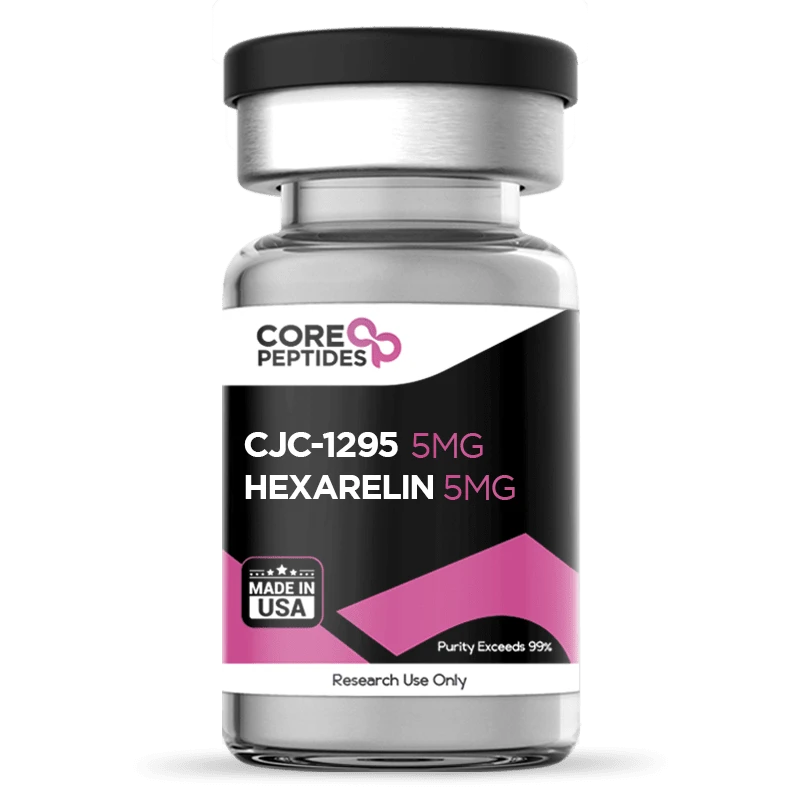
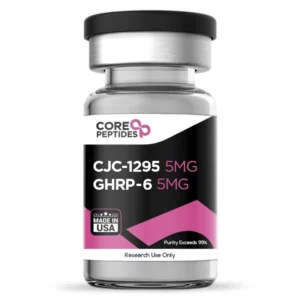
CJC-1295 (Mod GRF 1-29) & Hexarelin Blend (10mg) is an experimental peptide formulation combining two research compounds that have been investigated in relation to growth-hormone signalling and pituitary-cell biology. The formulation contains 5mg of CJC-1295 (no DAC), also known as Modified GRF 1-29, and 5mg of Hexarelin, providing a total peptide content of 10mg.
The referenced product is supplied as a lyophilised powder with a stated purity of >99%. CJC-1295 (no DAC) is a modified growth-hormone-releasing hormone (GHRH) analogue, whereas Hexarelin belongs to the growth-hormone secretagogue (GHS) family.
These compounds have different molecular targets and have therefore attracted interest in experimental studies examining complementary pathways involved in pituitary growth-hormone release.
Importantly, research on the two individual compounds should not be confused with evidence for the specific 5mg/5mg combination. The Core Peptides listing states that direct laboratory experiments evaluating this exact CJC-1295 (no DAC) and Hexarelin blend have not been conducted. Consequently, any proposed synergistic activity should be regarded as a research hypothesis rather than an established property of the blend.
What Is the CJC-1295 (Mod GRF 1-29) & Hexarelin Blend?
This blend combines two distinct experimental peptides associated with the study of the growth hormone (GH) axis.
CJC-1295 (no DAC), or Modified GRF 1-29, is a modified analogue related to growth-hormone-releasing hormone (GHRH). Research has investigated its interaction with the GHRH receptor on pituitary somatotroph cells and its ability to stimulate growth-hormone secretion.
Hexarelin, also known as Examorelin, is a synthetic growth-hormone secretagogue that has been investigated for its interaction with the ghrelin/GHS receptor pathway. Unlike a GHRH analogue, Hexarelin belongs to a different class of GH-releasing compounds.
The scientific interest in combining these two classes comes from the possibility that activation of separate signalling pathways could produce complementary effects in experimental pituitary models. However, evidence for combinations of GHRH-type peptides and Hexarelin should not be interpreted as direct evidence for this specific formulation.
CJC-1295 (No DAC) – Modified GRF 1-29
CJC-1295 (no DAC) is commonly referred to as Modified GRF 1-29 or Mod GRF 1-29. It is a modified fragment based on the structure of growth-hormone-releasing hormone.
GHRH is a naturally occurring hypothalamic hormone involved in regulating growth-hormone secretion from pituitary somatotroph cells. CJC-1295 (no DAC) has been studied as a synthetic analogue designed to interact with the same general receptor pathway.
Research into Modified GRF 1-29 focuses primarily on GHRH receptor signalling, pituitary-cell responses and growth-hormone secretion. Contemporary reviews emphasise that the clinical evidence specifically concerning CJC-1295 without DAC is very limited, with no peer-reviewed controlled human studies directly establishing clinical efficacy.
Hexarelin – Growth-Hormone Secretagogue Research
Hexarelin, also known as Examorelin, is a synthetic peptide belonging to the growth-hormone secretagogue family.
Unlike GHRH analogues, Hexarelin has been investigated for activity through the growth-hormone secretagogue receptor (GHS-R), a receptor associated with the ghrelin signalling system.
This distinction is important when examining the CJC-1295 and Hexarelin combination. The two compounds are not simply duplicate versions of the same peptide; they represent different pharmacological research approaches to studying pituitary GH secretion.
CJC-1295 & Hexarelin Blend (10mg) Product Highlights
- Product name: CJC-1295 (Mod GRF 1-29) & Hexarelin Blend
- Total quantity: 10mg
- CJC-1295 (no DAC): 5mg
- Hexarelin: 5mg
- Form: Lyophilised powder
- Stated purity: >99%
- CJC-1295 alternative designation: Modified GRF 1-29 / Mod GRF 1-29
- Hexarelin alternative designation: Examorelin
- Research category: Growth-hormone axis and pituitary-cell research
- Blend ratio: 1:1 by stated mass
- Research status: Experimental
- Intended purpose: Laboratory and research use
The stated product composition is based on the referenced Core Peptides listing.
CJC-1295 & Hexarelin Blend Chemical Profile
| Property | Specification |
|---|---|
| Blend | CJC-1295 (no DAC) & Hexarelin |
| Total peptide content | 10mg |
| CJC-1295 (no DAC) | 5mg |
| Hexarelin | 5mg |
| Blend ratio | 1:1 by mass |
| Physical form | Lyophilised powder |
| Stated purity | >99% |
| Primary research field | Growth-hormone and pituitary-cell biology |
How CJC-1295 (No DAC) Is Studied
CJC-1295 without DAC is investigated primarily as a GHRH receptor agonist analogue. The GHRH receptor is expressed on pituitary somatotroph cells, where activation forms part of the signalling pathway controlling growth-hormone secretion.
Experimental studies of GHRH analogues examine receptor activation, intracellular signalling and subsequent GH release. These models can help researchers understand how modifications to the native GHRH structure affect peptide stability and biological activity.
It is important to distinguish CJC-1295 without DAC from CJC-1295 containing the Drug Affinity Complex (DAC). The two forms have substantially different pharmacological characteristics. Current reviews note that direct human evidence for the no-DAC form remains particularly limited.
How Hexarelin Is Studied
Hexarelin is investigated as a growth-hormone secretagogue. Research has examined its interaction with the GHS receptor pathway and its effects on pituitary growth-hormone release.
Because the GHS receptor pathway differs from the GHRH receptor pathway, Hexarelin provides researchers with a complementary experimental tool for investigating the regulation of pituitary GH secretion.
Research into Hexarelin has included studies of growth-hormone secretion, pituitary signalling and interactions between GHRH-related and GHS-related pathways.
Why Combine CJC-1295 and Hexarelin?
The scientific rationale for combining a GHRH-type peptide with a growth-hormone secretagogue comes from research suggesting that these pathways can influence pituitary GH release through different receptors.
Studies involving GHRH and Hexarelin have reported greater GH responses when both signalling pathways were activated simultaneously than when either compound was studied alone.
The Core Peptides product page cites earlier research by Arvat and colleagues examining GHRH and Hexarelin individually and in combination.
These findings provide a scientific rationale for investigating combinations of the two peptide classes. However, the distinction between GHRH + Hexarelin research and the specific CJC-1295 (no DAC) + Hexarelin blend is essential.
According to the supplier’s product documentation, the exact CJC-1295 (no DAC) and Hexarelin combination has not itself been evaluated in laboratory experiments. Therefore, synergy should be described as a potential research hypothesis, not as a demonstrated characteristic of this product.
Growth-Hormone Axis Research
The growth-hormone axis involves communication between the hypothalamus, pituitary gland and peripheral tissues. Growth-hormone-releasing hormone from the hypothalamus stimulates pituitary GH secretion, while somatostatin provides inhibitory regulation.
Additional signalling pathways, including the ghrelin/GHS receptor system, can also influence GH release. Researchers study these interconnected pathways to understand the regulation of pulsatile hormone secretion.
CJC-1295 (no DAC) and Hexarelin are of interest because they represent two different approaches to experimentally stimulating GH-related signalling.
Pituitary Cell Research
Pituitary somatotrophs are specialised cells responsible for producing and releasing growth hormone. Their activity is regulated by several hypothalamic and peripheral signals.
Laboratory models using pituitary cells allow researchers to examine how peptide agonists interact with receptor systems and how these interactions affect intracellular signalling and hormone secretion.
CJC-1295 (no DAC) is investigated in relation to the GHRH receptor, while Hexarelin is studied in relation to the GHS receptor pathway. This makes the two peptides useful experimental tools for examining complementary mechanisms of pituitary stimulation.
Receptor Pathway Research
| Peptide | Research-associated pathway | Primary research interest |
|---|---|---|
| CJC-1295 (no DAC) | GHRH receptor | GHRH-like signalling and pituitary GH release |
| Hexarelin | GHS receptor / ghrelin-related pathway | Growth-hormone secretagogue activity |
The different receptor pathways are central to the scientific rationale behind studying the compounds together.
CJC-1295 and Hexarelin Research Synergy
Synergy in pharmacological research refers to a combined effect that is greater than would be expected from simply adding the individual effects together.
Historical research involving GHRH and Hexarelin has reported experimental GH responses that were interpreted as synergistic when both receptor systems were activated. The Core Peptides listing cites research in which combined GHRH and Hexarelin exposure produced a larger GH response than either compound alone.
However, this evidence concerns GHRH and Hexarelin, rather than direct testing of the exact CJC-1295 (no DAC) and Hexarelin formulation. Consequently, researchers should avoid treating the historical findings as proof that this specific 10mg blend produces a synergistic response.
Research Applications for the CJC-1295 & Hexarelin Blend
The blend may be relevant to controlled laboratory research involving:
- Pituitary biology: Investigation of somatotroph-cell responses to peptide signalling.
- Growth-hormone research: Study of mechanisms controlling GH synthesis and release.
- GHRH receptor research: Investigation of receptor-mediated signalling associated with Modified GRF 1-29.
- GHS receptor research: Study of Hexarelin-associated signalling pathways.
- Peptide pharmacology: Investigation of different peptide classes acting on endocrine pathways.
- Hormonal signalling: Examination of interactions between GHRH-related and ghrelin-related pathways.
- Receptor synergy research: Exploration of whether simultaneous pathway activation produces additive or synergistic responses.
- Cellular signalling: Investigation of intracellular pathways associated with pituitary hormone secretion.
Understanding the 10mg Formulation
The 10mg designation represents the total quantity of peptide material in the referenced product. It consists of two separate research compounds:
- 5mg CJC-1295 (no DAC / Mod GRF 1-29)
- 5mg Hexarelin
This produces a stated 1:1 mass ratio between the two peptides.
The 10mg quantity is a product specification and does not represent a recommended human dose. The formulation is described for research and laboratory purposes rather than clinical administration.
Lyophilised CJC-1295 & Hexarelin
The product is supplied in lyophilised powder form. Lyophilisation, commonly known as freeze-drying, is widely used for laboratory peptide preparations because it produces a dry material that can be characterised and stored according to appropriate research protocols.
Researchers should follow the supplier’s batch-specific documentation and institutional laboratory procedures when handling experimental peptide materials.
CJC-1295 No DAC vs CJC-1295 With DAC
The distinction between CJC-1295 without DAC and CJC-1295 with DAC is important when interpreting research literature.
| Feature | CJC-1295 No DAC / Mod GRF 1-29 | CJC-1295 With DAC |
|---|---|---|
| General description | Modified GHRH 1-29 analogue | Longer-acting CJC-1295 formulation containing DAC |
| DAC modification | Absent | Present |
| Research focus | GHRH receptor signalling and GH release | Longer-duration GH/IGF-1 axis research |
| Human evidence | Very limited direct evidence | More human pharmacology data than the no-DAC form |
Current literature emphasises that results obtained with CJC-1295 containing DAC should not automatically be attributed to the no-DAC/Mod GRF 1-29 form.
Current Evidence for CJC-1295 No DAC
The available evidence for CJC-1295 without DAC is considerably more limited than popular online descriptions may suggest.
A recent review of performance-enhancing peptides reports that there are no peer-reviewed human studies directly establishing the clinical effects of CJC-1295 without DAC. Claims concerning body composition, performance or other clinical outcomes are therefore not supported by adequate direct human evidence.
This makes the no-DAC form primarily an experimental research compound rather than a clinically validated therapeutic peptide.
Current Evidence for the Combination
The exact CJC-1295 (no DAC) + Hexarelin combination should be evaluated separately from studies involving either peptide individually or studies involving native GHRH plus Hexarelin.
The supplier states that no laboratory experiments have directly evaluated this exact blend. Earlier studies involving GHRH and Hexarelin provide a theoretical basis for examining the two pathways together, but they do not establish the pharmacological behaviour of this specific 5mg/5mg product.
This distinction is important for accurate scientific and SEO content: the blend can be described as a research formulation designed around complementary GH-related pathways, but specific synergistic or therapeutic outcomes should not be presented as established facts.
Analytical Quality and Peptide Research
Analytical characterisation is an important consideration when working with experimental peptides. Researchers should establish the identity and purity of research materials before incorporating them into controlled laboratory studies.
Common analytical approaches include:
- High-performance liquid chromatography (HPLC): Used to evaluate chromatographic purity.
- Mass spectrometry: Used to support molecular identity and molecular-weight confirmation.
- Certificate of Analysis: Provides batch-specific quality information where supplied.
- Lot traceability: Helps maintain consistency and reproducibility between experiments.
The referenced Core Peptides product listing identifies the blend as having a stated purity above 99% and provides a Certificate of Analysis section. :contentReference[oaicite:14]{index=14}
Why Researchers Study Growth-Hormone Secretagogues
Growth-hormone secretagogues and GHRH analogues provide experimental tools for studying the regulation of the endocrine GH axis.
Rather than treating growth hormone as an isolated hormone, researchers can examine how different receptor systems contribute to its secretion. GHRH receptor activation and GHS receptor activation represent two important signalling routes within this research field.
Studying these pathways independently and together can help researchers better understand pituitary signalling, hormone secretion dynamics and receptor interactions.
Frequently Asked Questions About CJC-1295 & Hexarelin Blend (10mg)
What is the CJC-1295 & Hexarelin Blend?
It is an experimental peptide formulation containing 5mg CJC-1295 (no DAC/Mod GRF 1-29) and 5mg Hexarelin, for a total peptide content of 10mg.
What does Mod GRF 1-29 mean?
Mod GRF 1-29 refers to a modified 1-29 amino-acid fragment related to growth-hormone-releasing hormone. It is commonly used as another designation for CJC-1295 without DAC.
What is Hexarelin?
Hexarelin, also known as Examorelin, is a synthetic growth-hormone secretagogue investigated for its activity through the GHS receptor pathway.
How much CJC-1295 is in the blend?
The referenced product contains 5mg of CJC-1295 without DAC.
How much Hexarelin is in the blend?
The referenced product contains 5mg of Hexarelin.
What is the total quantity?
The total peptide quantity is 10mg, consisting of 5mg of each peptide.
Why are CJC-1295 and Hexarelin combined?
They act through different research-associated receptor pathways involved in growth-hormone signalling. Combining different pathways provides a basis for experimental investigation into whether their effects are additive or synergistic.
Has the exact CJC-1295 and Hexarelin blend been directly tested?
According to the referenced supplier listing, direct laboratory experiments evaluating this exact combination have not been conducted. Research involving GHRH and Hexarelin provides a theoretical rationale but is not equivalent to testing this specific formulation.
Is CJC-1295 without DAC the same as CJC-1295 with DAC?
No. The no-DAC version, commonly referred to as Mod GRF 1-29, does not contain the Drug Affinity Complex. The two forms have different pharmacological characteristics and should not be treated as interchangeable research compounds.
Is this blend clinically approved?
No. The CJC-1295 (no DAC) and Hexarelin blend is an experimental research formulation and is not an approved medicine.
Is the 10mg quantity a recommended human dose?
No. The 10mg figure describes the amount of research material supplied and should not be interpreted as a human dosage recommendation.
What form is the blend supplied in?
The referenced product is supplied as a lyophilised powder. :contentReference[oaicite:19]{index=19}
What is the primary research area for this blend?
The principal research area is growth-hormone and pituitary-cell biology, particularly the interaction between GHRH-related and growth-hormone-secretagogue pathways.
Limitations of Current CJC-1295 & Hexarelin Research
Researchers evaluating this peptide blend should consider several important limitations:
- Limited direct evidence: The exact CJC-1295 no-DAC and Hexarelin blend has not been directly evaluated in laboratory studies according to the referenced supplier.
- Limited human evidence for no-DAC CJC-1295: Current reviews identify a lack of peer-reviewed controlled human studies directly evaluating the compound.
- Indirect synergy evidence: Evidence for combined GHRH and Hexarelin activity should not be presented as direct evidence for this particular formulation.
- Uncertain clinical relevance: Laboratory observations do not establish therapeutic efficacy in humans.
- Long-term safety uncertainty: Long-term safety data for these research compounds remain inadequate.
- Regulatory limitations: Research peptides should not be represented as approved medicines or established treatments.
Recent scientific reviews specifically caution that CJC-1295 without DAC remains poorly characterised in peer-reviewed human research and that clinical claims based on extrapolation from related compounds are not established.
CJC-1295 (Mod GRF 1-29) & Hexarelin Blend (10mg) Research Summary
CJC-1295 (Mod GRF 1-29) & Hexarelin Blend (10mg) combines two distinct experimental peptides associated with growth-hormone signalling. The formulation contains 5mg CJC-1295 without DAC and 5mg Hexarelin in a lyophilised powder preparation.
CJC-1295 (no DAC) is investigated as a modified GHRH analogue associated with the GHRH receptor pathway, while Hexarelin is studied as a growth-hormone secretagogue associated with the GHS receptor pathway. Their different signalling routes provide a scientific rationale for studying them together in controlled experimental systems.
Previous research involving GHRH and Hexarelin has suggested that simultaneous activation of the two pathways can produce enhanced GH responses in certain experimental settings. However, the referenced supplier states that the exact CJC-1295 (no DAC) and Hexarelin combination has not itself been directly evaluated in laboratory experiments.
Current scientific reviews also highlight the limited direct human evidence for CJC-1295 without DAC. Consequently, the blend should be considered an experimental research material, with proposed synergistic effects treated as hypotheses requiring further investigation rather than established clinical outcomes.
Research-Use Disclaimer
CJC-1295 (Mod GRF 1-29) & Hexarelin Blend (10mg) is intended for laboratory and research use only. It is not a medicine, dietary supplement, food product or approved therapeutic treatment.
The information provided in this description is intended for scientific and educational purposes. It summarises areas of experimental research and should not be interpreted as evidence that this peptide blend can diagnose, treat, cure or prevent any disease or medical condition.
Current evidence concerning the exact blend is limited, and direct human clinical evidence establishing its safety, efficacy, pharmacokinetics or therapeutic dosing is not sufficient.
This description does not provide instructions for human administration, dosing, injection, reconstitution for human use or self-experimentation. Researchers should consult relevant scientific literature, batch-specific analytical documentation, institutional procedures and applicable laws and regulations when working with experimental peptide materials.
Be the first to review “CJC-1295 (Mod GRF 1-29) & Hexarelin Blend (10mg)”
Related products
Peptides for Sale
Peptides for Sale
Peptide Blends for Sale
Peptides for Sale
Peptides for Sale
Peptides for Sale
Peptides for Sale
Peptides for Sale
Reviews
There are no reviews yet.