
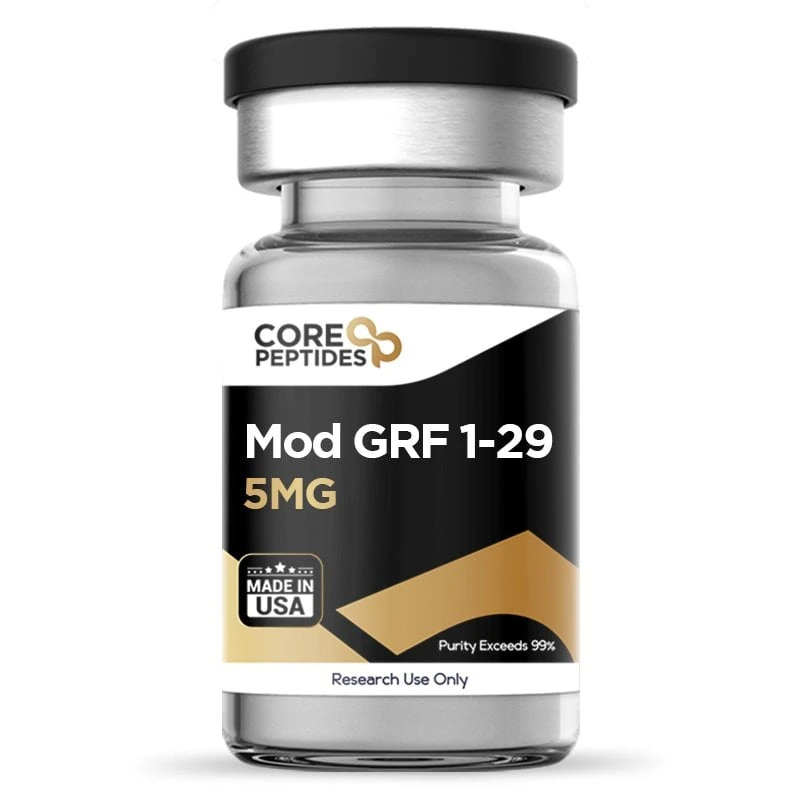

CJC-1295 NO DAC (Mod GRF 1-29) (5mg) – Research Peptide
CJC-1295 NO DAC (Mod GRF 1-29) (5mg) is an experimental synthetic peptide related to growth hormone-releasing hormone (GHRH). Also known as Modified GRF 1-29, this peptide is a modified 29-amino-acid analogue designed for research into GHRH receptor signalling, pituitary biology and the growth hormone (GH) axis.
The referenced product is supplied as a 5mg lyophilised powder with a stated purity of >99%. The formulation does not contain the Drug Affinity Complex (DAC), which distinguishes it from CJC-1295 DAC preparations and gives the No-DAC form a different research and pharmacokinetic profile.
CJC-1295 NO DAC is intended strictly for laboratory, analytical and in-vitro research. It is not presented as a medicine, dietary supplement or approved treatment.
What Is CJC-1295 NO DAC (Mod GRF 1-29)?
CJC-1295 NO DAC is commonly used as another name for Modified GRF 1-29, a tetrasubstituted analogue of the first 29 amino acids of growth hormone-releasing hormone.
Native GHRH is a hypothalamic hormone involved in regulating growth hormone secretion from the anterior pituitary. The 1-29 region represents the biologically important portion of GHRH that has been investigated for interaction with GHRH receptors.
Modified GRF 1-29 incorporates several amino-acid substitutions intended to improve resistance to enzymatic degradation compared with the corresponding unmodified peptide fragment. The referenced product contains the No-DAC form and therefore does not include the additional Drug Affinity Complex used in CJC-1295 DAC formulations.
CJC-1295 NO DAC (5mg) Product Highlights
- Product name: CJC-1295 NO DAC (Mod GRF 1-29)
- Quantity: 5mg
- Alternative name: Modified GRF 1-29
- Peptide type: Synthetic GHRH analogue
- DAC: None
- Form: Lyophilised powder
- Stated purity: >99%
- Molecular formula: C152H252N44O42
- Reported molecular weight: approximately 3367.9 g/mol
- Primary research area: GHRH and growth hormone signalling
- Intended purpose: Laboratory and research use only
The product specifications above correspond to the referenced Core Peptides listing.
How CJC-1295 NO DAC Differs from CJC-1295 DAC
The terms DAC and NO DAC refer to an important structural distinction between two commonly discussed CJC-1295 preparations.
| Feature | CJC-1295 NO DAC | CJC-1295 DAC |
|---|---|---|
| Common designation | Mod GRF 1-29 | CJC-1295 with DAC |
| Drug Affinity Complex | Absent | Present |
| General classification | Modified GHRH analogue | Modified GHRH analogue with DAC modification |
| Research profile | Relatively shorter-acting | Extended pharmacokinetic profile |
| Research focus | GHRH receptor and GH signalling | GHRH signalling and prolonged peptide exposure |
These two preparations should not be treated as interchangeable. Findings involving CJC-1295 DAC cannot automatically be applied to CJC-1295 NO DAC, because the DAC modification changes the peptide’s pharmacokinetic characteristics.
What Does “NO DAC” Mean?
NO DAC means that the peptide does not contain the Drug Affinity Complex used in the longer-acting CJC-1295 formulation.
The absence of DAC is an important product characteristic because DAC-containing and No-DAC preparations are investigated as distinct peptide materials. CJC-1295 NO DAC is generally discussed in research contexts as Modified GRF 1-29, whereas CJC-1295 with DAC is a separate modified preparation.
The referenced product is specifically identified as CJC-1295 NO DAC (MOD GRF 1-29).
Modified GRF 1-29 and GHRH Research
Growth hormone-releasing hormone (GHRH) is naturally produced in the hypothalamus and participates in the regulation of growth hormone secretion by pituitary somatotroph cells.
Research into GRF 1-29 developed from observations that the N-terminal portion of GHRH retains important biological activity. Modified versions of this fragment have subsequently been investigated to examine peptide stability, receptor interaction and endocrine signalling.
Modified GRF 1-29 represents a modified version of this 29-amino-acid region. The Core Peptides product information identifies four substitutions within the peptide sequence at positions 2, 8, 15 and 27. These modifications are described as being intended to improve resistance to enzymatic degradation and peptide stability.
Structural Modifications in Mod GRF 1-29
The sequence modifications are a central feature of Modified GRF 1-29 research.
| Position | Modification | Research significance |
|---|---|---|
| 2 | L-alanine → D-alanine | Associated with increased resistance to enzymatic degradation |
| 8 | Asparagine → glutamine | Intended to improve chemical stability |
| 15 | Glycine → alanine | Investigated in relation to peptide activity |
| 27 | Methionine → leucine | Associated with resistance to oxidation |
These substitutions distinguish Modified GRF 1-29 from the corresponding unmodified GRF fragment. :contentReference[oaicite:5]{index=5}
CJC-1295 NO DAC and GHRH Receptor Research
One of the principal research areas associated with CJC-1295 NO DAC is the GHRH receptor.
GHRH receptors are expressed on pituitary somatotroph cells. When GHRH-related signalling is activated, intracellular pathways involving G-proteins and secondary messengers such as cyclic AMP can contribute to downstream cellular responses.
Research into Modified GRF 1-29 therefore provides an experimental model for examining how synthetic GHRH analogues interact with receptor-mediated signalling pathways associated with growth hormone secretion.
The product literature describes CJC-1295 NO DAC as a peptide intended to interact with the GHRH receptor and discusses downstream signalling involving G-proteins and intracellular second messengers.
CJC-1295 NO DAC and the Growth Hormone Axis
The growth hormone axis is a complex endocrine network involving the hypothalamus, pituitary gland and peripheral tissues.
- GHRH: Provides an important stimulatory signal for pituitary GH release.
- Somatostatin: Acts as an inhibitory regulator of GH secretion.
- Pituitary somatotrophs: Produce and release growth hormone.
- Growth hormone: Acts on multiple tissues throughout the body.
- IGF-1: Represents an important downstream component of GH signalling.
Modified GRF 1-29 is primarily relevant to research into the GHRH side of this regulatory system.
Research Interest in Growth Hormone Pulsatility
Growth hormone secretion occurs in a pulsatile pattern rather than at a constant rate. This pulsatility is influenced by the interaction between stimulatory GHRH signals and inhibitory somatostatin signals.
Research involving modified GRF peptides has examined how synthetic GHRH analogues can influence this regulatory system.
However, direct evidence concerning the exact tetrasubstituted CJC-1295 NO DAC formulation remains limited. The product’s own research summary acknowledges that some cited investigations involve partially modified GRF 1-29 peptides rather than the exact commercial material.
This distinction is important when evaluating scientific claims and prevents results from related compounds from being incorrectly attributed to CJC-1295 NO DAC.
Research Evidence and Scientific Context
Research into GRF 1-29 and related GHRH analogues dates back several decades. Experimental work established that portions of the naturally occurring GHRH sequence can retain growth-hormone-releasing activity.
For example, research published in Nature investigated an amidated fragment of human growth hormone-releasing factor and its relationship with growth hormone release in experimental models.
Later work examined modified GHRH fragments and their endocrine effects. Such studies provide useful background for understanding why Modified GRF 1-29 remains of interest in peptide and endocrine research.
Nevertheless, evidence involving other GHRH fragments, animal models or different modifications should not automatically be considered evidence for the exact CJC-1295 NO DAC (5mg) product.
Potential Research Applications
CJC-1295 NO DAC may be relevant to controlled laboratory investigations involving:
- GHRH receptor research: Investigation of receptor-mediated signalling.
- Pituitary research: Study of somatotroph cell activity.
- Growth hormone research: Examination of GH regulatory mechanisms.
- GH–IGF-1 research: Investigation of relationships between GH signalling and downstream IGF-1 pathways.
- Peptide pharmacology: Examination of synthetic GHRH analogues.
- Peptide stability: Evaluation of how amino-acid substitutions affect degradation.
- Receptor biology: Investigation of GHRH receptor interactions.
- Analytical chemistry: Characterisation of peptide identity and purity.
- Comparative peptide research: Comparison of No-DAC and DAC-containing preparations.
CJC-1295 NO DAC Chemical Profile
| Property | Details |
|---|---|
| Peptide | CJC-1295 NO DAC |
| Alternative name | Modified GRF 1-29 |
| Quantity | 5mg |
| Peptide class | GHRH analogue |
| DAC | Absent |
| Molecular formula | C152H252N44O42 |
| Molecular weight | Approximately 3367.9 g/mol |
| Form | Lyophilised powder |
| Stated purity | >99% |
| Primary research pathway | GHRH receptor signalling |
The chemical specifications correspond to the referenced product listing.
Lyophilised Powder Format
The product is supplied as a lyophilised powder. Lyophilisation, also called freeze-drying, is commonly used for research peptide preparations.
Producing peptides in a dry form can support laboratory storage and analytical handling when appropriate research procedures are followed. Researchers should always consult product-specific documentation and relevant laboratory protocols for storage and handling requirements.
Purity and Analytical Characterisation
Reliable peptide research depends on accurate identification and characterisation of experimental material.
Common analytical techniques used for peptide characterisation include:
- High-performance liquid chromatography (HPLC): Used to assess chromatographic purity.
- Mass spectrometry: Used to support molecular identity and molecular-mass determination.
- Certificate of Analysis: Provides batch-specific analytical information where available.
- Lot tracking: Helps support experimental traceability and reproducibility.
The referenced CJC-1295 NO DAC product listing states a purity of >99% and provides access to HPLC and mass-spectrometry information.
CJC-1295 NO DAC vs Native GHRH
| Feature | Native GHRH | CJC-1295 NO DAC / Mod GRF 1-29 |
|---|---|---|
| Origin | Naturally occurring hormone | Synthetic analogue |
| Research sequence | Longer native GHRH sequence | Modified 29-amino-acid fragment |
| Sequence modifications | None | Four substitutions |
| Research purpose | Physiological GHRH signalling | Study of modified GHRH receptor signalling |
| DAC | Not applicable | Absent |
Modified GRF 1-29 is therefore best understood as a synthetic research analogue rather than an identical replacement for naturally occurring GHRH.
CJC-1295 NO DAC and Combination Research
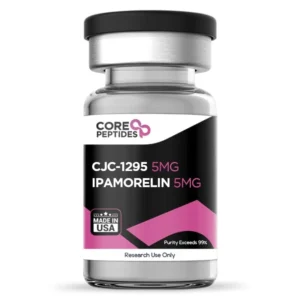
Modified GRF 1-29 is sometimes investigated alongside other experimental growth-hormone secretagogues, including compounds acting through different receptor systems.
The scientific rationale is based on the fact that GHRH-related signalling and growth-hormone-secretagogue pathways can influence pituitary somatotroph activity through distinct mechanisms.
However, claims of synergy require controlled comparative research. The existence of complementary signalling pathways alone does not establish that combining two peptides will produce a particular outcome.
The referenced product page discusses research combinations involving CJC-1295 NO DAC and growth-hormone secretagogues, including Ipamorelin.
Research Limitations
Several limitations should be considered when evaluating CJC-1295 NO DAC:
- Limited direct research: The exact tetrasubstituted CJC-1295 NO DAC formulation has less direct published evidence than some related GHRH compounds.
- Compound differences: Studies involving CJC-1295 DAC, other GRF analogues or native GHRH should not automatically be applied to Mod GRF 1-29.
- Model limitations: Findings from cell and animal experiments cannot automatically be translated into human outcomes.
- Clinical uncertainty: Experimental endocrine responses do not establish therapeutic efficacy.
- Long-term safety: The long-term safety profile of experimental CJC-1295 NO DAC use has not been adequately established.
- Product variability: Research outcomes can depend on peptide identity, purity, formulation and experimental conditions.
Frequently Asked Questions About CJC-1295 NO DAC (5mg)
What is CJC-1295 NO DAC?
CJC-1295 NO DAC is a synthetic GHRH analogue commonly referred to as Modified GRF 1-29. It is investigated in relation to GHRH receptor signalling and growth hormone regulation.
What does Mod GRF 1-29 mean?
Mod GRF 1-29 refers to a modified version of the first 29 amino acids of growth hormone-releasing hormone. The peptide incorporates several sequence substitutions intended to improve its stability compared with the unmodified fragment.
What does NO DAC mean?
NO DAC means that the peptide does not contain the Drug Affinity Complex associated with the longer-acting CJC-1295 DAC formulation.
How much peptide is in the product?
The referenced product contains 5mg of CJC-1295 NO DAC. This is a product quantity, not a human dosage recommendation.
What form is CJC-1295 NO DAC supplied in?
The referenced product is supplied as a lyophilised powder.
What is the stated purity?
The Core Peptides listing states a purity of >99%.
Is CJC-1295 NO DAC the same as CJC-1295 DAC?
No. CJC-1295 NO DAC, commonly called Mod GRF 1-29, does not contain the Drug Affinity Complex. CJC-1295 DAC includes this additional modification and has a different pharmacokinetic profile.
What is CJC-1295 NO DAC researched for?
Research interest includes GHRH receptor signalling, pituitary biology, growth hormone regulation, peptide stability and the broader GH–IGF-1 axis.
Does CJC-1295 NO DAC have the same evidence as CJC-1295 DAC?
No. The two preparations have different structures and pharmacokinetic characteristics. Evidence concerning one should not automatically be applied to the other.
Is CJC-1295 NO DAC an approved medicine?
No. The referenced product is presented as a research and laboratory material rather than an approved medicinal product.
Is the product intended for human consumption?
No. The referenced supplier explicitly identifies its products as being for research, laboratory or analytical purposes and prohibits human and animal consumption. :contentReference[oaicite:15]{index=15}
CJC-1295 NO DAC (Mod GRF 1-29) (5mg) Research Summary
CJC-1295 NO DAC (Mod GRF 1-29) (5mg) is an experimental synthetic peptide based on a modified 29-amino-acid segment of growth hormone-releasing hormone. It is characterised by the absence of the Drug Affinity Complex found in CJC-1295 DAC preparations.
The referenced product is supplied as a 5mg lyophilised powder with a stated purity of >99%. Its primary research relevance lies in the study of GHRH receptor signalling, pituitary somatotroph activity, growth hormone regulation, peptide stability and the GH–IGF-1 axis. :contentReference[oaicite:16]{index=16}
Modified GRF 1-29 incorporates several amino-acid substitutions that distinguish it from the corresponding unmodified GRF fragment. These modifications are investigated in relation to peptide stability and resistance to enzymatic degradation.
Although related GHRH fragments and analogues have been studied in experimental settings, evidence for the exact CJC-1295 NO DAC formulation should be interpreted carefully. Findings from DAC-containing CJC-1295, native GHRH or other modified GRF peptides should not automatically be attributed to this product.
Research-Use Disclaimer
CJC-1295 NO DAC (Mod GRF 1-29) (5mg) is intended for laboratory, analytical and in-vitro research purposes only.
It is not a medicine, dietary supplement, food product or approved therapeutic treatment. The information presented here is intended for scientific and educational purposes and should not be interpreted as evidence that this research material can diagnose, treat, cure or prevent any disease or medical condition.
Research findings involving related GHRH analogues, different CJC-1295 formulations, animal models or experimental peptide combinations should not automatically be attributed to the exact 5mg product described here.
This description does not provide instructions for human administration, dosing, injection, reconstitution for human use or self-experimentation. Researchers should consult relevant scientific literature, batch-specific analytical documentation, institutional procedures and applicable laws and regulations when working with experimental peptide materials.
Be the first to review “CJC-1295 NO DAC (Mod GRF 1-29) (5mg)”
Related products
Peptides for Sale
Peptides for Sale
Peptides for Sale
Peptides for Sale
Peptides for Sale

Peptides for Sale

Peptides for Sale
Peptides for Sale
Reviews
There are no reviews yet.